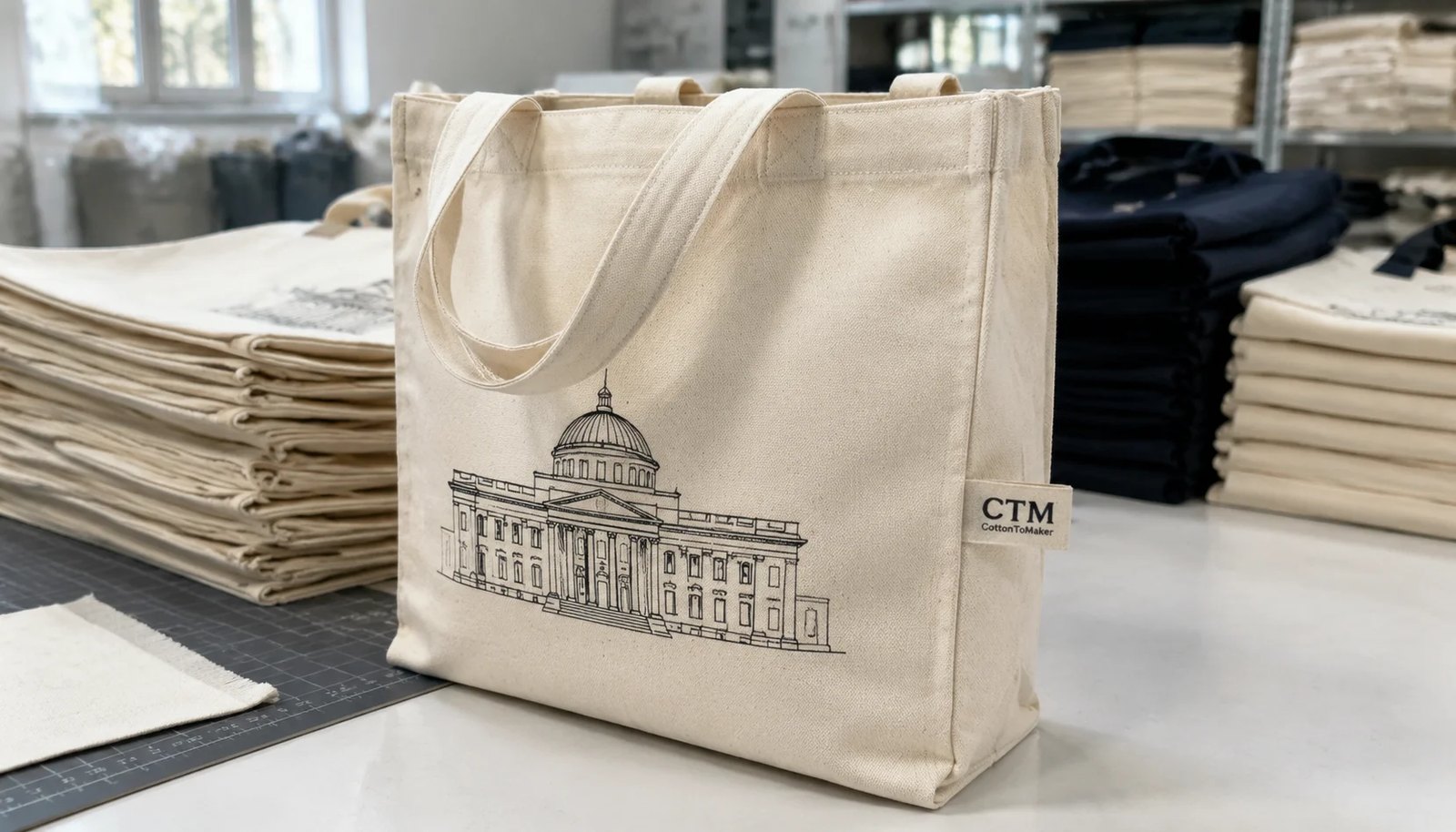
Start With the Buying Problem, Not the Price
A museum shop tote is not a blank canvas bag in the casual sense. It has to carry books, look good at the register, survive repeated handling by customers, and support the museum brand without creating avoidable quality disputes. In procurement terms, the item is a retail product with a functional job, a presentation standard, and a margin target. That is why a bulk quote should be built around the real use case: impulse item, catalogue carrier, exhibition souvenir, premium retail product, or seasonal branded gift.
If the RFQ starts with price alone, suppliers will fill the gaps with assumptions. Some will quote a thin body with a basic print and minimal finishing, while others will include heavier canvas, stronger handles, better carton packing, or a more stable print method. The result is a quote comparison that looks neat on paper but is not comparable in production. Procurement teams get better control when they define the product as a retail item first and a tote second.
For museum shops, the business question is usually not just whether the tote can be made. It is whether the bag will sell at the intended shelf price, arrive on time for an exhibition or season launch, and pass inspection without consuming staff time. The quote checklist should therefore connect directly to merchandising, receiving, and sell-through, not just factory cost. This is the main reason a strong canvas tote bag bulk quote checklist for museum shops needs to be more detailed than a standard promotional-product RFQ.
- Define the bag as a sellable retail item, not only a promotional tote.
- Tie the quote to the museum shop use case: books, souvenirs, apparel, or everyday carry.
- Separate must-have specs from optional features before asking for pricing.
- State the intended retail price band if the bag must fit a margin target.
- Identify whether the tote will be sold alone, bundled, or used as a purchase-with-purchase item.
Lock the Product Spec Before You Ask for Numbers
The fastest way to get unusable quotes is to send a loose brief. A useful tote RFQ should define the size, fabric weight, handle length, print area, closure style, label type, and packing format in measurable terms. For example, a buyer should specify finished width, height, and gusset depth rather than saying medium tote. Handle length should be noted as total length and drop if that matters to shoppers carrying the bag on the shoulder.
The same discipline applies to canvas construction. A supplier may describe the body as canvas, duck, or heavy cotton, but procurement teams need the actual construction details that affect handfeel, sewing behavior, and print quality. Ask for the exact gsm or ounce weight, whether the fabric is pre-shrunk or washed, and whether the weave is plain or a variation that changes the surface. These details are not decorative. They affect shrinkage, print alignment, and how the bag sits on shelf.
It also helps to freeze the non-negotiable elements before quote collection begins. If the museum needs a specific logo placement or a side-seam woven label, say so upfront. If the bag must fold to a set dimension for shelf display or mailing, specify that too. The more the supplier has to infer, the more likely the quote will hide a surprise later in sampling or production.
- Provide finished dimensions, not just approximate size labels.
- State handle length, handle width, and attachment style in the RFQ.
- Specify whether the canvas should be raw, washed, or pre-shrunk.
- Define print placement with a simple dimensioned layout if possible.
- Confirm whether gusset, pocket, or closure features are mandatory or optional.
Choose the Canvas Weight That Matches the Shelf Price
For museum shops, the most workable range is usually 12 oz to 16 oz canvas, depending on the target retail price and the perceived value of the design. A lighter body can work for low-cost impulse items, but once the bag is carrying books, catalogues, or boxed merchandise, the material has to feel stable in hand and keep its shape after repeated folding. If the tote is intended to be a souvenir that customers keep for years, the fabric should also support that brand expectation.
When comparing quotes, ask whether the supplier is quoting by actual GSM, finished fabric weight, or a marketing description such as heavy canvas. Those are not the same. A proper quote should state the fabric construction clearly, because a small difference in weave density or finishing can change appearance and sewing performance. Buyers should also ask whether the quoted price assumes a single-lot fabric purchase or allows for lot variation across a multi-shipment program.
There is also a merchandising consideration. Heavier canvas usually looks and feels more premium, but it can increase material cost and freight weight. A museum shop that sells smaller souvenirs might not need the heaviest body on the market. A balanced choice is often better than a maximum-weight choice. The right spec is the one that supports the intended shelf price, gift-shop presentation, and load-bearing needs without making the program too expensive to replenish.
A practical quote request should ask the factory to price the same tote at two adjacent fabric weights, such as 12 oz and 14 oz or 14 oz and 16 oz, if the design can support either. That comparison helps the buyer see whether the upgrade is worth the cost. It also exposes whether a supplier is pricing from a real material source or simply copying a generic line item from a past job.
- 12 oz canvas can work for lighter souvenir bags or high-volume entry items.
- 14 oz to 16 oz usually gives a better retail feel for museum catalogues and branded merchandise.
- Pre-shrunk or washed canvas helps reduce size drift after production and use.
- Raw canvas may cost less, but shrinkage can affect final dimensions and print placement.
- Ask for fabric lot consistency if you plan to reorder the same bag across a season.
Compare Print Methods by Artwork and Order Size
Most museum shop programs are best served by screen print when the artwork is bold, limited to a few colors, and likely to repeat across a season. Screen print gives solid color laydown, a retail-friendly look, and lower unit cost once setup is spread across the order. It remains the most practical route for many bulk tote programs because it balances appearance, cost, and repeatability. It is especially effective for line art, exhibition marks, logo-only applications, and simple one-color illustrations.
Heat transfer, digital print, or other decoration methods may make sense for highly detailed artwork or very small runs, but those routes often change the economics and the wear profile of the bag. If the artwork has fine lines, gradients, or multiple tones, the buyer should decide in advance whether visual detail or long-term durability matters more. A nice-looking sample is not enough if the print cracks, lifts, or becomes faded after ordinary use.
Museums also need to think about how the art sits on the bag. A centered print on the front panel is easier to control than artwork that wraps over seams or extends too close to the side gusset. If the design must cross a seam, the RFQ should say so explicitly and the buyer should expect a stricter sample review. Print placement is not just aesthetic; it affects production yield and final appearance.
For quote comparison, ask each factory to state the print method, the number of screens or setup steps, the included color count, and the expected tolerance for color matching. If the museum brand has a strict pantone target, that should be written into the request. If exact matching is less important than overall look, say that too. A quote is only useful when the supplier knows what kind of control level is required.
- Use screen print for simple logos, exhibition marks, and strong one-color or two-color graphics.
- Use spot colors only when brand color matching is critical and the run justifies setup.
- Request a strike-off or print proof if the artwork is central to the product identity.
- Ask how the print will behave over seams, hems, and the handle attachment zone.
- State whether the bag will be washed or only spot-cleaned, since that changes print durability expectations.
Treat MOQ as a Cost Model, Not a Fixed Number
MOQ in canvas tote sourcing is usually driven by fabric utilization, print setup, cutting efficiency, and packing labor. A supplier may quote one MOQ for a stock body with custom print and a much higher MOQ for a custom size, custom label, or custom-dyed fabric. Buyers often miss this because they ask for quantity without stating which parts are fixed and which parts are flexible. The result is a quote that looks simple but hides the real production logic.
The practical way to compare suppliers is to ask what happens to MOQ when the spec changes. If the bag size is adjusted by a few centimeters, if the print area grows, or if woven labels are added, the quote should show whether the factory can absorb that change or whether the order must move into a different production lane. This matters for museum shops that may want one base bag across several exhibition graphics or store locations.
MOQ should also be analyzed against assortment strategy. If the museum is ordering multiple artwork versions, the total order may be large enough to support the factory, but each version may still be too small individually. In that case, the buyer needs the factory to quote by version, by size, and by colorway. A blended MOQ can hide which SKU is actually carrying the cost burden.
The useful question is not just what is your MOQ. It is what is the MOQ for this exact construction, and what variables move it up or down. That answer tells procurement whether to simplify the spec, consolidate versions, or accept a higher minimum because the design has unique production requirements.
- Split the order by artwork version and size if multiple museum titles are involved.
- Clarify whether the MOQ is tied to fabric color, print color, or final carton pack.
- Ask for the unit price at your target quantity and the next price break above it.
- Avoid combining too many custom elements if the first run is meant to test sell-through.
- Ask whether sample approval counts toward MOQ or is separate from the production quantity.
Use a Quote Format That Exposes Hidden Cost
A useful factory quote for museum shop totes should not be a single line item with an all-in price. It needs enough detail to show where the money goes and where the risk sits. At minimum, the quote should identify fabric cost, cutting and sewing, print setup, print run cost, label or hangtag cost, packing, carton specifications, and any special handling fees. Without that breakdown, a procurement team cannot tell whether a lower price is achieved through a lean process or through omitted work that reappears later as a change order.
This matters because two quotes with the same unit price can hide very different assumptions. One factory may quote 2,000 pieces with loose packing and no barcode work, while another includes polybagging, inner carton support, and retail labeling. The second quote may look more expensive, but it could be the cheaper landed option once store receiving and internal labor are counted. The only fair comparison is a like-for-like comparison with the same assumptions.
The quote should also identify what is not included. Buyers should ask for clarity on sample fees, lab testing, revised artwork, rush production, carton strengthening, domestic delivery to a consolidation point, and import documentation. If these items are not in the quote, they should be listed as exclusions, not left implied. Procurement decisions are much easier when the supplier states exactly what is inside the number and what is outside it.
For museum shops, the quote should ideally be structured so a merchandiser or finance lead can read it without decoding factory jargon. When possible, ask for a line for the bag body, a line for print, a line for labels, a line for packing, and a line for freight or delivery terms. That makes the comparison usable across suppliers, especially if one factory is domestic and another is offshore.
- Require a breakdown of bag body, handles, print, label, packing, and carton work.
- Ask whether the quote includes one sample revision or whether revisions are charged separately.
- Confirm whether the supplier is pricing from finished dimensions or cut dimensions.
- Identify any extra charge for rush production, mixed cartons, or split shipments.
- List exclusions in writing so they do not surface later as add-ons.
Make Sample Approval Test the Real Production Method
Paper approval is not enough for a canvas tote bag bulk order. The approval sample should use actual fabric weight, actual print method, real stitch construction, and the final label or woven tab. If the sample is only a visual mockup or a lightly made sales sample, it will miss the issues that usually appear in bulk: print shift, handle twist, uneven hem width, seam puckering, and carton pack inconsistency. A proper pre-production sample is the best way to catch production drift before the bulk run starts.
For museum shops, the sample should also be checked in the way the bag will be sold. Put books, catalogues, notebooks, or the intended retail fill weight into the sample. Check whether the opening is wide enough, whether the handle drop works on the shoulder, and whether the print is visible when the bag is folded or hung on a fixture. A tote can pass a visual check and still fail the practical one if the shoulder drop is awkward or the opening closes too tightly around merchandise.
The sample process should also include a signoff method. The buyer should know who approves the sample, what photos or measurements are required, and what changes are still allowed after approval. If the museum wants to change the label size or shift the artwork after the sample is approved, that should be treated as a new revision with new timing. Otherwise the project can drift into informal rework that is hard to trace.
If the artwork is important, ask for a print proof or strike-off before full cutting. That small step can reveal registration issues, line thickness problems, or color tone differences that are invisible in the artwork file. It is much cheaper to correct a proof than to correct a finished bulk run.
- Approve one pre-production sample with actual production components, not just a white mockup.
- Check measurements after pressing and before final packing.
- Test handle comfort with real product weight, not with an empty bag.
- If the artwork is critical, request one strike-off or print proof before mass cutting.
- Write down what changes require a new sample and a new approval cycle.
Pack the Tote for Store Receipt, Not Just Factory Shipping
Packing is where a simple quote can turn expensive. Museum shop buyers often need clean retail handling, predictable carton counts, and easy backroom receiving. Flat-packed totes are usually efficient, but the supplier should define whether each bag is folded to a standard size, whether polybags are used, and whether a barcode label is placed on the outer polybag, the carton, or both. If those details are left out, a low-price quote can become a labor-heavy receiving problem.
The carton spec matters as much as the bag spec. Ask for carton dimensions, gross weight, pack count, and how the cartons are marked by style, color, and size. If the museum uses multiple shop locations or seasonal replenishment, a clear carton system cuts labor and reduces receiving errors. Good carton marking is especially important when several exhibition graphics or SKU variants are shipping together.
Retail-ready packing can also influence freight density and shelf readiness. A more compact fold can reduce carton volume. A stronger master carton can protect the goods during transit. A barcode on the outside of the carton can save time at the warehouse. Each of these choices has a cost, but not all costs belong in the same bucket. Procurement should be able to compare the bag price and the handling price separately.
Ask the factory to explain whether the packing method is designed for direct-to-store, warehouse-to-store, or pure bulk export. Those are different operational models. A tote that is fine for export in plain cartons may still be inefficient for a museum shop that needs quick restocking and clear style identification on arrival.
- Specify carton count per style and keep it consistent across the order.
- Confirm whether retail polybags are needed or if carton-only packing is acceptable.
- Ask for barcode placement and carton marking before production starts.
- Check whether packing increases freight density enough to change the landed cost meaningfully.
- Define the fold size if the bag must display neatly on a shelf or peg.
Read Lead Time as a Production Sequence
Lead time for canvas tote bags is not a single date. It is a sequence: sample approval, material booking, cutting, printing, sewing, finishing, packing, and inspection. A supplier that says 30 days may mean 30 days after sample approval and deposit, not 30 days from PO release. That distinction matters if the bags are tied to an exhibition opening, holiday launch, or seasonal store reset. Procurement should ask for the lead time broken into steps rather than accepting one headline number.
The buyer should also ask which step is likely to bottleneck the order. Printing capacity, woven label sourcing, and carton procurement often create delays even when sewing itself is routine. If the order uses a custom label or a multi-color print, get those long-lead items into the schedule first. A bag made from readily available canvas can still be late if the decoration or packaging materials arrive after the sewing line is ready.
A realistic schedule should include the approval path, not only the factory path. If internal museum stakeholders need several days to review the sample or artwork proof, build that into the timeline. Procurement teams sometimes lose time by assuming the clock starts after the factory has everything. In practice, the clock starts when both sides are aligned on the sample and the PO is released.
For hard launch dates, ask the supplier for a milestone calendar with dated checkpoints: artwork confirmation, sample sent, sample approved, materials in house, production start, first inspection, packing complete, and ship date. That level of detail is more useful than a single promised delivery week because it shows where schedule risk actually lives.
- Tie the factory timeline to sample approval, not to the initial quote date.
- Ask which materials are stock and which require external sourcing.
- Confirm whether weekends, peak season, or public holidays affect the schedule.
- Build a buffer if the order has a hard in-store launch date.
- Request milestone dates instead of only one final ETA.
Compare Landed Cost, Not Only Unit Price
For museum shop buyers, the cheapest factory price is often not the best landed outcome. A bag that is slightly cheaper at source can cost more once freight, inspection, local labeling, carton work, and receiving labor are added. The right comparison is the total cost to put the finished tote onto a store shelf or into a distribution center. If the bag will be sold across several museum locations, a small difference in packing or carton efficiency can compound quickly.
When comparing suppliers, line up the same assumptions: fabric weight, print method, packing, carton count, inspection level, and incoterm. If one supplier quotes EXW and another quotes FOB, the difference is not just logistics language. It changes the cost structure and can hide material or handling fees in different places. The buyer needs enough detail to normalize the quotes before drawing conclusions.
It is also worth comparing operational cost, not just invoice cost. A bag with retail-ready packing, clean carton marks, and a consistent fold can reduce receiving labor. A bag that arrives in mixed cartons, with vague labels and inconsistent pieces per carton, may cause staff time to spike. In a museum shop context, that internal labor is part of the real cost of the item even if it does not appear on the supplier invoice.
A strong procurement process uses the quote to estimate margin against the planned shelf price and to understand the amount of risk built into the order. If the project is a limited exhibition run, the buyer may accept slightly higher cost for cleaner execution. If the tote is a core replenishable SKU, consistency and reordering ease may matter more than the first run savings.
- Compare prices on the same incoterm and the same packing assumptions.
- Include inspection, domestic transport, and import handling in the comparison.
- Check whether retail-ready packing can reduce your internal labor cost.
- Use the quote to estimate the true margin against planned retail price.
- Normalize the quote for any added label, hangtag, or carton work before deciding.
Specification comparison for buyers
| Spec decision | Recommended option | When it fits | Buyer risk to check |
|---|---|---|---|
| Fabric weight | 12 oz to 16 oz canvas for retail museum bags | When the bag must feel substantial, hold books or catalogues, and support a retail shelf price rather than a giveaway price | Too-light canvas can feel flimsy, the bag can collapse when displayed, and print coverage can look less premium |
| Canvas construction | Plain weave cotton canvas with controlled shrinkage | When you need a clean print surface, stable cutting, and predictable sewing on a repeat program | Loose weave, yarn slub variation, or high shrinkage can shift print placement and final dimensions |
| Print method | Screen print for 1 to 4 spot colors; heat transfer only for very small runs or complex art | When the design is bold, repeatable, and likely to be reordered for a museum title, exhibition, or gift shop line | Multi-color registration drift, ink cracking on stress points, and poor hand-feel can create returns or markdowns |
| Handle build | Long shoulder handles with reinforced X-box or bar-tack attachment | When shoppers carry catalogues, postcards, bottled items, or folded merchandise | Weak handle reinforcement is a common failure point in retail use and internal quality audits |
| Closure style | Open-top unless you need security or contents retention | When the tote is meant to be a low-friction impulse item at point of sale | Closures add cost, sewing time, and SKU complexity without always improving sell-through |
| MOQ route | Stock body with custom print if the artwork is stable; cut-and-sew custom body only if size or trim must be unique | When volume is moderate and you need a balance of flexibility and unit cost | Custom fabric, custom dyeing, or nonstandard trim can raise MOQ and delay first shipment |
| Packing format | Flat packed with clear carton counts and barcode label placement | When warehouse receiving and shelf replenishment matter to the buying team | Loose polybagging, inconsistent carton packs, or vague carton marking increase receiving labor |
| Sample stage | Pre-production sample with actual fabric, print, stitching, and label execution | When artwork, size, and finish need approval before bulk commitment | Paper approvals miss color shift, handle length, seam appearance, and folding behavior |
| Quote structure | Price split by bag, print, label, packing, and carton method | When comparing suppliers across different factory models or sourcing routes | All-in quotes can hide setup charges, waste assumptions, or repack fees |
Buyer checklist before sampling
- Lock the bag size, fabric weight, handle length, print area, and any label or hangtag requirement before requesting price.
- Send vector artwork and specify the number of print colors, print placement, and acceptable color tolerance.
- State target quantity by size and by artwork version so the factory can quote real MOQ usage, not a blended guess.
- Request quoted breakdowns for fabric, printing, sewing, label application, packing, carton specifications, and any test or inspection fee.
- Ask for pre-production sample timing, approval method, and what changes trigger a new sample or a new setup charge.
- Confirm carton pack count, inner packing method, barcode placement, and whether the goods must be retail-ready or warehouse-ready.
- Define inspection criteria for stitching, print registration, handle strength, measurement tolerance, odor, and defect acceptance.
- Ask whether the quote assumes pre-shrunk fabric, washed canvas, or raw canvas that may shrink after production.
- Confirm whether the bag will be sold folded, hung, or stacked so the folding spec and carton pack can match store operations.
- Ask for the incoterm, domestic freight assumptions, and any export documents that are included or excluded from the quote.
Factory quote questions to send
- What exact canvas weight or GSM is included in the quote, and is it pre-shrunk, washed, or raw?
- What weave construction and yarn count are you pricing, and are there any known shade or texture variations by lot?
- What print method are you pricing, how many colors are included, and what setup charges apply for each artwork version?
- What are the final bag dimensions, handle length, handle width, and reinforcement method being quoted?
- What MOQ applies to this construction, and does the MOQ change if we modify print size, label type, packing, or color count?
- What is included in the sample fee, and will the sample use actual fabric, print, stitching, and carton packing?
- How many pieces per carton are you quoting, and are master cartons, inner polybags, desiccants, or carton inserts included?
- What is the standard lead time after sample approval, and what factory steps could extend it?
- Which defects are covered before shipment, and how do you handle rework if print, sewing, or packing falls outside tolerance?
- What documentation can you provide with the shipment, such as inspection records, carton labels, packing list, or test reports if requested?
Quality-control points to confirm
- Fabric weight should match the approved spec within an agreed tolerance, checked by lot rather than by a single swatch.
- Canvas should be inspected for weave consistency, shade uniformity, and visible defects such as slubs, thin spots, holes, or oil marks.
- Bag dimensions should be checked after pressing and before packing, not only on cut pieces.
- Print registration, ink opacity, coverage over seams, and edge sharpness should be inspected on the finished bag, not just on a strike-off.
- Handle stitch density, bar-tack placement, and X-box reinforcement should hold under a practical load test with books or weighted inserts.
- Side seams, bottom seams, and top hems should be checked for skipped stitches, puckering, raw-edge exposure, and broken thread tails.
- Label placement, barcode position, hangtag attachment, and any woven side tab should stay consistent across cartons and carton lanes.
- Carton pack counts should match the PO exactly, with clear lot coding, size markings, and style identification for receiving.
- Fold direction and finished folded size should be checked so the bag displays consistently on shelf or rack.
- Odor, loose fibers, and print curing should be checked before shipment, especially for bags that will go directly to retail.