Why a Worksheet Beats a Loose RFQ
A canvas tote bag looks simple until the quotes arrive. One supplier quotes 8 oz canvas with basic stitching, another quotes 12 oz with reinforced handles, and a third includes print setup but excludes carton labels. The unit prices cannot be compared because the products are not the same. A bulk order worksheet solves this by forcing every supplier to quote against the same fabric, construction, print, packing, and timeline assumptions.
For procurement teams, the worksheet is not paperwork for its own sake. It is a cost-control tool. It reduces the number of quote revisions, prevents low-price substitutions, and gives the merchandiser a clean approval trail before deposit. For brand owners and distributors, it also helps explain why a cheaper quote may create higher claim risk later: thin fabric, weak handles, poor print adhesion, or cartons that fail at the warehouse.
- Use one worksheet per bag style, not one worksheet for an entire campaign with mixed sizes.
- Lock the must-have specs first: fabric, size, handle, print, packing, and delivery window.
- Ask suppliers to mark any deviation in writing instead of silently quoting a cheaper alternative.
- Compare quotes only after confirming the same assumptions are included in each price.
Start With the Real Use Case
The first line of the worksheet should describe how the tote will be used. A retail resale tote, a grocery giveaway, a conference kit bag, and a subscription box insert do not need the same canvas. If the bag will carry books, bottled drinks, catalogs, or packaged cosmetics, handle strength and bottom construction matter more than shaving a few cents from fabric weight.
This use case also guides sampling. A tote used for a one-day event may only need clean printing and acceptable stitching. A tote sold in a boutique may need better fabric handfeel, straighter seams, cleaner inside finishing, and more careful folding. When the factory understands the use case, it can recommend a realistic material and construction instead of guessing from a logo file.
- State the expected contents and estimated carry weight, for example 3 kg event kit or 6 kg grocery use.
- State whether the tote is a free giveaway, paid retail item, staff uniform accessory, or packaging component.
- State the sales channel because retail shelf presentation needs better folding and packing control.
- State any warehouse rule such as maximum carton weight, barcode placement, or no individual polybag.
Fabric Weight and Canvas Specification
Canvas weight is one of the biggest reasons bulk tote quotes become confusing. Many buyers ask for 12 oz canvas, but not every supplier interprets this in the same way. Some quote fabric weight before dyeing or finishing, while others quote finished weight. GSM gives a more measurable reference, but the worksheet should still include both oz and GSM where possible.
For most brand merchandise and importer programs, 10 oz to 12 oz cotton canvas is a practical middle range. It feels more substantial than lightweight promotional cotton but still folds and ships efficiently. 8 oz can work for high-volume budget orders if the bag is not expected to carry heavy goods. 14 oz and heavier canvas is suitable for premium retail or heavy-duty use, but buyers should expect higher material cost, slower sewing, and higher freight weight.
- 8 oz canvas: suitable for budget events, lighter contents, and freight-sensitive programs.
- 10 oz canvas: balanced option for branded giveaways with better handfeel.
- 12 oz canvas: common choice for retail-quality promotional totes and stronger daily use.
- 14 oz to 16 oz canvas: premium and durable, but requires careful sewing and carton planning.
- Ask for fabric color standard, shrinkage tolerance, and whether natural canvas may contain cotton seed specks.
Size, Gusset, Handle, and Sewing Details
A tote worksheet should not list only width and height. The gusset, handle drop, handle width, seam type, and reinforcement method all affect cost and function. A bag measuring 38 x 42 cm with no gusset is not the same product as a 38 x 42 x 10 cm gusseted tote. The gusset uses more fabric, changes cutting efficiency, and may require a different folding method for packing.
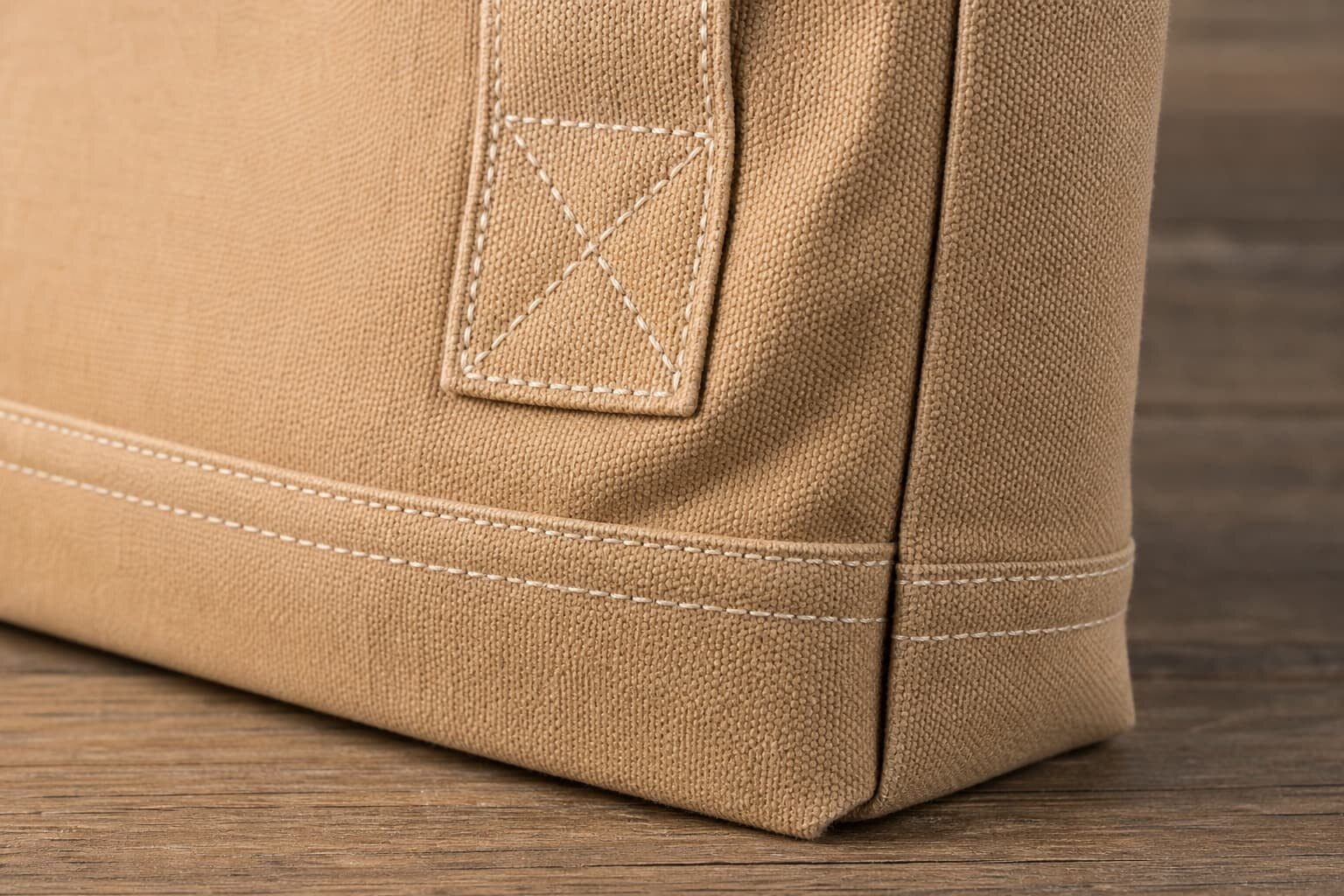
Handle construction deserves special attention. Buyers often approve a front logo but ignore the handles until the first claim. For heavier use, ask for cross-stitch or box-stitch reinforcement where the handle joins the bag body. If the tote has long shoulder handles, confirm the handle drop after sewing, not the full handle length before attachment. This avoids a common mistake where the finished bag hangs too high or too low for the intended user.
- Quote finished bag dimensions as width x height x gusset, with tolerance such as +/-1 cm.
- Specify handle drop separately from handle total length.
- Define handle width, usually around 2.5 cm to 3.5 cm for standard cotton canvas totes.
- Confirm inside seams: overlock, bound seam, or simple folded seam depending on target quality.
- Require reinforcement stitch details for bags expected to carry heavy kits or retail goods.
Print Method Decision on the Worksheet
The artwork should not be sent as an attachment without print instructions. A factory needs to know the print size, color count, position, fabric color, and durability expectation. For simple logos in one to three solid colors, screen printing is usually the most stable and cost-effective bulk method. It gives clean edges and predictable repeatability when the artwork is prepared properly.
For gradients, photo-style artwork, or low-volume multi-design orders, heat transfer or digital printing may be more practical. However, these methods need buyer approval for handfeel, edge visibility, and wash behavior. On coarse canvas, fine details can fill in or look rough. The worksheet should include the artwork file type, Pantone references, print tolerance, and whether the print must pass rub or light wash checks.
- Use vector artwork such as AI, PDF, EPS, or SVG for logos and line art.
- State Pantone color references instead of only saying black, red, or navy.
- Define print position from top edge, side seam, or center line so the factory can inspect it.
- Set print size in centimeters, not only as a percentage of the bag front.
- Ask whether the factory will print before sewing or after sewing because this affects placement control.
MOQ Logic and Cost Drivers
MOQ is not one fixed number for every canvas tote order. It changes with fabric color, fabric weight, printing method, label requirements, and packing style. A natural canvas tote with one black screen print can often be produced at a lower MOQ than a custom-dyed canvas tote with multiple designs and retail packaging. Buyers should ask the supplier to explain the MOQ by material, print, and sewing line setup.
A useful worksheet separates cost drivers instead of chasing only the final unit price. Fabric usually carries the largest cost impact, followed by labor complexity, print setup, packing, and waste allowance. If a quote is much lower than others, the buyer should check whether the supplier reduced fabric weight, removed reinforcement, changed the print method, or excluded inner packing and carton labels.
- Ask MOQ per fabric color, because dyed canvas may require a fabric mill minimum.
- Ask MOQ per print design, because each screen or transfer setup may add cost.
- Ask whether setup charges are included, amortized, or billed separately.
- Ask if price changes at 500, 1,000, 3,000, 5,000, and 10,000 pieces.
- Ask whether wastage for fabric cutting and print defects is built into the quote.
Quote Data Buyers Should Require
A clean canvas tote quote should contain enough data for a buyer to compare suppliers and issue a purchase order without guessing. The worksheet should request the quoted specification line by line: material, size, print, label, packing, carton, sample, lead time, Incoterm, payment terms, and quote validity. If the supplier only sends a one-line unit price, the buyer has no protection against later changes.
Quote validity also matters because cotton fabric prices, exchange rates, and freight conditions can move. A serious factory quote should state how long the price is valid and what assumptions it uses. Buyers should also request estimated carton dimensions and gross weight early, because tote bags are bulky. A low unit price can be offset by inefficient packing or cartons that exceed warehouse limits.
- Request unit price by quantity tier and confirm currency.
- Request Incoterm such as EXW, FOB, CIF, DDP, or buyer-nominated forwarder handover.
- Request carton size, pieces per carton, net weight, gross weight, and estimated CBM.
- Request whether sample cost and print setup cost are refundable after bulk order.
- Request HS code suggestion only as a reference; importer should confirm final customs classification.
Sampling and Approval Controls
The worksheet should define the sample path before production begins. A random stock sample is useful for checking general sewing ability, but it is not enough for bulk approval. For a canvas tote order, the pre-production sample should use the planned fabric weight, final bag size, final handle construction, final logo print, final label, and intended packing method if possible.
Buyers should record sample comments in measurable terms. Instead of writing make logo bigger, write front logo width to be 22 cm, centered horizontally, top of logo 12 cm below bag opening. Instead of improve handle, write handle drop to be 28 cm, cross-stitch reinforcement required at four attachment points. This prevents unclear approvals and gives the factory QC team a practical standard to follow.
- Approve fabric handfeel and shade under normal light, not only from a phone photo.
- Measure the sample after sewing and compare against the worksheet tolerance.
- Check print adhesion with a dry rub test and light scratch test before approving.
- Load the sample with realistic contents and inspect handle attachment after carrying.
- Keep one sealed approved sample at the factory and one with the buyer for final inspection comparison.
Packing, Cartons, and Warehouse Receiving
Packing is often treated as an afterthought, but it can create claims even when the tote itself is acceptable. Canvas bags crease when compressed too tightly, and printed areas can stick or mark if packed before ink is fully cured. If the buyer needs retail-ready presentation, the worksheet should specify folding method, individual polybag or paper band, warning label if required, barcode sticker, and master carton markings.
For distributor and importer orders, carton control is part of the product specification. Cartons should be strong enough for export handling and sized for practical warehouse receiving. Too many pieces per carton can make the gross weight unacceptable. Too few pieces per carton increases carton count and freight volume. The worksheet should ask the factory to recommend a packing plan and then the buyer should approve it before mass packing.
- State pieces per inner bundle, such as 25 or 50 pieces, when warehouse counting speed matters.
- Define whether each bag is flat packed, folded once, folded twice, or individually packed.
- Require carton marks with PO number, SKU, color, quantity, carton number, and gross weight.
- Set maximum carton weight if the warehouse has manual handling limits.
- Ask the factory to avoid direct pressure on raised print, thick transfers, or embossed labels.
Lead Time and Production Milestones
Lead time should be broken into stages, not accepted as one general number. Canvas tote production may include fabric sourcing, dyeing or bleaching, cutting, printing, curing, sewing, trimming, inspection, packing, and shipment handover. If the order uses natural canvas and a simple one-color print, the schedule is usually easier. If it uses custom-dyed fabric, multiple print colors, or retail packing, the critical path becomes longer.
The worksheet should ask the factory to state what starts the production clock. Some suppliers count from deposit receipt, while others count from final artwork approval, sample approval, or fabric arrival. For buyers managing a campaign launch or retail delivery window, this detail is important. A realistic schedule with approval deadlines is safer than a short promise that depends on instant buyer feedback.
- Separate sample lead time from bulk production lead time.
- Confirm whether fabric is in stock or needs weaving, dyeing, or finishing.
- Ask how many days are needed for print screen preparation and ink testing.
- Confirm when final inspection can happen before shipment booking.
- Build buyer approval time into the schedule for artwork, sample, packing, and inspection results.
Specification comparison for buyers
| Spec decision | Recommended option | When it fits | Buyer risk to check |
|---|---|---|---|
| Fabric weight | 10 oz to 12 oz cotton canvas, approx. 280-340 GSM | Retail gifting, bookstore totes, brand merchandise, conference bags needing good body | Confirm whether supplier quotes oz before or after washing; request GSM tolerance and fabric shrinkage data |
| Budget fabric | 8 oz canvas, approx. 225-240 GSM | Large event orders where price and freight weight matter more than premium handfeel | Bag may feel thin with dark print; check handle reinforcement and load test |
| Heavy-duty option | 14 oz to 16 oz canvas, approx. 400-475 GSM | Retail resale, grocery use, heavier promotional kits, long-life brand bags | Higher sewing difficulty, higher freight weight, possible needle marks, longer production time |
| Print method | Screen print for 1-3 solid colors | Most bulk logo totes with clean artwork and stable repeat orders | Require Pantone reference, print size, print position tolerance, and rub test approval |
| Full-color artwork | Heat transfer or digital print, depending on fabric color and artwork area | Small MOQ programs, gradient graphics, photo-style designs, seasonal retail drops | Check wash durability, handfeel, cracking risk, and whether transfer edge is visible |
| Structure | Bottom gusset with reinforced cross-stitch handles | Retail buyers needing better standing shape and improved perceived value | Factory must quote gusset depth, seam allowance, handle length, and carton folding method |
| Packing | Flat packed by 25 or 50 pieces per inner bundle, export carton marked by SKU | Distributor and importer orders with warehouse receiving requirements | Avoid over-compressed cartons that crease print area or deform gussets |
Buyer checklist before sampling
- Confirm final bag size in width x height x gusset, measured after sewing, with tolerance stated in millimeters or centimeters.
- Specify canvas weight by oz and GSM, and ask whether the weight is greige, dyed, washed, or finished fabric.
- Define handle width, handle drop, handle material, stitching pattern, and whether reinforcement is required at the top seam.
- Attach artwork as vector file and include Pantone color, print size, print placement, and acceptable position tolerance.
- State expected carton packing, individual packing rules, barcode or label requirements, and maximum carton weight.
- Request MOQ by fabric color, print design, bag size, and packing style, not only one general MOQ number.
- Ask for sample timing, sample cost, sample freight payer, and whether the sample uses production fabric and production print ink.
- Require a quote breakdown showing bag unit cost, print cost, setup charge, label cost, packing cost, carton cost, and export documentation cost.
- Confirm lead time in stages: material booking, pre-production sample approval, bulk cutting, printing, sewing, QC, packing, and shipment handover.
- Set acceptance criteria for fabric shade, print color, stitch defects, stains, odor, measurement tolerance, and carton marking before deposit.
Factory quote questions to send
- What is the exact canvas specification you are quoting, including oz, GSM, weave, yarn count if available, and finished fabric width?
- Is the quoted fabric natural, bleached, dyed, washed, or pre-shrunk, and what shrinkage tolerance should we expect?
- What is the MOQ for this bag size if we order one print design, two print designs, or multiple fabric colors?
- Does the quoted price include reinforced handle stitching, inside overlock, bottom gusset, side label, barcode sticker, and export carton?
- Which print method do you recommend for our artwork, and what are the setup charges, color limits, and artwork file requirements?
- Can you provide a pre-production sample using production fabric, production thread, final print method, and final packing?
- What measurement tolerance do you normally control for bag width, height, gusset, handle drop, and print placement?
- How many pieces per carton do you recommend, what is the estimated carton size and gross weight, and can the carton meet our warehouse limit?
- What is your standard inline and final inspection process for canvas tote bags, and can you share an inspection report format?
- What production lead time applies after sample approval and deposit, and what part of the schedule is most affected by fabric dyeing or print approval?
Quality-control points to confirm
- Fabric GSM check against approved sample, including tolerance for finished fabric rather than only supplier catalog weight.
- Bag measurement check for width, height, gusset depth, handle drop, and seam allowance after sewing and pressing.
- Handle strength check using a realistic load test based on intended contents, with attention to stitch tearing at the top edge.
- Print color and position check against approved artwork, Pantone reference, and pre-production sample.
- Rub, scratch, and light wash checks for printed logos, especially for dark ink on natural canvas or transfer print on heavy fabric.
- Stitching check for skipped stitches, loose threads, uneven bartacks, puckering, broken needles, and open seams.
- Cleanliness check for oil marks, dust, mildew smell, fabric slubs above agreed limit, and dirty fold lines.
- Packing check for correct SKU, bundle count, carton marks, barcode labels, silica gel if required, and carton compression.
- Needle or metal contamination control where retail buyers require a broken needle record or metal detection process.
- Final AQL inspection plan or buyer-defined defect list before balance payment and shipment release.