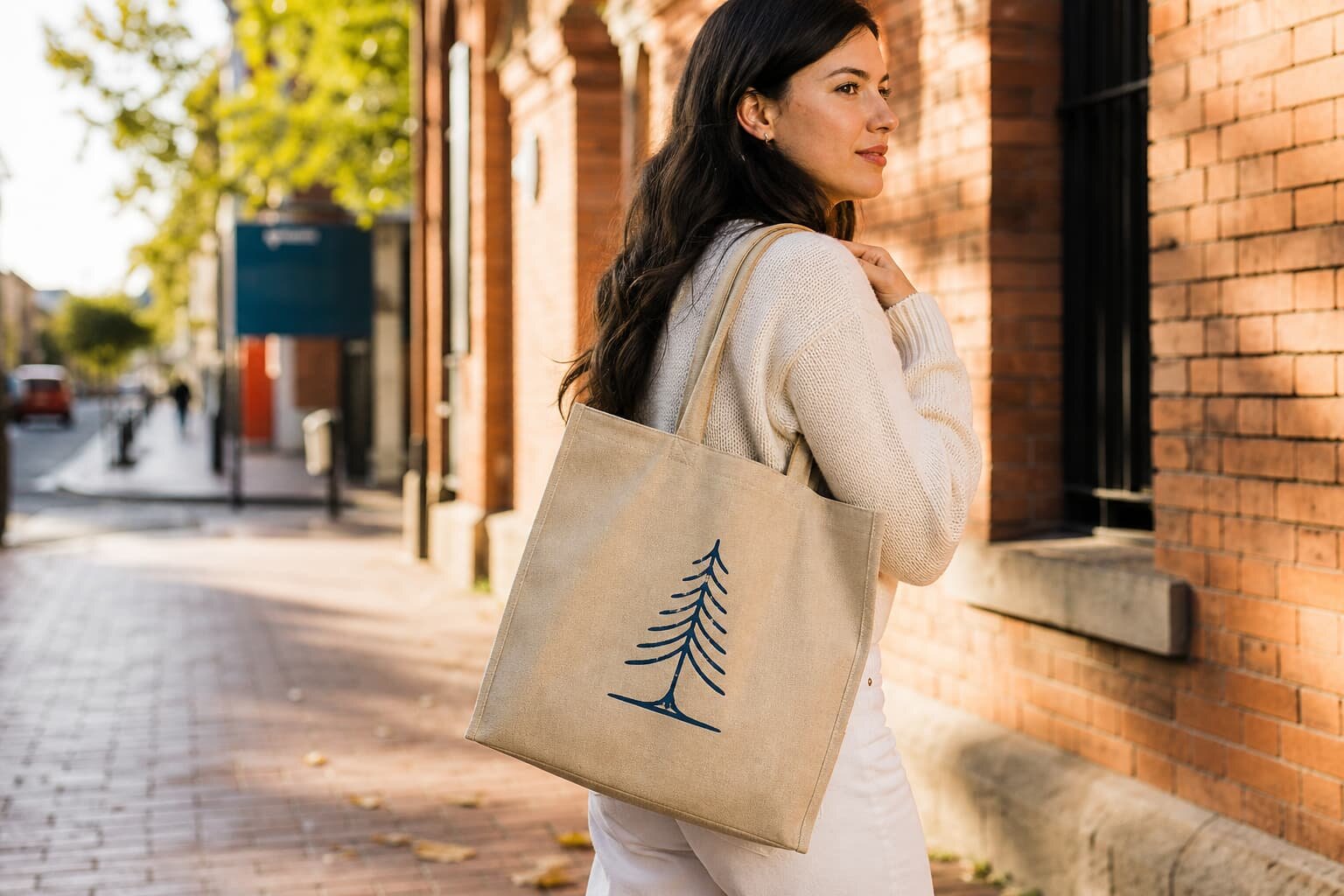
Why the bottom gusset corner changes the whole quote
A canvas tote bag bottom gusset corner is not just a shape detail. It is the point where a flat bag becomes a load-bearing, three-dimensional product. That change affects fabric usage, cutting efficiency, stitch count, print placement, and how the bag folds in packing. If your RFQ does not define the corner clearly, two factories can quote what looks like the same tote and still produce different bags, different costs, and different failure risks.
For buyers, the quote sheet should tell the factory how the bag must behave in real use. Does it need to stand upright on a shelf? Does it need to carry boxed items without collapsing? Is the corner visible on a retail shelf, or is it hidden under print and packaging? Once you answer those questions, the quote becomes a sourcing tool instead of a price-only request.
- State whether the bag must stand, fold flat, or both.
- Add a simple sketch or photo that shows the corner from the inside and outside.
- Identify the end use: promo carry, retail gift, grocery-style carry, or premium resale.
- Tell the factory whether the corner will be visible under print or label placement.
Lock the finished size before you ask for price
The biggest quoting mistake is giving only a headline size, such as width by height, and leaving the gusset vague. For a bottom gusset tote, the finished dimensions should include body width, body height, gusset depth, handle drop, and the measurement method. Tell the factory if the size is measured after pressing, after folding, or on a stuffed sample. A supplier quoting from a different measurement basis may look cheaper at first and then surprise you with a different construction later.
Bottom gusset corners also need a clear seam allowance and corner angle reference. If you want a square bottom, say so. If you want a softer corner that closes more easily, say that too. The more precisely you define the corner, the easier it is to compare two quotes on the same basis. Without this, one factory may add hidden labor in cutting and sewing while another cuts corners literally and commercially.
- Specify finished dimensions in cm and the tolerance you can accept.
- Define whether the gusset depth is measured flat or after sewing.
- Show the print-safe zone so artwork does not cross the seam line.
- If the bag must hold a box, state the box size or internal volume target.
Choose fabric weight for the load, not for the lowest quote
Canvas weight is one of the main cost drivers in a tote bag quote. Common buying bands are 8 oz (about 272 gsm), 10 oz (about 340 gsm), and 12 oz (about 407 gsm). Eight-ounce canvas can work for light promo use, but it may feel soft at the corner and show more distortion when the bag is filled. Ten-ounce canvas is often the practical middle ground for retail tote programs. Twelve-ounce canvas gives more body and a stronger hand, but it usually costs more to cut, sew, and finish.
Do not stop at weight alone. Ask whether the canvas is natural, bleached, dyed, pre-shrunk, or enzymatically washed. Ask if the fabric is single-layer or lined, and whether the bottom needs a base insert to support the gusset. A higher GSM fabric with poor finishing can still give you a bad corner, while a well-made 10 oz canvas with the right reinforcement may outperform a heavier but poorly controlled fabric.
- Ask for fabric weight in both oz and gsm if the factory can provide both.
- Confirm shrinkage allowance before printing or cutting large volumes.
- Check whether the tote is unlined, partially lined, or fully lined.
- If shape retention matters, ask about a removable base insert instead of overbuilding the fabric.
Quote the print method and artwork position as one system
A tote with a bottom gusset corner can print well, but only if the print method matches the structure. Screen printing is still the most common choice for solid logos and simple artwork because it is stable, repeatable, and usually economical at volume. Heat transfer may make sense for short runs or more detailed graphics, but buyers should check handfeel, cracking, and wash or rub durability. Embroidery or woven labels can work well for premium positioning, but they add cost and do not replace a clean print spec.
The most important detail is placement. Do not let the main artwork cross the gusset seam or sit so low that it distorts when the bag is filled. Define the print size, the number of colors, the Pantone target if relevant, and the safe margin from the side seam and bottom corner. A quote that does not separate setup cost from per-piece print cost is hard to compare, especially when one supplier is pricing a single-color screen print and another is pricing a more complex decoration method.
- State print method: screen print, heat transfer, embroidery, woven label, or a mix.
- Give the exact number of colors and whether a Pantone match is required.
- Add the safe distance from the bottom seam and side seam.
- Ask for a blank sample photo and a decorated sample photo before bulk approval.
Define the corner construction, not just the bag shape
In a quote sheet, the bottom gusset corner should be described as a construction sequence. Is it a boxed corner, a folded bottom, or a gusset made from a separate panel? Are the raw edges bound, turned in, or enclosed in a lining? Does the factory use a single row of stitching, double-stitching, or a bar-tack at the stress point? Each answer changes labor time, machine time, and the risk of seam failure in use.
Buyers should also set acceptance criteria for the corner. The corner should sit evenly on both sides, with no twisting, no raw edge exposure, and no obvious puckering once the bag is pressed. If the tote will carry heavier items, ask for a reinforcement point at the base seam or at the transition where the gusset turns upward. Do not accept a quote that calls the corner a standard detail without naming the actual stitch path.
- Ask for the stitch type and stitch density, not just a promise of strong sewing.
- Require both inside and outside photos of the approved sample corner.
- Tell the factory whether raw edges may be visible inside the bag.
- If the bag will carry weight, ask for a documented load test on the sample.
Build sample and MOQ logic into the RFQ
A good quote sheet should separate sample work from bulk work. Ask for the price and lead time of a prototype sample, then the pre-production sample, then the bulk order. This matters because a bottom gusset corner often needs a physical sample to confirm how the bag folds, how the seams stack, and whether the print lands correctly after sewing. A flat artwork proof will not tell you if the logo is too close to the seam or if the corner collapses under load.
MOQ is also tied to the construction. A simple tote with one-color screen print may have a lower MOQ than a multi-color design with a special gusset, lining, or label package. Factories may also need separate MOQ logic for fabric color, print color, or packing format. If you change the gusset depth after quoting, you are often changing the marker layout and cutting yield, which means the first quote is no longer valid.
- Ask for three numbers: proto sample, pre-production sample, and bulk MOQ.
- Confirm whether the MOQ changes with fabric color, print color count, or packaging type.
- Request a photo of the pre-production sample before bulk approval.
- Never approve bulk from an artwork file alone when the corner detail matters.
Ask for packing and lead time details, not just FOB price
Many tote quotes look similar until you inspect packing. Ask whether each bag is bulk folded, polybagged, inserted with tissue or cardboard, or packed retail-ready. Ask how many pieces go in an inner pack and how many in the master carton. Ask for carton dimensions and gross weight assumptions so your freight forwarder can estimate volume correctly. If the bag has a structured bottom gusset, packing method can change the final shape as much as the sewing does.
Lead time should also be broken out instead of treated as a single promise. A quote should separate sample lead time from bulk lead time and note what drives delays: fabric booking, print setup, seasonality, or packing changes. As a buyer, you want a quote that tells you whether the factory already has the right canvas in stock, or whether the order depends on a new fabric run. That difference can affect your launch date more than a small unit-price gap.
- Request inner pack count, master carton count, and carton size.
- Ask if the carton is export-strength and whether corner protection is needed.
- Get separate timelines for sample approval and bulk production.
- Ask what part of the lead time depends on fabric availability.
Compare quotes line by line instead of comparing only the total
The most reliable way to compare supplier quotes is to break them into the same line items. At minimum, compare fabric, cutting, sewing, print setup, print per piece, label or trim, packing material, cartons, sample fees, and any testing or tooling charges. If one factory gives a low unit price but excludes screens, cartons, or a second sample round, that quote is not cheaper; it is incomplete. The same is true when a supplier quotes the right construction but uses a different fabric weight or a different seam allowance without saying so.
For a canvas tote bag bottom gusset corner quote sheet, the goal is not only to get a number. The goal is to understand where the number comes from and where it will move if the order changes. If you increase the gusset depth, the fabric yield changes. If you move the print lower, the reject risk changes. If you request retail folding, packing labor changes. Once you see the cost drivers clearly, you can negotiate the real tradeoff instead of arguing over a misleading FOB total.
- Compare quotes using the same spec sheet, not the factory's own version of the style.
- Check whether screens, plates, cartons, and labels are included or excluded.
- Ask for any price break tied to larger MOQ or simpler packing.
- Verify the incoterm so you are comparing the same delivery basis.
The mistakes that usually create rework or hidden cost
Most production problems start in the RFQ, not in the sewing line. Buyers often skip the seam allowance, leave the gusset undefined, or reuse a generic tote spec for a bottom gusset order. Another common mistake is approving print placement from a flat artwork file without checking how the image lands on a folded corner. The result is warped artwork, a weak seam, or a bag that looks fine when empty but fails when it is filled and pressed for packing.
The other costly mistake is assuming the supplier knows your market expectation. A promotional tote, a retail tote, and a premium gift tote may all use canvas, but they do not share the same acceptance criteria. Put the use case, the required finish, the packing method, and the target shelf presentation into the quote sheet. If your order is for a retail program, the corner finish matters as much as the logo. If it is for a promo program, cost and pack efficiency may matter more than a perfectly sculpted bottom.
- Do not quote from a generic tote template when the bag has a special gusset corner.
- Do not approve artwork placement without seeing a sewn sample.
- Do not compare vendors until the fabric weight, print method, and packing are identical.
- Do not release bulk until the sample corner passes your load and appearance check.
Specification comparison for buyers
| Spec decision | Recommended option | When it fits | Buyer risk to check |
|---|---|---|---|
| Gusset depth | 8-10 cm for most retail totes; 12 cm only when volume justifies it | Promotional bags, bookstore totes, everyday retail carry | Too much depth can add seam bulk and distort print near the corner |
| Canvas weight | 8 oz (272 gsm) for light promo, 10 oz (340 gsm) for mainstream retail, 12 oz (407 gsm) for heavy carry | Match the weight to target load and price point | Thin fabric can collapse at the corner; heavy fabric can raise cost and sewing time |
| Corner reinforcement | Double-stitch plus bar-tack at stress points; add binding or patch only if load is high | Reusable bags, grocery-style carry, premium retail programs | Extra reinforcement changes the look and may add labor if it is not quoted clearly |
| Print placement | Keep critical artwork above the fold and away from the corner seam | Large logos, retail branding, text-heavy designs | Artwork across a gusset corner can skew, crack, or fail registration when the bag is filled |
| Packing format | Bulk flat-fold with inner polybag, or retail-ready insert if the bag ships to store shelves | Wholesale, e-commerce, or retail distribution | Wrong pack format can create crush marks, higher freight, or repacking labor |
Buyer checklist before sampling
- Finished width, height, and gusset depth with tolerances
- Corner style reference photo, sketch, or annotated tech pack page
- Fabric composition, weight in oz or gsm, and color target
- Print method, color count, artwork size, and safe margin from seams
- Handle length, drop, width, and reinforcement detail
- Need for lining, base insert, inside pocket, or closure
- Sample stages required: proto, pre-production sample, and bulk approval
- Packing requirement: fold method, polybag, insert card, and carton count
- Destination, incoterm, target delivery window, and seasonal cutoff
- Market compliance or testing needs before bulk release
Factory quote questions to send
- What finished size did you use to calculate the quote, and what cutting allowance is built in?
- How is the bottom gusset corner constructed, and how many sewing operations are required?
- Which fabric weight and finish are included in the price, and is shrinkage already considered?
- Does the quote include print screens, setup charges, labels, and packing materials?
- What is the MOQ by color, by print version, and by style change such as gusset depth?
- What are the sample lead time and bulk lead time, and what changes them?
- How will the bags be packed, how many per inner pack and carton, and what carton size is assumed?
- Which cost items are excluded from the quote, such as testing, cartons, or local transport?
Quality-control points to confirm
- Measure finished width, height, and gusset depth after pressing, not just on the cut piece.
- Check left and right corner symmetry so the bag sits flat and stands evenly.
- Verify stitch length, seam allowance, and bar-tack placement at the stress points.
- Inspect print position against the seam line so the design stays clear when the bag is filled.
- Confirm the handle attachment points and corner reinforcement have no skipped stitches or loose threads.
- Run a buyer-defined load or carry test on approved samples before bulk release.
- Check fabric defects, shade variation, odor, stains, and thread trimming on random cartons.
- Verify polybag count, insert cards, carton marks, and outer carton strength before shipment.