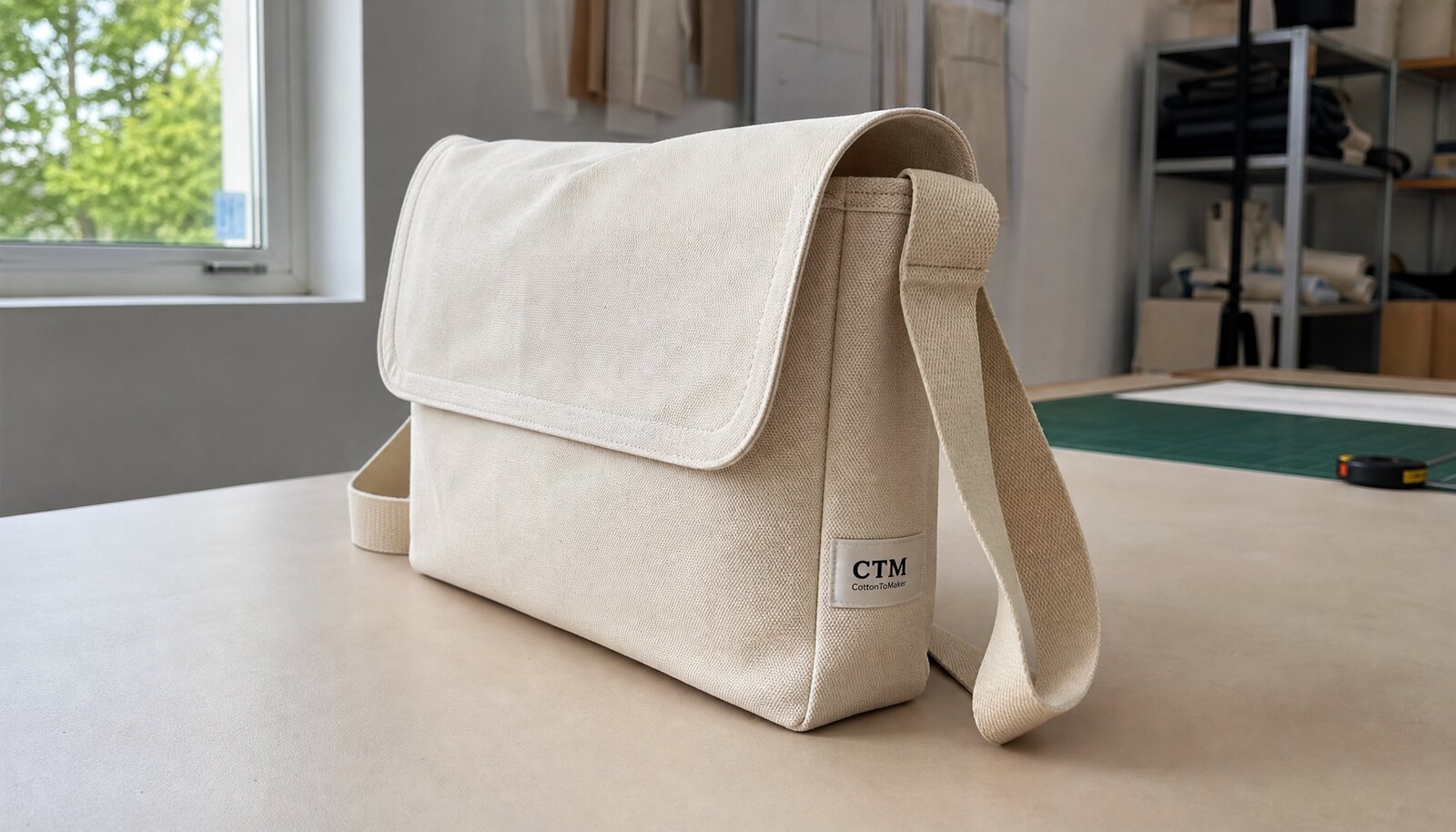
Start With the Retail Use Case
Canvas shoulder bags for retail are not interchangeable just because the silhouette looks familiar. A museum shop bag, a bookstore carry bag, and a promotional gift bag all need different construction priorities. One has to look clean under store lighting, one has to carry weight without sagging, and one may need to pack flat enough for a display table or ecommerce fulfillment line. If the brief does not say how the bag will be sold and used, every supplier will fill in the blanks differently and the quotes will not compare cleanly.
Start with the contents and the customer behavior. Ask what the bag must carry, how heavy the load is, whether the bag will be handed to the customer folded or open, and whether it needs to sit upright on shelf. That single decision tree drives the rest of the spec: fabric weight, strap reinforcement, closure type, and packaging format. A bag designed for folded checkout handoff can be built differently from a bag that must hold shape on a retail fixture.
The best RFQs are short on adjectives and long on operating context. Write down the retail channel, the target load, the display format, and the expected purchase season. That keeps the factory from overbuilding one part of the bag and underbuilding another. It also helps you avoid paying for features that do not matter to the store or the shopper.
- Define the primary use before discussing price.
- State whether shelf appearance or carry strength matters more.
- Specify whether the bag must fold flat, stand upright, or both.
- Call out any channel detail that affects packing or labeling.
Translate the Bag Into a Quoteable Build
A clean quote starts with a build the factory can actually price. For many retail programs, 10 oz canvas is a sensible baseline because it gives enough structure for a finished look without making the bag unnecessarily heavy. If the product is meant to carry books, hard goods, or a more premium load, 12 oz canvas is usually the better starting point. If the brand wants a softer handfeel, washed canvas may fit better, but that decision should be deliberate because washed goods can behave differently in cut, sew, and packing.
Do not let the supplier substitute a generic tote spec. Fix finished width, height, gusset depth, strap width, strap drop, and seam allowance on a drawing or spec sheet. If the bag has an internal pocket, lining, zipper, snap, piping, or reinforcement patch, list each one. Those details are not small. They affect sewing time, fabric yield, defect risk, and the actual landed cost.
A useful quote window also includes tolerances. For a sewn retail bag, a realistic baseline is about +/-0.5 cm on smaller dimensions, about +/-1.0 cm on larger dimensions, and about +/-5 mm for logo placement. That gives procurement enough control to compare vendors without asking production to hit impossible machine-grade precision.
- Use 10 oz canvas as the low-complexity baseline unless the use case needs more body.
- Move to 12 oz canvas when the bag needs better structure or a more premium feel.
- Write dimensions in centimeters and include strap drop, gusset, and seam allowance.
- List all trims and reinforcements so the factory is quoting the same build you are buying.
Build the Comparison Table Around Real Cost Drivers
The easiest way to misread canvas shoulder bags for retail is to compare only the headline unit price. A real buyer comparison has to expose the build choices behind the number. Fabric weight, strap construction, print method, closure, packing, and inspection standard all change the cost. If one quote is cheaper because it excludes labels or packing labor, the comparison is not useful and the savings may disappear as soon as the bags reach your warehouse or 3PL.
Treat the quote as a bill of materials, not a marketing number. Ask the factory to break out shell fabric, straps, thread, artwork, labels, packing materials, and cartons. Separate one-time setup costs from recurring unit costs so you can see what is truly expensive and what is simply being amortized over a short order. If the factory cannot show the cost split, the number is probably hiding something the buyer will discover later.
The comparison table in this article is meant to make that tradeoff visible. The point is not to crown one option as universally best. The point is to show where a cheaper version is faster but less controlled, and where a premium version is more durable but needs more approval discipline. That is the level procurement needs when the bags are going straight into retail.
- Ask for the quote as a BOM with line items.
- Separate setup charges from unit price.
- Compare only after fabric, trims, and packing are aligned.
- Flag any quote that looks too flat to reflect the build.
Branding That Works on Canvas
Canvas accepts branding well, but the artwork has to be designed for the cloth, not just placed on it. One-color screen print is usually the most efficient option for simple retail logos because it is durable, readable, and easy to repeat. If the brand wants a more premium look, a woven label, patch, or embroidery can work well, but the artwork should be simplified before production. Fine lines, tiny type, and tight negative spaces often lose clarity on textured canvas.
Placement matters as much as the method. A logo sitting too close to a seam can distort when the bag is filled. Artwork placed across a fold line can crack earlier than expected. If the bag will be sold folded, ask the supplier to show the print position in both the open and packed states. That keeps the retail presentation consistent and prevents a clean proof from turning into a crooked shelf sample after packing.
Approve the artwork on the actual substrate whenever possible. A digital mockup is useful for layout, but it does not show ink spread, stitch density, or how a label sits on a woven surface. If the program uses embroidery or a stitched patch, request a strike-off or sewn sample before bulk. That small step usually costs less than correcting a full run that was approved only from a screen file.
- Use screen print for simple, repeatable retail graphics.
- Use woven labels, patches, or embroidery when the brand needs a more finished look.
- Keep text and fine detail simple because canvas texture reduces clarity.
- Approve logo position on the bag itself, not just in a file preview.
Sample Approval Before You Award
Sample approval for retail bags should test both appearance and use. A sample that looks right on a table can still feel wrong in the hand or fail when loaded. Measure the sample flat, check strap balance, and carry it with a realistic retail load. If the bag is for books or heavy shopping, test it with a heavier fill than you would use for apparel or gift items. The goal is to find the bag's weak points before you commit to bulk fabric and sewing time.
Use the pre-production sample as the lock point. That version should match the final fabric shade, print position, label placement, seam finish, and packing method. If a supplier changes one of those after approval, treat it as a revision that needs review, not a minor shop-floor adjustment. The more retail-facing the product, the more expensive a late change becomes because it can affect presentation, receiving, and replenishment behavior.
A practical test set is straightforward. Check dimensions against the spec, cycle the straps, open and close any closure several times, and inspect the seam stress points after loading. Fold the bag if it will be shipped flat and make sure it recovers cleanly. That is enough to catch most of the problems that later become returns or angry receiving notes.
- Measure the sample and compare it line by line with the spec sheet.
- Test the bag at the load it will actually see in retail use.
- Check how the bag folds, unfolds, and recovers if it is shelf-packed.
- Treat the approved pre-production sample as the production reference.
Production QC That Catches Returns Early
Production QC should focus on the defects that create store returns or receiving rejects. For canvas shoulder bags, those are usually weak strap stitching, crooked print, mixed shade lots, open seams, dirty fabric, and poor packing. The inspection plan should catch those issues on the line and again before shipment. Do not inspect only the first cartons, because that can hide drift in the later part of the run.
Use a simple acceptance framework that the factory can follow. If your house standard is not already defined, AQL 2.5 for major defects and 4.0 for minor defects is a practical starting point. Major defects include open seams, strap failure, severe print misplacement, or bags that are visibly dirty. Minor defects include small loose threads, slight wrinkles, or minor packing inconsistencies. The important part is to define the limits before the order ships, not during the dispute.
Load testing should mirror the product's actual use. A light shopping bag can be tested at 5 kg, while a book-oriented bag should go to 8 kg or more. If the bag includes zipper hardware, snaps, or decorative metal parts, cycle those components as part of the inspection. A retail buyer does not need laboratory theater. It needs enough structure in the QC plan to prevent obvious failures from passing through.
- Inspect the first units off the line and then a later batch near the end of production.
- Check strap anchors, seams, logo position, and carton count.
- Use a load test that matches the real retail use case.
- Inspect a mix of cartons from the top, middle, and bottom of the lot.
Compliance, Packing, and Landed Cost
Compliance for canvas shoulder bags is market-specific, not universal. The documents you need depend on destination, product age grade, fabric composition, trim materials, and your retailer's internal policy. Ask the supplier which declarations and test reports they can provide for the exact materials used in your bag, not a generic certificate from a different build. If the bag uses printed ink, coated trim, metal hardware, or any special finish, make sure the paperwork matches those components.
Packing is part of the product, not an afterthought. The buyer should specify whether the bag ships bulk, in polybags, with insert cards, with barcode stickers, or in shelf-ready cartons. If a retailer or 3PL has a receiving requirement, put it into the spec before the PO. A perfectly sewn bag can still create avoidable delays if the carton markings are wrong, the barcode is placed badly, or the pack count is inconsistent.
Landed cost should include more than factory price and freight. Carton dimensions, gross weight, packing density, and the chance of rework all affect the final number. A cheaper ex-factory quote can become a worse landed cost if it ships in oversized cartons or needs repacking after arrival. That is why procurement should compare freightability, not only unit price.
- Ask for the exact compliance documents your market and retailer require.
- Write carton marks, barcode placement, and pack count into the spec.
- Confirm carton size and gross weight before freight booking.
- Compare landed cost, not only ex-factory price.
Supplier Selection and RFQ Questions
Pick the supplier based on capability, not country label. The relevant question is whether the factory can make this exact bag repeatedly at the quality level you need. Some suppliers are strong at stock-program branding and quick turnaround. Others are better at custom cut-and-sew, line control, and retail pack-outs. The right source is the one that can prove the specific build, not the one with the best brochure.
When you are evaluating factories, ask for evidence that maps to your order. That means current production photos, sample records, line controls, and the actual site that will sew the bags. If the sales contact is not the factory, clarify who owns the sewing, printing, and packing. A clean answer on responsibility is worth more than a polished quotation deck.
Use RFQ questions to expose assumptions that would otherwise stay hidden. Ask whether the quote includes screen setup, label tooling, barcode application, and carton printing. Ask where the lead time can slip: fabric booking, print approval, sewing capacity, or final packing. Ask for the same answer in EXW and FOB terms so freight and origin cost are visible. The goal is to make the supplier describe the build in operational terms instead of broad promises.
- Verify the exact site that will sew and pack the order.
- Ask for capacity and lead-time gates, not just a single promised delivery date.
- Confirm whether setup, labels, and packing are included in the quote.
- Request the quote in at least two shipping terms so landed cost can be compared.
PO-Ready Checklist for Bulk Release
Before the purchase order goes out, the bag should already be defined closely enough that production has no room to reinterpret it. The RFQ, sample approval, artwork file, packing spec, and inspection criteria should all say the same thing. If the documents disagree, the factory will usually follow the cheapest interpretation unless the buyer catches it early. That is where margin and launch timing get lost.
A good PO package removes uncertainty. It should make the product, the acceptance criteria, the packing rules, and the document requirements obvious to the factory and the receiving team. It should also make clear who signs off on the pre-production sample, who approves the first-off-line photos, and what happens if the bulk run drifts from the approved standard. That is the difference between a controlled order and a hopeful one.
For retail programs, the strongest PO package is often the simplest. Keep the spec precise, the artwork final, the packing instruction readable, and the inspection expectations measurable. If the supplier still has to guess after reading the documents, the PO is not ready.
- Attach the approved sample reference, spec sheet, and artwork file to the PO.
- Confirm the exact BOM and packing instruction in writing.
- State the acceptance standard, including tolerance limits and AQL target.
- Verify the production site, the seller of record, and the export terms.
- Confirm the lead-time gates: material, print, sewing, packing, inspection, and booking.
- Ask for first-off-line photos and packed carton photos before shipment release.
Specification comparison for buyers
| Decision | Lower-cost / faster option | Higher-control / premium option | Buyer tradeoff to watch |
|---|---|---|---|
| Supplier route | Stock bag with logo applied | Direct factory with custom pattern, sewing, and packing | Stock is faster, but dimensions and construction are harder to control |
| Fabric package | 10 oz canvas, unlined | 12 oz canvas, washed canvas, or lined build | Heavier cloth improves body and shelf appeal, but raises cost and carton volume |
| Strap construction | 25 mm webbing with simple topstitch | Wider webbing with box-X and bar-tacks at anchors | Stronger anchors reduce return risk, but add sewing time and cosmetic variation |
| Closure / interior | Open top | Zipper, snap, or internal pocket | Added function increases utility, but also increases labor and defect points |
| Branding method | One-color screen print | Woven label, patch, embroidery, or multi-location print | Premium branding needs tighter artwork control on real fabric |
| Packing | Bulk polybag only | Insert card, barcode, size sticker, and shelf-ready carton | Retail-ready packing saves labor downstream, but adds unit cost and carton cube |
| Compliance file | Basic material note | Market-specific test reports and origin documents | The required documents depend on destination and product classification |
| Inspection focus | Visual check only | Measurement, load testing, carton audit, and pack verification | A pretty sample is not enough for retail programs |
Buyer checklist before sampling
- Define the end use before asking for quotes: books, apparel, gifts, cosmetics, or general shopping.
- Approve the fabric in writing with weight, weave, color reference, and whether it is raw, washed, or pre-shrunk.
- Lock finished dimensions, strap width, strap drop, gusset depth, and seam allowance on a measured sample.
- State the target load so strap reinforcement and stitch density are built around a real carry requirement.
- Choose the branding method early and make sure the artwork suits the weave and print area.
- Specify packing in detail: bulk, polybag, insert card, barcode, carton count, and pallet pattern if needed.
- Request a sample, pre-production sample, and first-off-line photos before release to bulk.
- Set tolerance limits for size, print position, shade variation, stitch quality, and carton count.
- Ask for the exact BOM and confirm which items are included in unit price and which are separate.
- Verify the legal seller, the actual production site, and the export responsibility before issuing a PO.
Factory quote questions to send
- What is the exact fabric weight in GSM and the construction of the canvas you are quoting?
- Is the canvas raw, washed, or pre-shrunk, and what shrink allowance did you build into the pattern?
- Please quote this as a line-item BOM: shell fabric, straps, thread, print or label, packing, and carton.
- What are the MOQ and price breaks by color, size, and artwork version?
- Which costs are one-time setup charges, such as screens, artwork prep, label tooling, or patch dies?
- What is your standard production lead time, and where are the gating steps for fabric, print, sewing, packing, and booking?
- Can you quote EXW, FOB, and DDP separately so freight and destination cost are visible?
- Which inspection standard do you use, and can you support AQL 2.5 for major defects and 4.0 for minor defects?
- What is the overrun or underrun tolerance on this line?
- Can you show recent factory photos, in-process QC records, and the exact production site that will sew this order?
Quality-control points to confirm
- Measure finished width, height, gusset, and strap drop against the approved sample; use a tolerance of about +/-0.5 cm for smaller dimensions and about +/-1.0 cm for larger dimensions unless your product is unusually tight-spec.
- Verify the print position is within about +/-5 mm of the approved location and that no key artwork crosses a seam or fold line.
- Check stitch continuity, loose thread ends, skipped stitches, and bar-tack placement at strap anchors and other stress points.
- Run a load test that matches the real retail use case: at least 5 kg for light shopping bags and 8 kg or more for book-oriented bags.
- Repeat lift-and-set cycles on the straps and check for stitch creep, seam slippage, or strap twist.
- Inspect fabric shade, slubs, holes, oil marks, lint, and odor before packing.
- Open and close any zipper or snap at least 20 times and verify the hardware does not jam, pop, or misalign.
- Inspect a mix of cartons from the top, middle, and bottom of the run before shipment release.
- Use AQL 2.5 for major defects and 4.0 for minor defects if your program does not already have a house standard.
- Verify carton count, barcode readability, pack consistency, and master carton markings against the packing list.