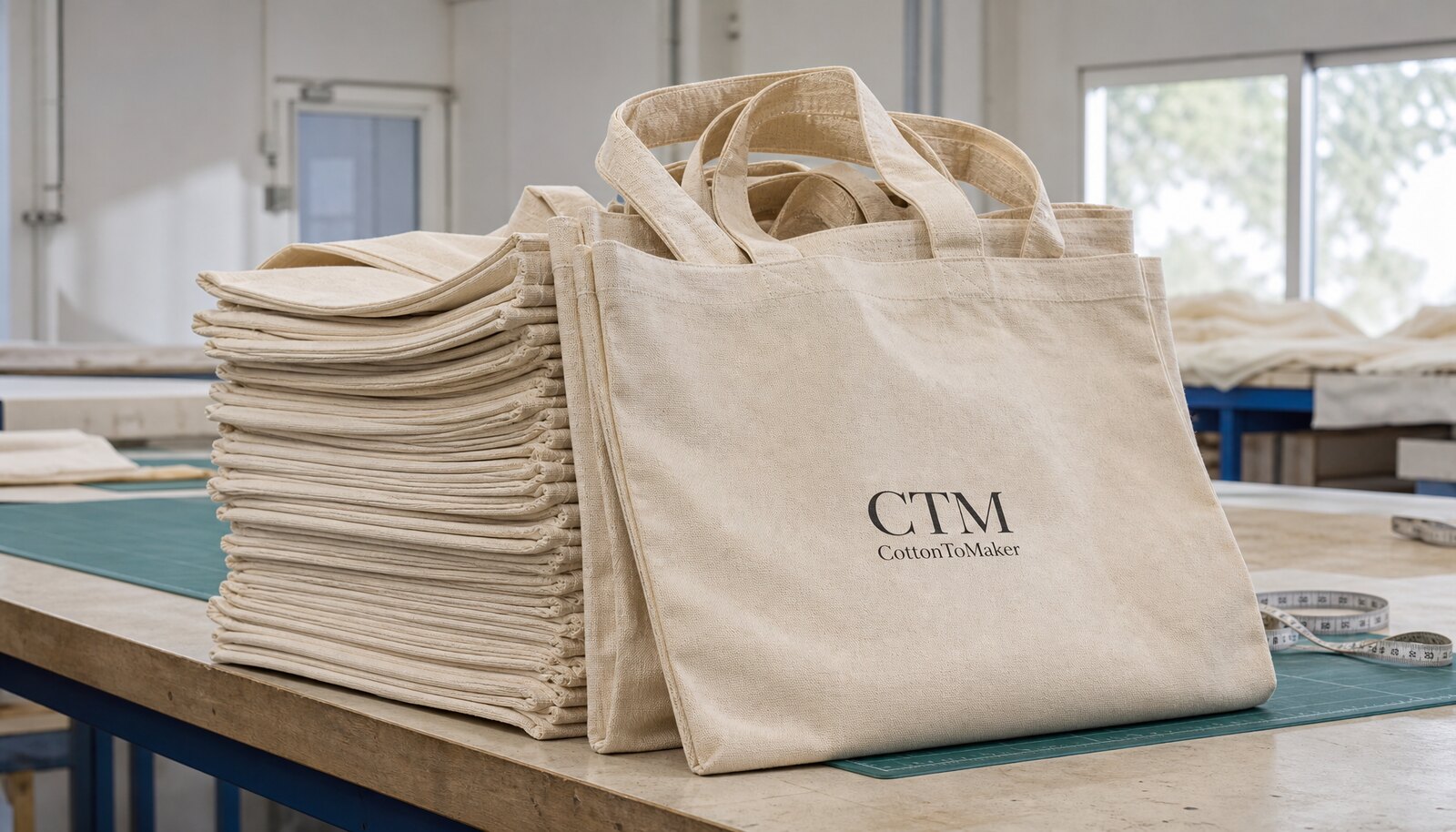
Why event buyers spec canvas differently
Canvas shopping bags for events are not the same buying problem as retail totes. An event bag is judged on first impression, carry comfort, and how well it survives one crowded day of use. The buyer usually wants a bag that looks more substantial than a folded nonwoven tote, but not so heavy that the unit cost and freight become hard to justify. That balance is the real sourcing issue.
The best spec depends on what the bag will carry and how long it needs to stay in circulation. A conference kit with a notebook, brochure, and water bottle needs more structure than a giveaway bag for a product launch. If the bag is being used as part of the brand presentation, the print surface, seam finish, and handle feel matter as much as the raw fabric weight. That is where many quotes fail: they describe the style, but not the actual use case.
- Define the event role before you quote the bag.
- Match the bag weight to the item load, not to a vague idea of premium quality.
- Separate first-day appearance from long-term reuse if the bag will be kept after the event.
Choose the right canvas weight and build
For most event programs, 10 oz canvas around 340 gsm is the safest default. It usually gives enough body for a clean print, better shelf presence than lighter fabric, and a reasonable sew time. If the tote is mainly a handout carrier with low fill weight, 8 oz canvas around 270-280 gsm can reduce cost without making the bag feel flimsy. If the bag must carry catalogs, sample packs, or retail goods, move up to 12 oz canvas around 400 gsm or heavier.
Do not spec weight alone. The weave density, finishing, and stitch plan affect performance as much as GSM. A loose weave at a high GSM can still look cheap, while a dense weave at moderate weight can carry better and print cleaner. Handle length and drop also matter. Event bags often fail on comfort before they fail on fabric, so the handle length should fit the way attendees actually carry the bag, whether by hand or over the shoulder.
- 8 oz / 270-280 gsm: light promos and short-carry use.
- 10 oz / 340 gsm: balanced event tote spec.
- 12 oz / 400 gsm+: premium feel, higher load, and stronger shape retention.
- Reinforced handles and neat gusset corners matter more than a vague 'heavy-duty' claim.
Print choice drives both cost and durability
For most canvas shopping bags for events, screen print remains the benchmark because it is durable, cost-efficient at volume, and visually clean on natural canvas. One-color logos are the easiest to execute and usually the best option when the brand mark is bold. If the design is multi-color, has gradients, or uses fine detail, digital or heat-transfer methods may look better at first glance, but they need a stronger QC plan because the finish can crack, peel, or feel too plastic on a woven bag.
The print area should be specified with the bag structure in mind. A design that runs too close to a seam or gusset can warp after stitching. Buyers should also decide whether they need one-side print, two-side print, or a small woven label on the seam. For event use, a simple logo on one side often gives the best cost-to-impact ratio. If the brand wants the bag to be reused after the event, the print should survive rubbing in cartons, car boots, and daily carry.
- Use screen print for simple logos and volume.
- Use digital or transfer only when the artwork truly requires it.
- Confirm print placement relative to seams before approving the sample.
- Ask for cure and rub checks, not only a visual print proof.
Supplier route and MOQ logic
The sourcing route changes the economics more than many buyers expect. A direct factory is usually the cleanest option when the spec is stable, the logo is approved, and the order is large enough to justify setup time. A trading company can help when the buyer is managing multiple items or needs a single point of contact, but the quote should still show the underlying process costs. A local decorator can be useful for urgent projects, yet the buyer needs to confirm whether the bag body is actually suitable for the event load, not just printable.
MOQ should be tied to the actual build, not only to the bag family. Fabric weight, print colors, handle construction, and packing format all affect the minimum. A 10 oz one-color tote may have a far lower MOQ than a 12 oz two-color bag with custom inner packing. Buyers should avoid comparing quotes that hide setup charges in the unit price at one quantity and separate them at another. The only fair comparison is a quote that shows the same spec, the same print method, and the same packing level across all suppliers.
- Direct factory: best for repeatable specs and higher volume.
- Trading company: useful for mixed programs and bundled buying.
- Local decorator: best for very short deadlines or domestic distribution.
- Compare MOQ against the exact fabric, print, and pack format you need.
How to read a real factory quote
A usable quote for canvas shopping bags for events should not stop at unit price. It should break out fabric weight, body size, handle length, print colors, sample fee, carton spec, and lead time. Without that detail, the lowest quote can be the one with the weakest fabric, the smallest print area, or the most aggressive assumptions about packing. Those shortcuts are easy to miss until the bags arrive and the event team opens the cartons.
If the supplier gives tiered pricing, make sure the quantity breaks are realistic for your actual forecast. A quote that looks cheap at 5,000 units may be irrelevant if your first event only needs 1,200 pieces. Also confirm whether the quote is EXW or FOB. Freight, export handling, and carton volume can change the landed cost enough that the apparent unit savings disappear. For event buyers, the correct metric is landed cost per usable bag, not factory price alone.
- Ask for an itemized quote, not a single blended number.
- Use the same artwork, same fabric weight, and same packing standard in every comparison.
- Check whether the quote includes sample approval time and setup charges.
- Measure landed cost against the event calendar, not just the purchase order value.
Sample approval should test the real risk points
A sample is not just a color reference. It is the chance to catch construction issues before they become a full production mistake. Buyers should inspect the fabric hand feel, seam alignment, handle attachment, print position, and the way the tote stands when filled. If the bag is supposed to hold brochures or boxed samples, test it with the real contents, not a generic weight guess. That reveals whether the gusset depth and handle drop are correct.
For branded events, the sample should also confirm that the logo reads correctly from normal viewing distance. A print that looks acceptable on a close-up photo can disappear on the actual bag if the contrast is too low or the logo is too small. Approval should be tied to a written sample standard: approved artwork file, approved Pantone reference if relevant, approved dimensions, and approved packing method. Once that standard is locked, production should not drift unless the buyer signs off again.
- Inspect with the intended insert load, not an empty bag only.
- Approve the actual print position, not just the art file.
- Lock the sample as the reference for sewing, printing, and packing.
- Keep one signed sample for warehouse and one for supplier control.
QC thresholds that catch event-day failures
Event bags fail in predictable ways: loose handles, crooked prints, weak bottom seams, and inconsistent carton counts. The QC plan should focus on those points. A simple visual check is not enough. The supplier should verify stitch quality at the handle base, the gusset corners, and the side seams where the bag gets stress during loading. Print defects should be measured against the approved artwork, not a loose judgment of whether the logo looks acceptable.
A practical buyer spec can use AQL-style sampling, but the exact acceptance threshold should be agreed in advance. Many buyers use a stricter inspection on print alignment and visible defects than on minor thread tails, because event attendees notice the logo first. Load testing should reflect the real use case. If the bag is meant for documents and small giveaways, a moderate static hang test may be enough. If it must carry heavier inserts, the test load should rise accordingly. The goal is not to over-engineer the tote. It is to make sure the bag performs at the event without looking worn out before the booth closes.
- Set size tolerance, stitch tolerance, and print placement tolerance in writing.
- Inspect handle reinforcement and bottom seam strength with a real load.
- Separate cosmetic defects from functional defects in the acceptance plan.
- Require carton count verification before release.
Packing choices can change your cost and usability
Packing is often treated as a small detail, but it changes both freight and distribution. Bulk-packed canvas bags take less carton space and are easier to quote, but they can crease heavily and require more handling at the event site. Individual polybags look more retail-ready and help keep printed surfaces clean, but they increase material cost and carton volume. For large event shipments, the buyer needs to decide whether the receiving team has time to sort and re-pack, or whether the bags should arrive ready to hand out.
Carton marking should support the actual distribution flow. If bags are being shipped to multiple venues, label cartons by color, artwork, or event name. If the bags are being kitted with brochures or inserts, ask the factory whether they can count and pack to a fixed set quantity per carton. That can reduce labor at the destination and make the receiving process more reliable. Packing choices are not cosmetic. They are part of the operating plan for the event.
- Bulk pack lowers cost and freight volume.
- Individual polybags improve presentation but add volume and labor.
- Use clear carton labels if the bags will be split across venues.
- Count-to-carton packing helps event teams move faster on arrival.
Lead time and scheduling risk need a buffer
Canvas tote orders usually look simple until the schedule compresses. Fabric sourcing, cutting, printing, sewing, curing, inspection, and packing each create a possible delay. If the order includes a new artwork file or a new colorway, the approval loop can take longer than expected. Buyers should work backward from the event date and leave a buffer for sample review, correction, and shipping delay. A single missed approval window can turn a manageable order into an airfreight decision.
The safest schedule is the one that assumes rework may be needed. If the first sample is off in print placement or handle drop, the supplier needs time to correct the pattern before bulk production starts. Buyers should also ask how the factory handles material availability. Natural canvas is usually easier than custom dyed or specialty-finished fabric, but if the factory does not stock the right width or weight, the lead time can stretch. A realistic plan beats a rushed promise every time, especially for event goods that must arrive together and look consistent.
- Work backward from the event date and include sample approval time.
- Leave buffer for print correction and shipping variation.
- Ask whether the supplier stocks the target canvas weight or must source it first.
- Use a backup freight plan if the date is fixed and non-negotiable.
The RFQ language that prevents mistakes
A good RFQ for canvas shopping bags for events reads like a production instruction sheet. It should define the exact bag size, canvas weight, handle style, print method, artwork placement, packing format, and target quantity. It should also state what is not acceptable, such as loose stitches, off-center logos, thin fabric, or changed carton counts. That kind of language saves time because the supplier can quote against a spec instead of making assumptions.
The most common mistake is over-describing the bag in a way that sounds detailed but does not help production. Saying the bag should be 'premium' is not useful. Saying it should be 10 oz canvas, 38 x 42 cm body size, 10 cm gusset, 60 cm self-fabric handles, one-color screen print, bulk packed 50 per carton is useful. Buyers who write that way get cleaner quotes, fewer sample revisions, and less argument later. That is the standard to aim for.
- Use measured dimensions and finished GSM.
- State print side, print area, and color count.
- Include packaging and carton count in the RFQ.
- List the defect types that are automatic rejects.
Specification comparison for buyers
| Spec decision | Recommended option | When it fits | Buyer risk to check |
|---|---|---|---|
| Sourcing route | Direct factory with cutting, sewing, and printing in one place | Repeat event programs, controlled artwork, and buyers who need consistent specs | Confirm who owns print setup, fabric sourcing, and final QC so the quote is not split across hidden vendors |
| Sourcing route | Trading company or sourcing agent | Mixed baskets, multi-item campaigns, or buyers who need one contact for several SKUs | Check whether they are passing through actual factory terms or adding margin on every process |
| Sourcing route | Local decorator or regional converter | Very short lead times, low quantities, or domestic distribution deadlines | Verify canvas source, stitch strength, and whether print quality is better than the bag body itself |
| Fabric weight | 8 oz / about 270-280 gsm | Light event handouts, low-fill giveaways, and short-carry usage | Risk of a thin hand feel, show-through, or early seam distortion if the bag is overloaded |
| Fabric weight | 10 oz / about 340 gsm | Default choice for most event tote programs | Check that the factory is quoting true finished GSM after washing or finishing, not only greige fabric weight |
| Fabric weight | 12 oz / about 400 gsm or heavier | Premium launches, retail-like presentation, or bags that need a stiffer body | Higher fabric cost and longer sew time; make sure the event budget really needs the upgrade |
| Print method | 1-color or 2-color screen print | Simple logos, large runs, and buyers who want strong durability and low unit cost | Confirm cure quality, registration tolerance, and whether the print area is limited by seam placement |
| Print method | Heat transfer or digital print | Small runs, multi-color artwork, or complex gradients | Check rub resistance, wash tolerance if relevant, and whether the finish feels plastic on a canvas bag |
| Construction | Self-fabric handles with cross stitching and bar tacks | Most event bags that must carry catalogs, samples, or small retail items | Ask for handle drop length, stitch count, and load-test evidence instead of accepting a generic 'strong handle' claim |
Buyer checklist before sampling
- Lock the use case first: handout, retail promo, conference kit, or product bundle carrier.
- State finished bag size, gusset depth, handle drop, and whether the bag must fit A4 or letter-size inserts.
- Choose fabric weight in finished GSM and specify if the fabric should be natural, bleached, dyed, or washed.
- Define print method, print size, Pantone target, and whether both sides or one side are printed.
- Specify reinforcement points: handle cross stitch, side seam allowance, and any bottom board or base seam requirement.
- Set a target MOQ that matches the event calendar and the packaging format you can accept.
- Request a pre-production sample or photo proof with actual fabric, thread color, and print placement.
- Confirm carton quantity, inner packing, carton marks, and whether retail-ready labels are needed.
- Ask for production lead time by process step, not just a single overall date.
- Require load-test and visual QC criteria before shipment release.
Factory quote questions to send
- What is the finished bag size, fabric GSM, and weave count you are quoting?
- Is the print screen setup, plate fee, or color change cost included in the unit price?
- What handle construction are you using, and how many reinforcement stitches are standard?
- Does the quote include pre-production sample, shipping cartons, and basic inner packing?
- What MOQ applies to the exact fabric weight and print method, not just the bag style?
- What is the production lead time after sample approval, and what adds delay?
- What QC standard do you apply for size tolerance, stitching defects, and print registration?
- Can you confirm whether the quote is EXW, FOB, or another Incoterm, and where handoff happens?
Quality-control points to confirm
- Finished dimensions should stay within an agreed tolerance, typically about +/- 1 cm on body size and handle drop unless the spec says otherwise.
- Handle stitching should use reinforced cross stitches or box-X stitches at the attachment points, with no loose ends or skipped lines.
- Seams should be straight and flat, with no puckering, needle holes, or open seam gaps at the gusset corners.
- Print registration should stay aligned to the approved artwork placement, with no obvious shift, blur, or edge break.
- Ink cure should pass a dry rub check so the logo does not smear or transfer during packing and event handling.
- Fabric should be free of oil stains, weaving flaws, broken yarns, and uneven dye or bleach patches in the visible area.
- Each sample bag should pass a practical load test for the intended use case, not just a decorative inspection.
- Carton count, outer labels, and inner packing should match the shipment list so distribution teams can receive and allocate quickly.