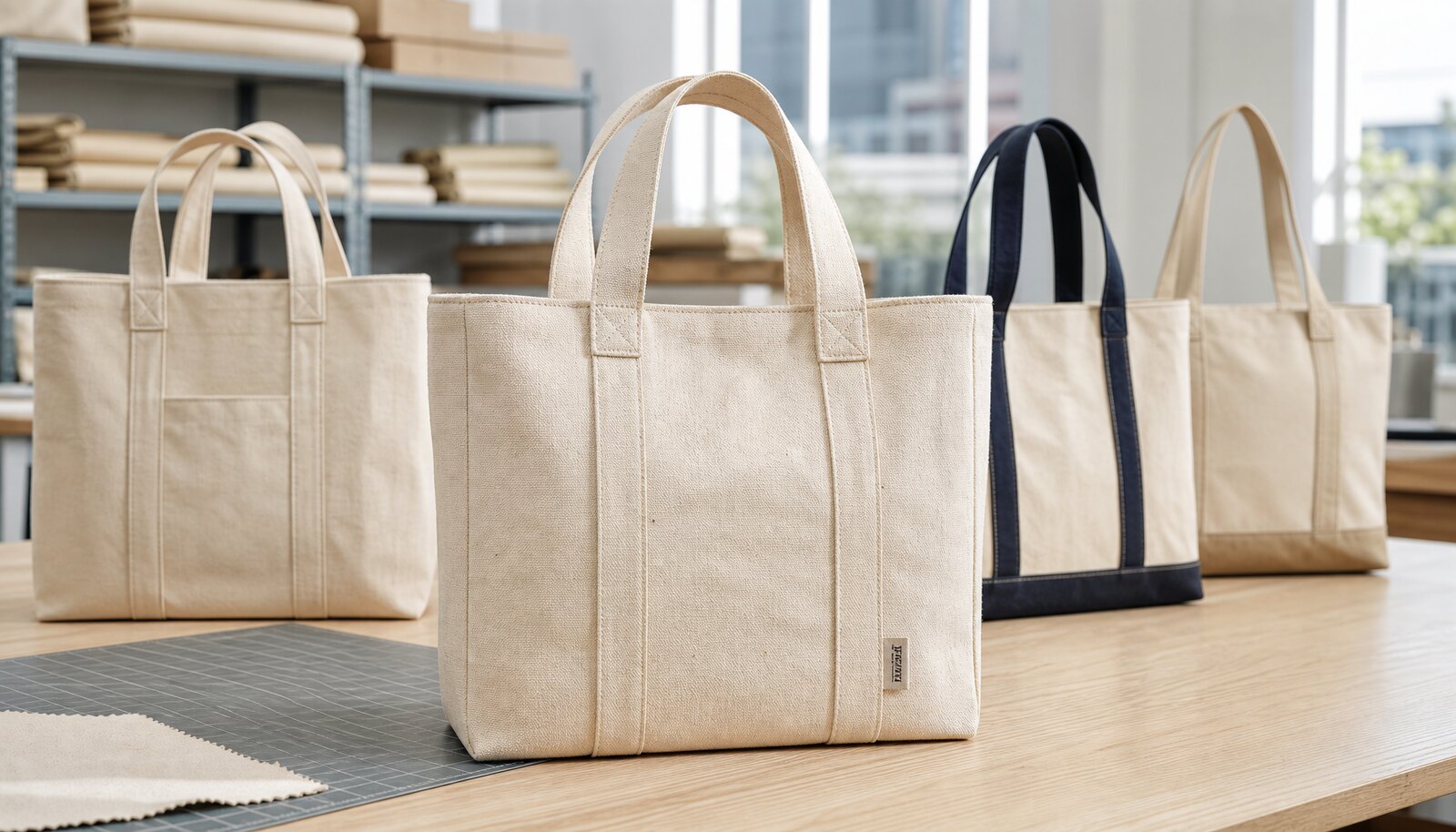
Why These Bags Work for Corporate Gifts
Canvas shopping bags fit corporate gifting because they are useful after the event, easy to brand, and simple to pack with catalogs, welcome kits, or retail samples. They also create more repeat exposure than a single-use giveaway. For buyers, the real advantage is that the bag can carry a logo without looking disposable, but that only works if the bag structure and print quality match the brand's standard.
The common mistake is treating every canvas tote as the same product. A bag that looks fine on a sales sheet can fail in hand if the fabric is too light, the handles are narrow, or the print cracks after folding. For corporate gifts, the target is not only low unit cost. It is a bag that feels solid, ships cleanly, and does not create complaints when the recipient opens the set.
- Best use cases: employee welcome packs, conference handouts, retail partner gifts, product launch kits, and seasonal brand promotions.
- Poor fit cases: very heavy shopping loads, wet-use environments, or premium gift programs that need rigid structure and lining.
- Buyer goal: balance appearance, cost, and durability so the bag still looks worth keeping after first use.
Choose the Right Canvas Weight and Bag Build
For most corporate gift programs, the starting point is 8 oz to 12 oz canvas, or roughly 270 to 410 GSM depending on how the mill measures the cloth. An 8 oz bag works for light handouts, brochures, and soft goods. A 10 oz bag is usually the safest middle ground because it feels substantial without becoming expensive or stiff. A 12 oz bag is better when the gift needs a premium look or when the bag itself is part of the gift value.
Build details matter as much as fabric weight. A bag with a wide gusset, reinforced cross stitch, and longer shoulder drop behaves differently from a flat promotional tote. Buyers should lock the body size, gusset depth, handle length, and seam construction before requesting quotes. If the bag is meant for retail display or resale later, consider a cleaner finish, tighter top edge, and a more stable bottom panel so the bag holds shape after packing.
- 8 oz / about 270-300 GSM: light handouts, short-term use, lower cost.
- 10 oz / about 320-350 GSM: balanced option for most corporate gifts.
- 12 oz / about 380-410 GSM: premium feel, stronger shape, higher unit cost.
- Handle reinforcement: bartack or box-X stitching at each stress point is usually worth the small cost increase.
- Gusset and bottom: specify them in millimeters so the supplier cannot interpret them loosely.
Lock the Branding Method Before You Price the Bag
The print method changes both the quote and the failure mode. A simple one-color screen print is still the most efficient option for a clean logo on canvas. It gives good opacity and consistent placement when the artwork is bold and the print area is controlled. If the design includes gradients, small type, or multiple colors, the supplier may suggest digital transfer or multi-pass printing, but the buyer should compare durability and hand feel, not only the visual result on the sample.
For a corporate gift, the safest branding choice is usually a direct print plus a small woven label or side label. That combination keeps the main logo visible while adding a manufacturing detail that feels intentional. Embroidery can work on heavier canvas, but it adds cost, can pucker light fabric, and is not always the best choice for large logo fills. Buyers should define the artwork size, Pantone target, and acceptable registration tolerance before the supplier starts sampling.
- Screen print: best for simple logos, stable repeat runs, and lower setup cost.
- Digital or heat transfer: useful for detail-heavy artwork or short runs, but check wash resistance and edge durability.
- Woven label or side label: good secondary branding element when you want a more finished product.
- Embroidery: suitable only when the canvas is heavy enough to avoid distortion.
- Do not approve artwork from a PDF alone if the print area and scale are not marked on the bag dieline.
How Suppliers Price Canvas Gift Bags
The quote on a canvas shopping bag is usually driven by five variables: fabric weight, bag size, number of colors, stitching complexity, and packing format. A small change in any one of them can change the total more than buyers expect. For example, adding a gusset, switching from short handles to shoulder handles, or moving from one-color print to two-color print all increase labor and setup time. That is why buyers should not compare two quotes unless the bag construction is identical on paper.
Good quote data is more than a unit price. A useful quote shows the base material, print setup, accessory cost, packing cost, sample charge, and any tooling or plate fee. It also states whether the quotation is ex-factory, FOB, or DDP. Without that structure, the apparent low quote can become the expensive option once freight, carton charges, or artwork changes are added.
- Ask for pricing at multiple breakpoints, such as 500, 1,000, 3,000, and 5,000 pcs.
- Separate setup fees from recurring unit cost so you can compare repeat orders accurately.
- If the supplier includes freight, make sure it is itemized and not blended into the bag price.
- The same artwork can have very different cost outcomes depending on whether the factory charges by color, print area, or screen count.
Compare Sourcing Routes Before You Send the RFQ
The right sourcing route depends on quantity, speed, and how much control you need over the finished bag. Direct factory sourcing is usually the best answer when the order is large enough to justify custom fabric and printing. A domestic print shop can be the faster route for a last-minute campaign, but it usually limits your fabric options and raises the unit cost. Trading companies help when the job includes several moving parts, though buyers need to understand where the real manufacturing happens.
The practical rule is to match the route to the risk. If the project is a one-off event with modest volume, speed may matter more than cost. If the program will repeat across multiple markets or seasons, source from a factory that can hold the same canvas weight, stitching standard, and print process over time. Ask for production evidence, not just a polished sample room photo.
- Prefer direct factory sourcing when the spec is custom and the order is repeatable.
- Use local suppliers when the lead time is too short for sample loops and sea freight.
- Use a trading company only when they can show exactly how the bag is produced and packed.
- For multi-country rollouts, align the spec sheet first so each route quotes the same product.
What to Approve in the Sample Stage
A sample is useful only if it represents the bulk process. Buyers should separate three checkpoints: blank sample, printed sample, and pre-production sample. The blank sample confirms size, canvas weight, handle length, and overall construction. The printed sample proves the artwork, color density, and registration. The pre-production sample should come from the intended material and process line so the buyer can judge the exact finish that will go into the order.
During approval, compare the sample against the intended use, not just against a pretty reference bag. A conference handout needs neat folding and stable print. A gift bag for retail buyers needs stronger seams, cleaner edge finishing, and more consistent panel alignment. If the sample already shows crooked handles, fuzzy print edges, or uneven top stitching, the bulk order will rarely improve on its own.
- Measure the sample: width, height, gusset, handle drop, and logo position.
- Test the load with the type of items the bag will actually carry.
- Rub the print lightly by hand to see whether it sheds pigment or cracks.
- Inspect the inside finish, because loose threads and weak seam ends are often hidden there.
- Approve only when the sample matches the intended packing format, not just the bag shell.
QC Points That Prevent the Common Defects
Most quality problems in canvas gift bags are not dramatic. They show up as inconsistent sizes, loose threads, weak handle stitching, crooked prints, or fabric marks that were missed during packing. These defects matter because corporate gifts are judged visually and often distributed in front of clients or employees. A bag that looks slightly off can reflect badly on the brand even if it still functions mechanically.
Set acceptance criteria before the order starts. The buyer should define what is acceptable on seams, print registration, fabric blemishes, and carton counts. If the order is for retail handout use, the reject threshold should be stricter than for internal office use. The point is to remove ambiguity during inspection so the supplier cannot treat cosmetic issues as acceptable variation.
- Require reinforced handle points with no skipped stitches or loose bartacks.
- Set dimensional tolerance for the bag body and the print position.
- Reject bags with visible stains, holes, heavy slubs, or misaligned panels.
- Check that all print colors sit within the approved Pantone or visual target.
- Count a sample from each carton if the order is distributed by mixed packing lines.
Packing, Labeling, and Presentation Choices
Packing decisions affect both cost and presentation. A folded bag in a simple polybag is efficient for bulk shipment, but it may not be enough for a premium gift kit. If the bag will be handed out with brochures or product inserts, a flat fold with an insert card can keep the pack neat and protect the print face. If the bag is going into retail channels, then carton labeling, size marks, and barcode placement need to be agreed early so the pack line does not improvise.
The buyer should also decide whether the order is ship-ready or presentation-ready. Ship-ready means the cartons are optimized for transport, not for end-customer display. Presentation-ready means the bag can come out of the carton clean, folded consistently, and free from wrinkles or transit marks. That difference can change labor time, carton count, and the packing cost more than a junior buyer expects.
- Define fold style: flat, tri-fold, or roll fold.
- Specify whether each bag needs a polybag, paper band, tissue wrap, or insert card.
- Write carton quantity, carton size, and gross weight limits into the PO.
- Use clear carton marks if the bags will be split across event venues or multiple warehouse doors.
Lead Time Risks and Landed-Cost Comparison
Lead time is often stretched by sample revisions, fabric booking, print screening, and packing changes rather than by sewing alone. Buyers should separate the timeline into sample time, bulk time, and transit time. If the product is for a fixed event date, leave room for a sample rework and a document correction. The cheapest quote can become useless if it cannot hold the delivery window.
For landed cost, compare more than the ex-factory price. Include freight, duty, inland delivery, artwork setup, carton costs, and any destination handling charge. A direct factory quote may look lower than a local supplier, but the final landed cost can move the other way once shipping and QC rejects are included. The most reliable comparison is a like-for-like quote sheet that holds bag spec, packing, and delivery terms constant across suppliers.
- Build in time for one sample revision if the artwork is not already final.
- Avoid changing packing after production starts unless the buyer accepts a schedule slip.
- Use the same Incoterms across quotes before comparing totals.
- If the supplier promises an unusually short lead time, verify whether fabric is already in stock or only the sample is ready.
Specification comparison for buyers
| Spec decision | Recommended option | When it fits | Buyer risk to check |
|---|---|---|---|
| Direct factory in Asia | Best for 3,000+ pcs, custom canvas weight, and controlled printing | You have a clear spec sheet, enough lead time, and want the lowest ex-factory cost structure | Confirm the seller is the actual maker, not a broker, and ask for factory photos, machine list, and recent production records |
| Trading company or sourcing agent | Use when the project has many moving parts or multiple SKUs | You need help consolidating bag body, print, packaging, and freight across suppliers | Margin can hide the real factory price, so compare the landed quote against a direct factory offer |
| Local decorator or print shop | Good for small campaigns and tight deadlines | The bag is mostly standard stock with one logo and a short handout window | Stock canvas may not match the sample, and bag build quality can be weaker than factory-made units |
| Regional cut-and-sew partner | Useful for brands that need closer communication and moderate quantity | You want faster sample loops and easier face-to-face approval | Capacity can be limited, and fabric color or GSM may vary if the mill source is not stable |
| Domestic promotional supplier | Best for very small runs or rush events | The order is under the factory MOQ or needs multiple design revisions | Unit cost is often higher, and the supplier may blend stock bags from different sources |
| Marketplace reseller | Only for very simple, low-risk handout bags | The design is generic and the buyer can tolerate loose spec control | Spec drift is common; size, canvas weight, and handle stitching may not match the listing exactly |
| Stock bag distributor with print add-on | Practical for fast replenishment and repeat programs | You need a known bag base with a logo added locally | Print area, thread color, and fabric shade may differ between batches |
| Integrated factory with in-house print and packing | Best balance for branded corporate gifts at scale | You need one accountable source for body, print, finishing, and carton packing | Verify each process is actually in-house, not outsourced after sample approval |
Buyer checklist before sampling
- Bag size, gusset depth, and handle drop are written in millimeters, not only in inches or marketing names.
- Canvas weight is defined as GSM or oz and tied to the exact fabric finish, including bleached, natural, or dyed cloth.
- Print method is named by artwork type: one-color screen print, multi-color screen print, heat transfer, digital print, embroidery, or woven label.
- Maximum print area and logo placement are marked on the dieline or reference sample.
- MOQ, overrun tolerance, and any color minimums are stated in the quote.
- Sample type is defined: blank sample, printed sample, pre-production sample, or production confirmation sample.
- Packing method is written down: fold style, insert card, tissue, polybag, carton count, and carton mark content.
- Lead time is split into sample time, bulk production time, and freight time.
- Inspection standard is agreed before order release, including AQL target or defect threshold.
- Incoterms and payment terms are compared on the same basis, with freight and destination charges separated from ex-factory cost.
Factory quote questions to send
- What is the exact canvas GSM or oz weight, and is that based on washed fabric or greige fabric before finishing?
- Is the bag body cut from the same fabric roll used for the approved sample, or can the bulk come from a different lot?
- What is the standard stitch count, seam allowance, and reinforcement method at handle points and side seams?
- Which print process will you use for this artwork, and what is the setup cost per color or per logo position?
- What is the MOQ for the exact spec, and how does the price change at 500, 1,000, 3,000, and 5,000 pcs?
- What packing format is included in the quote, and does it cover individual polybags, carton labels, and master carton marks?
- How many days are needed for sample development, pre-production approval, and bulk completion before shipment?
- What are the overrun and shortage tolerances, and how are defective units replaced or credited?
Quality-control points to confirm
- Fabric weight matches the approved spec within an agreed tolerance, and the hand feel is consistent across the lot.
- Bag dimensions are within tolerance for width, height, and gusset, especially when the bag must fit a gift set or brochure.
- Handle length and attachment points are even, with no twisting, loose bartacks, or broken top stitches.
- Print registration, color density, and edge sharpness match the approved sample under normal viewing distance.
- Seams are straight and secure, with no skipped stitches, open corners, or weak stress points at the bottom and handle joins.
- Fabric defects such as stains, holes, slubs, and misweave are within the agreed reject threshold.
- Odor, lint, and residue from printing or finishing do not affect retail handout quality.
- Packing count, carton labeling, and inner packing format match the PO and do not deform the bag during transit.