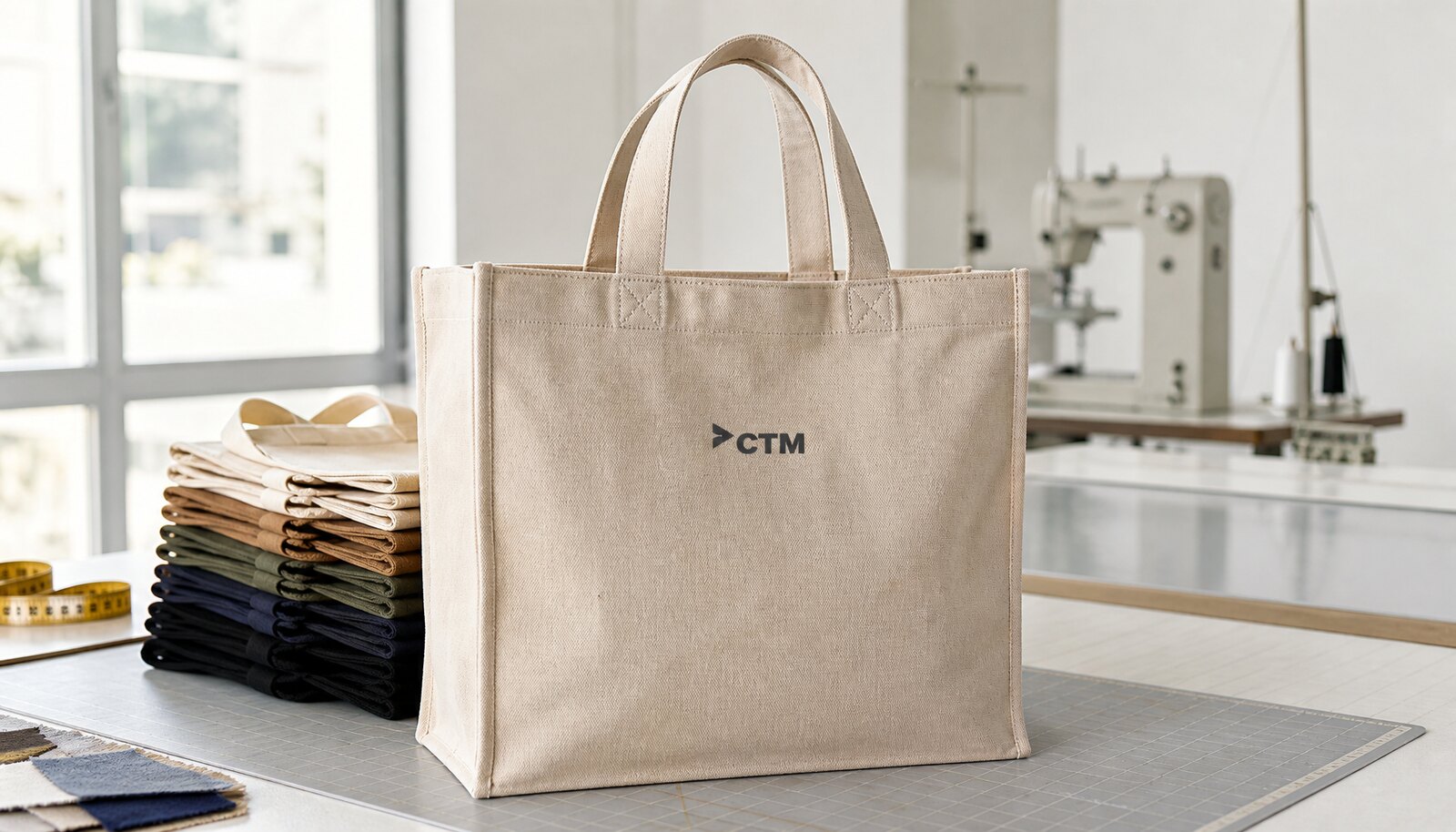
1) What a launch-ready canvas bag spec must include
For canvas shopping bags for brand launches, the bag is not just a tote; it is part of the brand presentation, warehouse workflow, and sell-through experience. That is why a buyer spec must do more than name the product. It needs to tell the supplier what the bag must do, where it will go, and what failure looks like. A clean spec reduces quote variance and makes the approval process much faster.
Start with the commercial use case. A bag for retail shelf display needs a more polished surface, a stable body, and a print that reads clearly at arm’s length. A bag for event handouts can be lighter and simpler. A bag used as a gift-with-purchase may need stronger handles and cleaner folding because it is often seen as part of the premium product set. Once the use case is clear, fabric weight, structure, and packing become easier to set.
The most common buyer mistake is writing only a nominal size and a logo note. That is not enough. You should specify finished dimensions, seam allowances, gusset or bottom construction, handle drop, reinforcement method, artwork placement, decoration method, target quantity, packing style, and delivery term. If the supplier has to guess any of those points, the quote will be less reliable and the production risk will rise.
A good launch spec also states what is not acceptable. For example, if the bag will sit on a retail shelf, say whether loose threads are acceptable, whether minor wrinkling is acceptable, whether the print may shift by a few millimeters, and whether natural canvas shade variation is acceptable. These boundaries matter because they prevent later arguments over what “good enough” means.
For procurement teams, the goal is repeatability. The spec should be tight enough that a factory, a trading company, and a third-party inspector would all reach the same conclusion when they compare bulk goods to the approved sample.
- Use case: retail shelf, event, gift-with-purchase, distributor bundle, or e-commerce insert.
- Finished size: width × height × gusset, plus handle drop and tolerance.
- Structure: single-layer, lined, gusseted, boxed bottom, or reinforced top hem.
- Decoration: method, artwork version, print area, and color count.
- Packing: bulk pack, retail fold, inner polybag, carton count, and label format.
2) Fabric weight, construction, and why the oz-to-GSM conversation matters
One reason sourcing canvas bags becomes confusing is that suppliers use different unit systems. Some quote 8–12 oz, while others say 120–220 GSM, and premium product briefs may refer to 10–12 oz or 340–400 GSM. Those figures are not always interchangeable in a neat one-to-one way, especially when suppliers are describing a finished fabric with finishing effects rather than a raw mill cloth. Procurement teams should therefore ask for both systems on the quote and verify the actual test basis.
As a practical buying guide, 8 oz canvas is generally better suited to light promotional use, simple giveaways, or orders where cost matters more than structure. 10 oz, or roughly the mid-300 GSM range, is a common middle ground for brand launches because it balances body, price, and print appearance. 12 oz and above gives the bag more shape, better shelf presence, and less wrinkling, but it also increases cost, weight, and often sewing resistance. For bags that need to hold bottles, boxed goods, or heavier retail items, a stronger grade usually pays back in fewer complaints and a better customer impression.
The construction matters as much as the fabric weight. A single-layer open-top tote can be economical and suitable for bulk distribution, but its finish depends heavily on seam quality and hem control. A lined bag or a boxed-bottom tote feels more premium and stands upright better, which helps on shelf. However, every added panel, lining layer, or reinforcement patch increases labor content and creates more inspection points. Buyers should compare the whole construction, not just the fabric number.
This is where exact tolerances matter. If the approved sample is 10 oz canvas, ask the supplier what actual range they will accept in bulk. A useful question is whether the supplier controls weight by mill certificate, incoming roll inspection, or final bag verification. If they cannot explain the control point, the buyer should treat the weight claim as unverified until the sample and bulk lot are tested.
3) Sourcing route: direct factory, trading company, or hybrid model
The right supplier route depends on how much control the buyer needs over the bag and how much commercial complexity the launch can tolerate. For a brand launch, direct factory sourcing is usually the strongest default because canvas bags are simple enough that the buyer benefits from talking directly to the people controlling fabric, cutting, sewing, printing, and packing. Direct factories can often explain where the quote is coming from: cloth consumption, seam labor, decoration setup, or packing labor.
That said, direct factory does not automatically mean lower risk. A good factory still needs to prove capability. Ask for recent photos of the exact kind of tote construction you need, request a pre-production sample from actual bulk materials, and confirm whether the bag is sewn in-house or subcontracted. If the sewing, printing, and packing are done in different locations, the buyer should know where each control point sits and who owns the final inspection.
Trading companies can be useful when the buyer is bundling several product types, needs more responsive communication, or wants help managing multiple factories. The main risk is opacity. If the supplier cannot state the fabric source, sewing capacity, and actual inspection plan, the buyer may only see a polished quote and not the underlying production method. That matters because a launch order is often time-sensitive and any ambiguity can surface only after sample approval.
A hybrid model can work when a trading company coordinates but the buyer requires factory documents, sample photos, and traceable lot information. In that case, the procurement team should insist on named manufacturing sites, not generic assurances. The decision should be based on evidence, not labels. Ask for capability proof such as a similar bag sample, cutting layout photos, production line shots, quality records, and carton-packing photos. If the supplier hesitates to show those, the buyer should be cautious regardless of whether they call themselves a factory or a trader.
- Direct factory: best for spec control, technical clarification, and repeatability.
- Trading company: useful for consolidation, but verify source and inspection control.
- Hybrid: workable if the supplier provides factory identity, sample evidence, and line ownership.
- Verification: request sample photos, production-line photos, and a lot-specific packing plan.
4) Landed cost, not unit price: how procurement should compare quotes
For launch orders, the unit price is only one piece of the decision. The real question is landed cost at the destination, because shipping, carton density, pallet efficiency, and packing method can change the economics enough to offset a small unit-price difference. Two suppliers can quote the same tote at similar ex-factory prices, yet one may produce denser cartons, fewer breakages, and lower carton volume. That supplier can be cheaper in the warehouse even if the factory price looks higher.
Buyers should normalize quotes before comparison. First, confirm the same bag size, fabric weight, print method, handle build, and packing. Then compare ex-works, FOB, or CIF terms on the same basis. If one supplier includes inner polybags, barcode labels, or carton marks and another does not, the apparent price difference is misleading. Add the missing costs before ranking the suppliers.
Freight is especially important with canvas because the bags are relatively light but bulky. A bag that folds less efficiently or is packed in oversized cartons can increase cubic volume quickly. That can add sea freight, air freight, and warehouse handling cost. A slightly smaller carton or better folding method may save more than a small fabric discount. Procurement should ask for carton dimensions, net weight, gross weight, and estimated pallet pattern before deciding. Without those numbers, landed cost is only a guess.
There is also a hidden cost in sampling and corrections. If the supplier charges separately for plain sample, printed sample, pre-production sample, screen setup, color matching, or revised artwork, those costs should be listed and compared. Even if they are not large, they matter when a buyer is testing several factories. A quote that looks low but excludes setup and sample charges may become the most expensive route if the order requires multiple revisions.
5) Print, decoration, and brand placement: choosing the right method for the launch
Decoration is where many launch orders go wrong because the buyer describes the artwork but not the production method. A good specification names the print process, the number of colors, the maximum print size, and the exact placement window. It should also say what the logo is supposed to do: read clearly from a distance, feel premium by touch, survive reuse, or stay budget-friendly across a large rollout.
Screen printing is usually the most practical method for simple logos and controlled quantities. It handles solid shapes well and keeps unit cost reasonable. But it needs good registration, stable screens, and clean ink control. Fine lines, tiny type, gradients, or photo-like graphics are harder and may fill in or distort on rough canvas texture. If the artwork is detailed, the buyer should ask the supplier how they will avoid ink bleed, edge blur, and uneven opacity.
Embroidery can deliver a premium tactile look, but it adds cost and can distort lighter canvas if the stitch density is too heavy. Woven labels or woven patches work well when the brand wants a durable, neat identifier without full-surface printing. Heat transfer can support more artwork detail but should be checked for adhesion, crack resistance, and how it behaves on textured canvas. The right choice depends on the launch positioning, not on what the supplier prefers to sell.
For brand launches, print placement tolerance should be written in measurable terms. For example, instead of saying “centered,” define the allowed offset from centerline or from seam reference points. Ask for a strike-off or pre-production print sample, and keep that physical sample as the visual benchmark. If the bag uses more than one colorway or artwork version, label each approval sample separately so the bulk team cannot mix them up.
6) MOQ, lead time, and production planning for launch dates
MOQ is not just a commercial number; it is a reflection of how the supplier schedules fabric, labor, and decoration setup. For a launch order, a factory may give a lower MOQ if it uses stock canvas and a simple one-color print. If the buyer wants custom dyeing, special hardware, multiple print areas, or mixed sizes, MOQ usually rises because the setup burden rises. Procurement teams should ask what is driving the MOQ so they can decide whether the lower price or broader design freedom matters more.
Lead time should be mapped by milestone. There is time for sample development, artwork adjustment, material booking, bulk sewing, printing, inspection, and shipment. A quote that says only “20 days” is incomplete because it may refer only to sewing time after all approvals are done. For a retail launch, that is not enough. The buyer should ask for a calendar that begins with sample approval and ends with ready-to-ship goods.
If the launch date is fixed, ask whether the supplier can reserve stock fabric, pre-book sewing capacity, or hold printing slots. That is particularly useful when the order depends on a campaign date or retail event. Buyers should also ask what factors can extend the lead time: color matching, artwork revisions, rain or humidity issues for printing, supplier peak season, or export congestion. These are ordinary risks, not excuses, and they should be addressed before the PO is issued.
A practical launch plan should also include contingency. If the first bag sample is not approved, how long does a revision take? If one artwork version is delayed, can the other version ship first? If the bag requires custom packaging, does that happen in-house or at a partner facility? These are the questions that separate a workable launch schedule from a fragile one.
- Ask the supplier to break lead time into sample, material booking, production, inspection, and dispatch.
- Confirm whether the quoted MOQ is driven by fabric dyeing, print setup, or sewing efficiency.
- Check whether stock fabric can be used to reduce launch risk.
- Build in buffer for artwork corrections and shipping congestion.
7) Carton planning, palletization, and warehouse receiving requirements
A lot of bag sourcing problems show up only after production, when the goods arrive at the warehouse and the receiving team discovers that the cartons are awkward, overfilled, or unlabelled. For launch orders, carton planning should be part of the quote stage, not an afterthought. The buyer should ask for carton dimensions, gross weight, bag count per carton, and the recommended carton stacking pattern. Those details affect freight cost, warehouse handling, and damage risk.
Canvas bags are often compressible, but that does not mean cartons should be stuffed until the bags are crushed. Overpacking can create wrinkled product, distorted handles, and corner damage to print areas. Underpacking can waste cubic volume and raise freight cost. The right balance depends on the bag structure and destination. If the bags are retail-ready, a fold standard should be agreed in advance so every unit has the same look when unpacked.
If palletization is required, define the pallet size, carton layers, stack height, pallet wrap method, and whether each pallet needs an outer label. This matters when the goods enter a distribution center that receives by pallet rather than by loose carton. The supplier should be able to propose a carton plan that protects the product while keeping the volume reasonable. Ask for photos of a packed master carton and, if possible, a sample pallet pattern. If the supplier cannot describe carton efficiency, the freight forecast will be weak.
Warehouse teams should also know whether barcode stickers, carton marks, or country-of-origin labels are applied at the factory. Small labeling mistakes can create receiving delays and repacking cost later. For launch orders, the safest approach is to standardize carton content by SKU and destination and to mark mixed shipments clearly if they cannot be avoided.
8) Quality control: measurable acceptance criteria that prevent disputes
QC for canvas shopping bags should be specific enough that a third-party inspector can apply it without guessing. High-level statements like “good quality” are not enough. The buyer should define what constitutes a critical, major, and minor defect; what sample size applies; and what the acceptance route is if the lot fails. For launch orders, this is especially important because brand damage can happen fast if a visibly poor tote reaches consumers or stores.
Use measurable checks. For size, inspect finished dimensions on flat bags. For print, verify placement and color against the approved sample under neutral light. For stitching, check handle attachment, side seams, top hem, and gusset corners. For fabric, separate structural issues such as holes or tears from cosmetic issues such as mild slubs or natural variation. The more visible the bag, the stricter the defect definition should be. A plain canvas tote makes small flaws easier to spot than many other products.
Sampling should also be discussed upfront. Many buyers rely on AQL inspection, but the exact sampling level should be matched to the risk of the order. For a launch order, procurement teams often use tighter controls on critical and major defects than they would on routine replenishment. The point is not to create unnecessary rejection. It is to prevent a shipment of bags with wrong artwork, weak handles, poor print placement, or inconsistent carton content. Once those issues are in the warehouse, the cost to fix them is much higher.
The best dispute prevention tool is a signed approval set. That includes the approved sample, approved artwork file, approved carton label, and agreed QC checklist. If the supplier and buyer are comparing the same documents, arguments about “acceptable variation” become much easier to resolve.
9) Supplier benchmarking framework: how to compare factories without relying on price alone
Procurement teams often ask for three quotes, but three prices alone do not identify the best supplier. A useful benchmark framework compares capability, transparency, quality system, and commercial fit. For canvas shopping bags for brand launches, the buyer should ask each supplier to submit the same documents and answer the same set of technical questions. That creates a fair basis for comparison and reduces the chance that one quote looks cheaper only because it is less complete.
A simple benchmark matrix can score suppliers across four areas. First is spec understanding: do they correctly repeat back the size, fabric, print method, and packing requirements? Second is process control: can they explain fabric sourcing, cutting, sewing, decoration, and packing steps? Third is QC strength: do they have an inspection plan, defect categories, and escalation process? Fourth is commercial reliability: are their lead time, MOQ, and quote assumptions clear and stable? A supplier that scores well in all four areas is usually safer than one that is merely lowest price.
Request evidence, not just claims. A supplier should be able to show a similar tote sample, a spec sheet, carton photos, and at least one example of a QC workflow. If they claim to have export experience, ask what incoterms they usually quote and what documents they provide. If they claim premium capabilities, ask to see clean print registration, seam detail, and packing consistency. The buyer’s job is to verify whether the factory can actually produce the bag that the launch requires.
The benchmark should also include responsiveness. A supplier who answers technical questions clearly and returns corrected quotes quickly is often easier to manage during sampling and production. In launch programs, communication speed can matter as much as unit price because errors are easier to fix before bulk than after shipment.
10) FAQ and quote language that helps procurement close the order
FAQ should do more than repeat basic sourcing advice. For launch orders, the better questions are the ones that help procurement get a clearer quote and avoid disputes later. Ask the supplier what changes the price, what changes the lead time, and what proof they can provide before bulk starts. If the supplier answers those questions cleanly, that is usually a better signal than a polished sales pitch.
Useful quote language is direct. For example, ask for the exact fabric unit system, the finished-size basis, the approval sample stage, the defect acceptance level, and the carton plan. Ask whether the quote assumes one artwork only or multiple SKUs. Ask whether the supplier can keep the same fabric source for reorders. These questions matter because brand launches often expand into repeat production once the market response is known.
For procurement teams working under deadline, the best approach is to turn the discussion into a controlled checklist: spec, sample, price, QC, packing, and dispatch. That is the sequence that reduces mistakes. Once those are aligned, the buyer can compare canvas shopping bags for brand launches on a fair basis and place a PO with more confidence.
Specification comparison for buyers
| Spec decision | Options to compare | Best fit | Tradeoff to check |
|---|---|---|---|
| Fabric weight and hand feel | 8 oz / ~280 GSM, 10 oz / ~340 GSM, 12 oz / ~400 GSM, 14 oz+ / ~480 GSM | 8 oz for promo handouts, 10–12 oz for retail launches, 14 oz+ for premium structured bags | Heavier fabric improves body and durability but raises cost, freight, and sometimes sewing difficulty |
| Construction | Single-layer open top, double-layer body, lined body, gusseted tote, boxed bottom | Single-layer for cost control, gusseted or boxed-bottom for product-carrying launches, lined body for premium gifting | More structure improves presentation but increases labor, lead time, and inspection points |
| Handle build | Self-fabric handles, cotton webbing handles, longer shoulder drop, reinforced X-box or bar-tack | Self-fabric for low cost, webbing for strength, longer drop for shopping comfort | Weak handle attachment is the most common functional failure; handle length also affects carton packing |
| Decoration method | Screen print, heat transfer, embroidery, woven label, woven patch, discharge print | Screen print for most launch logos, embroidery or woven label for premium positioning | Decorative methods differ in texture, wash resistance, setup cost, and minimum quantity |
| Color strategy | Natural canvas, bleached white, solid-dyed stock color, custom-dyed color | Natural for fastest sourcing, stock dyed for brand color alignment, custom dyed for high-volume repeat programs | Custom color usually means extra MOQ, shade risk, and longer lead time |
| MOQ route | Stock fabric with standard print, custom fabric, custom size, multi-color artwork, mixed SKUs | Stock fabric + one-color print for launch testing, custom specs for long-run programs | Lower MOQ often increases unit price and narrows options for size, color, or packing |
| Packing level | Bulk pack, inner polybag, retail fold + insert, barcode label, master carton only | Bulk pack for DC replenishment, retail-ready pack for store launch, barcode-labeled bulk cartons for traceability | More presentation packing increases labor, carton volume, and handling time |
| Supplier type | Direct factory, trading company, hybrid sourcing | Direct factory for spec control, hybrid when local coordination is needed, trading company for consolidated purchases | Indirect routes can hide fabric source, sewing line capacity, or inspection limits unless documents are checked |
Buyer checklist before sampling
- Define the launch use case first: retail shelf, event giveaway, gift-with-purchase, distributor bundle, or e-commerce insert. The use case determines fabric weight, decoration durability, and packing standard.
- Write the size as finished dimensions plus tolerances, not only a nominal size. Include width, height, gusset, and handle drop.
- Choose the fabric range before RFQ and reconcile it to one unit system. If you use oz, ask the supplier to state GSM too, and verify the conversion on the spec sheet rather than assuming it is exact.
- Specify the bag structure: single-layer, lined, gusseted, boxed bottom, reinforced top hem, or reinforced handle patches.
- State artwork clearly: number of print colors, placement, print size in millimeters, and whether there is one artwork or multiple SKUs.
- Ask for a pre-production sample made from actual bulk fabric, actual ink or thread, and final packing method. Do not approve from a hand-cut mock-up alone.
- Require an itemized quote that separates fabric, sewing, decoration, packing, sample charges, testing, carton labels, and freight assumptions if freight is included.
- Confirm carton packing and pallet plan before PO release, including cartons per pallet, cartons per layer, stack height, gross weight target, and whether palletization is included.
- Set measurable quality criteria in advance: stitch count, print alignment tolerance, fabric defects allowed, and defect severity thresholds.
- Ask for confirmation of lead time by milestone: sample approval, material booking, production, inspection, and dispatch.
Factory quote questions to send
- What is the exact fabric specification, including weave type, GSM or oz, yarn count if available, and whether the fabric is pre-shrunk or enzyme washed?
- Is the quotation based on finished size or cut size, and what tolerances do you allow on width, height, gusset, and handle length?
- Please separate the quote into base bag cost, decoration cost, packing cost, sample cost, and any tooling or setup charges.
- What print method is included, how many colors are priced, and what happens to unit cost if the artwork changes or a second print location is added?
- What handle material and reinforcement are included, and how many bar-tacks, X-boxes, or seam passes are used at the stress points?
- What is your standard MOQ by fabric color, print color count, and bag structure, and what changes the MOQ?
- Can you provide photos or a short video of the actual sewing line, print area, cutting equipment, and packing area for a similar bag?
- What inspection standard do you follow on launch orders, and do you accept AQL 2.5 / 4.0 or a buyer-defined inspection plan?
- How do you control color consistency between sample and bulk, especially for natural canvas and dyed canvas?
- What is the master carton size, gross weight, and recommended pallet pattern, and can you follow our carton mark format?
Quality-control points to confirm
- Fabric weight: verify against the approved spec with a calibrated GSM test or documented supplier mill certificate. A practical tolerance of ±5% is usually easier to manage than a loose verbal claim; anything visibly lighter than the approved sample should be flagged.
- Dimensions: measure finished bags laid flat after pressing. Use width, height, gusset, and handle drop. A common procurement tolerance is ±0.5 cm for small bags and ±1.0 cm for larger bags, unless the buyer has stricter retail requirements.
- Stitching: inspect for skipped stitches, loose ends, uneven seam allowance, broken thread, and open seam ends. Stress points should have consistent reinforcement. Handle attachment should not show seam gap or puckering under hand pull.
- Print quality: check placement, registration, edge sharpness, opacity, and color consistency under neutral light. A one-color logo on a plain canvas bag should be centered within the agreed placement window; obvious off-center placement is a launch-critical defect.
- Fabric defects: classify slubs, holes, stains, weaving flaws, oil marks, and shade variation. For launch orders, any stain, hole, or severe shade banding should be treated as critical, not cosmetic.
- Color control: compare bulk against the signed-off sample under D65 or equivalent neutral light. Natural canvas can vary by batch; the supplier should confirm whether the approved sample is the benchmark or whether shade range is allowed.
- Handle strength: perform a manual pull test on sample units and inspect the stitching after load. If the bag is intended for shopping use, the handle area should not separate, stretch visibly, or create tearing noise during light-to-moderate pull.
- Carton and pallet condition: confirm clean cartons, correct carton marks, dry packing, no crushing at the corners, and no compressed print surfaces. Pallet wrap should not damage the cartons or deform the bags.
- Packing accuracy: count bags per carton, verify the fold direction, and confirm barcode or sticker placement if used. Mixed SKUs or mixed sizes should be separated and labeled to avoid warehouse mis-picks.
- Acceptance thresholds: define critical, major, and minor defects before inspection. For launch orders, critical defects should include wrong size, wrong artwork, holes, stains, missing handles, severe seam failure, and wrong quantity; these should trigger rejection or rework per the agreed plan.