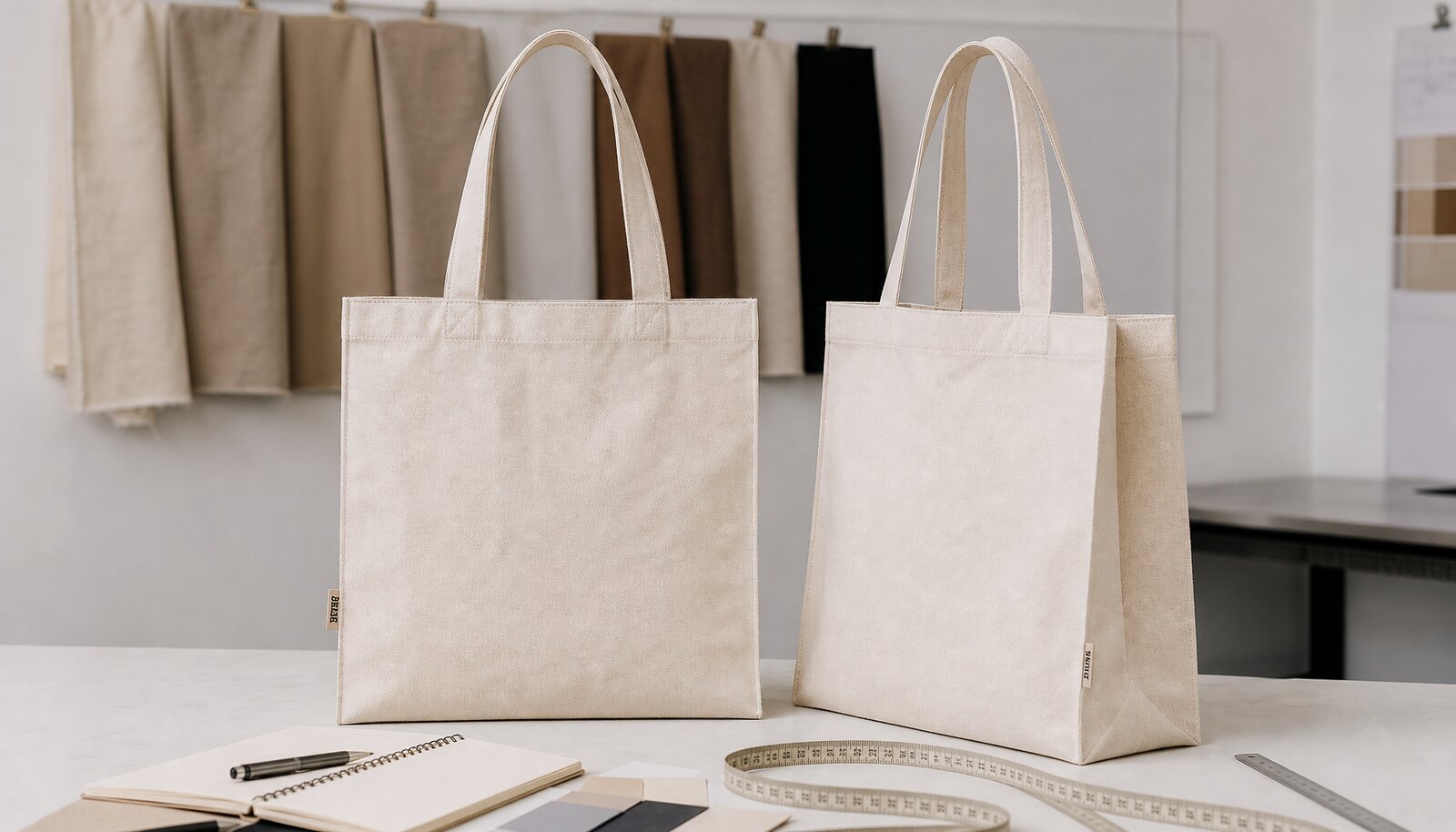
Start With the Buying Job, Not the Tote
For apparel brands, canvas retail merchandise bags are not just packaging. They are a carry item, a brand surface, and often the first durable touchpoint a customer keeps after the purchase. That makes sample approval a procurement decision, not a design review. A bag can look correct on a table and still fail when it is filled with folded shirts, weighed at the till, stacked in a warehouse, or handled by store staff all day.
The sample needs to answer one question: will this exact construction survive the order quantity, the packing method, and the retail use case? If the answer is only visual, the approval is incomplete. If the bag will be used as a purchase carrier, a gift-with-purchase insert, or a premium reusable tote, the approval standard should match that job from the start.
- Define the primary use case before asking for a sample.
- Tie the sample to a real load, such as folded knits, denim, accessories, or mixed purchase weight.
- Keep one approval file for bag construction, branding, packing, and carton spec.
Write the Spec Before the First Sample Is Cut
Weak specs are the most common reason sample rounds stall. The factory cannot hit a target that is described only as "heavy canvas" or "good quality tote." A procurement-ready spec should state the finished dimensions, fabric weight, handle width and length, seam allowance, reinforcement style, print position, and final pack format. If the bag is supposed to fit a folded hoodie or a boxed tee, that capacity should be written down, not implied.
Use measurable language wherever possible. Ask for GSM and ounces, not just canvas. Ask for the logo size and distance from the top edge, not just "centered print." If there are brand color requirements, identify the target system and the acceptable tolerance. The more the spec behaves like a controlled production document, the less likely the supplier is to substitute a lighter fabric, shrink the print area, or simplify a seam detail later.
- State the exact fabric weight in GSM or ounces.
- Specify the finished size, handle dimensions, and seam allowance.
- Define the logo size, location, color reference, and print method in writing.
Choose the Right Fabric Weight and Build
For most apparel retail use, 10 oz canvas is the practical default because it balances cost, hand feel, and carry performance. Eight-ounce canvas can work for light-load gifting or low-cost merch, but it is more likely to stretch, drape loosely, or show print distortion. Twelve-ounce canvas has a heavier, more premium feel and usually gives more margin under load, but it can raise material and sewing cost and may require more careful folding for retail packout.
Construction matters as much as weight. A simple tote with no gusset is easy to make and quote, but a gusseted bag often carries garments better and holds a cleaner shape when filled. Handle reinforcement, seam turn-in, and bottom stitching all affect durability. If the bag is expected to be reused, build for stress at the handle base first. That is where weak samples usually fail.
- Use 8 oz only when the load is clearly light and the budget is the priority.
- Use 10 oz as the baseline for most retail apparel launches.
- Use 12 oz when the bag must feel premium, carry more weight, or withstand repeat use.
Verify the Sample Source and the Real Production Path
A sample from a polished sample room is not enough if bulk will run somewhere else. The biggest sourcing risk is a sample that looks right because it was made by a different team, on different machines, with different fabric, and perhaps even by a different company than the one that will actually produce the order. That is why procurement should ask who cuts, sews, prints, and packs the sample, and whether the same site and same line will make bulk.
Ask for direct evidence, not reassurance. A dated photo of the sewing line, cutting tables, print screens, and packing area is more useful than a general promise that the factory is "fully capable." If a trading company or sourcing agent is involved, ask which steps are subcontracted and whether subcontracting can happen without written approval. The more transparent the production path, the lower the risk that the approved sample becomes irrelevant once the order is placed.
- Require the supplier to disclose the actual production entity and location.
- Ask for dated line photos or live video from the same site that will make bulk.
- Treat undisclosed subcontracting as a procurement risk, not a neutral detail.
Review the First Sample Like a Production Part
The first sample should tell you whether the factory understood the spec, not whether the bag looks attractive in isolation. Measure the bag flat and filled. Check whether the handles balance, whether the bag stands or collapses as intended, whether the seams align, and whether the bag folds to the carton footprint you need. A sample that is visually acceptable but awkward to carry will create a real-world complaint the first time it is used by a customer or store associate.
Look for differences between sample behavior and production behavior. Sample rooms sometimes over-stitch, trim more aggressively, or hand-finish details that bulk will not match. That is why a photo of the actual production line matters. If the sample is made with one team and bulk with another, you are not reviewing a pre-production reference. You are reviewing a prototype with limited predictive value.
- Compare the sample to the tech pack line by line, not to memory.
- Carry-test the bag with the actual product weight you expect at retail.
- Open, fold, and repack the sample several times to check shape recovery and handling.
Set Numeric QC Thresholds Before You Approve Bulk
Procurement buyers need thresholds, not adjectives. If the quality standard is only "good stitching" or "nice print," the supplier has room to interpret defects as acceptable. Set a load threshold, a seam standard, a print standard, a color tolerance, and a packing standard before the sample is signed off. The goal is not to create a laboratory specification for every order. The goal is to remove ambiguity from the approval decision.
The thresholds below are practical procurement baselines for canvas retail merchandise bags. They should be tightened if the bag is part of a premium launch or if the customer will use it for heavier items. They can also be loosened slightly if the bag is a low-cost gift item, but any relaxation should be written into the purchase file so future reorders do not inherit a weaker standard by accident.
- Load test: 5 kg for 8 oz, 7 kg for 10 oz, and 10 kg for 12 oz, held for 30 minutes with no seam opening, handle tear, or deformation greater than 5 percent.
- Stitch density: about 7 to 9 stitches per inch on body seams and about 8 to 10 stitches per inch at reinforcement points, with no skipped stitches or open seam sections.
- Print adhesion: at least a 4B cross-hatch tape result or an equivalent internal method, with no flaking, cracking, or edge lift after normal handling.
- Color tolerance: Delta E 2.0 for brand-critical logo colors and up to Delta E 3.0 on natural canvas body fabric if both sides approve the reference.
- Carton control: count variance must be zero against the packing list, and gross carton weight should stay within plus or minus 5 percent of the approved packed carton sample.
- Defect rule: any critical defect fails the sample immediately, and repeated minor defects should be treated as an approval failure rather than an observation.
Treat Branding Methods as a Cost and Risk Decision
The right logo method depends on artwork, order size, and how long the bag must hold up in use. Screen print is usually the best choice for simple one- to four-color artwork because it is repeatable and economical at volume. Embroidery creates a more premium texture, but it can pull on lighter canvas and usually adds setup and stitch time. Heat transfer is useful for complex art and short runs, but it needs stricter checks on edge lift and rub resistance.
The sample should match the production method exactly. A hand-applied transfer on the sample is not the same as a production transfer. A photo of an embroidered sample made by a different team is not enough if the final order will run on another machine. For apparel brands, the key question is not which method looks nicest in one sample. It is which method will repeat reliably across the full order without introducing rework.
- Use screen print for simple logos and repeat orders.
- Use embroidery for a small premium mark where texture matters more than speed.
- Use heat transfer only when artwork complexity or short-run needs justify the durability tradeoff.
Approve Packing and Cartonization as Part of the Product
A tote bag that passes visual inspection can still fail procurement if it is packed incorrectly. Store and warehouse teams care about fold direction, polybag size, barcode placement, master carton marks, and carton count. If the bag is going to retail distribution, the sample should include the final packing sequence, not just the sewn bag. Packing mistakes create receiving delays, manual repacking, and avoidable chargebacks.
Packing also changes landed cost and carton efficiency. Flat-folded bulk packs are simpler and cheaper, but a retail-ready pack with polybag, barcode, hangtag, and insert card can add labor and complexity. The buyer should approve the fold method so the bag fits the intended carton count and should confirm that the carton remains within the warehouse limits for weight and size. A good sample that ignores packing is not a finished sample.
- Approve the fold method so carton count and carton size stay stable in bulk.
- Confirm polybag thickness, warning text, and barcode readability before release.
- Check whether the bag needs a hangtag, origin label, care label, or retail insert card.
Read the Quote for Hidden Cost Drivers and MOQ Triggers
A canvas tote quote is only useful when it is broken into the same cost buckets used in production. The main drivers are fabric weight, print complexity, handle construction, lining or pocket additions, packing requirements, and carton spec. A low unit price that omits screen charges, label application, packing labor, or carton costs is not a lower quote. It is an incomplete one.
This is where procurement teams should compare the option set, not just the headline number. Ask for the MOQ at each configuration and the incremental lead-time impact of each added feature. In many factories, the step from a simple one-color tote to a lined, multi-color, retail-packed tote changes more than the price. It changes the whole production plan. If the supplier cannot explain that change clearly, they do not yet have control of the order.
- Compare quotes on identical specs: same fabric weight, same print method, same pack format, same carton count.
- Ask for one-time charges separately from recurring unit cost.
- Request the price at MOQ and the price at a realistic reorder quantity so you can see scale effects.
Release Bulk Only After a Locked Golden Sample Exists
The final approval should be tied to one dated, signed, and archived reference sample. That golden sample should match the agreed fabric, dimensions, print method, label placement, packing method, and carton spec. Keep photographs of all sides, a measurement sheet, and the sign-off record together with the purchase order. If the supplier changes thread, trim, ink, or pack format later, you need a reference that shows exactly what was approved.
For larger runs or launch-critical orders, ask for a pre-production confirmation before bulk sewing starts. That step is where you catch fabric shade drift, handle reinforcement issues, wrong barcode placement, or carton problems before the whole lot is made. Sample approval is not a ceremonial task. It is the cheapest point in the process to stop a packaging error, a retail complaint, or a costly rework charge.
- Archive the golden sample photos, revision notes, and sign-off date in one order file.
- Require written notice before any change to fabric, print, trim, or packing.
- Do not release bulk if the sample does not represent the actual production route.
Specification comparison for buyers
| Decision | Quantified guidance | Best use | Buyer tradeoff to verify |
|---|---|---|---|
| Fabric weight: 8 oz canvas | Lowest-cost baseline; sample load target should be about 5 kg for 30 minutes without seam opening or handle tear | Light retail inserts, gift-with-purchase, low-fill merchandising | Can feel thin, distort after printing, or show show-through on darker inks; verify finished GSM and not just the supplier description |
| Fabric weight: 10 oz canvas | Practical default for apparel retail; use a 7 kg for 30 minutes load target in sample approval | Most branded merchandise bags and moderate apparel purchases | Usually the best balance of cost and appearance, but still needs handle reinforcement and exact pack-out dimensions |
| Fabric weight: 12 oz canvas | Heavier hand; many quotes rise stepwise versus 10 oz because cutting and sewing are slower and material use is higher | Premium retail, heavier garments, repeat reuse | Check whether the factory is charging for heavier canvas, stronger thread, or both; confirm bag still folds to the required carton count |
| Print method: 1 to 2 color screen print | Lowest recurring print cost in many orders; use if artwork is simple and repeat orders are likely | Simple logos, store carry bags, core brand marks | Verify the production method is the same one used for the sample; require opacity, registration, and adhesion tests |
| Print method: 3 to 4 color screen print | Usually adds screens, setup time, and a higher reject risk on registration | Brand art with a limited palette and stable annual demand | Ask for per-color screen charges and a registration tolerance of about 1.5 to 2 mm on production samples |
| Print method: embroidery | Premium finish, but setup and stitch time are usually higher than screen print for a small logo | Small marks, premium merch, limited color art | Confirm backing, stitch density, and whether the sample is embroidered on the actual production line machine |
| Print method: heat transfer | Best for short runs or complex art; less setup than multi-screen printing | Short tests, complex graphics, seasonal pilots | Check edge lift, wash/rub durability, and whether the transfer is a production-grade film or a one-off sample application |
| Packing format: bulk folded only | Lowest labor and carton complexity | Internal distribution or non-retail use | Fastest to quote, but may not reflect final store or warehouse requirements |
| Packing format: flat folded, polybagged, barcoded, carton-marked | Adds labor, labels, and pack controls; often the difference between a good sample and a useful retail sample | Retail and omnichannel fulfillment | Approve fold direction, polybag thickness, barcode placement, and exact carton count before bulk release |
Buyer checklist before sampling
- Lock the finished size, fabric weight, handle length, seam allowance, and acceptable tolerance before any sample is cut.
- State the planned print method, print position, number of colors, and the exact color reference system you want used for approval.
- Require the sample to reflect the final production route, including the same sewing line, print process, and packing method planned for bulk.
- Ask for dated line photos or a short live video of cutting, sewing, printing, and pack-out from the actual production site.
- Approve the fold method, polybag style, barcode location, and master carton spec before the sample is signed off.
- Compare supplier quotes on a line-item basis for fabric, cut and sew, print, labels, packing, cartons, and any test or screen charges.
- Keep one signed golden sample, one dated photo set, and one revision log in the purchase order file.
- Set the reorder trigger and the latest acceptable ship date early if the bag will be tied to a seasonal apparel launch.
Factory quote questions to send
- What exact canvas weight will you use for the sample and for bulk production, and can you state it in both GSM and ounces?
- Who actually makes the sample, and will the same factory line make bulk production without subcontracting any step?
- What is the MOQ for each configuration: fabric color, print color count, lining, pocket, zipper, label, and retail packing?
- Please break out fabric, cutting, sewing, printing, label application, packing, carton, and testing charges so we can compare true landed cost.
- What are the acceptable tolerances for finished size, handle length, seam location, and print placement?
- What test method do you use for load, stitch, print adhesion, and carton count verification before shipment?
- What changes will trigger a new sample or a new approval cycle, and how do you document those changes?
- Can you send photos of the actual production line, the packed carton, and the first finished bulk sample before full production starts?
Quality-control points to confirm
- Fabric weight must be within plus or minus 5 percent of the approved GSM or ounce target; do not accept an unmeasured substitute just because the hand feel seems similar.
- Finished dimensions should stay within plus or minus 0.5 cm for standard tote width and height, and plus or minus 1 cm for handle length unless your tech pack says otherwise.
- Stitch density on body seams should be about 7 to 9 stitches per inch, and handle reinforcement should be about 8 to 10 stitches per inch, with no skipped stitches or open seams.
- Load test should pass at the agreed rated load for 30 minutes with no seam opening, handle tear, bottom failure, or permanent deformation greater than 5 percent; use 5 kg for 8 oz, 7 kg for 10 oz, and 10 kg for 12 oz as a practical baseline unless your use case needs more.
- Print adhesion should reach at least a 4B result on a cross-hatch tape test or an equivalent internal standard, with no flaking, cracking, or edge lift after normal handling.
- Color tolerance for the logo should stay within Delta E 2.0 of the approved reference for brand-critical colors; on natural canvas body fabric, Delta E up to 3.0 is often acceptable if both sides approve it in writing.
- Dry rub should pass at a 4/5 level and wet rub at a 3/5 level on the approved internal test method, especially if the bag will be handled by store staff or shipped with printed cartons.
- Carton count variance must be zero against the packing list, and carton gross weight should stay within plus or minus 5 percent of the approved packed carton sample for the same pack count.
- Any critical defect, such as wrong size, wrong print placement, seam failure, missing barcode, or wrong carton count, should fail the sample immediately.
- Major cosmetic defects should be limited to one per sample unit at most; if the sample shows repeated minor issues, treat it as an approval failure rather than a warning.