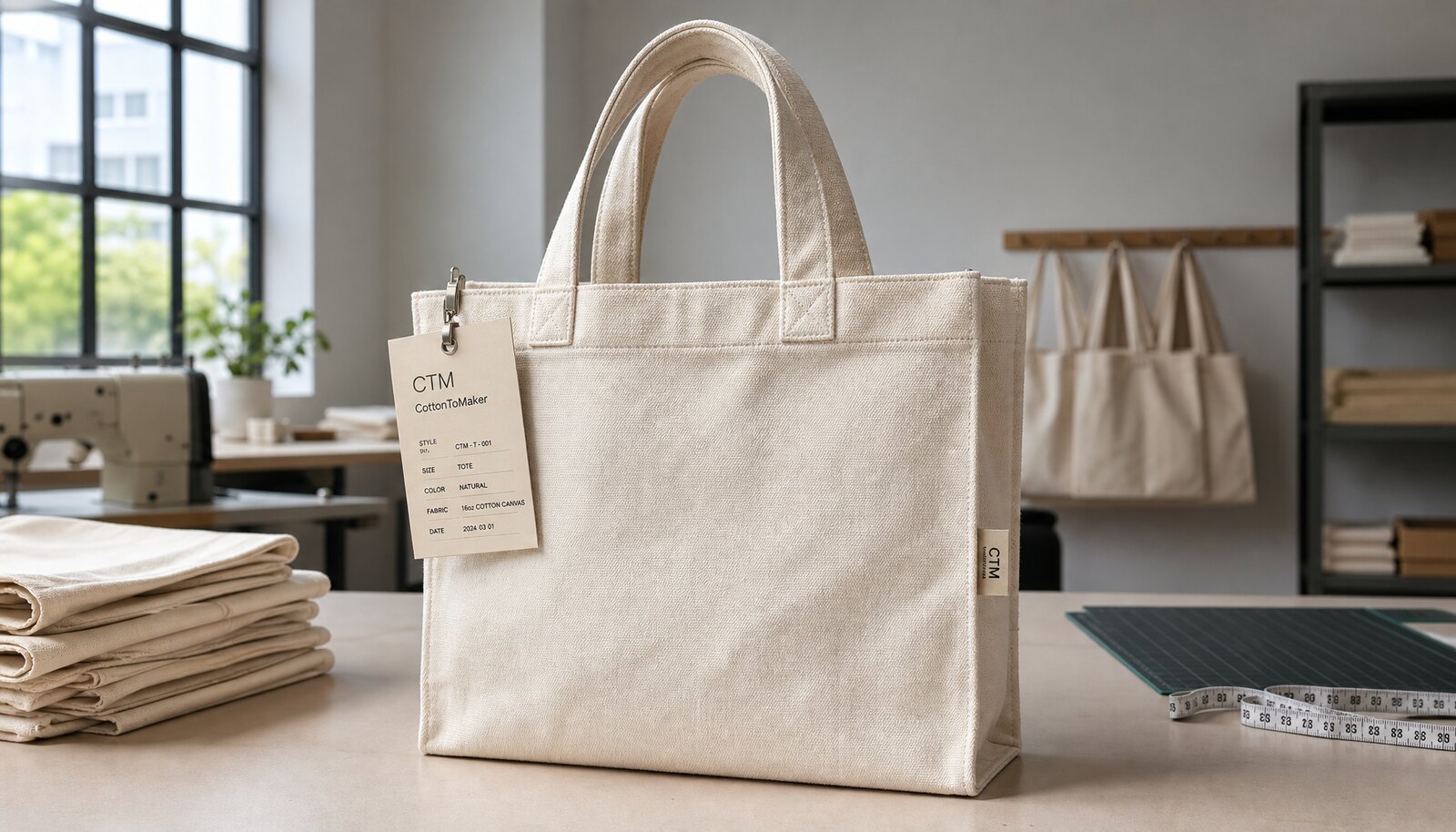
Why reorder planning matters more than first-order quoting
For canvas retail merchandise bags, the first order usually gets more attention than the second. That is a mistake. A reorder is where spec drift starts: a factory substitutes fabric from a different mill, print density changes because the old screen was cleaned out, or packing gets simplified without anyone noticing until store teams complain. For retail chains, the bag has to look identical across replenishment cycles, not just acceptable on paper.
The clean way to manage a reorder is to treat it like a controlled production release. The buyer should work from one master record that includes bag size, fabric weight, handle type, print method, pack-out, and carton data. When that record is complete, supplier quotes become comparable. When it is incomplete, every vendor fills the blanks differently and the lowest quote often turns into the highest landed cost.
- Reorders fail most often on fabric substitution, print placement, and carton packing.
- A single approved master spec reduces quote noise and production surprises.
- Retail chains need repeatability across stores, regions, and replenishment cycles.
Start with the right fabric weight and construction
Most canvas retail merchandise bags for retail chains sit in the 10 oz to 12 oz range, which is usually the practical middle ground for shopping use, event giveaways, and moderate merchandise loads. If the bag is only carrying lightweight apparel, a 10 oz fabric can be enough. If the bag must feel premium, hold boxed goods, or survive repeated customer use, 12 oz gives more body and better seam stability. Buyers should ask for the fabric in GSM, not only oz, because some suppliers quote loosely and the finished hand feel can vary a lot from mill to mill.
Construction matters as much as fabric weight. A well-made 10 oz bag with strong seams and proper reinforcement can outperform a badly sewn 12 oz bag. For retail programs, self-fabric handles are common because they print and fold cleanly. If the chain wants a heavier carry feel, webbing handles can be considered, but that changes cost, visual style, and sewing complexity. The RFQ should state whether the bag is single layer, gusseted, or lined, because each version changes fabric usage and carton dimensions.
- 10 oz is usually enough for light retail merchandise and higher-volume programs.
- 12 oz is safer for premium presentation and heavier carry loads.
- Always specify finished GSM, weave density, and whether shrinkage allowance is built in.
- Clarify if the handle is self-fabric, cotton webbing, or another material.
Print method choice drives both appearance and repeat-order cost
For reorder planning, print method is one of the easiest places to lose money. A simple one- or two-color logo is usually best handled with screen print because setup is manageable and the print is robust enough for retail use. If the graphic has gradients, fine lines, or many colors, buyers may be tempted by transfer methods, but that should be a deliberate decision, not a default. Transfer can work for short runs or highly detailed art, but the supplier needs to prove rub resistance and wash/abrasion stability if the bags will be handled repeatedly.
The bigger issue on reorders is consistency. A screen print can still drift if the ink mix changes or the factory repositions the artwork by eye. That is why the approved sample should record logo location from the top edge, side seam, and bottom hem. For retail chains, a 5 mm shift may not matter on a giveaway bag, but it can be obvious on a shelf-ready merchandise bag. If color is brand-critical, ask for a physical ink drawdown or printed strike-off against the original sample before bulk production.
- Screen print is generally the most stable option for repeating simple retail logos.
- Transfer methods are better for detailed artwork but need more quality control.
- Artwork placement dimensions should be written into the spec, not left to the printer's judgment.
- For brand colors, request a strike-off or print proof before bulk approval.
Compare supplier routes on more than just unit price
Retail buyers often receive three kinds of quotes: a direct factory quote, a trading company quote, and a hybrid quote from a factory that outsources part of the work. Those routes can all be valid, but they behave differently on reorder stability, communication speed, and quote transparency. Direct factories usually give the best control over fabric, stitching, and packing, while traders may be faster at assembly of multi-item programs or smaller MOQs. The key is to compare them on the same basis: fabric spec, print method, packing, lead time, and included services.
The cheapest ex-works number is not enough. A trader may quote lower freight-ready cartons but outsource the printing, which introduces a second layer of tolerance risk. A direct factory may quote slightly higher but include better control over fabric sourcing and packing consistency. When a retail chain is planning replenishment, the best supplier is usually the one that can repeat the approved sample with the fewest moving parts, not the one that is only cheap on paper.
- Compare ex-works and landed cost separately.
- Identify whether printing and packing are in-house or outsourced.
- Ask each supplier to quote against the same reference sample and pack spec.
Supplier comparison table buyers can actually use
The table below compares the sourcing routes most often used for canvas retail merchandise bags for retail chains. It is written for procurement teams that need a repeatable reorder, not a one-off event bag. Use it to decide how much control, speed, and price pressure you want in the next buy.
If the chain is still testing a bag program, a trading company can help bridge design changes and small initial MOQs. If the style is already approved and must be repeated with minimal variance, a direct factory route is usually the safer sourcing path. For multi-country rollouts, the best decision often depends on how quickly the supplier can hold the spec, not how many samples they can send.
Quote structure: what should be separated and what should not
A useful quote for canvas retail merchandise bags should separate recurring production cost from one-time setup cost. Screen setup, plate making, and artwork adjustment should be visible. Packaging inserts, barcode labels, and custom carton artwork should also be shown clearly if they are not standard. This lets buyers compare a new supplier against the current vendor without being tricked by hidden first-order fees.
The buyer should also ask for quote data that supports logistics planning. That means carton quantity, carton dimensions, gross weight, and whether the price is based on bulk packed bags or individually polybagged units. If the bags are for chain stores with distribution centers, a slightly higher unit cost can still be the better choice if the cartons are denser and easier to receive. For imported programs, volumetric freight often matters as much as unit cost.
- Separate setup fees from recurring unit pricing.
- Require carton dimensions and gross weight in the quote.
- State whether polybags, hangtags, or size stickers are included.
- Use landed cost as the final comparison metric.
MOQ logic for retail chains is not just about total pieces
MOQ should be discussed by size, color, and print setup. A factory may accept 5,000 total pieces, but if the order is split across four colors and two print positions, the true production economics change fast. That is why retail buyers should ask whether MOQ is tied to fabric dye lot, print screen count, or carton pack standard. A clean reorder program usually stays within one or two colors and one artwork version to keep the cost predictable.
For a chain account, it is also worth planning the reorder window. If the bag becomes a seasonal add-on or gift-with-purchase, the supplier may need to reserve fabric in advance to hold the price. A factory can usually manage a repeat run more smoothly when the artwork is unchanged and the bag size stays stable. If the order will be split into multiple release dates, the RFQ should say whether the factory is expected to hold blank stock, finished stock, or only raw fabric.
- MOQs often change with color count, print complexity, and packing requirements.
- Repeat orders are easier to price if the artwork and bag size stay fixed.
- Split shipments should be planned in advance so the factory can reserve materials.
Sample approval should test the bag as a product, not as a picture
A good sample approval process starts with the right sample type. For a reorder, buyers should prefer a pre-production sample or a golden sample built from the actual bulk materials. A printed photo is not enough. The bag should be checked for size accuracy, handle drop, seam quality, print registration, color match, and folding behavior. If the bag will go through distribution centers, carton sample and label proof should be part of the approval as well.
One practical rule: compare the sample against the last approved production piece, not against memory. If the new sample feels lighter, the canvas may have dropped in weight or the weave may have changed. If the handle appears narrower or the stitching looks different, those changes should be recorded before bulk starts. Buyers who allow small unexplained changes on the sample usually see larger problems in bulk.
- Approve against a physical golden sample whenever possible.
- Record all critical measurements and print positions on the sample sheet.
- Keep carton label and pack pattern in the approval file.
- Reject samples that differ in fabric feel, print sharpness, or handle reinforcement without explanation.
Packing details affect warehouse receiving and store readiness
Packing is where many retail bag programs lose efficiency. If the bags are bulk packed with no inner pack count, the distribution center has to count and re-pack them. If the bags are individually polybagged when they do not need to be, freight cost rises and warehouse opening time slows. The right packing method depends on the channel. Store distribution programs often need clear carton labeling and a stable carton count. Promotion programs may need a cleaner retail-ready presentation.
The RFQ should define fold direction, outer carton markings, and any retail barcode or size sticker requirements. If the bags will sit on pallets, ask for carton dimensions and a pallet count estimate. That helps the logistics team estimate how many units fit per pallet and whether the order should be split by region or store cluster. A quote that ignores packing details may look attractive until the warehouse rejects the receiving pattern.
- Define inner pack count and carton quantity before production starts.
- Choose bulk pack or individual polybag based on warehouse process, not habit.
- Ask for carton dimensions early to support pallet planning.
- Make sure SKU, size, and quantity labels are printed correctly on every carton.
Lead time risk: where a 'standard' reorder gets delayed
A standard production lead time for a canvas retail merchandise bag reorder is often 30 to 45 days after sample approval, but only if the spec is stable and the materials are available. The schedule usually breaks at three points: fabric reservation, print setup, and packing queue. If the supplier needs to source a fresh fabric lot, lead time can extend quickly. If the artwork changes, new screens or plates add days. If the factory is busy with larger programs, your packing slot can slip even when sewing is complete.
Buyers should ask the supplier to show the timeline by stage: fabric prep, cutting, printing, sewing, QC, and packing. That is more useful than a single delivery promise. For a retail chain, the safest reorder plan includes a buffer for artwork sign-off and carton label approval. If the bags are tied to a seasonal window, build that buffer into the PO date rather than hoping the factory can compress the full schedule later.
- Lead time should be counted from sample approval, not just order placement.
- Ask for stage-by-stage timing so schedule risk is visible.
- Reserve buffer time for artwork, carton labels, and final packing approval.
Specification comparison for buyers
| Spec decision | Recommended option | When it fits | Buyer risk to check |
|---|---|---|---|
| Source route | Direct factory reorder on an approved spec sheet | Best for chain stores repeating the same SKU across stores or seasons | Risk of silent spec drift if the supplier relies on old artwork or verbal memory instead of a signed master sample |
| Fabric weight | 10 oz to 12 oz cotton canvas for most retail merchandise bags | Good for gift-with-purchase, checkout retail, and moderate fill weights | Risk of underweight fabric if the supplier quotes oz only; convert to GSM and verify finished fabric shrinkage |
| Printing method | Screen print for 1-2 spot colors; heat transfer only for short-run or complex graphics | Best when the logo is simple and repeatable across large reorders | Risk of color variation and lower rub resistance if transfer film is used for high-touch retail bags |
| Handle construction | Self-fabric handles with bar-tack reinforcement or cross-box stitch at stress points | Works for medium to heavy merchandise and repeated customer use | Risk of handle failure if stitching count, thread type, and stitch length are not defined |
| MOQ logic | Price by size/color/print setup, not only total pieces | Useful when the chain reorders multiple store programs or seasonal colors | Risk of hidden setup cost if the quote bundles one-time screen or plate charges into the unit price |
| Packing method | Bulk polybag with carton insert and carton label, or folded with size sticker for store allocation | Fits warehouse intake and store-level distribution planning | Risk of mixed counts per carton if pack ratio, carton gross weight, and inner-pack count are not written into the PO |
| Quality standard | AQL-based inspection with approved reference sample and written measurement tolerance | Appropriate for importers and distributors managing repeat batches | Risk of disputes if the supplier only promises 'good quality' without measurable stitch, size, and print criteria |
| Lead time model | Use 30-45 days production after sample approval for standard repeats | Fits planned reorders with stable artwork and available fabric | Risk of missed launch dates if fabric stock, print plate prep, and packing labor are not confirmed separately |
| Supplier type | Factory with in-house cutting, printing, sewing, and packing | Best for control of repeat quality and change tracking | Risk of slower sampling if the factory outsources print or embroidery and cannot lock color matching |
Buyer checklist before sampling
- Lock the master spec: bag size, finished fabric weight/GSM, handle drop, seam allowance, print placement, and thread color before sending the reorder RFQ.
- Use one approved reference sample and attach photos of front, back, inside, handles, and carton label to the RFQ.
- Separate one-time costs from recurring costs: screen setup, plate fee, packaging insert, and carton artwork.
- State the required pack-out: inner pack count, carton quantity, fold direction, polybag use, and retail barcode label position.
- Define measurement tolerances for width, height, handle length, and logo placement so the factory can price against real acceptance criteria.
- Request fabric and print proofs before bulk production if the artwork has changed, the fabric mill changed, or the reorder is after a long gap.
- Confirm the production lead time after sample approval, not from PO date, and ask how many days are needed for fabric reservation and print setup.
- Ask for carton dimensions and gross weight early so the logistics team can calculate pallet and freight efficiency.
- Set inspection standards in writing, including stitching quality, color consistency, smudge/rub resistance, and pack count accuracy.
Factory quote questions to send
- What is the exact fabric specification in GSM, weave, and finished shrinkage after washing or pressing?
- Is the quoted price based on direct factory production, or does it include outsourced printing, embroidery, or packing labor?
- How many colors are included in the price, and what is the setup fee for screens, plates, or artwork correction?
- What is the handle construction: self-fabric, webbing, or rope, and how many reinforcement stitches are used at each attachment point?
- What is the acceptable size tolerance for finished bag dimensions and handle drop?
- What packing format is included in the unit price, and what is the carton quantity, carton size, and gross weight?
- What is the standard production lead time after sample approval, and what parts of the schedule are on the critical path?
- What quality checks are done before packing: measurement, stitch inspection, print alignment, and carton count verification?
- Can you provide a pre-production sample, top-of-bulk sample, or first-article photo set for approval before the full run?
- If the reorder repeats an old style, what changed from the last production lot in fabric source, ink, thread, or packing method?
Quality-control points to confirm
- Finished size should stay within the agreed tolerance for width, height, and gusset depth; do not accept vague wording like 'slight deviation' without numbers.
- Canvas weight should be confirmed by fabric spec or measured reference; a lighter feel often means lower GSM or different weave density than the quoted sample.
- Stitching at the handle base should be even, with no skipped stitches, loose thread tails, or seam puckering under load.
- Print registration should match the approved sample for position, color density, and edge sharpness; the logo should not appear shifted toward the seam or hem.
- Corners and stress points should be reinforced cleanly, with bar-tacks or cross-box stitching consistent across the order.
- Carton pack count must match the PO; cartons with mixed counts or unsealed inner packs create warehouse delays and shrinkage disputes.
- Fold line and bag presentation should be consistent for retail handout or shelf display; a sloppy fold pattern changes carton efficiency and perceived quality.
- Outer cartons should carry the correct SKU, color, and quantity label; missing carton marks cause receiving errors in chain distribution centers.