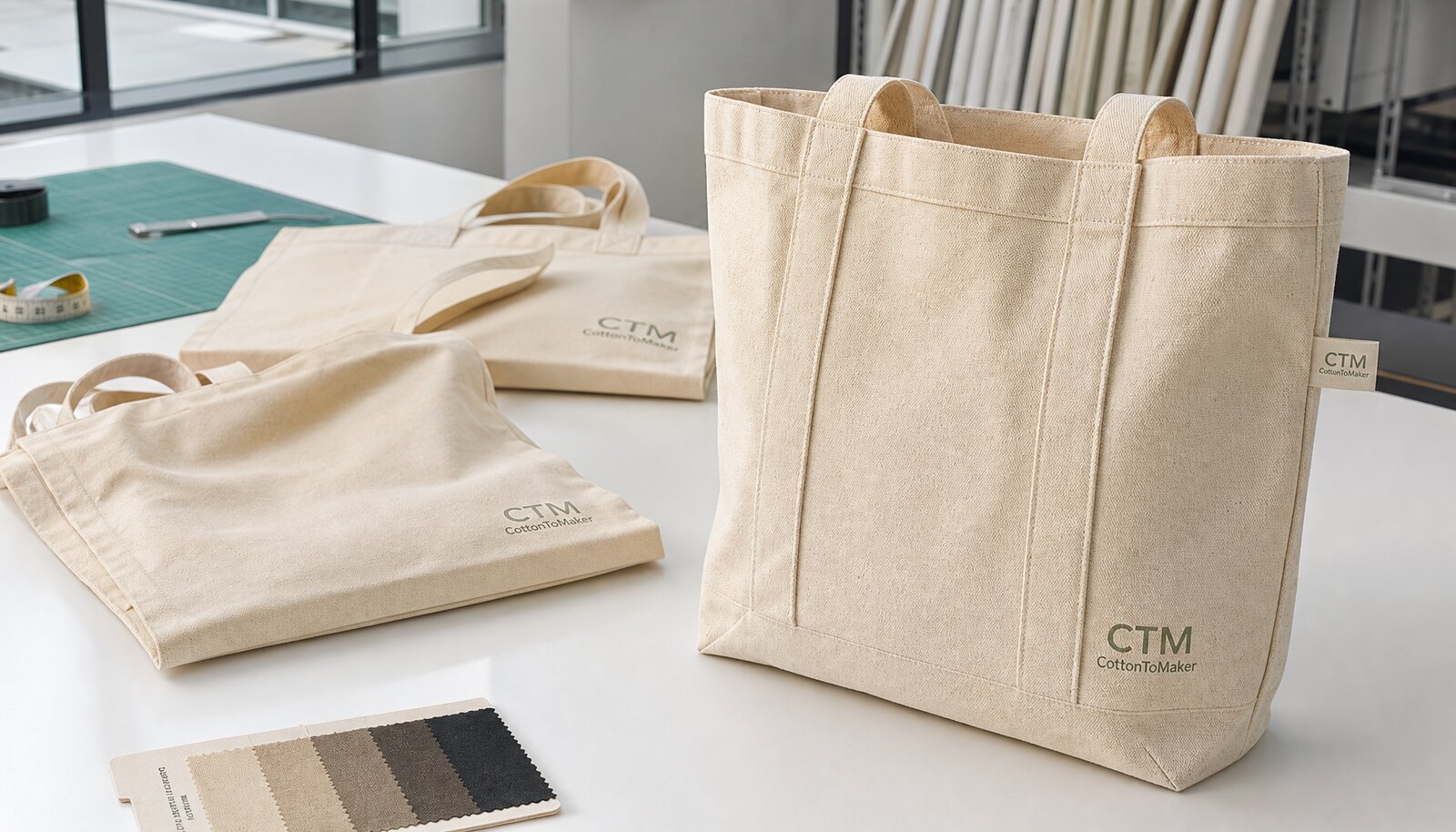
Why this bag fails in ecommerce, not in the sample room
Canvas retail merchandise bags look simple, but ecommerce brands lose margin on the details that do not show up in a single hand-approved sample. The most common failure is not a dramatic defect; it is a small mismatch between the approved sample and the shipped bulk lot. A bag can pass a sales sample review and still arrive with looser stitching, lighter fabric, shorter handles, or a print that looks acceptable at arm’s length but fails after packing and distribution.
For procurement teams, the real job is to lock the spec in a way a factory can repeat. That means defining the fabric weight, print method, reinforcement, and carton format before you compare quotes. If the supplier’s quote does not separate material cost from print cost and packing cost, you are not comparing the same product. You are comparing different risk levels.
- Use the approved sample as a reference, not as a vague style reference.
- Write down the exact use case: resale merchandise, packaging insert, store event bag, or daily carry.
- Treat handle strength, print durability, and carton consistency as commercial risks, not cosmetic issues.
Start with fabric weight, because it drives cost and failure rate
For canvas retail merchandise bags, fabric weight usually sits in a practical range of 8 to 12 oz, or roughly 227 to 340 GSM. For ecommerce brands selling apparel, books, accessories, or boxed goods, 10 to 12 oz is often the safer range because it holds shape better and feels more premium on arrival. An 8 oz canvas can work for lighter merchandise or promotional packaging, but it shows wrinkles faster and may distort when packed tightly.
Do not rely on a supplier saying “heavy canvas” or “premium canvas.” Ask for the exact weight in oz or GSM, the tolerance, and whether the fabric is pre-shrunk. A bag that shrinks after washing or even after humidity exposure can change print position and carton fit. If your brand uses a centered logo or a multi-color front print, shrinkage becomes a placement issue, not only a fabric issue.
- 8–10 oz: lighter retail use, lower cost, higher risk of soft structure.
- 10–12 oz: better for resale, better drape control, better perceived value.
- Ask whether the fabric lot is greige dyed, piece dyed, or printed after cutting, because this changes shade consistency.
Print method choices should match order size and artwork complexity
Most ecommerce merchandise bags are printed by screen print, because it gives strong color, clean edges, and lower unit cost at volume. It is the right default for one- to two-color logos, large icons, and simple brand marks. If your artwork has gradients, fine line work, or multiple colors with tight registration, digital or heat transfer may solve the design problem, but the tradeoff is usually higher cost and different durability behavior.
For buyer comparison, quote the same artwork in the same placement size across all suppliers. A factory can make a low-cost quote look competitive by shrinking the print area, changing the print count, or using a faster method with weaker adhesion. The quote should say whether the print is one-side only or both sides, what ink type is used, and whether the final finish is matte or slightly raised. If a print will be folded inside the bag during packing, folding lines can mark the print if the curing is poor.
- Screen print: best for repeat orders and durable branding.
- Heat transfer: useful for variable art or lower MOQ, but inspect peel resistance.
- Digital print: good for complex graphics, but confirm fabric compatibility and color drift.
Use supplier options that match your order stage, not just your target unit price
For canvas retail merchandise bags, the lowest quote is often the least useful if your order is tied to a sales launch or retail replenishment calendar. A direct factory is usually the best route when you need repeatable materials, stable sewing standards, and clear responsibility for bulk quality. A trading company can be helpful when you need mixed product consolidation, lower MOQ, or multilingual coordination, but it may add another layer between the buyer and the actual sewing line.
If you are testing a new design or need a very small first run, a stock route can reduce commitment, but stock bags create the highest risk of spec compromise. The fabric shade, handle length, and label application may not match the long-term program. Buyers should choose the sourcing route based on where the risk sits: launch testing, recurring replenishment, or seasonal volume.
- Direct factory: best for long-term programs and spec control.
- Trading layer: useful for smaller mixed orders and coordination support.
- Stock route: fastest, but the least reliable for consistent branded retail use.
Compare sourcing routes by what can go wrong in bulk
A useful quote comparison should not stop at unit price. The real difference between suppliers often appears in the hidden variables: whether they can repeat the same fabric hand feel, whether they understand retail carton marking, and whether their pre-shipment checks cover measurement and packing count. A supplier that offers a low price but no evidence of previous production control is usually transferring risk to the buyer’s receiving team.
When you compare suppliers, ask them to quote the exact same version of the bag. Use the same size, same fabric weight, same print count, same handle length, and same packing count. If one supplier includes a woven side label and another does not, the quote is not comparable. Buyers save more by preventing rework than by chasing the lowest line item.
- Unit price is only useful when the materials, print, and packing are identical.
- A missing reinforcement stitch can cost more than a small price increase would have.
- Retail buyers should compare landed risk, not only ex-factory price.
What to put in the sample approval stage
The approval sample should be made with the actual production fabric, the actual print method, and the actual sewing construction. A sales sample or a photo-approved sample is not enough for a branded retail bag. The difference between a show sample and a production sample is where most disputes start: the sample may have cleaner stitching, better material, or a hand-finished print that the factory cannot repeat at scale.
A strong sample approval process includes a physical side-by-side comparison against the written spec. Measure the bag flat, check the handle drop, inspect the inside seam finish, and test whether the print cracks when the bag is folded along its natural crease. If the buyer is planning online retail, the sample should also be packed the way it will ship, because carton compression can change the appearance of the product at first opening.
- Approve size with a tape measure, not by eye.
- Compare print color under neutral light, not only under warehouse lighting.
- Keep one sealed gold sample for production comparison and one for receiving reference.
Quality inspection points that catch the expensive mistakes
A proper inspection checklist for canvas retail merchandise bags needs measurable thresholds. Start with dimensions: the finished width, height, and gusset should stay within the agreed tolerance, and the handles should match within a small difference so the bag hangs evenly. Then move to stitching. Look for even stitch density, no skipped stitches, no loose thread nests, and no weak starts or stops at the handle joints and side seams.
Print quality deserves its own inspection step. Check registration, coverage, fading, and whether ink is rubbing off on the fold line or carton liner. If the design uses a light ink on dark canvas, the buyer should inspect for strike-through and uneven opacity. For ecommerce, the hidden cost is not only returns; it is also customer perception. A bag that looks slightly off in photos or unboxing videos can damage the product line even if the bag technically functions.
- Measurement tolerance: align to your approval spec and reject obvious asymmetry.
- Stitch quality: no open seams, loose bar-tacks, or broken thread tails.
- Print quality: no ghosting, blocking, color shift, or tacky surface.
Packing decisions affect damage, warehouse speed, and landed cost
Packing is often treated as a minor line item, but it affects receiving labor and damage claims. A bag that is folded inconsistently will create carton height variation and can slow down warehouse counting. If the bags are intended for retail resale, the buyer should define whether each bag is individually polybagged, folded with tissue, or packed loose in bulk. A simple, consistent fold is usually enough unless the bag has delicate print, a premium presentation requirement, or dust exposure during transport.
Carton marks should show the style, color, quantity, gross weight, net weight, and carton number. If the order includes multiple colorways or print versions, separate cartons by SKU and keep the count clear. For importers, carton size matters because it affects pallet loading and volumetric freight. A bag with a strong retail feel can still become expensive if the carton is oversized and the shipment cubes out before it weighs out.
- Define fold direction and finished folded size.
- Use consistent carton counts to reduce warehouse receiving errors.
- Ask for carton dimension samples if the order is high volume or palletized.
Lead time and MOQ logic: where the schedule usually slips
For canvas bags, MOQ is not just a factory policy; it is tied to fabric cutting efficiency, print setup, and carton consolidation. A lower MOQ can be possible, but it often comes with a higher unit price because the factory must absorb setup cost across fewer units. If your design uses a special fabric shade, custom woven label, or multi-color print, the MOQ may rise because the factory must reserve material and print capacity.
Lead time slips most often when buyers approve too late, change print art after sampling, or choose a bag size that does not fit the supplier’s standard cutting layout. Ask whether the quoted lead time starts after sample approval, after deposit, or after artwork confirmation. If a supplier cannot state the trigger point clearly, the schedule is not yet controlled. For seasonal retail, that ambiguity is where late arrivals begin.
- MOQ rises with custom fabric, custom color, complex print, and special packing.
- Lead time should include cutting, sewing, printing, finishing, inspection, and carton prep.
- Avoid late artwork changes unless you are willing to pay for rework and delay.
Use landed-cost thinking before you award the order
The cheapest ex-factory quote can become the most expensive landed order once freight, packing, inspection, and rework are added. For canvas retail merchandise bags, the landed cost should include unit price, setup cost, sample cost, carton spec, inland handling, freight method, and the cost of any defects that are likely to be repaired or replaced. A bag with a slightly higher factory price can still win if it ships in smaller cartons, needs less rework, and passes inspection on the first attempt.
Buyers should compare quotes using the same commercial frame. One supplier may include basic inner packing and a standard carton, while another prices them separately. If the quote is vague, turn it into a comparison matrix and normalize the line items. The goal is not to reward the lowest headline number; it is to identify the supplier who can deliver a consistent, sellable bag at the lowest real cost.
- Normalize quotes by fabric, print, sewing, packing, and inspection scope.
- Include freight cube and carton count in the landed-cost estimate.
- Reserve a budget for sample revisions if the artwork or construction is new.
Specification comparison for buyers
| Spec decision | Recommended option | When it fits | Buyer risk to check |
|---|---|---|---|
| Fabric weight | 10–12 oz canvas for retail resale bags; 8–10 oz for lighter promo use | When the bag must hold apparel, boxed gifts, or daily carry items without collapsing | Too light causes weak hand feel and seam strain; too heavy raises cost and freight |
| Canvas weave and finish | Plain weave with pre-shrunk or sanforized finish when appearance consistency matters | When the brand needs stable dimensions and a cleaner shelf presentation | Uncontrolled shrinkage can distort print placement and make packed bags look uneven |
| Print method | Screen print for bold one- to two-color artwork; heat transfer or digital only for small runs or complex art | When the logo area is large and the artwork will be repeated across many units | Poor ink curing, cracking, or mismatch between sample and bulk shade |
| Handle construction | Reinforced X-box or bar-tack at handle joins with matching stitch density on both sides | When the bag is intended for retail merchandise, heavier products, or repeated customer use | Loose bar-tacks and uneven stitch bite are common early failure points |
| MOQ route | Standard MOQ from a direct factory for stable artwork and repeat orders; lower MOQ through a trading layer only for testing | When you need predictable quality and a longer production relationship | Low MOQ quotes can hide weaker fabric, loose QC, or packing changes that only appear in bulk |
| Sample stage | Pre-production sample with final fabric, final print, final size, and final packing method | When the bag will be sold under a brand name and quality issues create returns or chargebacks | Using a sales sample as approval can miss real bulk problems in fabric lot, color, or sewing |
| Packing format | Flat packed with size-count master carton marks and moisture protection when needed | When warehouse picking speed, carton count accuracy, and palletization matter | Random packing and weak carton specs create receiving delays and damage claims |
| Inspection route | Factory in-line + final AQL inspection with measured tolerances and packaging count verification | When the order is large enough that inspection cost is lower than return risk | No defined AQL or measurement plan leads to subjective acceptance and dispute |
| Sourcing route | Direct factory for repeatable specs; local stockholder only for urgent replenishment | When lead time and brand consistency matter more than the lowest initial quote | Stockholder substitutions can change fabric hand feel, handle length, or logo color without notice |
Buyer checklist before sampling
- Lock fabric weight in GSM or oz, plus acceptable tolerance, before requesting quotes.
- Approve the final bag size with sewn measurement points, not only a catalog dimension.
- Confirm print method, print size, Pantone target, and cure requirement for wash or rub resistance.
- Require stitch details at handles, side seams, and top hem, including reinforcement style.
- Set packing rules: folded size, carton count, polybag use, desiccant if needed, and carton marks.
- Request a pre-production sample, then compare it against a bulk gold sample on arrival.
- Define inspection thresholds for measurements, color variation, print defects, loose threads, and dirt marks.
- Ask for production photos, carton loading photos, and final count evidence before shipment release.
Factory quote questions to send
- What is the exact canvas weight, weave type, and finish you are pricing, and what tolerance applies across the bulk lot?
- What sewing construction will you use at the handle attachment, top hem, and bottom seam?
- Which print method is included in the quote, how many colors are priced, and what setup or plate cost applies?
- What is the MOQ by fabric color, print design, and packing format, and how does the unit price change at higher volume?
- What are the sample stages included before bulk approval, and which one matches the actual production materials?
- What carton size, units per carton, and master carton markings are included in the packing quote?
- What is the production lead time after sample approval, and what items can extend it such as fabric sourcing or print alignment?
- What inspection report, test photos, or pre-shipment evidence will you provide before balance payment?
Quality-control points to confirm
- Measure finished bag width, height, and gusset at three points and compare against the approved tolerance.
- Inspect fabric weight, surface consistency, and visible slub or weave irregularity against the approved reference.
- Check handle length equality, stitch density, bartack placement, and pull strength at both handle anchors.
- Review print registration, color match, edge sharpness, curing completeness, and rub resistance.
- Confirm seam integrity at side seams, bottom seams, and stress points with no skipped stitches or loose thread nests.
- Verify the top hem width and fold uniformity so the bag opens cleanly and stacks well in retail packing.
- Count cartons, inner packs, and units per carton against the packing list and master carton marks.
- Inspect for stains, oil marks, broken needles, fabric damage, odor issues, and mixed lots before shipment release.