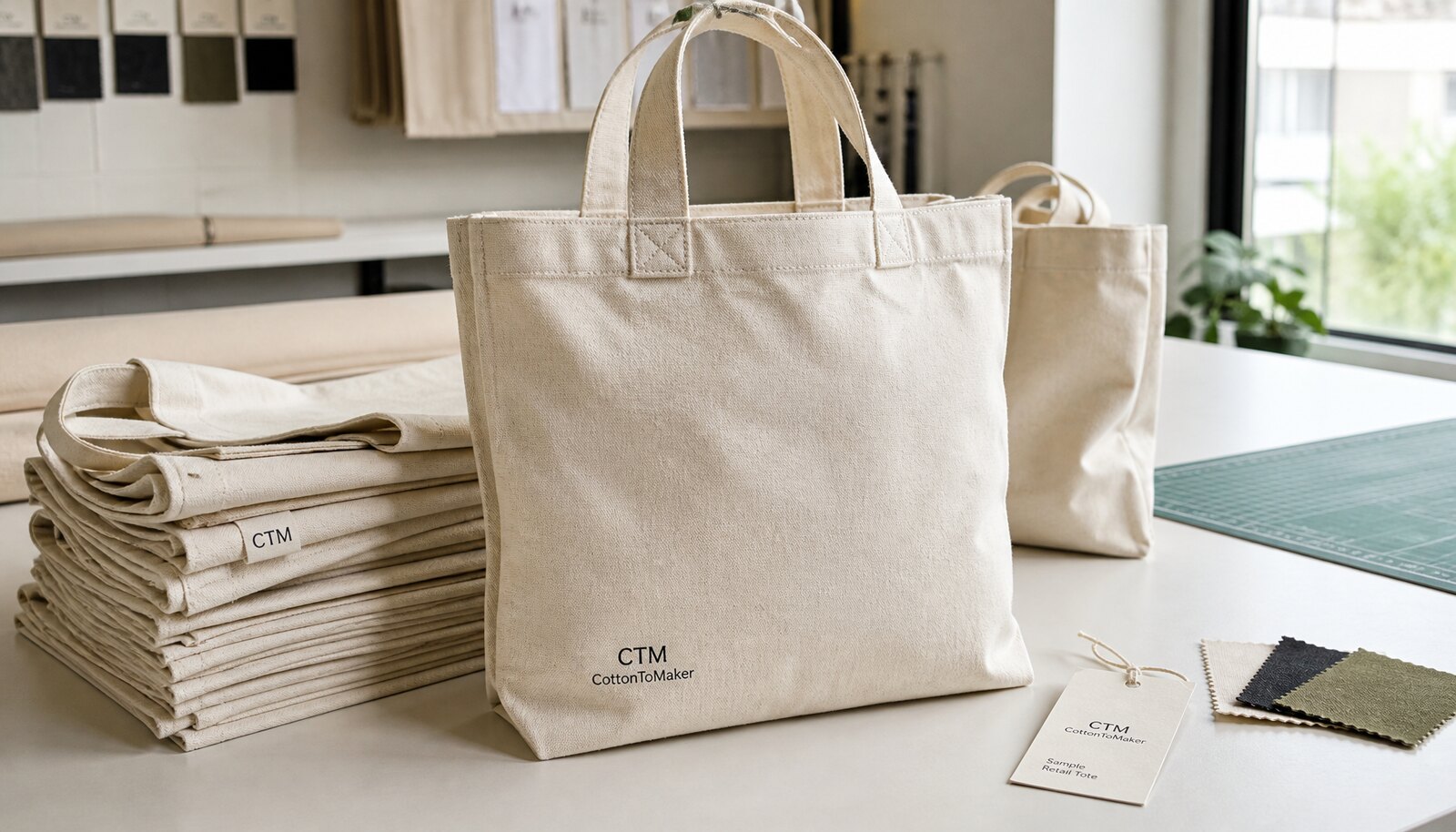
Why retail chains need a tighter inspection standard
Canvas retail merchandise bags look simple, but they fail in very specific ways that matter to chain operations. A bag can pass a visual glance and still create problems at store receiving, on the sales floor, or during replenishment if the fabric weight is inconsistent, the handles twist, or the print shifts from panel to panel. For a multi-store program, the issue is not only appearance; it is repeatability. Buyers need a bag that arrives the same way on every production run, not a one-off sample that hides weak construction.
The fastest way to reduce disputes is to define the acceptance standard before the quote is finalized. That means converting the buying brief into measurable items: fabric weight, dimensions, print method, stitch type, packing count, carton marks, and a defect threshold. If those items are not written down, the supplier will price to the loosest interpretation and the quality team will inspect to a stricter one. That gap is where most avoidable claims start.
- Retail chains should treat the bag as a printed soft good, not a generic tote.
- The approved sample should be the control document for all incoming inspection.
- A clear spec sheet prevents the supplier from substituting lighter canvas or weaker stitching.
Start with the right canvas spec, not just the artwork
For canvas retail merchandise bags for retail chains quality inspection checklist work, fabric weight is the first commercial decision. In most chain programs, 10 oz to 12 oz canvas, roughly 340 to 410 GSM, is the practical range because it gives enough body for branding and shelf presentation without creating an expensive, bulky item. Below that range, the bag can look soft and cheap and the print may telegraph weave texture too aggressively. Above that range, the bag gets heavier in carton, costs more to ship, and becomes less convenient for store staff to fold, count, and replenish.
Natural, bleached, and dyed canvas behave differently in inspection. Natural canvas usually has more visible slubs and shade variation, which is acceptable if the buyer approves a realistic reference sample. Bleached white canvas gives better color contrast for logos but can show stain, oil, or yellowing more easily in transit. Dyed canvas needs tighter color control and often requires a strike-off or lab dip-style approval, especially if the bag is part of a chain visual program.
- 10 oz canvas is a common entry point for promotional retail bags with moderate loading.
- 12 oz canvas is safer when the bag must hold heavier merchandise or feel premium.
- If your logo uses fine text, avoid overly coarse weave that breaks edges during print.
Choose the print method based on artwork and rejection risk
The print method has a bigger effect on QC than many buyers expect. Silkscreen is usually the most economical option for one to three spot colors and performs well when the artwork is bold and the approval standard is clear. It also gives the strongest control over repeat production because the print layout can be locked and re-run. The risk is ink build-up, poor registration on multi-color designs, or shade drift if the supplier changes ink batch without notice.
Heat transfer and digital print are useful when the chain artwork has gradients, photographic detail, or more colors than a standard screen setup can handle. They solve artwork complexity, but they introduce different risks: edge lift, transfer cracking, or a hand feel that may not match retail expectations. Embroidery can work for a premium look, but only on small areas and usually not for high-volume price-sensitive merchandise bags. If the design depends on sharp edges and exact brand color, the sample approval needs to include both daylight viewing and touch testing after folding.
- For one-color logo bags, silkscreen usually gives the best price-to-durability ratio.
- For fine-line graphics, confirm minimum line thickness and smallest text size before art release.
- For premium retail programs, test the print after folding, because cracking often appears at crease points first.
Use supplier type as a sourcing decision, not a price label
A low quote can come from several very different sourcing routes, and the route matters. Direct factories are usually the best fit for repeat chain programs because they control stitching, printing, and packing in one place, which improves traceability. Trading companies can be useful when you are testing a smaller launch order, need mixed items, or want a faster quote package. Specialist converters may cost more, but they are often stronger on print accuracy, stitching consistency, or custom finishing details that a general bag factory may not manage well.
The table below is the practical way to compare sourcing options. The important point is not which route is cheapest on paper; it is which route can keep the same spec, packing method, and defect rate across a repeat order. Retail chains usually pay for stability, not only unit cost. If the first order is for a pilot store rollout, a trading company might be acceptable. If the bag is going into a national re-order cycle, direct factory control is usually easier to defend during QC and replenishment.
- Compare like for like: same GSM, same print method, same carton pack, same sampling stage.
- Ask who owns the sewing, print, and packing steps; layered subcontracting often hides risk.
- If the supplier cannot name their inspection sequence, the quote is incomplete.
How to compare supplier routes for chain retail programs
When the buyer team reviews quotes, look for differences in who is actually doing the work. A direct factory quote should show material source, print setup, sewing process, and final packing. A trading company may provide more service, but the buyer still needs the underlying factory spec and inspection path. The same bag can vary widely in defect rate depending on whether the seller owns production or only aggregates orders.
For chain programs, a stable supplier route usually beats a slightly lower price. If the quote is lower because the fabric is lighter, the handle reinforcement is simpler, or the packing is looser, that cost advantage often disappears in claims, repacking labor, or store dissatisfaction. Use the comparison table as a sourcing filter before sample approval, not after the PO is already in motion.
- Direct factory: best for repeat programs and tighter process control.
- Trading company: useful for pilot orders and mix-and-match consolidation.
- Specialist converter: preferred when print finish or premium handling matters more than the lowest unit price.
Read the quote like a merchandiser, not only a buyer
A useful quote should show what is included and what is not. For canvas retail merchandise bags for retail chains quality inspection checklist planning, you need the unit price plus the structure behind it: fabric weight, print setup, handle type, reinforcement, inner pack, outer carton, and whether the sample fee will be credited. If the supplier only lists a price per piece without the spec basis, the quote cannot be compared fairly. One factory may quote a stronger 12 oz body with tighter stitching, while another may be offering 10 oz with simpler construction and calling it the same product.
MOQ logic also matters. A low MOQ may look attractive, but the unit price often includes a higher setup burden spread over fewer units. If you expect reorders, ask for at least two price tiers so you can see the cost curve. For chain buyers, the real question is not only the first-order price but whether the supplier can reproduce the same product at a stable second or third run without changing fabric shade, stitch density, or carton pack.
- Look for separate lines for fabric, printing, stitching, packing, and freight-related handling if applicable.
- Clarify whether the quote includes pre-production sample and strike-off costs.
- Request volume breaks so you can judge reorder economics before committing.
QC thresholds that catch the most common bag failures
The main inspection points are straightforward, but they must be written with measurable tolerance. Dimensions should match the approved pattern, not just “close enough.” Handle placement should be symmetric, and the drop length should suit the store use case. If a bag is meant to hang on a hook or sit folded at checkout, the handle length and seam position affect both appearance and usability. Fabric shade should be checked against the approved reference under consistent light, because canvas can look different under warm warehouse lighting and daylight.
Print inspection should focus on registration, ink coverage, edge sharpness, and repeatability from piece to piece. A common mistake is accepting a good center sample while ignoring edge distortion caused by the press or fabric tension. Stitching should be inspected for skipped stitches, thread tails, broken reinforcement, and seam puckering. On chain orders, packaging errors can be just as damaging as sewing defects; the wrong barcode label or mixed carton count creates receiving delays that erase a good unit price.
- Set dimensional tolerance before production, especially for bag width and handle drop.
- Reject visible print shift that changes logo readability or brand alignment.
- Use a simple pull test on handles and seam corners to catch weak reinforcement.
Sample approval should simulate production, not just show the artwork
Sample approval should answer a production question: can the factory repeat this bag at volume? A clean one-off sample is not enough if the bulk run will use different fabric, a different print mesh, or a different sewing line. The buyer should request a pre-production sample or at least a production-intent sample built from the final materials and final print setup. If the sample is made from upgraded fabric or hand-finished details that cannot be repeated economically, it gives false confidence.
The approval note should be practical and specific. Rather than broad comments like “looks good,” mark the exact items that are accepted: canvas tone, print position, seam appearance, handle length, and packing style. If a change is needed, state whether it is mandatory for bulk production or simply preferred. That distinction matters when a factory has to manage lead time and material booking. A good sample approval package reduces last-minute rework, especially for multi-store launches where the order window is short.
- Approve the sample under the same lighting used for final QC where possible.
- Keep one sealed reference sample for production comparison and one for receiving inspection.
- If the quote has multiple fabric options, approve the exact fabric code, not only the visual look.
Packing, carton marks, and distribution-center reality
Packing is a production detail that often gets treated as an afterthought, but retail chains feel it immediately. Flat packing usually works best for canvas merchandise bags because it saves carton space and simplifies store or warehouse handling. The question is how the bags are folded, whether they are polybagged individually or in bundles, and how many pieces go into each master carton. If the packing method changes between sample and bulk order, the bag may still be acceptable physically but fail the receiving workflow.
Carton marks should be readable and consistent, especially if the chain uses multiple SKUs, store allocations, or warehouse labels. The inspection should verify that barcode labels are placed in the agreed position and that carton counts match the packing list. Moisture protection matters too; canvas can absorb warehouse odor or humidity if cartons are weak or stored badly. For long transit routes, confirm that outer cartons are strong enough to protect print and prevent crushing at the corners.
- Flat packing is usually the default for chain distribution efficiency.
- Bundle counts should be fixed and easy to count without opening every polybag.
- Master carton labels must match SKU and PO data exactly to avoid warehouse delays.
Lead time and schedule risk: where orders actually slip
Lead time is rarely lost in sewing alone. It is usually lost in sample revision, fabric reservation, print approval, or carton artwork changes. A realistic timeline should separate the pre-production sample stage from bulk production and pre-shipment inspection. If the supplier only gives one total lead time number, the buyer cannot see which stage is flexible and which stage is critical. For retail chains, that matters because merchandising calendars are fixed long before freight schedules are confirmed.
The cleanest way to manage schedule risk is to freeze the spec early. Changes to fabric weight, handle color, or print placement after sample approval can force new material booking and reset the line schedule. If the launch date is immovable, consider a spec that uses standard factory materials and a simple print setup. The difference between a safe launch and a delayed one is often a narrower design scope, not faster sewing.
- Ask for a milestone schedule: sample, material confirmation, mass production, inspection, ship date.
- Reserve extra time if the order needs custom color matching or multi-color printing.
- Treat artwork revisions after approval as a schedule risk, not a cosmetic edit.
Specification comparison for buyers
| Spec decision | Recommended option | When it fits | Buyer risk to check |
|---|---|---|---|
| Fabric weight | 10 oz to 12 oz canvas, usually around 340 to 410 GSM | Retail chains that need a visible, reusable bag with enough body for printing and shelf display | Too light can wrinkle and distort print; too heavy raises cost and makes folding/picking less efficient |
| Print method | Silkscreen for simple spot colors, heat transfer or digital for complex artwork, embroidery only for premium small areas | When artwork needs clean brand colors and durable repeated handling | Ignoring ink coverage, hand feel, or fine-line limits can cause rejected shade variance or cracking |
| Handle construction | Cross-box or reinforced stress-point stitching with 2-3 rows at top seam | For store giveaway bags, paid retail bags, and higher load expectations | Single-row stitching may pass visual inspection but fail load or repeat-use expectations |
| Bag size | Standard retail format around 38 x 42 cm with 60 cm handles, adjusted for product fit | When the bag must hold apparel, books, or mixed merchandise and still fit checkout workflow | Oversized bags raise freight and packing cost; undersized bags create customer complaints |
| Lining and structure | Unlined for low-cost volume, partial lining or base gusset for premium retail use | For chains needing better shape retention or higher perceived value | Added structure changes cost, lead time, and carton count; confirm exact construction in sample |
| MOQ route | Factory standard fabric/specs with limited customization for first order | When a buyer needs low-risk launch quantities or quick replenishment | Custom dye, special trims, or unique print placement can inflate MOQ and delay approvals |
| Packing method | Flat packed with bulk polybag inside master carton, barcode label on carton and inner pack if needed | For chain distribution centers that scan, count, and replenish by SKU | Loose packing or mixed carton lots create receiving errors and store allocation problems |
| Supplier route | Direct factory for repeat programs, trading company for small mixed-order trials, specialist converter for complex decoration | When comparing price, speed, and control across launch vs. replenishment buys | A cheaper quote may hide higher defect risk, weaker QC, or less stable lead time |
| Inspection standard | AQL-based final inspection with visual, dimensional, and packaging checks tied to approved sample | For chain buyers needing predictable incoming quality and claim protection | Without written defect thresholds, suppliers may treat cosmetic flaws as acceptable |
Buyer checklist before sampling
- Approved reference sample with signed comments on fabric color, hand feel, handle length, stitch pattern, and print position
- Declared fabric weight in GSM or oz, with tolerance range stated on the quotation
- Confirmed print method, number of colors, Pantone targets, and maximum acceptable shade variation
- Bag size, gusset depth, and handle drop written in the PO, not only in artwork notes
- Stitching requirement for handle reinforcement and seam allowance defined with a photo or drawing
- Packing spec including polybag type, carton quantity, carton size, barcode label format, and drop test expectation
- Inspection plan with defect categories, AQL level, and sampling size agreed before mass production
- Lead time broken into sample, material booking, production, and pre-shipment inspection milestones
Factory quote questions to send
- What exact canvas construction are you quoting: GSM, weave count, and whether it is bleached, natural, or dyed?
- Is the quoted price based on one approved print method, and what is the setup charge for each additional color or side?
- What stitching construction is included at the handle and side seams, and do you charge extra for reinforcement?
- What is the MOQ for the quoted spec, and how does the price change at the next volume tier?
- What carton packing is included, and does your quote cover inner polybags, carton marks, and barcode labels?
- What is the standard lead time after sample approval, and what steps could extend it?
- Which defects are covered by your internal QC, and what rework or replacement terms apply if final inspection fails?
- Can you provide a pre-production sample or production-dyed strike-off that matches the final bulk run?
Quality-control points to confirm
- Fabric weight matches the approved GSM or oz target within the agreed tolerance, with no thin streaks or uneven weave that weakens print coverage
- Panel dimensions, handle length, handle drop, and gusset depth stay within agreed tolerance and match the approved sample
- Print placement is centered and consistent, with clean edges, no pinholes, no ghosting, and no visible mis-registration beyond the agreed limit
- Color is compared under daylight-equivalent lighting against the approved reference, especially for natural canvas shade and any brand Pantone target
- Stitching density is even, thread is not broken or skipped, and handle reinforcement does not pucker or tunnel the fabric
- Seams, corners, and stress points hold shape under a reasonable pull test, with no open stitches or loose threads affecting retail appearance
- Packing count is exact per carton, inner pack labeling is clear, and barcode or SKU marks scan correctly at receiving
- Cartons are clean, dry, and properly taped, with no odor, oil stain, or damage that would trigger retail distribution rejection