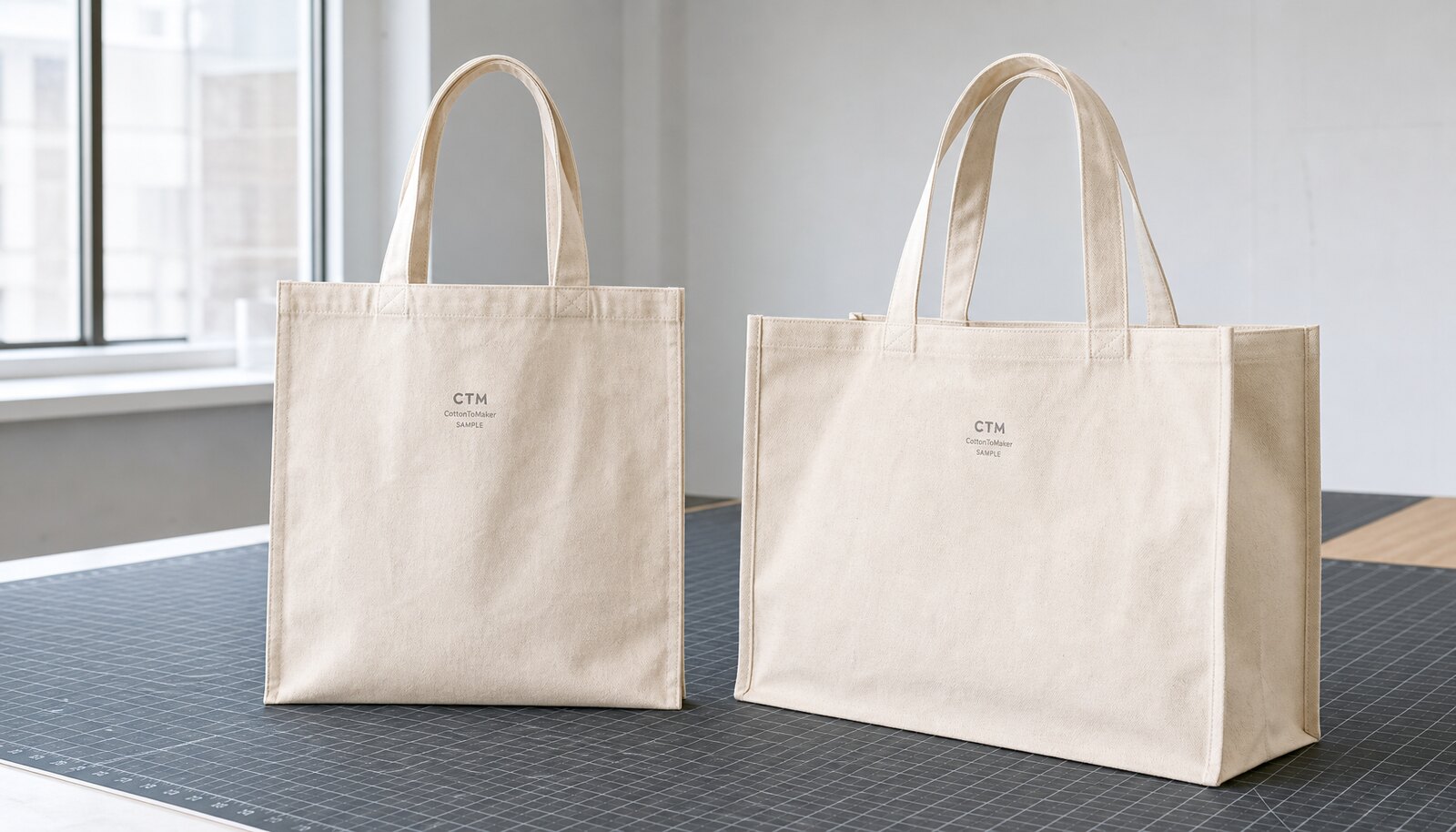
Why winery retail bags need a different specification
Canvas retail merchandise bags for wineries are not generic tote bags with a logo on them. In a tasting room or gift shop, the bag has to carry bottles, look credible next to premium wine, and remain useful after the customer leaves. That combination changes the sourcing brief. A bag that is acceptable for a trade-show handout can look underspecified on a retail shelf, especially when the winery wants the packaging itself to reinforce a premium position.
For procurement, the first decision is function, not artwork. Start by defining whether the bag will be sold at retail, bundled with a bottle set, used as a branded takeaway, or reserved for seasonal promotions. Each use case changes the right size, the useful fabric weight, and the acceptable price point. If you skip that step, suppliers will quote to different assumptions, and the comparison will be misleading from the start.
- Retail resale: the bag must have shelf presence and a finish that supports a selling price.
- Bottle carry: handles, seams, and gussets matter more than decorative detail.
- Gift bundle packaging: the bag must fit typical wine accessories without bulging or distorting.
- Sustainability positioning: natural canvas usually fits a winery brand story better than a short-life disposable carrier.
Canvas versus paper, jute, nonwoven, and recycled-poly
A proper canvas retail merchandise bags for wineries sustainable packaging comparison should compare performance and procurement tradeoffs, not just material labels. Canvas usually gives the strongest premium signal for winery retail because it feels reusable and carries print well on natural fiber. That matters when the bag is meant to sit on a shelf, not disappear at the exit.
Paper is the easiest low-cost option, but it is a short-use carrier. It can work for lightweight purchases or one-time events, yet it usually does not support repeat use, moisture exposure, or heavier bottle loads. Jute carries a strong natural story and can feel durable, but its coarse surface can limit fine print detail and make the bag feel rougher than a premium wine brand may want. Nonwoven polypropylene is economical and flexible for promotional use, though many buyers still read it as a campaign item rather than a retail product. Recycled-poly or recycled-PET can be useful where moisture resistance or wipe-clean handling matters, but the brand message is different from cotton canvas and should be chosen deliberately.
The right choice depends on the commercial role of the bag. If the bag is part of the winery's merchandising line, canvas usually wins because it behaves like a reusable retail item. If the bag is only there to get a bottle home safely, paper or nonwoven may be enough. Procurement teams should compare the full life of the bag, not just the first purchase price.
- Canvas: best when repeat use, shelf appeal, and brand perception matter.
- Paper: cheapest to buy, but weakest on reuse and bottle protection.
- Jute: strong natural positioning, but less refined for detailed logos.
- Nonwoven: efficient for low-cost campaigns, less convincing as premium retail packaging.
- Recycled-poly: practical where weather resistance and wipe-clean performance matter more than natural-fiber appearance.
Fabric weight and construction: the part of the quote that changes everything
The most common sourcing error is comparing two canvas bags as if they were the same product when the fabric weight, weave density, and construction are different. A 10 oz tote and a 14 oz tote may look similar in a product photo, but they do not have the same stiffness, print behavior, or seam stability. For winery retail use, 12 oz is often the practical lower end for a bag that should feel substantial, while 14 oz is better when the bag needs to carry heavier bottle sets or support a more premium retail price.
That said, fabric weight should not be treated as a rule divorced from the rest of the spec. A well-made 10 oz bag can outperform a poorly constructed 12 oz bag if the handles, bottom seam, and cutting accuracy are better. Conversely, a heavy cloth bag can still fail if the handle attachment is weak or the print process damages the surface. Buyers need the full spec: fabric, cut, stitch, reinforcement, and finishing. If a supplier only gives a unit price and a fabric number, the quote is incomplete.
For first-round sourcing, a sensible comparison is often 12 oz versus 14 oz canvas, flat versus gusseted construction, and standard handles versus reinforced self-fabric handles. Those are the features that most affect how the bag feels in a winery retail environment.
- 12 oz canvas: a common starting point for reusable retail bags with balanced cost and body.
- 14 oz canvas: stronger premium feel and better support for heavier content.
- Flat tote: lower cost, but less useful volume and weaker shelf presence.
- Gusseted tote with bottom reinforcement: better for bottles, gift items, and repeat carry.
- Handle reinforcement: more important than many buyers expect, especially if the bag carries glass bottles.
Print method choices and what wineries should ask for
Decoration should follow artwork complexity and volume, not habit. Screen printing is usually the strongest default for one to three solid colors on canvas because it gives good opacity and survives normal retail use. It is also easier to cost at scale. For winery logos, vineyard marks, and short text, screen print is typically the most reliable starting point.
Heat transfer and digital printing are worth quoting when the artwork has many colors, gradients, or a small first order quantity. The tradeoff is surface behavior and durability. A print that looks sharp in a sample room can still rub, crack, or fade earlier than expected if the bag is used often. That does not make the method wrong, but it means buyers should test it on the actual canvas weight and ask for a strike-off on the production fabric, not a generic proof.
If the bag is supposed to feel premium, consider whether the brand needs a woven label, woven patch, or a restrained one-color print instead of a full photographic image. On natural canvas, less decoration often reads better. The goal is not to maximize ink coverage. It is to get a clean, durable, retail-ready result that matches the wine brand's position.
- Screen print: best for simple logos and repeatable retail orders.
- Heat transfer: useful for complex art or smaller runs, but ask for wear testing.
- Digital print: suitable for detailed visuals, provided the supplier can prove consistency on canvas.
- Woven label or patch: useful when the brand wants a more refined retail look than ink alone can deliver.
- Always approve the artwork on actual fabric, not only on a paper proof or screen render.
How to compare quotes without getting fooled by the unit price
A useful quote comparison starts with a normalized spec. Two suppliers can both quote a "canvas tote," but one may be quoting a lighter cloth, different handle construction, a smaller carton pack, or a separate charge for setup. The cheapest headline price can become the most expensive landed cost once the extras are added. For that reason, procurement should ask for a full quote breakdown rather than a single number.
At minimum, normalize the following before you compare suppliers: finished size, fabric weight, print method, number of colors, handle construction, pack format, carton count, incoterm, and whether samples or tooling are credited against the bulk order. If you are comparing factories in different regions, also separate the product price from the freight and import charges. A lower ex-works price does not matter if the freight, duty, and destination handling erase the savings.
A practical landed-cost worksheet should show product cost, print setup amortized across the run, packing materials, export carton cost, inland freight to port or warehouse, international freight, insurance if used, duty, brokerage, and local receiving cost. Once those numbers are in one place, a quote that looked expensive may prove to be the more efficient option because it includes packing or avoids rework.
- Compare only identical size, fabric weight, print coverage, and carton spec.
- Ask suppliers to separate unit price, sample charge, and setup or tooling.
- Use the same incoterm across every quote before ranking suppliers.
- Normalize freight, duty, and destination charges before judging the final price.
- Treat missing detail as a risk, not as savings.
Supplier route: direct factory, trading company, or local converter
Supplier route affects both price and control. A direct factory is usually the best fit when the bag needs a custom size, repeatable print quality, and stable reorders. You get closer to the people managing fabric cutting, sewing, and packing, which makes it easier to lock the spec and inspect deviations before production goes too far. For a winery that expects to reorder the same bag across seasons, that control usually matters more than shaving a small amount off the quote.
A trading company can still be useful, especially if the buyer wants one contact for multiple packaging items or needs help consolidating different product types into one shipment. The tradeoff is transparency. Ask which plant actually makes the bags, whether the sample came from the same production line as the bulk order, and how the supplier handles quality issues when the actual factory changes fabric or trims. A local converter may be quicker to communicate with and easier to visit, but it often comes with narrower material options and a higher finished cost.
The procurement question is not which route sounds better in theory. It is which route gives you the most reliable control over the specific bag you are buying. If the spec is simple and the schedule is tight, a local converter may be enough. If the bag is a core retail item with repeat orders, direct factory sourcing is usually the stronger commercial choice.
- Direct factory: strongest for repeatability, spec control, and long-term pricing.
- Trading company: useful for multi-item sourcing, but requires tighter paperwork and spec discipline.
- Local converter: faster communication and often simpler logistics, but usually higher cost.
- Ask who owns each step of production so you know where substitutions can happen.
MOQ and lead time: useful heuristics, not universal rules
MOQ and lead time depend on factory type, region, material availability, and how much customization is involved. For a custom canvas tote with one logo, one size, and standard packing, 3,000 to 5,000 pieces per design or color is a common first-order band at many direct factories. Some smaller converters can quote lower quantities, but the unit price often rises quickly because setup time is spread across fewer pieces. Larger factories may prefer higher quantities if they are buying fabric by the roll and running print and sewing lines at full efficiency.
Lead time also needs context. A standard run with existing canvas, a simple print, and ordinary packing can often fit into a 35 to 50 day window after sample approval. That is a useful heuristic, not a guarantee. Add time for custom dyeing, special labels, multiple print locations, or seasonal congestion, and the schedule can stretch materially. Buyers sourcing for harvest events, holiday retail, or tasting-room launches should work backward from shelf date, not from the purchase order date.
The practical answer is to ask the supplier what part of the schedule is fixed and what part is variable. If material sourcing is the bottleneck, that needs to be known before artwork is approved. If printing is the bottleneck, color count and registration become schedule risks. If packing is manual, carton count and labeling need to be frozen early.
- 3,000-5,000 pcs per design is a common starting band for custom direct-factory orders.
- Lower MOQs are possible, but expect higher unit cost or fewer fabric choices.
- 35-50 days after sample approval is a practical baseline for standard production, not a promise.
- Custom dyeing, special labels, or peak season can add time.
- Ask the supplier which step usually causes schedule slippage so you can plan around it.
Sample approval: what the first physical bag must prove
A sample is only useful if it reflects the real production method. The sample should be made on the same canvas weight, with the same print process, same handle construction, and same finishing approach that will be used for the bulk order. A paper proof or a prettier display sample can hide the real issues: weave visibility under print, seam distortion, or a handle drop that feels awkward when the bag is loaded.
For winery retail bags, test the sample with the intended use in mind. If the bag is supposed to hold one bottle, test it with one bottle. If it is a gift bundle, load it with the actual contents or a realistic weight equivalent. Then inspect the bag after load and after a short carry. You are looking for handle behavior, seam stress, and whether the bag stands or collapses in a way that affects shelf appeal.
Use the sample stage to eliminate ambiguity, not to leave decisions open. Measure the finished dimensions, photograph the sample against the approved artwork, and keep one retained golden sample on file. If the supplier later claims that a production lot matches the approved item, you need a physical reference that both sides accepted before bulk sewing started.
- Approve the sample on actual production fabric, not on a substitute cloth.
- Test the bag with the intended load, not only empty by hand.
- Measure finished size, handle drop, and gusset depth directly.
- Check logo placement, print coverage, and edge sharpness on the woven surface.
- Retain one signed-off golden sample as the production reference.
Quality control and acceptance criteria that actually help at receiving
Quality control for canvas bags should be written as a pass/fail set of criteria before the factory starts cutting. The important point is to focus on defects that affect retail value, carry performance, or warehouse handling. Loose threads matter less than open seams, but both need to be defined so the factory knows the threshold. Buyers should not rely on vague language such as "good quality" or "A-grade" without a measurable reference.
A practical inspection set should cover fabric weight or hand feel, stitching density, seam integrity, handle reinforcement, print registration, odor, stains, size variance, and carton counts. For premium retail programs, add a specific tolerance band for logo placement and size. A small misalignment may be acceptable on a giveaway tote, but not on a gift shop item selling alongside premium bottles. If the bag is going into retail distribution, make the factory confirm that carton labels, SKU marks, and pack counts match the PO exactly before dispatch.
If you use third-party inspection, tell them what failure means. Examples include open seams, missing bar-tacks, visible print smearing, major shade variation between cartons, or bag dimensions outside the tolerance band. The goal is not to create a complicated document. It is to create a standard that prevents arguments after the shipment lands.
- Set size tolerances before production, and tighten them for premium retail SKUs.
- Confirm stitching at handle joins, bottom corners, mouth reinforcement, and gusset seams.
- Define acceptable print placement and register deviation in writing.
- Reject lots with open seams, major staining, odor, or carton-count errors.
- Use a retained golden sample and a written inspection sheet so the receiving team knows what to compare against.
Packing, freight, and warehouse handling
Packing can change both cost and damage risk. Flat packing is usually the default for canvas retail bags because it reduces carton volume, improves count accuracy, and makes warehouse receiving easier. If the bag is sensitive to dust or needs a more polished retail presentation, a simple inner polybag may be worth the extra material and labor. The question is not whether polybags are always good or bad. It is whether they solve a real handling problem for this specific program.
Carton design deserves more attention than it usually gets. If cartons are too large, the bags shift and wrinkle. If they are too small, the folds compress and the handles crease. Ask the factory for carton dimensions, piece count per carton, and gross weight before production starts. That gives your logistics team enough information to estimate freight and helps the warehouse confirm whether the boxes are practical for manual handling.
For winery programs, the receiving side should also know the SKU structure. If you are carrying multiple colors or print variations, label each carton clearly and keep counts consistent across cartons. Mislabeling a retail bag shipment can waste more time than a small price difference ever saved.
- Flat-pack format is usually the most efficient for freight and warehouse receiving.
- Use inner polybags only when dust control or retail presentation justifies the extra cost.
- Ask for carton size, piece count, and gross weight before mass production.
- Make carton marks legible and consistent across all SKUs.
- Avoid mixed-count cartons unless the buyer has explicitly approved them.
Specification comparison for buyers
| Material option | Best fit for winery use | Procurement upside | Main tradeoff to check |
|---|---|---|---|
| Canvas | Retail merchandise, tasting-room resale, premium gift packaging, reusable brand bags | Strong shelf presence, good printability, durable enough for repeat carry, familiar sustainable packaging story | Higher unit price than paper or nonwoven; verify fabric weight, shrinkage, and handle reinforcement |
| Paper | Short-lived take-home packaging, low-cost event handouts, lightweight purchases | Lowest entry cost, easy to brand, efficient for short-term programs | Poor reuse, limited bottle protection, and weaker brand visibility after the first use |
| Jute | Natural-positioned retail or gift programs where rougher texture fits the brand | Strong sustainability signal and sturdy hand feel | Coarser surface can limit print detail, and the material can feel less refined for premium wine retail |
| Nonwoven polypropylene | Promo campaigns, budget retail bags, high-volume giveaways | Low cost and wide supplier availability | Often reads as promotional rather than premium; durability and brand perception vary widely |
| Recycled-polyester or recycled-PET | Weather-exposed carry use, utility bags, programs that need moisture resistance | Good strength-to-weight ratio and easier wipe-clean performance | Brand feel is different from natural-fiber canvas, and the sustainability story should be stated carefully and consistently |
| Material | cotton canvas, jute, felt, nonwoven, or laminated paper sized to bottle diameter, weight, and condensation risk | Before price comparison | Different cloth weights, backing, or certification claims make quotes hard to compare |
| Construction | bottle fit, bottom reinforcement, handle or cord strength, divider option, seam allowance, and upright stability | Before sampling | Weak stress points create returns and failed inspections |
| Decoration | screen print, hot stamp, woven label, embroidery, or paper label positioned for curved bottle presentation | Before artwork approval | The wrong method can crack, bleed, pucker, or fail on the chosen fabric |
Buyer checklist before sampling
- Confirm the end use before quoting: retail resale, tasting-room giveaway, bottle carry, or gift bundle packaging.
- Lock the finished size, gusset depth, and handle drop before artwork is released.
- State the intended load, such as one bottle, two bottles, or a mixed gift set, so the supplier can size the seam and handle reinforcement correctly.
- Request the exact fabric specification in oz or GSM, plus weave type and shrinkage allowance.
- Approve a physical sample made on the same fabric weight and print method that will be used in production.
- Provide vector artwork, Pantone targets, and a tolerance for logo placement before sample development begins.
- Ask for a landed-cost quote that separates product price, print setup, packaging, cartons, inland freight, and export terms.
- Confirm pack format: flat fold, polybag or no polybag, pieces per carton, carton dimensions, and gross weight.
- Set a defect tolerance in writing for stitching, print clarity, staining, odor, and size variance.
- Request the factory’s QC flow: incoming fabric check, in-line inspection, final inspection, and carton count verification.
Factory quote questions to send
- What exact canvas weight, weave type, and shrinkage allowance will you use, and can you show the approved swatch or mill spec?
- Is your MOQ based on fabric purchase, print setup, or full finished goods, and does it change by color or artwork version?
- Please quote the same bag in paper, jute, nonwoven, and recycled-poly if you offer them, using the same size and print coverage for a fair comparison.
- What is included in your unit price: handles, labels, print setup, polybags, carton marks, and export cartons?
- Can you break out sample charge, tooling or screen fee, and whether those fees are refundable against bulk order volume?
- What are your standard tolerances for finished size, handle drop, print placement, and stitch alignment?
- How do you verify color on natural canvas, and do you use a written approval sample or a retained golden sample?
- Which processes are in-house and which are outsourced, especially printing, labels, and packing?
- What is your normal production lead time after sample approval, and what factors add days to the schedule?
- What packing configuration do you recommend for warehouse receiving, and what is the carton gross weight per box?
Quality-control points to confirm
- Measure finished size, gusset, and handle drop against the approved tech pack, not a verbal description.
- Set an explicit size tolerance before production; a practical starting point is a tight band for premium retail bags and a slightly wider band for promo use.
- Inspect seam construction at stress points: handle joins, bottom corners, gusset transitions, and mouth reinforcement.
- Check stitch density and back-tack consistency so a bag that looks acceptable in a photo does not fail in loading or repeated use.
- Verify fabric weight and hand feel against the approved swatch or golden sample, especially if multiple mills are available.
- Check print registration, edge sharpness, ink coverage, and rub resistance on the actual canvas surface.
- Reject any lot with oil stains, broken yarns, visible holes, heavy odor, loose threads, or uneven shade variation across cartons.
- Confirm handle reinforcement by pull-testing a sample bag with the intended load profile rather than with an empty bag.
- Verify carton count, inner pack format, SKU labels, and shipping marks before shipment release.
- Agree a final inspection standard in writing, including AQL or pass/fail criteria for critical, major, and minor defects.