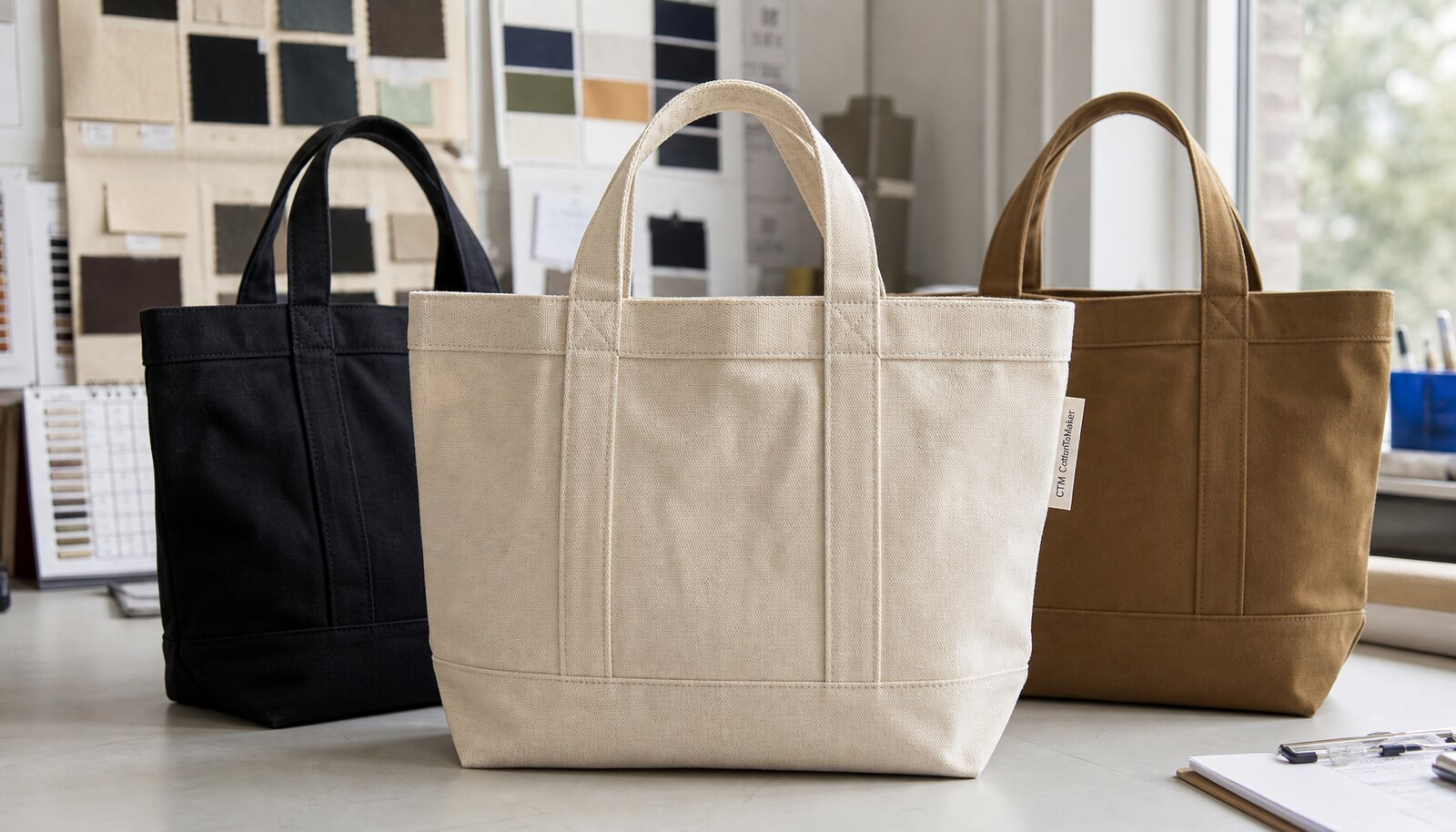
Start With the Job the Bag Has to Do
Canvas tote sourcing goes wrong when the team starts with the material instead of the use case. A bag that sits inside a subscription box has to fold predictably, fit a fixed carton, and open cleanly without distorting the unboxing sequence. A bag for a conference floor or retail handout has a different job: it needs to be visible from a distance, feel sturdy in the hand, and survive repeated use without the handle or seams failing early. Those are different commercial requirements, even if the bag shape is the same.
The cleanest procurement move is to define the bag as part of the channel, not just part of the design. Ask whether it is a packaging insert, a promotional giveaway, a sellable merchandise item, or a support item that carries other products. That answer determines how much weight the bag should carry, how much decoration risk is acceptable, and how strict the packing spec needs to be. If the RFQ does not separate those use cases, suppliers will make assumptions that can raise cost or create a bag that looks fine on paper but fails in the real packing line.
- Subscription box inserts usually need flatter folds, tighter carton control, and lower variance on size.
- Event giveaways usually need better hand feel, stronger handles, and faster visual recognition from several feet away.
- Retail merchandise bags should be quoted as finished goods, not as generic packaging accessories.
Translate the Use Case Into a Real Spec
A usable tote spec starts with a small set of dimensions and material choices that a factory can actually build to. For canvas, the buyer should state the finished size, gusset depth, handle length, handle drop, and whether the bag is open-top, zipper-closed, or reinforced with binding. The fabric should be written in a way that a mill and sewing line can both understand: oz weight or GSM, weave, fiber blend, and any wash, dye, or coating treatment. If those details are missing, two vendors can quote the same name and still deliver different bags.
For most buyer programs, the useful discussion is not abstract premium versus budget. It is whether the bag needs to hold a light insert, a stack of catalogs, a boxed set, or product samples with sharp edges. A lighter 6 oz canvas may be acceptable for a flat promotional pack. An 8 oz to 10 oz canvas usually gives a better retail feel without overbuilding the item. Heavier constructions are worth considering only when the bag carries real weight or needs to survive repeated use. The right spec is the one that fits the channel and keeps freight, packing, and customer handling under control.
- Write the finished size and the cut size separately.
- Define the bag load case, not just the visual look.
- State the fabric weight in oz or GSM and the finish, not just the word canvas.
Choose Fabric and Construction for the Actual Load
Canvas is a broad label, so the quality difference often comes from construction details rather than the word itself. Stitch count, seam allowance, base reinforcement, and handle anchoring affect how long the bag lasts more than a generic fabric description does. A low-cost tote can look acceptable on a sample table and still fail when the handles are pulled repeatedly or when the bag is filled with a hard-edged product. Buyers should ask how the side seams are finished, whether the bottom is boxed or flat, and whether the handles are stitched through multiple layers at the stress points.
If the bag will sit in a subscription carton, structure matters as much as strength. A thicker fabric can improve the retail feel, but it may also make the bag harder to fold and pack efficiently. For that reason, some programs are better served by a medium-weight canvas with good seam reinforcement than by an overbuilt tote that drives carton volume and freight. The goal is not maximum weight. The goal is enough durability to match the customer journey without paying for unnecessary material or handling complexity.
- Use lighter canvas for low-cost inserts and one-time event handouts.
- Use midweight canvas when the bag should feel merchandised rather than disposable.
- Ask the factory to explain where seam reinforcement is added and why.
Match Decoration to Artwork and Risk
Decoration is the point where a simple tote can turn into a production problem. A logo that looks clean on screen may become difficult on textured canvas because ink settles differently, edges register differently, and small type can fill in. Screen printing remains the most practical choice for many buyer programs because it is repeatable, cost-effective, and easy to scale for one- or two-color artwork. It is also easier to compare between suppliers because the process steps are usually more transparent than with mixed decoration methods.
Other decoration methods are useful when they solve a specific business problem. Embroidery can give a more retail finish but can add bulk and cost. Woven labels and sewn patches can be good when the design needs texture or a more premium look. Heat transfer and digital printing can support more complex artwork, but they should be used only when the design complexity justifies the extra process risk. Procurement should always ask for the print area, color count, placement tolerance, and any setup cost for multiple locations. Without those details, a low quote may simply mean the supplier left out part of the decoration work.
- Use screen print for simple logos and reorder stability.
- Use embroidery or woven labels when the bag needs a retail-grade finish.
- Use transfer or digital print only when the artwork complexity clearly demands it.
Compare Supplier Routes by Time, Control, and Hidden Cost
The supplier route often has more effect on the final cost than the fabric itself. A direct factory with sewing and printing under one roof usually gives the cleanest control path, but only if the factory truly owns each step. A nearshore supplier can be more useful when the launch date is fixed, artwork changes often, or the business cannot afford long transit time. Domestic cut-and-sew with imported fabric is often strongest for replenishment, premium merchandising, or programs where communication speed matters more than absolute unit cost.
Blank-bag plus local decoration can be a smart speed play, but it introduces another handoff and another point of failure. Trading companies can simplify purchasing if they name the actual factory, define who owns inspection, and state who pays for replacement if the order misses spec. The main risk is hidden responsibility: one party quotes the bag, another prints it, and a third packs it, then nobody owns the defect when the shipment lands. Buyers should compare routes on the full commercial picture, not only on the line price.
In practice, the right route depends on whether the priority is speed, control, or scale. If the team is launching a seasonal event with a fixed date, speed and freight reliability may matter more than the lowest factory cost. If the bag is part of a recurring retail assortment, control and reorder continuity matter more. If the company needs a long-term core SKU, dual sourcing or a backup source becomes part of the real sourcing plan, not a later contingency.
- Demand the named factory when a trading company quotes the job.
- Check whether printing is in-house or subcontracted.
- Choose route based on launch date, reorder frequency, and how much handoff risk you can tolerate.
Build the Quote So the Prices Are Comparable
A tote quote is only useful when every supplier is pricing the same thing. That means one BOM, one pack format, one freight term, one inspection scope, and one approved artwork file. If one quote includes a polybag, an insert card, and carton labeling while another assumes a loose blank bag, the comparison is broken from the start. The same problem appears when a factory prices a screen-printed tote and another prices embroidery, or when one assumes bulk packing and another assumes individual retail packing.
The quickest way to normalize the quote is to ask for three price views: blank, decorated, and retail-packed. That breaks the order into clean cost blocks and exposes where the savings or the markup really sits. It also helps with procurement decisions because the team can see whether a change in artwork, packing, or shipping term would move the unit price materially. If the bag is likely to be reordered, a clear quote structure also makes future negotiations easier because the buyer can separate material cost from setup and handling cost instead of starting over on every PO.
- Ask for blank, printed, and retail-packed pricing side by side.
- Keep freight term, inspection scope, and packing format identical across bids.
- Separate tooling, sample charges, and production cost so the apparent unit price is not misleading.
Use MOQ Logic to Control Variation
MOQ on canvas bags is usually driven by setup economics, not by an arbitrary policy. The more the order changes at once, the more setup work the factory has to absorb. A custom fabric, a second print position, a woven label, or individual packing can all push the MOQ higher because each step adds labor or material constraints. That is why a simple event tote can often be ordered in smaller quantities than a fully branded merchandise bag with custom trim and retail pack-out.
Procurement teams should be deliberate about where they allow variation. If the goal is a short event run, keep the base bag standardized and vary only the artwork. If the goal is a retail program, the buyer can justify more customization but should accept that MOQ and lead time will usually move with it. For repeat programs, it is often better to lock the base bag and treat artwork as the variable. That protects reorders and reduces the chance that a small design change forces a new material buy or a new approval cycle.
A practical rule is to treat each added variable as a cost and risk multiplier. Changing size, color, print method, and pack format in the same order almost always makes sourcing harder than expected. It is better to isolate one change at a time when possible, especially on a first order. That keeps the approval process cleaner and gives the procurement team a better read on what is driving the quote.
- More customization usually means a higher MOQ and a longer approval cycle.
- Keep the base bag stable if you need reorder continuity.
- Treat each extra variable as an added setup cost, not a free upgrade.
Sample to Prove Fit, Finish, and Pack-Out
Sampling should prove that the tote works in the real packing environment, not just that it looks good on a desk. For subscription box inserts, the sample should be folded, packed, and removed using the actual box, actual insert sequence, and actual filler weight. For event giveaways, it should be checked for hand feel, fold recovery, and the way it presents when distributed at speed. A sample that photographs well can still fail if it wrinkles badly, opens unevenly, or does not sit correctly inside the carton.
The approval set should include more than a single golden bag if the program is serious. At minimum, buyers should review a proto sample for construction, a pre-production sample for the final BOM, and a strike-off or print reference for decoration. The approved version should be labeled by style, color, artwork revision, and date, then tied to the PO file. That avoids the common issue where one stakeholder approves the size, another approves the print, and the factory combines both into a version nobody actually signed off on. The more the order depends on exact presentation, the more disciplined the sample record needs to be.
- Test the sample with the actual box contents or an equivalent load.
- Measure the finished bag after pressing, not just before sewing is complete.
- Store the approved sample code and artwork revision with the purchase order.
Set QC Around Likely Failure Modes
Quality control should focus on the ways canvas bags actually fail. Handle attachment is one of the biggest risk points, so the inspection plan should check stitch density, anchor symmetry, and reinforcement at the stress areas. Print quality is another recurring issue: misregistration, uneven ink coverage, color drift between lots, and cracking after folding can all turn into customer complaints. If the bag includes labels, snaps, zippers, or metal hardware, those components need separate checks for sharp edges, rust risk, and crooked placement.
A useful inspection plan is specific enough that the factory can follow it without guessing. Many buyer teams use AQL 2.5 for major defects and 4.0 for minor defects on general merchandise, then tighten the plan for premium retail programs or launch orders. Measurement checks should be tied to the approved sample, with clear tolerances for width, height, gusset depth, and handle length. A practical control target for many tote programs is plus or minus 1/4 in plus or minus 6 mm on the main dimensions and plus or minus 1/2 in plus or minus 12 mm on handle length, unless the fit requirement is tighter. The point is not to force a universal standard. The point is to make the acceptance rule explicit before the factory starts cutting.
- Check handle attachment and seam strength as separate control points.
- Set measurement tolerances before bulk production starts.
- Require defect photos and a corrective note when the same issue appears across multiple cartons.
Treat Packing, Compliance, and Reorder Control as Part of the Product
Packing changes both cost and customer experience. A canvas bag may be shipped flat, folded once, tissue-wrapped, polybagged, banded, or kitted with other components. Each format has a different cost profile and a different risk of scuffing, wrinkling, or warehouse rejection. For subscription boxes, the question is whether the bag maintains the presentation sequence. For event or retail programs, the question is whether the pack format protects the print surface and lets the warehouse receive the goods without rework. Carton count, case size, gross weight, and pallet pattern should all be locked before freight is booked.
Compliance should be matched to the destination market and the exact material mix. If the canvas is dyed, coated, or printed, ask for documentation that relates to the actual order rather than a previous order that happened to be similar. If the bag will be sold in retail channels or used in a consumer-facing merchandising program, evidence matters more than claims, especially for materials, restricted substances, and sustainability statements. Buyers should also ask how the supplier handles reorder continuity: fabric lot control, color matching, and print repeatability. A good first order is useful only if the second order can match it without a new round of avoidable disputes.
- Fix case pack, carton size, and pallet pattern before freight booking.
- Match compliance evidence to the exact material mix and destination market.
- Ask how the supplier will keep fabric lots and print color consistent on reorders.
Specification comparison for buyers
| Supplier route | Best-fit sourcing scenario | Typical MOQ band | Lead-time range | Commercial risk note |
|---|---|---|---|---|
| Direct factory with in-house sewing and printing | Stable annual program with repeat artwork and a single pack format | 1,000 to 5,000 pcs per artwork | 25 to 45 days after sample approval, plus transit | Best when you want fewer handoffs; verify that printing, sewing, and final packing are truly in-house and not split across subcontractors |
| Nearshore supplier in Mexico, Turkey, or Eastern Europe | Date-driven launch, quick replenishment, or market-specific packaging | 300 to 2,000 pcs per artwork | 10 to 30 days after approval | Lower transit exposure and easier escalation, but confirm fabric stock and decoration capacity before awarding |
| Stock blank bag plus local decorator | Pilot runs, regional events, or short-lived campaigns that need speed | 100 to 1,000 pcs depending on stock depth | 7 to 20 days if blanks are on hand | Fastest route, but the two-step supply chain can create blame gaps on color, size, or pack-out |
| Trading company or sourcing agent | Buyer needs coordinated sourcing across multiple mills or factories | 500 to 10,000 pcs depending on factory network | 25 to 60 days depending on source mix | Convenient if the agent names the factory and owns QC; high risk if they only resell a vague specification |
| Domestic cut-and-sew with imported fabric | Premium retail program or replenishment where response time matters | 250 to 2,000 pcs | 15 to 35 days | Good control and shorter transit, but fabric continuity and labor cost need to be watched closely |
| Fully custom factory program | Recurring merchandising calendar with branded fabric, trims, or labels | 3,000 to 20,000 pcs | 35 to 70 days including sample approval | Worth it only when demand is stable enough to justify custom material and setup costs |
| Dual-source primary plus approved backup | Business continuity plan for a core tote SKU | Primary MOQ applies; backup often lower on first PO | Primary lead time as normal; backup usually 10 to 20% slower on first order | Low operational risk if both sources share the same BOM, inspection rules, and approved sample |
| Small pilot from stock inventory | Launch test, internal review, or event proof-of-concept | 50 to 300 pcs | 3 to 14 days | Useful for validation, but limited control over color, hand feel, and size consistency |
Buyer checklist before sampling
- Define the bag's job before asking for price: subscription insert, event giveaway, retail merchandise, or resale item.
- Write the finished size, gusset depth, handle length, and handle drop into the RFQ; do not rely on a product photo.
- State the fabric weight in oz or GSM, the weave or blend, and whether the bag is washed, dyed, coated, or uncoated.
- Fix the decoration method, artwork size, number of colors, placement, and acceptable print tolerance before sample approval.
- Ask for both cut size and finished size, plus the allowed variation after sewing and pressing.
- Specify whether the bag must be able to hold a stated load, such as a pack of bottles, a catalog set, or a boxed kit.
- Choose the pack format early: flat-folded, tissue-wrapped, polybagged, banded, or kitted with other components.
- Request a proto sample and then a pre-production sample, and keep the approved sample tied to the PO file.
- Ask for carton count, carton dimensions, gross weight, barcode format, and pallet pattern before freight is booked.
- Confirm what compliance documents are relevant for the destination market and the exact material mix, not a previous order.
Factory quote questions to send
- What is the exact canvas specification, including GSM or oz weight, weave, fiber blend, and any finish on the cloth?
- What are the finished dimensions after sewing and pressing, and what tolerances do you hold for width, height, gusset depth, and handle length?
- Which decoration method is included in the price, how many colors are covered, and what changes if the artwork moves or needs a second placement?
- What is the MOQ by artwork version, colorway, and packing format, and which line items push the MOQ higher?
- Is sewing, printing, and final packing controlled in-house, or does any step move to a subcontractor?
- Can you quote blank, printed, and retail-packed versions side by side so I can compare the true landed cost?
- What sample stages do you offer: proto sample, pre-production sample, strike-off, and sealed golden sample?
- What inspection standard do you follow for stitch quality, measurement tolerance, color consistency, and carton accuracy?
- What load or durability tests do you perform on handles and seams, and what are the acceptance thresholds?
- What compliance documents can you provide for the target market, and how recent are the test reports?
Quality-control points to confirm
- Use an AQL plan that matches the risk level of the order; for general merchandise runs, many buyers use AQL 2.5 for major defects and 4.0 for minor defects, while premium retail programs often tighten the major-defect threshold.
- Treat the approved sample as the measurement baseline. A common control target is plus or minus 1/4 in plus or minus 6 mm on width and height, and plus or minus 1/2 in plus or minus 12 mm on handle length, unless the fit requirement is tighter.
- Check finished dimensions after sewing and pressing, not on cut panels, because seam take-up can change the usable size.
- Inspect stitch density and seam continuity on load-bearing seams. A practical target is 6 to 8 stitches per inch on primary seams, with no skipped stitches, no open seam sections, and no loose thread tails longer than the agreed limit.
- Test handle attachment separately from general seam appearance. Ask for a load test that reflects the actual use case, such as a static hold with the expected pack weight plus a safety margin.
- Check print registration against the approved strike-off under consistent light. Common acceptance rules include no visible misregistration beyond the approved tolerance, no pinholes, no ink bleed, and no cracking after normal folding.
- Review color under the agreed light source, ideally a standard light booth or a defined daylight equivalent, because canvas texture can make color look different across lots.
- Watch for cosmetic defects that become customer complaints: stains, oil marks, crooked labels, broken stitches, puckering, damaged corners, and sharp hardware edges.
- Verify carton pack count, master carton markings, SKU, artwork version, and destination labels before shipment leaves the factory.
- If the bag is going into fulfillment or retail distribution, add a drop and compression check on packed cartons so transport damage is caught before the goods are received.