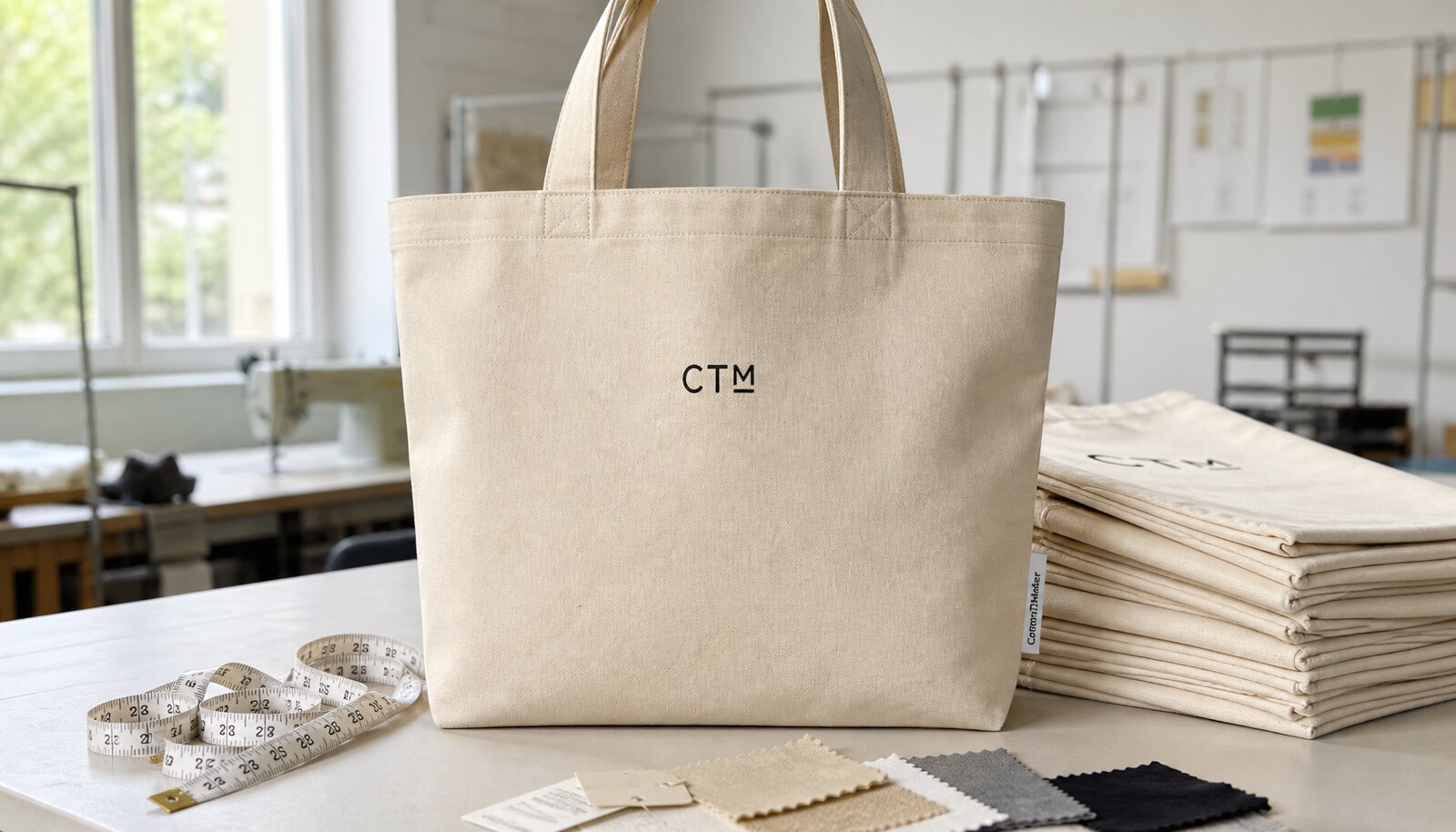
Start With the Retail Job, Not the Bag Spec
For a school store, a canvas retail merchandise bag is usually doing two jobs at once. It carries a purchase home, and it acts as part of the brand experience. That means the buying brief should start with the retail job, not with the fabric name. A buyer who writes 'canvas tote' on the RFQ without defining the use case can easily end up with a bag that looks durable in a sample room but fails in real life: too soft for books, too small for folded apparel, too plain for retail display, or too expensive for the checkout flow.
The first question is what the bag must carry. A bookstore bag for hoodies and notebooks needs different dimensions, handle length, and reinforcement than a giveaway bag at a campus fair. A bag that replaces outer packaging needs to be easier to fold, label, and scan. A bag sold as a retail item needs better presentation on shelf, cleaner print, and more predictable packing. Once you define the retail job, the rest of the specification becomes much easier to compare across suppliers.
This is also where the sustainable packaging comparison should be grounded in operations rather than marketing language. Canvas is not the correct answer for every school program. If the only job is to hand over a low-value item one time, paper or a lighter packaging format may be more practical. Canvas becomes compelling when the school wants a reusable carrier that is still merchandisable, so the bag continues to work after checkout instead of being thrown away at the door.
For procurement teams, this framing changes the sourcing conversation. Instead of asking 'Which tote is cheapest?', ask 'Which bag gives us the best cost per use, the right shelf appearance, and the least risk of replenishment problems?' That one shift tends to produce better specs, better quotes, and fewer surprises when the first shipment reaches campus.
- Define the bag's role: retail SKU, checkout carrier, event giveaway, or packaging substitute.
- State the expected load using examples such as textbooks, hoodies, or mixed merchandise.
- Decide whether reuse, shelf presentation, or lowest landed cost is the top priority.
Choose Canvas Weight, Weave, and Finish for Real School Use
The word canvas hides a lot of variation. For school retail merchandise bags, the buyer needs to know the fabric weight, weave type, and finish, because those details affect strength, print quality, and how the bag sits on the shelf. A lighter canvas in the 200 to 250 GSM range can work for apparel, stationery, and low-load merchandising if the buyer wants a softer fold and lower freight cost. As the contents become heavier or the bag needs a more structured retail look, buyers usually move toward 250 to 300 GSM or higher.
Weave matters too. Most retail totes use a plain weave because it is economical and predictable, but a tighter plain weave or a denser twill can improve print clarity and reduce panel distortion. Twill can feel more premium and may hide some surface irregularity, but it is not always the cheapest route. The right choice depends on how visible the bag needs to be in store and how cleanly the logo must reproduce. If the artwork includes fine lines or small type, ask the supplier which weave gives the best print edge on that exact design.
Finish is another detail that procurement often misses. Natural, unbleached canvas can look more earthy and support an environmentally oriented message, but it may vary more from batch to batch in shade and flecking. Bleached or dyed canvas can give a more controlled retail appearance but may raise dye consistency and colorfastness questions. Enzyme washing, pre-shrinking, or softening can change hand feel and shrinkage behavior. If the bag will be reused often, ask whether the cloth is pre-shrunk and what dimensional change to expect after use or cleaning.
The practical standard is simple: ask the supplier to quote the fabric in GSM or ounces, specify the weave, and name the finish. Do not accept 'good quality canvas' as a spec. For repeat school programs, the fabric should be locked in writing, with a retained sample and an agreed tolerance range for shade and shrinkage. That is the difference between a repeat order and a new sourcing exercise every semester.
- Light retail use: 200-250 GSM, compact fold, lower freight per carton, suitable for apparel or gifts.
- General school merchandising: 250-300 GSM, better shape retention, clearer print, better shelf presence.
- Heavier or premium use: 300 GSM and above, stronger body and handle anchoring, higher material cost.
Specify the Construction Details Buyers Usually Forget
Construction details are where a lot of tote orders win or lose value. Two bags with the same GSM can behave very differently if one uses short handles, weak seam allowance, or minimal reinforcement. For a school retail program, the buyer should specify handle length, handle width, attachment method, seam construction, and whether the corners are boxed, gusseted, or flat. Those choices change not only durability but also how the bag displays on a rack or stack.
Handle design deserves special attention. Short hand-carry handles are fine for a simple merchandise tote, but school buyers often underestimate how much better a longer handle works when students carry books or layered apparel. Ask the factory for the finished handle drop, not just the cut length. Also ask how the handles are attached. Self-fabric handles folded and stitched cleanly can feel more substantial than thin tapes, but the right answer depends on the look and the load. Where the load is heavier, reinforcement at the handle base matters more than a small difference in fabric cost.
Stitching should be described in enough detail that a second supplier could reproduce it. That means seam type, stitch density, bartack count, and any edge finishing. A tote with good-looking topstitching can still fail if the handle attachment area has skipped stitches or the seam allowance is too narrow. For school books or packaged merchandise, ask for a reinforcement pattern at the stress points, not just a 'strong handle' claim.
The buyer should also ask whether the bag has a gusset and what depth it has. Gussets help the bag hold shape and improve capacity, especially when the store sells folded apparel, mugs, or boxed items. However, a gusset adds sewing complexity and can increase cost. If the tote is meant to sit flat on shelf, you may want a bag that stands up better. If the tote must pack efficiently in cartons, a slimmer profile may make more sense. These are tradeoffs, not absolutes, so they should be part of the RFQ rather than left to the factory's default pattern.
- Ask for finished handle drop, handle width, and attachment method.
- Specify seam type, stitch density, and bartack count at load points.
- Confirm gusset depth or flat-body construction based on the intended merchandise mix.
Compare Sourcing Routes Before You Compare Prices
The source route drives most of the commercial outcome. A direct factory quote usually offers the best control over canvas weight, print method, handle construction, and packing format, but only if the factory is genuinely set up for retail-grade tote production. A trading company can be useful when the program has multiple SKUs, multiple campuses, or needs one contact to manage several factories. A domestic decorator using imported blanks is often the fastest route for rush needs, but it usually comes with less fabric flexibility and a higher unit cost.
The important comparison is not simply who is cheapest. It is who can deliver the same bag consistently, with the same retail presentation, and with the fewest hidden assumptions. A low number from a blank-based supplier can become expensive if the blank changes between shipments, if the print area is smaller than expected, or if packing has to be reworked for store use. On the other hand, a direct factory can look competitive until you add labels, hangtags, special folding, and freight. Buyers should compare all of those items line by line.
For schools with annual seasons, reorder control matters almost as much as first-order price. Ask whether the supplier retains screens, approved samples, carton specs, and color references. If the bag will be bought every term or every year, you want a supplier path that allows version control. Split sourcing sounds flexible, but it often causes shade drift, inconsistent carton counts, and mismatch between old stock and new stock on shelf.
Use the comparison table in this article to pressure-test each route, then ask for a sample and a fully loaded quote. That is the fastest way to separate a good unit price from a weak operational fit.
- Direct factory: best control, but requires a detailed technical brief and strict sample approval.
- Trading company: helpful for multi-SKU programs, but defect ownership must be written clearly.
- Domestic decorator: fastest for rush orders, but usually limited on fabric options and bag construction.
Build the RFQ Around the Decisions That Change Cost
A useful RFQ does not ask the supplier to guess what matters. It tells the supplier what is fixed, what is flexible, and what must be quoted separately. For canvas retail merchandise bags for schools, the details that most often change cost are fabric weight, weave, handle construction, decoration count, packing format, and whether retail labeling is included. If those items are hidden inside one unit number, suppliers will fill the gaps with their own assumptions, which makes comparison nearly impossible.
Procurement teams should ask for a split between the first order and the repeat order. The first run may include screen setup, sampling, label approval, and perhaps a new carton spec. The reorder should be priced differently if screens, cartons, and labels are already retained. If a factory cannot explain that distinction, the quote may not be ready for a repeat school program. Reorders are where the real cost picture appears, especially for annual merchandise seasons.
It also helps to tell suppliers how the bag will be sold or distributed. A school bookstore bag that sits on a shelf needs cleaner packing and often a barcode or a hangtag. A bulk carrier for event distribution may not. When the supplier knows the retail setting, they can quote the appropriate packing format instead of padding the order with unnecessary extras or leaving out items the store actually needs.
The RFQ should read like an operations brief, not a marketing request. Include the target program volume, campus count if relevant, delivery windows, carton expectations, and whether the bag must match existing merchandise colors. The more the supplier understands about the downstream use, the more reliable the quote will be.
- Separate first-order and repeat-order pricing.
- State which items are included: labels, hangtags, inserts, barcode stickers, and carton marks.
- Provide the sell/use scenario so the supplier can quote the correct packing format.
Approve Samples Like a Merchandiser, Not Just a Buyer
A pre-production sample should answer commercial questions, not just visual ones. Does the bag stand up in a retail stack? Does it fold neatly enough for shelf packing? Can staff scan or read the label without undoing the fold? Does the print survive the way the bag will actually be handled? These are the questions that matter for school procurement because the bag is part of store operations, not a standalone textile exercise.
The sample must use final fabric, final decoration, final label, and final packing method. A paper proof or a blank tote is not enough. If the supplier changes any of those inputs after approval, the buyer should re-approve the sample. That sounds strict, but it prevents the most common failure mode in tote programs: the sample looks right, the bulk feels different, and the receiving team discovers the difference too late.
Set the acceptance bands before the sample arrives. A practical sample sheet should state finished size tolerance, print placement tolerance, shade tolerance, handle length tolerance, and any acceptable cosmetic variation. For example, a buyer may allow small fiber flecks in natural canvas while still rejecting obvious stains, crooked seams, or print bleed. Writing that down in advance helps both sides avoid arguments based on aesthetics alone.
When the school store team reviews the sample, use actual merchandise if possible. Put in a folded hoodie, notebooks, or the normal mixed retail load. That will tell you more than an empty bag ever will. If the tote is being sold to customers, also check how it looks in the hand, on a shelf, and when stacked in a back room. Retail performance is visible, and the sample should prove it before bulk begins.
- Test with the actual product mix, not an empty bag.
- Approve only the final fabric, final print, and final pack format.
- Write tolerance bands before sample review to avoid subjective disputes.
Use Quality Control That Has Real Thresholds
QC should be specific enough that a factory, a third-party inspector, and the buyer would all agree on the same pass or fail result. Generic statements like 'check stitching' are not enough. For canvas retail merchandise bags, the most useful quality plan starts with AQL and then defines what counts as a major or minor defect. For many routine school programs, buyers use AQL 2.5 for major defects and AQL 4.0 for minor defects, but the final standard should match the school's risk tolerance and purchase size.
Major defects are issues that make the bag unusable, unsafe, or unsellable: open seams, handle failure, severe size out-of-spec, unreadable print, broken bartacks, torn fabric, wrong packing count, or a visibly wrong color. Minor defects are cosmetic or small process issues that do not affect function: loose threads, slight print shift inside tolerance, light puckering, or a small mark that does not show in normal use. The supplier should know the difference in writing before bulk sewing starts.
Testing should be practical, not just visual. Check the fabric weight against the approved spec using a mill certificate or test report, then compare to the sealed sample. Measure a representative set of finished bags from different cartons. Inspect handle reinforcement with a pull test by hand or, if the order is heavier duty, ask for a load test or simple hanging test. If the program is for books or apparel bundles, the bag should hold the actual expected load without seam slippage or handle distortion.
Print quality needs its own threshold. Ask for cure confirmation and a rub-resistance check so the ink does not smear on handling. If the design is close to a fold line, inspect the bag after folding and reopening. A logo that looks perfect on a flat sample can crack in normal retail use if the fabric or ink system is wrong. QC should also cover carton marks, pack quantity, and presentation, because a school receiving team often rejects a shipment for packaging errors even when the sewing is fine.
- Use AQL with written major and minor defect definitions.
- Test load with the actual intended merchandise weight.
- Check print rub resistance, seam strength, and carton accuracy before release.
Treat Packing as Part of the Product
Packing decisions affect both retail execution and freight cost. A school bookstore tote that is individually folded, labeled, and placed for shelf display is a different product from a bulk-packed promotional bag. If the bag will be sold or replenished from a retail fixture, the fold size, insert type, barcode placement, and carton presentation matter because staff need to restock quickly and customers need a tidy display. A clean retail pack can be worth paying for if it saves labor and reduces handling damage.
At the same time, packing is a place where sustainability claims need discipline. Some buyers want to cut plastic, but the answer is not to remove protection blindly. Canvas bags can still arrive dusty, scuffed, or crushed if protection is too minimal. A smarter approach is to reduce unnecessary packaging while keeping the bag saleable and countable. That may mean a recycled paper insert, a simple low-ink carton mark, or a lower-plastic pack format rather than a fully bare shipment.
Ask the supplier to quote two packing scenarios if needed: retail-ready and bulk. That allows the buyer to see the real cost difference between a display-friendly format and a shipping-only format. For many school programs, the retail version is worth the extra cost because it reduces store labor and improves presentation. For event distribution or internal transfers, bulk packing may be the better fit.
Carton details matter as much as the inner pack. The buyer should ask for carton dimensions, gross weight, and pack count so logistics and receiving teams can plan storage. If the tote is soft and the handles are bulky, carton compression can leave visible creases. That may not be a sewing defect, but it can still create a retail rejection. Packing should preserve the bag's shape until it reaches the shelf.
- Quote retail-ready and bulk packing separately if the school may use both.
- Confirm fold method, inner insert, barcode location, and carton marks.
- Ask for carton dimensions and gross weight before freight booking.
Verify Sustainability Claims With Documents, Not Slogans
For school buyers, sustainability claims need to be operationally believable. A canvas bag can support a lower-waste strategy because it is reusable, but that alone does not make the order sustainable. Buyers should ask what the fabric is made of, where it came from, whether any recycled content is actually present, and how the packaging is being reduced. If the supplier cannot document the claim, the claim should not appear in internal purchasing notes or customer-facing language.
The most useful documents are straightforward: a material declaration, a bill of materials, evidence of recycled content if claimed, and a packing specification that shows what has been removed or reduced. If the supplier says the canvas contains recycled fiber, ask for the percentage, the source of the claim, and whether it applies to the whole fabric or only part of the yarn. If the supplier says the packaging is reduced, ask to see the before-and-after pack configuration so the statement is more than a slogan.
It also helps to separate environmental claims into what the buyer can verify and what the buyer can only infer. Reuse potential is real if the bag is durable enough for repeated school use. Reduced packaging is real if the pack format is simpler and documented. Biobased, organic, or recycled-content claims should be supported by supplier paperwork, not just a product description. Procurement teams should treat sustainability as a spec item, not an afterthought.
In a school environment, the safest approach is usually the simplest one: choose the bag construction that lasts long enough to be reused, request the documents that support any material claim, and avoid overstating environmental benefits. That keeps the buying team aligned with compliance, communications, and actual program use.
- Request a material declaration or bill of materials.
- If recycled content is claimed, ask for the percentage and the evidence behind it.
- If reduced packaging is claimed, ask for the exact pack comparison before and after.
Build a Reorder Plan Before the First PO Ships
A school merchandise bag program rarely ends with the first order. Most buyers will need a second run for another term, another campus, or a replenishment cycle. That means reorder planning should be part of the original sourcing decision. Ask the supplier what will be retained after approval: screens, artwork files, label specs, carton dimensions, and the approved sample. If those items are not retained, the reorder becomes a fresh project with fresh risks.
Version control is the quiet difference between a controlled program and a messy one. A reorder should match the first bag closely enough that a customer does not notice a change in weight, shade, or print feel. If the supplier changes fabric source, label vendor, or packing method, that change should be approved in writing. The buyer should keep the sealed sample and the spec sheet in an accessible file so new team members can order the same product without guessing.
For multi-campus schools, the reorder plan should also define how campuses will request replenishment, who approves changes, and whether all locations buy from the same source. Split buying can create near-identical bags that are actually different in shade, size, or packaging. That causes receiving confusion and makes store displays look inconsistent. A centralized spec and a retained sample usually cost less than ad hoc local purchasing over time.
The practical rule is simple: if you expect the bag to become a recurring retail item, buy it like a recurring retail item. That means archiving documents, storing samples, and asking the supplier to explain how they will maintain consistency from one term to the next.
- Keep a sealed approval sample with the spec sheet and artwork file.
- Confirm what is retained for reorder: screens, labels, carton specs, and color references.
- Write a process for campus-level changes so the bag stays consistent across locations.
Specification comparison for buyers
| Spec decision | Recommended option | When it fits | Buyer risk to check |
|---|---|---|---|
| Primary sourcing route | Direct canvas factory quoting fabric, sewing, printing, and packing in one spec sheet | Best for school bookstores, campus merch programs, and distributor buys that need one owner for dimensions, decoration, and ship date | Confirm that the quote includes all packaging components, label work, carton marks, and the same approval sample that production will follow |
| Low-MOQ route | Regional decorator using imported blanks with limited customization | Useful for pilot runs, one-campus launches, welcome-week events, or short seasonal campaigns | Blank quality can shift by shipment; check body size, handle length, print area, and whether the same blank is reserved for reorder |
| Cost-control route | Trading company consolidating multiple factories under one PO | Works when you need several sizes, colors, or bag types on one program order | Clarify who owns the spec sheet, who approves the sample, and who pays if one factory changes fabric or trim without notice |
| Fast-turn route | Domestic printer with stocked blanks and simple decoration | Fits rush events, alumni weekends, bookstore resets, and short-notice promotions | Unit price is usually higher and fabric choice is limited; ask what blank weight, stitch count, and handle reinforcement are actually available |
| Retail-ready route | Factory that can add hangtags, side labels, barcode stickers, and shelf packing | Best when the bag will sit beside apparel, books, and spirit items in a retail display | Approve label placement, barcode readability, fold method, and carton presentation on the pre-production sample |
| Sustainability evidence route | Supplier that can document fabric origin, recycled content, and reduced packaging | Useful when the school store needs a credible sustainability statement that can survive internal review | Do not accept vague green language; request a written bill of materials, recycled-content declaration, and packing spec |
| Reorder route | Same factory that stored screens, trims, and carton specs from the first order | Best for annual school seasons and multi-campus programs where the same bag returns each semester | Confirm retained tooling, archived approval samples, and the exact version control process before you assume repeatability |
| Multi-campus route | One controlled factory program instead of split vendors | Best when many stores need the same shade, print, carton, and retail presentation | Split sourcing creates color drift, carton inconsistency, and avoidable rework across campuses |
Buyer checklist before sampling
- Start with the retail job, not the fabric: is the bag a bookstore carrier, a merchandise SKU, a gift-with-purchase, or a packaging substitute for checkout?
- State the load expectation in practical terms such as one hoodie, two books, or a mixed apparel bundle; then choose fabric and handle construction around that load.
- Lock the canvas spec in GSM or ounces plus weave type, not just the word canvas; ask whether the cloth is plain weave, twill, bleached, dyed, or enzyme-washed.
- Ask the supplier for finished size, cut size, shrinkage allowance, and after-wash behavior if the bag will be folded, stored, or reused.
- Choose handle length by use case: short handles for hand carry, longer handles for shoulder carry, and longer reinforcement if the school expects heavy contents.
- Request the handle construction detail: single-layer or self-fabric handles, folded width, bartack count, edge finish, and stitch density at the stress points.
- Decide whether the bag must display retail labeling or only carry merchandise; that affects hangtags, side labels, barcode placement, and shelf-ready packing.
- Approve one decoration method only after checking artwork size, stitch-out or print proof, ink cure, and whether the design crosses a fold line or seam.
- Request a pre-production sample with the final fabric, final print, final label, and final packing method; do not approve from a blank or a paper proof alone.
- Ask for a written tolerance range for size, shade, stitch density, and print placement so your inspection team knows what passes and what fails.
Factory quote questions to send
- What exact fabric are you quoting, including GSM, weave type, yarn count if available, finishing, and whether the cloth is bleached, natural, dyed, or enzyme-washed?
- What are the finished dimensions, seam allowances, and shrinkage allowance, and how much variation do you allow by batch?
- What handle style are you quoting, what is the handle width and finished drop length, and how many bartacks or reinforcement stitches are used at each attachment point?
- What is the stitch density in SPI or a similar unit, and what seam type do you use for side seams, bottom seams, and handle attachments?
- Which decoration method are you quoting, what is the print area, how many colors are included, and what happens to price and lead time if I add one more color?
- What is the MOQ by color, by size, and by print method, and does the repeat order keep the same screens, labels, and carton specification?
- Can you quote both retail-ready packing and bulk packing, and what is included in each format such as fold method, insert, polybag, tissue, hangtag, or barcode sticker?
- What carton pack quantity, carton dimensions, and gross weight are you using, and can you show estimated packing volume for freight planning?
- What QC standard do you inspect to, what is the sample size, and what defect thresholds do you use for stitch failure, size variance, print misalignment, and dirty marks?
- What is the expected lead time for sampling, fabric booking, printing, sewing, inspection, and dispatch, and which step is most likely to delay the order?
Quality-control points to confirm
- Use a written inspection plan before bulk begins. For a standard school order, inspect using AQL 2.5 for major defects and AQL 4.0 for minor defects unless your internal standard is stricter. Ask the factory to state the same plan in the pre-production approval.
- Define major defects clearly: broken stitches, open seams, missing bartacks, wrong finished size outside tolerance, unreadable print, severe shade mismatch, torn fabric, or a handle that fails under normal pull.
- Define minor defects clearly: loose threads, slight print shift within tolerance, small puckering that does not affect function, or cosmetic marks that do not affect retail saleability.
- Check fabric weight against the approved spec with a GSM test or supplier mill certificate, then verify by feel and drape against the sealed sample; the bulk run should not feel looser or noticeably lighter.
- Measure finished dimensions on a sample from each carton cluster: body width, body height, gusset depth if present, and handle drop. Set a pass/fail band before production, typically within the written tolerance rather than a vague 'close enough' standard.
- Count stitches where it matters. Ask for SPI or a stitched-count equivalent on body seams and reinforcement areas, and inspect the sample for skipped stitches, thread breaks, or irregular tension.
- Check seam strength by pulling the handle area and side seam manually on the sample, then request a load test if the school expects books or heavy merchandise. A practical internal test is to load the bag with the intended product mix and hold it for a fixed interval without seam failure, handle tear, or deformation.
- Inspect handle reinforcement closely. Acceptable examples include clean bartacks, even topstitching, and symmetrical attachment points. Reject obvious defects such as missed bartacks, frayed edge finishing, or one handle sitting higher than the other.
- For print quality, check registration, ink opacity, cure, and rub resistance. A simple shop-floor rub test should not leave visible smearing on a white cloth after curing. If the artwork crosses a fold line, confirm that cracking does not appear after repeated folding on the sample.
- Check shrinkage and shape retention if the bag will be used repeatedly. The bulk sample should not twist, narrow excessively, or distort after a basic wet/dry or steam exposure test if the fabric finish suggests shrinkage risk.