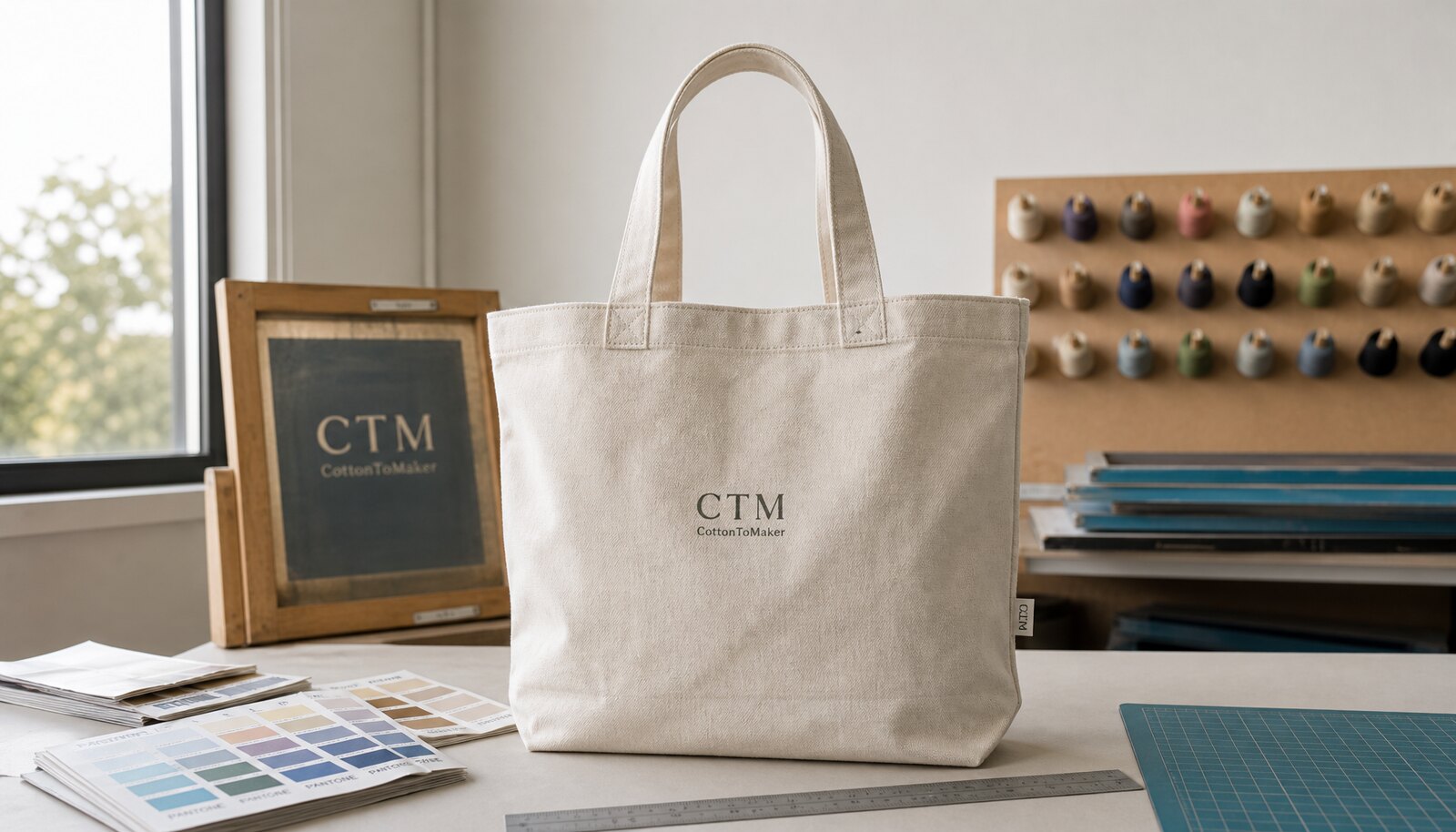
Why the print method matters in school retail
School merchandise bags are usually sold, not given away. That changes the decision. A campus bookstore or spirit shop needs a bag that carries textbooks, survives repeat use, and still looks intentional after a few months in circulation. The print method has to match that reality. A bag that looks fine on a sales sheet can fail when the logo sits on coarse canvas, the student folds it into a locker, or the store needs to reorder the same item next semester.
The right method depends on what the buyer is protecting. Some programs care about logo sharpness because the bag sits next to apparel and drinkware in a retail setting. Others care more about reorder stability, because the same art returns every term. For schools, the best choice is usually the one that gives a clean first impression, tolerates handling, and does not create a slow or expensive reorder process.
- Treat the bag as a retail item, not a promotional throwaway.
- Match the decoration method to the school's expected order repeat rate.
- Use the bag's real end use, carrying books or merch, to judge durability.
Start with the canvas body, not the logo file
Canvas weight changes how every print method behaves. A 10-12 oz cotton canvas is common for retail merchandise bags because it balances cost, structure, and printability. Lighter fabric can show more distortion around the print zone, while heavier 12-16 oz canvas gives a firmer hand and a more premium shelf look. If the bag is too soft, registration and edge sharpness get harder to hold. If it is too stiff, folds can stress the print after packing and repeated use.
The fabric finish matters as much as the weight. Natural unbleached canvas gives a warmer, more sustainable retail look, but the base color can shift the final logo tone. Bleached or dyed canvas can improve brand color control, yet it may introduce issues with shade consistency between lots. Buyers should also define whether the bag is pre-washed, enzyme-washed, or left raw, because finishing changes shrinkage, ink absorption, and seam behavior after printing.
- Typical buying window: 10-12 oz for standard retail, 12-16 oz for premium or heavy-use programs.
- Define whether the canvas is natural, bleached, dyed, washed, or raw.
- Ask for shrinkage expectations and whether the print method is tested after washing.
Screen print, transfer, embroidery, and label: what actually wins
For school retail merchandise bags, screen print is still the workhorse. It handles bold wordmarks, mascots, and simple crest art at a reasonable unit cost once setup is spread over volume. If the art uses one to four solid colors and the run is recurring, screen print usually gives the best balance of appearance and cost. A good factory can control ink deposit, cure temperature, and edge sharpness well enough for a bookstore display table.
Transfers and DTF are better when the artwork is detailed, the school has multiple campus versions, or the print needs to change quickly for events. Embroidery works when the logo is small and premium feel matters more than pure print sharpness. Woven labels or patches are useful when the buyer wants the bag body to stay clean but still carry visible branding. Sublimation is usually the wrong route for cotton canvas unless the fabric is specially coated, so buyers should not let a supplier steer them there just because the artwork is complex.
- Use screen print for bold logos and repeatable school-store runs.
- Use transfer or DTF for full-color art, seasonal graphics, and small-batch variation.
- Use embroidery or woven labels only when the design size and fabric weight support them.
How MOQ and setup costs shape the real quote
Print method and MOQ are linked. Screen printing needs setup work for each color, so a one-color logo can make sense at a lower quantity than a four-color crest. Transfers can lower setup effort for highly detailed artwork, but they often carry a higher per-piece decoration cost. Embroidery introduces digitizing and stitch setup, which becomes inefficient if the bag value is low or the logo is very large. A clean quote should show where the break-even point sits, not hide it in a single blended unit price.
Buyers should ask for quote levels that reflect how school programs actually order: a small event run, a semester launch, and a reorder lot. If the supplier only prices one quantity, you cannot see where the method becomes economical. It is also worth asking whether multiple campus names, colorways, or handle options change the MOQ. Many quotes look competitive until the buyer adds a second art version or a different bag color and the setup cost has to be repeated.
- Request prices at several quantity bands, not one sample quantity.
- Separate setup cost, per-unit decoration cost, and repeat-order cost.
- Ask whether additional colors, locations, or bag colors trigger new screens or new minimums.
What a supplier should prove before you compare quotes
A serious supplier should be able to show more than a mockup. For school retail bags, the useful evidence is a physical sample on the actual fabric weight, plus a clear production reference from a similar logo size or decoration method. If the vendor says the print is in-house, the sample should reflect the same ink system, curing process, and stitch quality that will run in bulk. If the decoration is subcontracted, the buyer needs that fact stated early, because the risk is coordination, not just print quality.
The best quote files are specific. They name the canvas weight, bag dimensions, handle length, print area, ink type or transfer type, packing style, and lead time split by stage. Vague offers are hard to compare and usually hide assumptions. If the supplier cannot answer whether the price includes screen setup, sample strike-off, barcode label application, or carton marks, the quote is not ready for procurement review.
- Ask for a physical sample or strike-off on the same fabric weight and color.
- Require the decoration method, setup cost, and print area to be written into the quote.
- Confirm whether the print step is in-house or outsourced before award.
Sample approval and QC thresholds that prevent retail defects
The sample is not just a preview. It is the control point for placement, color, and finish. On canvas, a logo can look centered on a digital proof and still sit too high, too low, or too close to the seam once sewn. Buyers should approve the print on a fully assembled bag, not a flat panel only. That matters especially for schools, where the bag is often displayed upright in a shop and the logo has to sit correctly relative to the top hem and handle line.
QC should focus on failure modes that actually appear on canvas. Ink spread, broken registration, uneven cure, and seam puckering are more common than dramatic print defects. The buyer should define acceptable placement tolerance, color variation, and fold durability before bulk starts. If the bag will be sold in a retail store, the print has to survive folding for shelf packing and repeat opening by customers, not only pass a visual check on the sample table.
- Approve the artwork on a sewn sample, not on a loose panel only.
- Set a placement tolerance for the logo and keep it consistent across cartons.
- Test the bag after folding, flexing, and light abrasion before bulk approval.
Packing choices change retail value and damage risk
Packing is part of the product for school retail buyers. A bag destined for a campus bookstore can be packed flat to reduce cube, but a store-ready item may need a clean fold, a barcode sticker, and a retail hangtag. The wrong packing method can crease the print line, shift the logo off center, or create a bag that opens badly on shelf. If the buyer wants the bag ready for direct sale, the packing spec should be written as carefully as the print spec.
Carton planning matters because retail bags are often reordered alongside other school merch. If the carton count is too low, freight cost rises. If it is too high, cartons become hard to handle in the warehouse or on the shop floor. Buyers should decide whether polybags are needed, whether silica is required for storage, and whether cartons need inner dividers to protect printed surfaces. Simple and repeatable usually wins, but only if the fold and label placement are defined in advance.
- Specify fold direction and finished pack size for every SKU.
- State whether retail polybags, barcode stickers, or hangtags are required.
- Use a carton count that fits both freight efficiency and store handling.
Lead time risk is usually hidden in artwork and approval steps
Most delays do not come from sewing alone. They come from artwork corrections, sample approval, and print setup. Screen print needs screens or plates. Transfers need art prep and test pressing. Embroidery needs digitizing and stitch trial. If the buyer misses the approval deadline, the bulk slot slips even when the factory is ready. For school retail calendars, that can matter more than the unit price because bookstore launches, orientation weeks, and alumni events have fixed dates.
Lead time should be broken into stages: sample, approval, bulk production, packing, and transit. A direct screen print run can be faster than a transfer-based order if the art is stable and the setup is already approved. Reorders usually move faster when the supplier has the exact art file, screen records, and packaging spec on file. Buyers who plan for one extra revision cycle tend to avoid the production rush that causes missed cartons, rushed curing, or late freight booking.
- Separate sample time from bulk time in the quote.
- Build in approval time for art changes, especially before school opening season.
- Keep the approved artwork and packing spec on file for reorders.
Choose the sourcing route by total landed cost, not unit print price
A low unit print price does not always produce a low landed cost. Direct factory sourcing can be efficient when the sewing and decoration are coordinated in one place, because there is less handling and fewer delays. A bag factory that outsources decoration may still work, but the buyer has to pay attention to handoff risk. Importing blank bags and decorating locally can make sense when artwork changes late or the buyer needs fast domestic delivery, but the extra freight, warehousing, and local decoration fees often erase the apparent savings.
For school retail merchandise, the right route depends on volume and repeat behavior. If the same bag will be reordered several times, a factory that holds the print spec, carton spec, and approved sample can reduce friction and improve consistency. If the program is experimental or the design changes by event, a more flexible route may be better. Buyers should compare the full landed cost with setup, packaging, inland delivery, customs, and the cost of a rejected lot, not just the printed bag price.
- Compare direct factory, mixed subcontracting, and local decoration on the same quote basis.
- Include freight, customs, packing, and rework risk in the landed-cost comparison.
- Use the repeat-order profile to decide whether flexibility or lowest unit cost matters more.
RFQ data that gets a usable quote the first time
A good RFQ removes guesswork. For this bag category, the buyer should send a flat artwork file, bag size, fabric weight target, canvas color, decoration method preference, print area, and the retail packing requirement. If the school has multiple logos or sub-brands, each version should be listed separately. The quote should also state the target market, because a bag for a campus bookstore is usually packed and finished differently from a bag for event giveaways or conference merch.
If the supplier is being asked to compare methods, the RFQ should force a like-for-like answer. That means one spec sheet for the bag body and separate quote lines for screen print, transfer, embroidery, or label decoration. It also means the buyer should request the sample stage, the MOQ, the setup cost, and the lead time for each option. That structure makes it much easier to review the quotes internally and stops the usual problem where one supplier looks cheaper only because they omitted setup or packaging.
- Send one master spec sheet and separate decoration options.
- List each logo version, color count, and print location clearly.
- Require setup, sample, packing, and transit to be shown as separate quote lines.
Specification comparison for buyers
| Spec decision | Recommended option | When it fits | Buyer risk to check |
|---|---|---|---|
| 1-color screen print on 10-12 oz canvas | Best for bold school wordmarks, mascots, and simple seals with strong edges | Campus stores, alumni events, and reorder programs where the same logo repeats across many cartons | Coarse weave can blur thin lines; require a strike-off on the actual fabric color |
| 2-4 color screen print | Best when the school art has limited spot colors and you want a clean retail look | Spirit shops and seasonal launches where the design stays flat and graphic | Color registration can drift on soft canvas; confirm trap tolerance and overprint order |
| DTF or heat transfer | Best for full-color art, gradients, small type, or artwork that changes by campus or event | Short runs, multi-campus programs, and designs that need frequent art revisions | Transfers can crack or feel heavy if the bag folds often; approve fold and rub tests |
| Embroidery | Best for a premium bag with a small logo or crest and a heavier fabric body | Alumni gifts, executive store items, and limited editions with lower decoration area | Small text can fill in; check backing, puckering, and stitch density on the final cloth |
| Woven patch or label | Best when branding should feel durable without putting ink on the bag body | Low-key retail lines and repeat programs that need a clean, long-life mark | Patch edge fray and placement variation can make the bag look inconsistent |
| Single factory with in-house sewing and print | Best balance of accountability, cost control, and speed for standard school merch | Buyers who want one PO, one QC owner, and fewer handoffs | Confirm the print line is truly in-house and not a hidden subcontracted step |
| Bag factory plus outsourced decorator | Best when the bag factory is strong at sewing but weak at decoration | Projects with mixed decoration methods or unusually large print areas | Two vendors can blame each other for defects; define who owns artwork, setup, and rework |
| Blank bag import plus domestic decoration | Best when artwork may change late or the buyer needs local reprint flexibility | Small programs, urgent events, and markets that value speed over the lowest unit cost | Landed cost can rise fast after freight, handling, and local labor are added |
Buyer checklist before sampling
- Lock the finished bag size, fabric weight, canvas color, handle length, and seam construction before asking for quotes.
- Specify the print method you want quoted, plus a backup method if the first choice is too expensive or too slow.
- Give the supplier the exact logo file, print area, Pantone targets, and the number of colors in each artwork version.
- Request a pre-production sample on the real fabric, not only a digital proof or a printed paper mockup.
- Ask for quote lines on fabric, cutting and sewing, decoration setup, unit print cost, packing, and freight separately.
- Confirm carton pack, fold method, barcode label position, and whether retail hangtags or polybags are included.
Factory quote questions to send
- What fabric weight, weave, and finished color are you quoting, and will the print method behave correctly on that canvas?
- Is the decoration done in-house or subcontracted, and who owns the quality issue if print or sewing fails?
- What is the MOQ by print method, by color count, and by bag size or style variation?
- What setup charges apply for screens, plates, embroidery files, or transfer preparation, and are they repeated on reorders?
- What sample stages do you provide before bulk, and what can change after the sample is approved?
- What is the bulk lead time by method, and how much does packing, carton labeling, or export documentation add to the schedule?
Quality-control points to confirm
- Approve the decoration on the actual canvas color and fabric weight that will be used in bulk.
- Keep logo placement within the agreed tolerance and reject cartons with visible drift across the lot.
- Check that screen print edges stay sharp, without pinholes, excessive ink spread, or color bleed into the weave.
- Fold and flex the bag after curing to confirm that the print does not crack, peel, or feel brittle.
- Inspect stitch lines, handle attachment points, and top hem after decoration so heat or pressure has not weakened the bag.
- Verify carton count, label accuracy, and pack orientation against the approved packing spec before shipment.