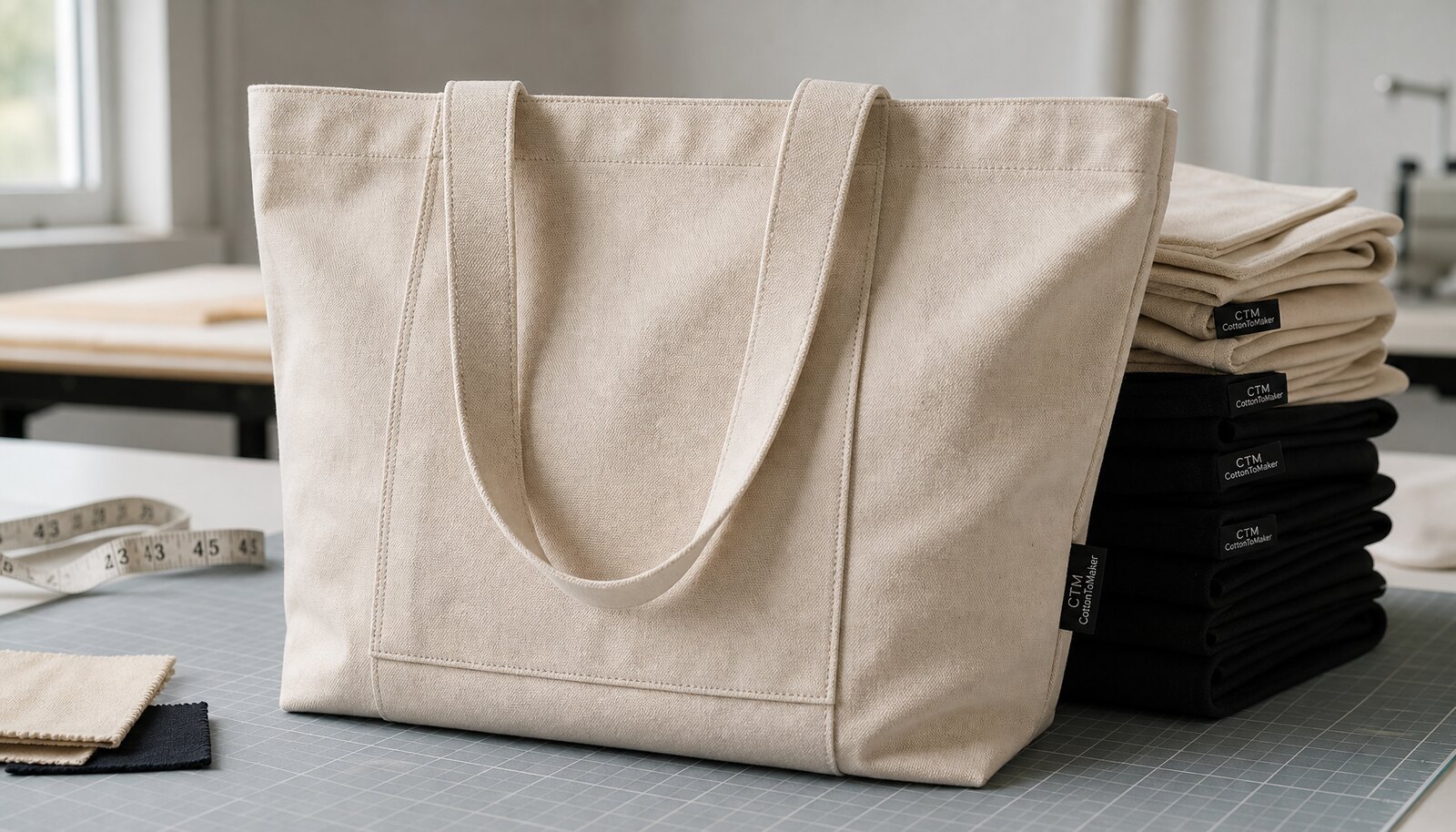
1. Why retail chains need a sourcing plan, not just a price quote
Canvas retail merchandise bags look simple, but private label programs fail when the buyer treats them as a one-line commodity purchase. A retail chain is not only buying a bag. It is buying a repeatable item that must fit store operations, brand presentation, warehouse receiving, and replenishment discipline. If the bag arrives with the wrong fold, wrong carton count, weak handles, or inconsistent print placement, the unit price savings disappear quickly in labor, claims, and markdown risk.
A sourcing plan forces the buying team to define the actual job the bag must do. Is it a checkout resale item, a gift-with-purchase item, a seasonal promotion, a store merch item, or a reusable carry bag for high-traffic retail floors? Those use cases are not interchangeable. A bag meant for checkout resale may need a cleaner finish and tighter label presentation. A promotional bag may tolerate simpler packing and a lighter fabric. A chain that sells the wrong bag spec into the wrong use case ends up paying twice: once in production, and again in store frustration.
For procurement, the key is to write the buying problem in operational terms. A useful plan defines the product, the channel, the pack-out, the acceptance standard, and the reorder trigger before the first RFQ goes out. That is especially important when sourcing canvas retail merchandise bags for retail chains private label sourcing plan work, because the same bag can be quoted very differently depending on whether the supplier assumes a promo giveaway, a retail shelf item, or a replenishment item with barcode and carton requirements.
The sourcing plan should also separate decisions that are hard to reverse from decisions that can be adjusted later. Fabric weight, bag dimensions, handle construction, and print method are hard-spec items. Carton mark format, inner poly use, and final pack count can sometimes be adjusted, but only if the supplier is told early enough. Buyers who lock the hard-spec items first usually get cleaner quotes and fewer production disputes later.
- Define the bag by use case before requesting a quote.
- Treat fabric, construction, print, and packing as separate decision layers.
- Write the acceptance standard before you compare supplier prices.
2. Start with the bag spec that matches shelf reality and in-store handling
For most retail merchandise programs, canvas in the 10 oz to 12 oz range is a practical starting point, roughly 340 to 400 GSM depending on weave and finish. This range gives the bag enough body to look retail-ready, accept clean decoration, and survive repeated customer use without collapsing into a soft promotional pouch. If the chain sells heavier boxed products or wants a more premium retail presentation, it is often worth moving up to the upper end of that range rather than trying to solve performance issues later with extra stitching or a thicker print layer.
Dimensions should be chosen around the actual items the bag will carry, not around an abstract tote standard. A common retail body size is somewhere near 38 x 42 cm or 40 x 45 cm, with a gusset that allows the bag to hold boxed candles, folded apparel, books, or small home goods without bulging at the seam. Buyers often under-spec the gusset because a flat sample looks neat on a table. In store use, however, a flat tote can be awkward to load and may wrinkle or tip when packed into a cart or basket.
Handle length deserves the same attention as the body. A handle that feels fine in a sample room may become too short once a customer is wearing a coat or carrying the bag over the shoulder. For chain programs, buyers usually need one handle spec that works for both hand carry and shoulder carry, or they need two separate styles. Handle attachment also matters: a pretty bag with weak handle bar-tacks will fail early in use, especially when customers load merchandise unevenly.
Material choice should be tied to the chain’s price point and visual goal. Natural cotton canvas offers a more organic retail appearance and usually prints well, but it will show weave variation, slub, and shade differences more obviously than a synthetic alternative. That is not automatically a defect. The procurement team just needs to decide how much variation is acceptable and write that into the approval standard. The best sourcing plans do not try to remove all natural variation; they control the variation so the bag still looks like one branded program.
- Choose the bag around the heaviest item the chain expects it to carry.
- Write handle length and gusset depth into the RFQ instead of leaving them open.
- Accept natural canvas variation only if the program spec says it is acceptable.
3. Choose the print method before you compare suppliers
Print method is one of the biggest cost drivers and one of the easiest places to hide product risk. For most retail merchandise bags, screen print is the best default when the artwork is simple and the annual volume is meaningful. It gives strong color density, good opacity on natural canvas, and generally better unit economics once setup is spread across enough units. For a chain that needs repeatable private label inventory, that matters more than a slightly lower sample cost.
Heat transfer can work for smaller runs, multi-color art, or designs that would be expensive to separate into multiple screens. DTG may be acceptable for very short runs or rapid prototypes. But buyers should ask a hard question: will the decoration still look acceptable after store handling, folding, stacking, and customer use? If the answer depends on ideal handling conditions, the method may be fine for samples but not for bulk retail production.
Embroidery is usually a premium option rather than the default. It can add texture and perceived value, but it also changes cost, lead time, and handle-area construction if the design sits near a seam. Embroidery can be attractive for a boutique retail chain or a limited seasonal line, but it is usually not the most efficient path for a high-volume chain that needs clean replenishment and consistent artwork matching. If the logo must be readable from a distance and the program needs repeatability, screen print often remains the safest commercial choice.
The important procurement point is that the print method should be decided before supplier comparison. If one supplier quotes screen print and another quotes heat transfer, the unit prices are not directly comparable. Ask every supplier to quote the same decoration method, the same number of colors, the same placement, and the same artwork size. Otherwise the buying team ends up negotiating mixed assumptions instead of a real market comparison.
- Screen print is usually the strongest value choice for repeat retail orders.
- Ask for rub resistance or wear evidence if the print will face frequent handling.
- Do not compare suppliers until print method and placement are fixed.
4. Compare supplier routes with decision-grade criteria, not just trust level
There are several ways to source canvas bags, and each route changes the commercial outcome. Direct sewing factories usually offer the best control over construction, fabric, and packing. That is valuable when the chain wants repeat orders and the buyer needs the bulk line to match the sample closely. Trading companies can be helpful when the chain needs mixed SKUs, broader coordination, or a single contact who can manage multiple product families. Specialized bag workshops are often a good fit when construction details matter more than sheer scale. Local converters can be useful when speed, domestic labeling support, or small pilot runs matter more than the lowest landed cost.
The route matters because it changes what the buyer must verify. With a direct factory, procurement should focus on line capability, production discipline, and whether the factory can truly repeat the approved sample. With a trading company, the buyer has to ask who actually owns production decisions and what proof exists that the quoted factory is the one making the goods. With a local converter or sample room, the buyer needs evidence that the bulk factory will reproduce the sample room’s standards instead of quietly downgrading material or packing.
For retail chains, the best supplier route is usually the one that can support the full commercial file, not just the sample. The buyer should expect the supplier to provide fabric data, decoration details, carton measurements, and packing logic in one quote. A source that can only give a bag price without pack-out data is not ready for chain procurement, even if the sample looks good. The more the program depends on private label consistency and repeat replenishment, the more important it is to source from a supplier that can document the entire path from material to carton.
- Compare supplier routes on more than unit price.
- Ask who actually owns QC decisions and rework authority.
- Choose the route that fits your replenishment model, not only the first order.
5. Build the RFQ around quote data procurement can actually compare
A useful RFQ gives suppliers enough detail to quote the same product, not three different interpretations of the same idea. At minimum, the request should include finished size, gusset depth, handle length, canvas weight, print method, decoration placement, label requirements, packing format, carton size, and required delivery window. If any of those items are left vague, one supplier may assume a lightweight promo bag while another assumes a retail-ready product with stronger seams and cleaner folding. The result is not a fair price comparison.
To make the quote decision-grade, ask for cost drivers separately. A clean quotation should show the base bag cost, print setup cost, per-color charge, woven label cost, hangtag cost, polybag or dust cover cost, carton cost, and any special folding or kitting fee. This structure helps buyers see which feature is creating cost pressure and which feature can be adjusted without reworking the entire program. It also helps when a retail chain wants to test one option against another, such as natural vs. dyed canvas or woven label vs. printed side label.
Procurement teams should also ask for freight-relevant data. Carton dimensions and gross weight are not small details; they can materially change landed cost. A bag program that saves a few cents at factory level can become more expensive once more cartons, heavier shipping weight, or more handling steps are added. If the supplier cannot provide carton data before production, the buyer cannot build a reliable landed-cost comparison.
This is where buyers should move past generic quote requests. A good supplier response is not just a number. It is a breakdown that lets the buyer compare the same canvas retail merchandise bags for retail chains private label sourcing plan across several commercial paths. If the supplier is unwilling to separate bag body, decoration, and packing charges, the quote is too opaque for chain procurement.
- Request separate pricing for body, decoration, label, and pack-out.
- Require carton size and gross weight for freight comparison.
- Ask when the lead time clock starts: deposit, artwork approval, or sample sign-off.
6. What samples should prove before bulk approval
For private label retail bags, a sample should prove construction, decoration, and packability, not just appearance. A plain sample confirms the body shape, seam layout, handle length, gusset behavior, and fold pattern. A decorated sample confirms print placement, logo readability, and color density. A pre-production sample, made with the same fabric, same decoration process, same label, and same packing method planned for the bulk run, is the real approval gate. If the sample is built differently from bulk, it is only a visual reference, not a production proof.
The sample file should be treated like a controlled document. The buyer should keep the approved sample version number, the date, the supplier contact, and a short note of what changed from the previous version. For important retail programs, retain one signed physical sample and enough photos to document front, back, inside, seam, label, and carton pack format. This makes it easier to resolve disputes if the bulk lot drifts from the approved sample.
Buyers should be careful about over-polished samples. A sample room can often make a bag look cleaner than the bulk line will produce, especially on stitching, fold accuracy, or print placement. That does not mean the sample is bad. It means the procurement team should ask one more question: can the bulk factory reproduce this result at the quoted pace? If the answer depends on exceptional hand finishing or a different material roll, then the sample is not a true production benchmark.
A strong sample review also looks at the negative spaces. Are the seams straight? Does the bag stand in a natural way? Are the handles twisted? Is the logo centered relative to the body and gusset? Can the pack format fit the chain’s carton without compressing the bag into a misshapen bundle? Buyers who test those small details usually avoid bigger retail disappointments later.
- Approve a pre-production sample that matches the planned bulk process.
- Save one signed physical sample and a photo record of all key views.
- Treat the sample as a controlled reference, not as a decorative demo.
7. Set QC thresholds that a factory inspector can actually use
A serious QC plan should describe pass/fail rules, not just say the goods must be “good quality.” For canvas bags, the usual issues are wrong dimensions, weak handle attachment, loose threads, crooked print, open seams, shade inconsistency, and poor fold consistency. Those defects are common enough that a retail chain should decide in advance which are critical, major, and minor. If the decision is left until inspection day, the factory and buyer often argue over what should have been obvious earlier.
A practical inspection plan usually includes measurement checks, visual checks, and simple function checks. Measurement checks cover bag width, height, gusset depth, handle length, and label position. Visual checks cover print alignment, print sharpness, seam straightness, shade consistency, and overall retail appearance. Function checks include a loaded carry test, handle pull observation, and carton drop or compression checks if the pack method is fragile. Buyers do not need to turn a tote bag into a lab project, but they do need enough structure to catch weak construction before the bags hit store shelves.
Many procurement teams use an AQL-style inspection plan for final random inspection. The exact AQL level should be agreed internally and with the supplier before production, but the important point is to define what is being inspected and how defects are classified. Critical defects should include open seams, wrong artwork, wrong size that affects use, missing labels where required, or any issue that makes the bag unusable or noncompliant. Major defects should include severe misprint, significant measurement failure, or weak reinforcement. Minor defects can include small loose threads, tiny cosmetic irregularities, or slight natural variation that does not affect function.
Stitch detail deserves special attention. Buyers often ask for a clear reference on stitch density in load-bearing areas, such as a defined number of stitches per inch or per 3 cm, plus reinforcement at handle joins and stress points. If the bag is supposed to carry heavier retail merchandise, ask for evidence of backtack, seam allowance consistency, and reinforcement patch placement. These are the details that separate a tote that looks fine from one that survives repeated in-store use.
If the bag will be washed, wiped, or reused often, request rub resistance or wash behavior evidence where practical. At minimum, ask for a controlled test of print stability and shrinkage on the chosen fabric. Buyers do not need every order to go through a full textile laboratory, but they should not rely on hand feel alone when the bag is intended for repeated customer use.
- Classify defects as critical, major, and minor before inspection starts.
- Ask for stitch density and reinforcement detail at load-bearing points.
- Use a loaded carry test and not only a visual approval.
8. Packing, carton configuration, and freight choices can change landed cost
Packing should be designed with the warehouse in mind, not as a factory afterthought. Flat-packed canvas bags usually ship efficiently, but only if the fold is consistent and cartons are filled in a way that avoids distortion. If the chain receives through a distribution center, carton counts, carton marks, and barcode readability matter as much as the bag itself. If stores receive directly, the carton format should make store handling simple and predictable. A few cents saved on unit cost can be lost quickly if the warehouse team has to re-sort or re-count merchandise.
Buyers should define the carton logic early. Common questions include: how many bags per inner bundle, how many bundles per carton, whether cartons need moisture protection, and whether the chain wants the bags packed with tissue, poly sleeves, or no inner wrap at all. The right answer depends on the route from factory to shelf. Bags that move through multiple warehousing steps may need more protection. Bags that go quickly from carton to shelf may be able to skip some materials and reduce waste.
Carton size also affects freight. Larger, under-filled cartons can waste space, while over-compressed cartons can crease the bag and create a poor retail presentation. The supplier should provide carton dimensions and gross weight before bulk production so procurement can compare shipping scenarios accurately. This is especially important for import programs where freight density, cubic volume, and packaging efficiency can materially affect landed cost.
Private label buyers should also decide whether they need store-specific separation in the carton. Some chains want one SKU per carton, others want clear destination labels, and some require barcode stickers for DC scanning. These details seem small during quotation but become highly visible during receiving. The more the program depends on chain-level logistics, the more important it is to build packing requirements into the RFQ and sample approval stage.
- Fix pack count per carton before production starts.
- Confirm whether inner poly, tissue, or moisture protection is truly needed.
- Require carton marks and barcode labels that match the receiving workflow.
9. Lead time risk usually comes from a small number of preventable changes
The quoted lead time is only useful when the critical path is clear. In most bag programs, delays come from three places: artwork approval, material availability, and packing changes after sample sign-off. A factory may quote a short production window, but if the buyer keeps moving the logo, changing the label, or revising the carton count, the schedule will slip. The schedule itself is not usually the problem; the change control process is.
A practical retail chain timeline normally includes sample development, sample approval, material reservation, bulk production, final inspection, and shipment. If the product is seasonal, the buyer should leave enough time for at least one correction round. That does not mean padding every date with unnecessary slack. It means understanding where the risk sits and building the schedule around the real approval gates. A one-week delay in sample sign-off can become a missed store launch if the bag is tied to a merchandising calendar or promotional window.
Lead-time discipline also depends on the supplier’s starting point. Some suppliers count lead time from deposit receipt. Others count from artwork approval or pre-production sample approval. Those are not equivalent. A buyer who does not ask this question may think the supplier is faster than the market when, in fact, the starting clock is simply different. Procurement teams should insist on a written lead-time definition in the quotation so the timeline can be managed against the same milestone on every order.
If the bag uses custom-dyed fabric, special labels, or retailer-specific carton marks, the buyer should expect more schedule sensitivity. These items are not deal breakers, but they do need earlier lock-in. The safest practice is to freeze the hard-spec items first, then allow a controlled change window only before material reservation. Once cutting begins, a late change can quickly turn into waste, rework, or a shipment delay.
The best retail sourcing plans treat lead time as a managed process rather than a promise. The buyer should ask what can delay production, who is responsible for each approval step, and what evidence will be shared when the order moves from sample to bulk. That is the difference between a vague date and a workable plan.
- Ask when the lead-time clock starts and ends.
- Freeze artwork, labels, and carton format before bulk materials are reserved.
- Leave room for one correction cycle on seasonal programs.
10. What to keep in the vendor file for reorders, audits, and cost control
A strong private label program gets easier after the first order only if the buyer keeps a clean vendor file. For canvas retail bags, that file should include the approved spec sheet, approved sample photos, sample version number, quotation with cost breakdown, carton dimensions, gross weight, packing method, QC criteria, and any compliance or test documents the chain requires. This is not just for audit comfort. It reduces rework when the buyer places the reorder six months later and no one remembers which version was actually approved.
The vendor file should also record the decision logic. Why was 10 oz chosen instead of 12 oz? Why was screen print chosen over heat transfer? Why was the carton packed with 50 units instead of 100? Those answers matter when the chain revisits the program and asks whether the bag is still competitive. If the reasons are documented, procurement can adjust the next PO based on facts instead of memory.
For retail chains with multiple stores or regional programs, it helps to attach store or DC specific notes to the file. If a program needs barcode stickers, a certain carton mark format, or destination separation, that information should sit with the approved spec, not in a separate email thread. The goal is to make the next order repeatable without re-litigating the same details with the factory. A bag program becomes easier to manage when the supplier and the buyer can both look at the same version-controlled record.
This file also supports supplier comparison later. If a new factory quotes a lower price, procurement can compare it against the exact approved baseline rather than a rough description. That makes negotiations sharper and protects the chain from paying less for a weaker product or paying more for unnecessary features. Over time, this is where a sourcing plan pays off: fewer surprises, cleaner reorders, and better leverage in annual reviews.
- Save the approved spec, sample photos, quotation, QC criteria, and packing details together.
- Document why major spec choices were made so reorders do not drift.
- Keep DC or store-specific packing instructions with the product record.
Specification comparison for buyers
| Supplier option | What to verify | Commercial advantage | Buyer risk to control |
|---|---|---|---|
| Direct sewing factory | fabric swatch, approved sample, seam close-ups, logo test photos, packing pilot, and final inspection evidence | Better sample-to-bulk control and faster production feedback | May be weaker on export paperwork or branded packing unless checked early |
| Trading company | Factory name, production photos, trim-source proof, and who owns QC decisions | Can coordinate small mixed orders and extra services | Markup can hide real factory capability and slow defect decisions |
| Specialized bag workshop | bag size, gusset, handle drop, seam allowance, stitch density, reinforcement patch, and loading expectation | More practical for detailed construction, trims, and repeat programs | Capacity may be limited during peak seasons |
| Low-price general supplier | 8-12 oz cotton canvas, 120-220 gsm cotton, recycled cotton, or blended fabric selected by use case and target price | Useful for simple promotional runs with loose specs | Material downgrades, weak packing, and vague inspection scope can erase savings |
| Retail-ready supplier | fold method, inner bundle, carton count, carton mark, moisture protection, SKU separation, and warehouse receiving needs | Can handle labels, SKU separation, carton marks, and receiving rules | Higher unit cost must be compared against reduced warehouse work |
| Compliance-focused supplier | Fabric records, labeling review, test plan, and production traceability | Safer for retail programs and repeat brand orders | Documentation claims need evidence, not only sales language |
| Local sample room plus bulk factory | Signed sample, bulk factory handoff, first-piece photos, and deviation owner | Good for complex branding before large production | Sample room quality may not match bulk line unless handoff is controlled |
Buyer checklist before sampling
- Final bag size, gusset depth, handle length, and intended carry load by use case
- Canvas weight in GSM or oz, plus whether the fabric must be natural, bleached, dyed, or recycled-content
- Logo method, print placement, number of colors, and whether repeat orders must match a master artwork file
- Private label requirements for woven label, side label, hangtag, barcode sticker, or retail-ready hang packing
- Required carton pack-out by store, by distribution center, or by export case
- Sampling path: plain sample, printed sample, pre-production sample, and golden sample approval
- Required QC thresholds for stitch density, print alignment, fabric shade, measurement tolerance, and load testing
- Target delivery window, ship mode, and whether partial shipment or split delivery is acceptable
Factory quote questions to send
- What fabric weight do you recommend for this bag size, and what is the actual measured GSM from your current roll?
- What is your MOQ for one artwork, one body color, and one label version, and how does MOQ change if we add a second print position or a woven label?
- Which print method are you quoting, and what is the setup charge per color, per side, or per placement?
- Can you provide a pre-production sample made from the same fabric, same handle material, and same print method as bulk production?
- What are your acceptable tolerances for bag dimensions, seam shift, and print registration?
- How do you pack each bag and each carton, and can you match our store or distribution center pack requirement exactly?
- What is your standard lead time after sample approval, and what steps can delay it?
- Can you provide a landed-cost worksheet including carton size, gross weight, carton count, and export packing list?
- What testing or compliance documents can you supply for the fabric, print ink, or labeling claims we need to keep on file?
- Who owns final approval if the sample room and bulk line differ, and how will you document any deviation before shipment?
Quality-control points to confirm
- Measure finished bag width, height, and gusset against the approved spec, with a practical tolerance agreed before mass production begins
- Inspect stitch quality at handle attachment points, side seams, and bottom seams for skipped stitches, loose threads, seam distortion, and weak backtack
- Check stitch density at critical seams; buyers commonly ask for a defined stitch count per inch or per 3 cm on load-bearing areas
- Confirm print placement, color density, and edge sharpness on the approved fabric color under daylight-equivalent light
- Set measurement tolerance examples in the spec, such as ±0.5 cm on body size for smaller tote programs or a tighter buyer-defined limit on premium retail bags
- Review fabric shade consistency across rolls and cartons, especially on natural canvas where weave and shade variation are normal but must still be controlled
- Test a loaded carry sample with a practical retail weight, not just an empty-bag hand feel test; many buyers specify a simple pass/fail load and a short hold period
- Check for rub resistance or crocking where print sits on high-contact surfaces, especially on darker ink over light canvas or light ink over dyed fabric
- If the program includes washing or repeated reuse, ask for wash test evidence or at least a controlled wash sample for print cracking, shrinkage, and seam distortion
- Classify defects before inspection: critical defects such as open seams or wrong artwork, major defects such as wrong size or severe misprint, and minor defects such as loose threads or small cosmetic variation