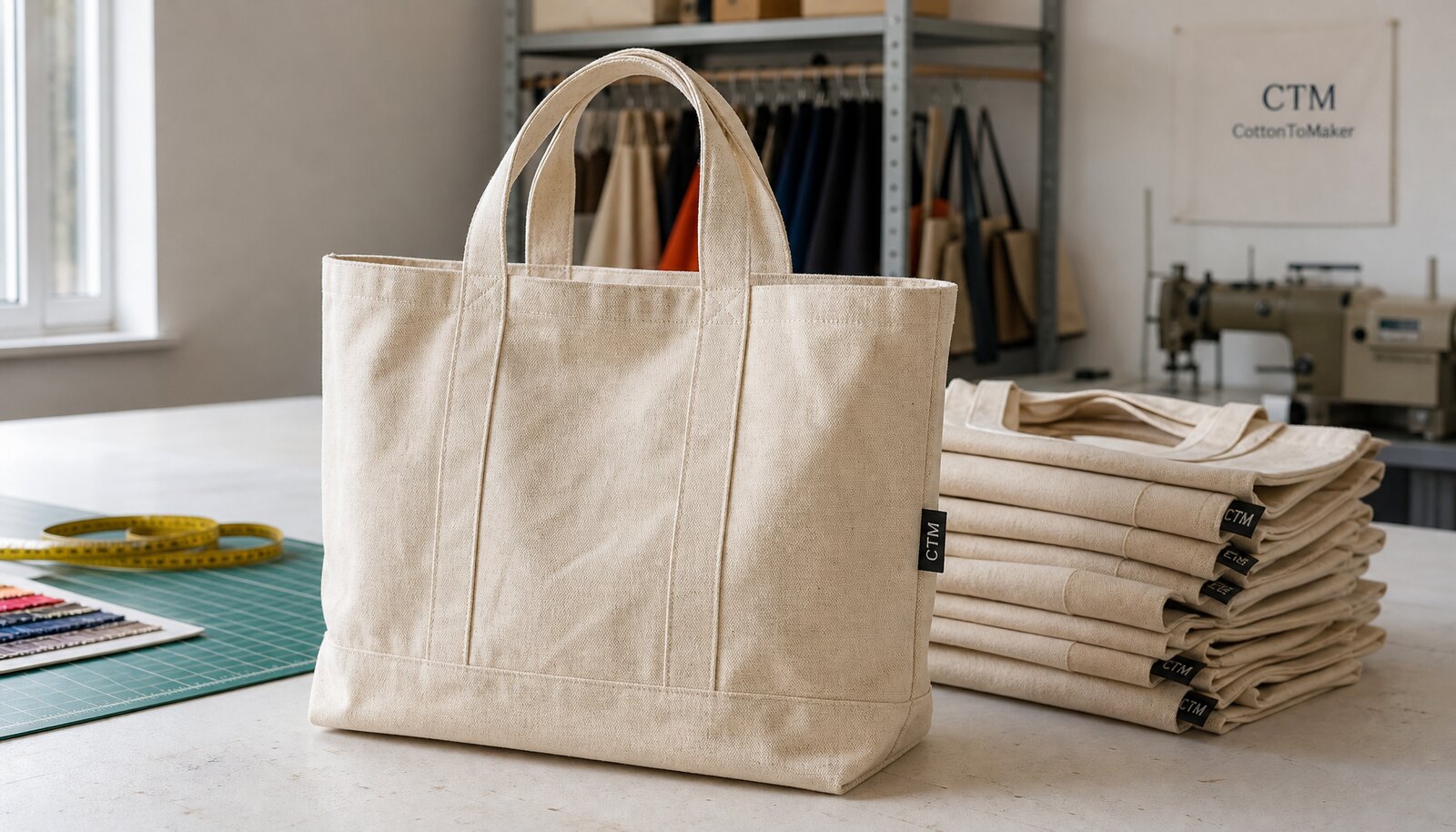
Why canvas bag quotes drift
Canvas tote quotes drift because suppliers are often pricing different assumptions, not the same product. One factory may assume a 12 oz natural cloth with basic topstitching, while another prices a 16 oz structured bag with reinforcement, a tighter pack-out, and a more conservative QC plan. The buyer sees one item. The factories see three different work packages.
The fastest way to create bad pricing is to send a photo and ask for a quote. A photo does not tell the supplier the finished dimensions, the seam allowance, the handle construction, the print method, the label requirements, or whether the bag must stand upright in store. If those items are missing, the supplier will fill in the blanks with its own defaults. That is how a low quote can turn into a revision later.
Retail chains need comparability more than they need a cheap headline number. You are not buying a one-time promotional tote. You are buying a repeatable SKU that may need to be reordered, packed the same way, received the same way, and reissued across stores without change. That requires a quote built on a controlled spec, not a style reference.
A useful RFQ is the one a factory can price line by line. If the quote does not break out fabric, sewing, print, packing, cartons, and setup, the buyer cannot tell whether the number is competitive or just incomplete.
- A low quote with missing assumptions is not a low-cost program.
- A retail chain needs repeatability, not a one-off sample that only looks good in a photo.
- If the spec is unclear, the factory will choose the cheapest valid interpretation.
Write the SKU before asking for price
Start with the finished product, not the artwork. The RFQ should state finished width, finished height, gusset depth, handle length or drop, seam allowance, top hem construction, and whether the bag needs a structured bottom or side reinforcement. If the tote has a pocket, lining, zipper, snap, piping, or binding, those details need to be written into the quote request as well. Every added component changes labor time and material consumption.
Use one unit system and keep it consistent. Canvas is often described in ounces per square yard, but some suppliers quote GSM. That is fine if the spec locks the conversion and the acceptable range. For example, 12 oz canvas is about 407 GSM, 14 oz is about 474 GSM, and 16 oz is about 542 GSM. If the buyer expects a certain body or shelf presence, the spec should say so in functional language too: soft, medium body, or structured.
The bag's purpose matters. A bag meant to carry merchandise at checkout can be lighter than a bag that must stand upright on a shelf for display or reuse. A bag with a large gusset and reinforced handles costs more than a flat carry bag, even if the artwork is identical. If procurement leaves that difference out of the RFQ, the factory will price the lowest viable build and the discrepancy will surface later.
The practical rule is simple: if you cannot draw the bag from the spec, you do not have enough detail to compare factories.
- Lock the finished dimensions and measurement method: flat, seam-to-seam, or outer finished size.
- State whether the canvas is natural, bleached, dyed, washed, or coated.
- Include reinforcement points and any internal structure in the RFQ drawing.
- Ask the supplier to quote the cut size and finished size separately if that affects yield.
Fabric and construction are the real price drivers
For canvas retail merchandise bags, fabric and construction usually move price more than the logo. A 12 oz bag with simple seams is a different cost structure from a 16 oz bag with a reinforced bottom, double-needle stitching, and bar tacks at the handle joins. If the factory is not told which construction level the chain requires, it may quote the lightest option that still passes a visual sample.
Construction choices affect yield and production speed. Wider seam allowances, more complex folds, contrast binding, extra pockets, and shaped bottoms all add sewing time. Heavy canvas can also slow the line if the supplier does not have the right machine setup or operator experience. That risk matters for retail chain programs because a factory that can make a sample may still struggle to hold output and consistency at scale.
Ask the factory how the cloth behaves in production. Is the material pre-shrunk? Does the pattern already include shrinkage allowance? Is the edge going to fray unless it is bound? Does the bag need a stiffener to stand up in store? These questions are not academic. They determine fabric usage, reject rate, and whether the bag will still look correct after handling.
If the supplier cannot state the stitch standard and reinforcement method, the quote is not mature enough for a chain rollout.
- Ask for the stitch type at stress points: single needle, double needle, or equivalent reinforcement.
- Confirm whether bar tacks, backstitching, or another reinforcement method is used at the handle join.
- Request the supplier's shrinkage assumption in writing if the bag is washed, dyed, or pre-treated.
- Check whether the quoted factory actually sews heavy canvas on the line that will make your order.
Choose the decoration method for reorder stability
Decoration should be selected for repeatability, not just for how the first sample looks. For many retail chain programs, screen print is still the default because it gives stable color, predictable cost, and durable results for one- or two-color artwork. It also scales well when the same logo needs to be reordered across store groups or seasonal runs.
Transfer and embroidery can make sense, but they change the commercial model. Transfer can help with short runs or more complex artwork, but buyers should ask how it behaves after folding, abrasion, and repeated customer use. Embroidery can create a premium look, but it adds machine time and can change how the bag packs. A heavy embroidered logo may be the right choice for a premium line, but it is not the cheapest way to brand a high-volume merchandise tote.
What matters for procurement is a precise artwork spec. The RFQ should state the artwork file version, placement, print size, number of colors, color reference system, and any minimum line thickness the factory can reliably reproduce. Thin strokes, tiny text, and tight registration are often the first thing to fail on textured canvas. If the art is too detailed for the fabric, simplify it before approval instead of allowing the supplier to guess.
Also ask whether setup can be reused on reorder. If the screen, plate, or template can be reused, the buyer usually gets better future pricing and shorter lead time. If setup is recharged every time, the quote needs to make that explicit.
- Specify the print area and its distance from seams or edges.
- Ask for the setup fee by color and by placement.
- Require color approval against a physical sample when possible.
- Confirm whether decoration changes the pack-out dimensions or carton count.
Supplier evidence and compliance by market
A low quote from the wrong source is still expensive. Before negotiating price, confirm whether the seller is a direct cut-and-sew factory, a trading company, or a broker. Direct factories are usually the best fit when you need control over fabric, stitching, decoration, packing, and reorders. Traders and brokers can still work, but only if the actual production site is identified and the chain of responsibility is clear.
Ask for evidence tied to the actual site that will make the bag. A factory audit for another location does not prove the quoted line is compliant. Request the legal company name, production address, recent compliance or social audit summary, QC flow chart, and a material specification sheet for the quoted cloth. If the quote is for a multi-site operation, ask which site will print, which site will sew, and which site will pack.
Compliance needs to match the selling market. For the EU and UK, ask for the declarations relevant to textile articles and any chemical restrictions the buyer's brand requires, including a REACH SVHC declaration where applicable. For US programs, ask for fiber-content and country-of-origin label rules, and if the bag is intended for children, ask about CPSIA tracking and any relevant lead or other material compliance. California programs may also require a Proposition 65 review depending on inks, trims, or coated components. None of these requests are optional if the customer or channel requires them.
A good supplier can explain the chain of custody from raw cloth to packed carton. If the answer stays vague, the commercial risk rises fast.
- Request the actual production site address and compare it to the audit site.
- Ask whether print, sewing, and packing happen in one building or across multiple vendors.
- Request declarations and test reports that match the destination market.
- Reject generic compliance claims that are not tied to the exact bag style.
Sample approval should prove production, not just design
A pre-production sample has to prove how the bag will be made in bulk. It should use the same cloth, the same thread, the same decoration method, the same trims, and the same pack-out that the factory plans to use on the order. If the sample is built from special hand-picked fabric or a different print process, it may look better than production and give procurement false confidence.
Make the approval measurable. Define the allowable range for key dimensions, handle drop, print placement, and color match. Also define the visible defects that are not acceptable: crooked top edge, uneven gusset, loose threads, misaligned print, handle imbalance, stain, or weak seam finish. If the order includes several colors or sizes, approve each variant separately or create a master standard that identifies what can vary and what cannot.
The sample process should also cover the retail experience. Does the bag stand or collapse? Does it fold back into the carton cleanly? Does the print crack after basic handling? Can the label be scanned through the pack-out? These are practical questions for a chain rollout because a bad sample gate often becomes a receiving problem later.
Do not move to bulk until the supplier has a dated sign-off. If revisions are needed, request a revised sample instead of relying on verbal approval.
- Use one signed master sample at procurement and one at the factory line.
- Approve the sample only after checking cloth, print, stitching, and packing together.
- If the sample changes after review, require a revised approval before bulk release.
- Record the exact sample version so the factory cannot substitute a different reference later.
Set QC thresholds that the factory can measure
Quality control works only when the acceptance criteria are specific. For canvas bags, start with an AQL-based final inspection and define what counts as critical, major, and minor. Do not leave this to the factory's internal custom. If the defect map is not written down, a buyer and supplier will often disagree after the shipment arrives.
A useful QC plan combines incoming fabric checks, in-line controls, and final carton sampling. The buyer should state the critical dimensions and the tolerance band in the PO. Many retail programs start with about +/- 0.5 cm or 1/4 in on major dimensions, but the right range depends on the style and the way the bag is displayed or packed. Stitching can be measured by a stitch-count standard or another agreed seam check instead of a vague visual review.
If the bag is reusable or heavily handled, ask for a durability check that fits the use case. That can include a rub test, wash check, or seam strength review using a method the buyer and supplier both understand. The goal is not to turn every tote into a lab specimen. The goal is to reduce the chance that the print wears off, the seam opens, or the bag changes shape after normal customer use.
Cartons need the same discipline. Ask for a handling method that matches the ship route, whether that is a simple drop test, an ISTA or equivalent pack test, or a pallet compression check. A carton that survives factory pickup may still fail at DC receiving if it is overfilled or the stack pattern is unstable.
- Write the AQL level, defect classes, and sampling plan into the order documents.
- Define stitch appearance and seam integrity with an agreed measurable check.
- If the bag will be reused, ask for rub or wash evidence rather than visual approval alone.
- Include carton handling expectations in the RFQ instead of treating them as logistics details later.
Packing and freight should be priced before production starts
Packing is not a minor detail for retail chains. It affects receiving speed, barcoding, store allocation, freight cost, and whether the distribution center can handle the cartons without rework. The RFQ should say whether bags are bulk packed or polybagged, how many pieces go into an inner pack, how many inner packs go into a master carton, and where the barcode label is applied. If the brand wants source scan verification, that needs to be part of the quote, not a later request.
Canvas bags compress, but they can still be damaged by the wrong carton fill. Overpacked cartons can crease the bag or deform the shape. Underfilled cartons can crush during stacking. If the tote is shelf-ready, the supplier may need a fixed fold method, tissue, or a specific orientation inside the carton. Those choices add labor and material cost, so they should be visible in the quote.
Ask for carton dimensions and gross weight up front. That information affects pallet count, warehouse handling, and freight planning. Many DCs prefer cartons that can be lifted manually without strain, so a practical buyer should set a gross-weight ceiling in the spec instead of assuming the factory will choose one. If the shipment is palletized, ask for the pallet pattern, maximum pallet height, stack count, and whether floor-loading is allowed.
Packing errors often cost more than sewing defects because they slow receiving and trigger rework at the distribution center. A clean pack spec prevents that.
- State whether cartons are single-SKU or mixed-SKU.
- Define the inner pack count, master carton count, and carton labeling format.
- Ask for carton dimensions and gross weight before agreeing to freight terms.
- Confirm whether pallets are required and who pays for palletization.
Commercial terms that change total landed cost
The unit price is only useful when the rest of the commercial terms are visible. Ask the factory to separate material, labor, print setup, packing, cartons, testing, and any special handling charges. A single-line all-in quote can hide the real cost driver, especially when the order has multiple colors, split deliveries, or label variations. Line-item pricing is easier to compare and easier to negotiate.
MOQ should be read by style, color, and artwork version. A low total quantity can still carry a separate setup charge for each color or placement. That matters for chain programs that need store-specific versions or seasonal variants. Ask for tier pricing and reorder pricing so procurement can see whether the program becomes cheaper after the first run or whether every reorder resets the setup cost.
Lead time should also be broken out. The factory should tell you sample lead time, bulk lead time, inspection date, and shipping readiness date. If the supplier quotes a fast schedule without stating whether fabric is in stock, whether print screens need to be made, or whether cartons are sourced separately, the timeline is not reliable enough for a rollout plan.
If you negotiate payment terms, make sure the quoted scope is stable first. A better payment term is not helpful if the quote excludes packing, tests, or source-applied labels that the buyer assumed were included.
- Ask for a separate sample fee and whether it is credited against bulk.
- Request reorder pricing in writing, not just first-order pricing.
- Confirm whether split shipments, color splits, or rush schedules add charges.
- Keep the same spec version tied to the same quotation so pricing stays comparable.
What to send in the RFQ pack
The fastest path to a clean factory quote is a complete RFQ pack. Send the finished drawing, fabric spec, artwork file, pack-out requirement, compliance needs, QC standard, and delivery window together. Do not send those items in separate emails unless you enjoy quote drift. A factory can only price accurately when it sees the same version of the product that procurement plans to approve.
A strong RFQ pack also helps internal alignment. Buying, quality, logistics, and merchandising often care about different parts of the tote program. One team wants cost control, one wants appearance, one wants scan-friendly packing, and one wants receiving speed. Putting the full spec in one packet forces those requirements to agree before the quote goes out.
If you need a practical internal checklist, use this order of operations: define the bag, define the decoration, define the pack-out, define the QC method, confirm the compliance market, then request pricing. That sequence keeps the factory from guessing and keeps your team from comparing non-equivalent quotes.
Once the quote is in, compare it against the same checklist. If a supplier left out a requirement, do not normalize the number. Correct the scope first, then compare price.
- Finished size drawing with tolerance
- Fabric weight and finish spec
- Artwork file and decoration method
- Pack-out drawing and label format
- QC standard, AQL target, and defect definitions
- Destination market compliance requirements
- Delivery window and shipping terms
Specification comparison for buyers
| Spec decision | Buyer-side default | When it fits | Evidence or numbers to request | Cost risk if vague |
|---|---|---|---|---|
| Fabric weight | 12-14 oz canvas, about 407-474 GSM; use 16 oz, about 542 GSM, for a more structured bag | Standard retail merchandise bags, reusable totes, and shelf-ready display bags | Mill or fabric spec, GSM or oz tolerance, shrinkage allowance, weave density if known | Supplier may quote a lighter cloth and call it 'heavy canvas' |
| Construction | Single or double-needle seams with bar tacks or equivalent reinforcement at stress points | Any bag expected to carry merchandise repeatedly or hold shape on shelf | Pattern sketch, seam allowance, reinforcement map, stitch count standard | Extra labor can appear later as a change order if it was not priced upfront |
| Decoration | 1-2 color screen print for stable chain programs; embroidery or transfer only when the brand requires it | Repeatable logos, controlled reorders, and predictable unit cost | Artwork file version, print area, color references, setup fee by color, screen reuse terms | Low quotes may exclude extra screens, setup, or a second pass for coverage |
| Sample | Pre-production sample made from the same cloth, trim, print method, and pack-out as bulk | Retail launch, multi-store rollout, or any order with a reorder plan | Sample fee, sample lead time, revision count, signed approval sheet | A pretty sales sample can hide production defects |
| Packing | Bulk or polybag + inner pack + master carton with source-applied barcodes if required | DC receiving, store allocation, and scan-based inventory programs | Pieces per carton, carton dimensions, gross weight, label format, pallet plan | Rework at the distribution center often costs more than sewing defects |
| Inspection | AQL-based final inspection with defect classes written in the PO | Any chain order with a chargeback risk or strict vendor onboarding | AQL target, critical/major/minor definitions, inspection method, carton sampling plan | Generic 'good quality' approval gives you no leverage later |
| Freight and pallet | Single-SKU cartons, defined pallet height, and a manual-lift carton weight ceiling | Retail distribution centers and export shipments with handling constraints | Carton stack count, pallet pattern, max gross carton weight, floor-load vs palletized | Undisclosed carton size can change freight and warehouse handling cost |
| Compliance | Market-specific declarations and test reports, not just a generic factory audit | US, EU, UK, or branded programs with regulatory or customer compliance rules | REACH SVHC declaration, fiber-content and COO label rules, CPSIA if applicable, Prop 65 if relevant | A clean factory audit does not replace product compliance evidence |
Buyer checklist before sampling
- Lock the finished size, gusset depth, handle length or drop, seam allowance, and reinforcement points before asking for price.
- State the fabric weight in oz and/or GSM, plus the finish: natural, bleached, dyed, washed, coated, or greige.
- Specify the expected hand-feel and function: soft merchandise bag, structured shelf bag, or reusable carry tote.
- Define the decoration method, artwork file version, print area, number of colors, and acceptable color tolerance.
- Ask the factory to quote line by line: fabric, sewing, decoration, trim, packing, cartons, testing, and setup charges.
- Require a pre-production sample made with the final fabric, final print process, final trim, and final pack-out.
- Confirm MOQ by size, color, and print version, not only by total order quantity.
- Request factory evidence tied to the actual production site: address, registration, audit summary, and QC flow chart.
- Set pack-out rules in writing: inner pack count, master carton count, barcode format, label placement, and pallet plan.
- Write measurable QC criteria into the RFQ: size tolerance, stitch standard, print tolerance, AQL target, and carton handling requirements.
Factory quote questions to send
- What exact fabric weight, weave density, finish, and shrinkage allowance are you quoting for the canvas body?
- Is the quoted size the finished size or the cut size, and what tolerance do you allow on width, height, gusset, and handle drop?
- Is the print setup charged by screen, by color, by placement, or by the total artwork area, and can the setup be reused on reorder?
- Does your MOQ apply per color, per size, per artwork version, or only to the total order volume?
- Will the pre-production sample use the same cloth lot, the same thread, the same decoration process, and the same packing method as bulk?
- What stitch count range per inch do you standardize, and how are handle joins and bottom seams reinforced?
- What inspection standard do you use at final audit: AQL level, defect classification, and carton sampling plan?
- Can you provide the actual sewing site address, recent audit summary, material spec sheet, and QC flow chart for the quoted order?
- What is included in the pack-out price: polybag, inner pack, barcode label, carton marking, master carton test, and palletization if required?
- If the order is split by color, store group, or ship date, how do cost, MOQ, and lead time change?
Quality-control points to confirm
- Fabric weight should land within the agreed tolerance, and the supplier should be able to show how it is checked by lot.
- For standard retail totes, many buyers start with about +/- 0.5 cm or 1/4 in on key dimensions; write your own tolerance into the PO.
- Finished bags should match the approved sample on handle drop, gusset depth, seam appearance, and overall silhouette.
- Stitching should be straight and even, with no skipped stitches, loose thread, seam puckering, or broken tension at stress points.
- Handle attachment should include reinforcement and should not twist the bag when loaded with normal merchandise weight.
- Print registration should be clean, with no obvious misalignment, pinholes, bleeding, cracking, or weak opacity on the canvas weave.
- For reusable bags, ask for a documented rub or wash check when the print method or use case makes surface durability important.
- Use an AQL-based final inspection and define critical, major, and minor defects before bulk production starts.
- Cartons should meet the agreed handling standard, such as an ISTA or equivalent drop/compression method if the order is shipping by parcel or long-distance distribution.
- Inner pack counts, master carton counts, barcode labels, and style codes should reconcile exactly with the PO and packing list.