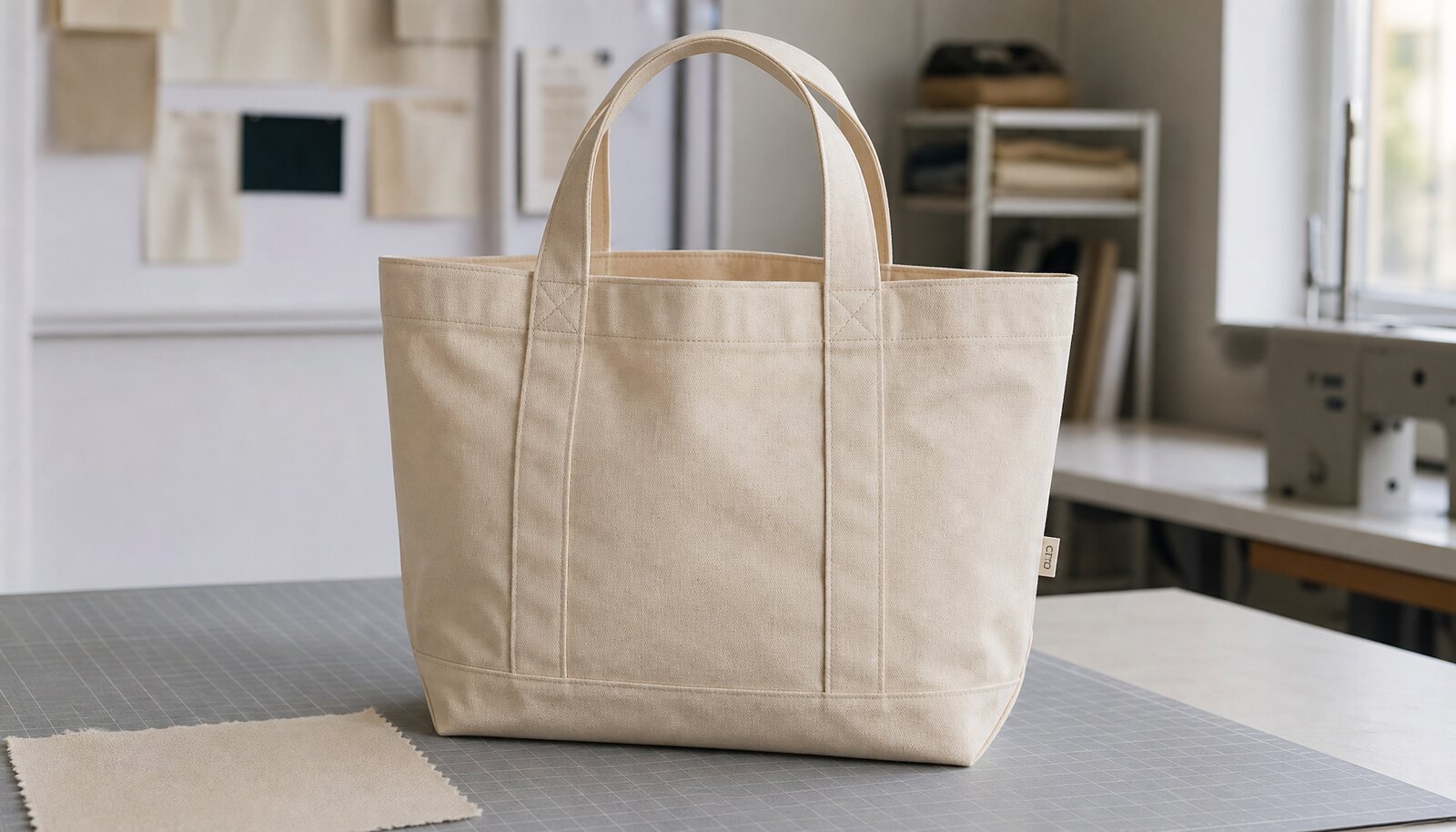
What This Buying Checklist Is Trying to Prevent
For gift shops, a canvas retail merchandise bag is not just a carry bag. It is part packaging, part impulse purchase, and part brand carrier. The buying mistake is usually to treat it like a simple commodity and let the quote decide everything. A low price on paper can hide the wrong fabric weight, weak handles, poor print registration, or carton packing that causes damage before the bags reach the store. This checklist is built to stop that pattern before the PO is issued.
The right starting point is the end use. A bag that carries postcards, candles, and small books needs a different structure from a bag that mainly functions as branded checkout packaging. Gift shop buyers also need to think about sell-through, not only unit cost. If the bag looks premium enough to sit near the register and strong enough to be reused, it can support margin. If it looks thin, prints poorly, or arrives crushed, the assortment loses value fast.
- Decide whether the bag is a checkout carrier, a souvenir item, or a branded retail product.
- Set the load expectation early so the factory does not build the wrong canvas weight or handle reinforcement.
- Treat packaging and display readiness as part of the product, not as afterthoughts.
Choose the Canvas Spec Around Use, Not Around Guesswork
Canvas weight is the first spec that changes the buying result. In wholesale gift shop programs, a common starting range is 10 oz to 14 oz for general retail use, with lighter canvas sometimes fitting low-cost souvenir bags and heavier canvas used when the bag needs a more structured look or higher carrying confidence. GSM and ounce weight are not the only factors, but they are the fastest way to narrow the quote range. A bag can be the right size and still feel wrong if the fabric is too limp or too stiff for the merchandise mix.
Once the base fabric is set, the rest of the structure needs to support the use case. Gusset depth, top hem finish, handle width, and seam reinforcement all affect the real carrying performance. If the bag is expected to hold bottles, boxed gifts, or hard-edged merchandise, add reinforcement at the handle attachment and make the top edge robust enough to survive repeat use. If the bag is mainly for lightweight paper goods, you can control cost by keeping the structure simpler, but do not underbuild the handles. Gift shop buyers often underestimate how fast a weak handle becomes a customer complaint.
- Use 10 oz to 12 oz canvas for lighter gift items and price-sensitive assortments.
- Use 12 oz to 14 oz canvas when the bag must feel more substantial on the shelf and in the hand.
- Use heavier construction only when the product mix justifies the added fabric and freight cost.
- State whether you want natural, bleached, dyed, or washed canvas, because color and finishing affect both cost and lead time.
Compare Sourcing Routes Before You Compare Unit Price
A clean quote comparison starts with the sourcing route, because each route creates a different risk profile. A direct factory is usually the best path when the bag spec is stable and the buyer wants control over materials, sewing, print, and packing. A trading company can help when the program mixes several products or when the buyer needs someone to manage multiple factories, but the paperwork needs more discipline. A domestic wholesaler is fast and easy to buy from, yet it generally gives up customization and margin.
For gift shop programs, the cheapest route is often not the best route. Stock blanks plus local printing can work well for short runs or testing a new design, but the blank bag may not match the final retail feel or the brand color standard. Factory-direct custom production takes longer, but it usually gives a better landed cost once the order volume is stable. The key is to compare like for like: same bag size, same canvas weight, same print method, same packing, and same delivery term.
- Direct factory fits repeat orders and tighter spec control.
- Trading company fits multi-item buying teams that want one contact point.
- Domestic wholesalers fit urgent buys but usually cost more per unit.
- Stock blanks plus local print fit low-risk market tests, not core programs.
Build the RFQ So Suppliers Quote the Same Bag
If buyers send only artwork and a vague size reference, the quotes will not be comparable. A useful RFQ should define the finished size, gusset depth, handle length, canvas weight or GSM, print method, print size, quantity, packing format, delivery target, and destination port or warehouse. It should also say whether the bag needs a woven label, care tag, hangtag, barcode label, or retail insert. The more the quote depends on assumptions, the less useful the unit price becomes.
The best way to compare suppliers is to force the same assumptions across all of them. For example, one quote may include flat packing and carton marks while another hides those costs in a general overhead line. One may quote natural canvas and another may quietly switch to a lighter fabric. Ask for a line-item breakdown so setup charges, print screens, sewing, packing, and cartons are visible. That is how procurement teams avoid apples-to-oranges pricing that looks attractive until the PO is placed.
- Include finished dimensions, not only artwork dimensions.
- State the exact decoration area and number of colors.
- Define packing: bulk, polybag, retail-ready, or mixed.
- Ask for the same incoterm or shipping basis from every supplier.
Print Method Choice Changes Cost, Appearance, and MOQ
Decoration is where gift shop bags often drift off spec. Screen printing is usually the most practical option for simple logos or seasonal art with one to three colors. It is durable and cost-effective once the screen setup is absorbed, but it needs clean artwork and stable placement. Heat transfer can handle more detailed graphics or small runs, though it may feel different on canvas and can age differently under folding and abrasion. Embroidery looks premium on heavier canvas, but it adds cost, changes handfeel, and can distort lighter fabric if the stitch density is too high.
The right print method depends on what the bag needs to say at retail. If the bag is meant to act like a branded souvenir, a woven label, embroidered mark, or a small patch can work well. If it needs to carry seasonal graphics or location-specific art, screen print is usually more efficient. Ask the factory for a strike-off or pre-production sample that shows the final ink density, placement, and edge quality. A good quote that ignores decoration detail is not a good quote; the print method is part of the cost and part of the quality standard.
- Use screen print for repeatable logos and a controlled color count.
- Use heat transfer only when the artwork needs detail that screen print cannot carry efficiently.
- Use embroidery or a sewn label when a premium look matters more than absolute unit cost.
- Require a sample or strike-off before bulk approval.
Set Sample Approval Rules Before Production Starts
A sample is not only for visual approval. It is the first time the buyer can test whether the bag actually works for the intended retail use. The sequence should be clear: reference sample, strike-off if needed, pre-production sample, then golden sample signed off by the buyer. Each step should carry a specific purpose. If the team skips straight to bulk approval, any disagreement later becomes a dispute over interpretation instead of a documented mismatch.
Sample checks should focus on the things that create the biggest production failures: bag size, stitch count, handle symmetry, seam security, color match, print placement, and the way the bag folds after pressing or packing. For heavier gift items, test the handle attachment by loading the bag with a realistic weight and moving it by the handles several times. The goal is not laboratory perfection. The goal is to catch the expensive mistakes while they are still cheap to fix.
- Approve a golden sample with measurements written on it or attached in the sample record.
- Confirm color under normal retail lighting, not only under factory light.
- Check the print after folding so you can see whether cracking or offset appears.
- Document any acceptable tolerance on size, stitch, and placement before bulk starts.
Packing Decisions Affect Freight, Damage, and Store Readiness
Packing is where many buyers lose money without noticing it. A canvas bag that looks fine in production can arrive wrinkled, dirty, or mislabeled if the packing standard is vague. Flat packing is usually the default for wholesale because it reduces volume and freight cost, but it must be paired with enough carton strength and moisture protection. If the bag is meant for direct retail display, the buyer should define whether it needs a polybag, a barcode label, a hangtag, or a folded insert that keeps the front panel clean.
Carton logic matters as much as inner packing. Ask for carton dimensions, gross weight, quantity per carton, and the way the bags are stacked. This affects sea freight, air freight, warehouse receiving, and shelf replenishment. For gift shops, a mixed carton can create handling problems at the store level because staff cannot easily pull the right SKU. Better to keep each carton cleanly labeled and consistent by size and print version, even if it means slightly more packing labor at origin.
- Flat pack when freight efficiency is more important than presentation on arrival.
- Polybag when dust protection or retail handling requires it.
- Use clear carton marks and barcode data that match the PO exactly.
- Define whether retail inserts or hangtags are inserted at factory or locally.
MOQ and Lead Time Should Follow the Real Production Bottleneck
MOQ is rarely about one number. It is usually the result of fabric width, dye lot, print screens, sewing line setup, and packing efficiency. A supplier may offer a low MOQ on paper, but once the buyer adds multiple artwork versions, custom colors, or special labels, the true minimum rises. That is why the order structure matters. One core bag with a few print variants is easier to make and replenish than five small styles with similar volumes. If the shop buys seasonally, a simple product architecture reduces dead stock and makes reorders more predictable.
Lead time should also be broken into stages, not treated as one number. Sample lead time, material sourcing time, bulk production time, and shipping time are different risks. If the supplier needs to reserve custom fabric or special trim, build that into the schedule early. Typical bulk lead times vary widely by season and complexity, so the better question is not only how many days the supplier quotes, but what happens if the buyer changes artwork late or misses approval on the sample. A realistic schedule protects both the factory and the retail launch.
- Ask MOQ by size, color, print version, and packing style.
- Separate sample time from bulk production time.
- Reserve extra time for seasonal peaks and artwork revisions.
- Keep the product range narrow if the first order is a test run.
Compare Landed Cost, Not Just Factory Price
The quote that wins the PO is often not the quote that wins the margin. Procurement should compare landed cost by including freight, duty, inland delivery, packaging upgrades, rework risk, and any local handling needed to make the bags shelf-ready. For canvas retail merchandise bags, a small change in fabric weight or pack size can change carton volume enough to shift freight cost materially. That is why the quote should show both unit price and packing density. A cheaper bag that ships inefficiently can cost more when it reaches the warehouse.
A good reorder decision also looks at how the first buy sells. If the bag moves quickly, the buyer may want to lock the same spec and order fabric in advance so the second order does not face a color shift or a supply delay. If sell-through is weaker than expected, the next order should simplify the design, reduce print complexity, or adjust the fabric weight. Gift shop buyers usually get better results when they treat the bag like a managed retail program, not a one-time purchase.
- Compare freight by carton cube, not only by unit price.
- Include local handling and warehousing when evaluating the true cost.
- Use the first order to learn the sell-through before expanding into many SKUs.
- Keep the spec stable if you expect repeat replenishment.
Specification comparison for buyers
| Spec decision | Recommended option | When it fits | Buyer risk to check |
|---|---|---|---|
| Sourcing route | Direct factory with sewing and printing in one workflow | Repeat orders, stable artwork, and a buyer who wants tighter process control | Confirm whether print, cutting, and final packing are truly in-house or quietly outsourced |
| Sourcing route | Trading company with a managed factory network | Mixed bag programs or teams that need one contact for several product lines | Make sure you still see the actual factory name, production location, and real lead time |
| Sourcing route | Domestic wholesaler with stocked blanks | Rush launches, small test buys, or seasonal fill-in orders | Stock may solve speed but usually limits size, color, and branding control |
| Production route | Stock blanks plus local printing | Small artwork runs and quick market tests for gift shop assortments | Check blank bag quality, print durability, and whether the blank shade matches your brand plan |
| Production route | One core body with multiple print variants | Gift shops carrying seasonal phrases or location-specific graphics | Too many SKUs can inflate MOQ, create leftover stock, and complicate reorders |
| Production route | Custom dyed fabric and custom trim | Established programs with forecast volume and a stable color standard | Dye lot variation and trim delays can create approval and scheduling problems |
| Decoration route | In-house screen printing | Simple logos, 1 to 3 colors, and repeatable retail programs | Require pre-production approval for ink opacity, placement, and handfeel |
| Packing route | Flat packed in master cartons | Most wholesale programs where freight efficiency matters | Control creasing, dust protection, carton strength, and retailer-ready labeling |
Buyer checklist before sampling
- Confirm the bag size, gusset depth, handle length, and the actual merchandise it must carry at retail.
- Lock the canvas weight or GSM and state whether the bag is natural, bleached, dyed, or washed.
- Choose one primary decoration method and define the number of print colors or embellishment areas.
- Set acceptable tolerances for body dimensions, seam placement, and handle symmetry.
- Define MOQ by size, fabric color, print version, and packing format instead of asking for one blanket number.
- Specify sample stages, who approves the golden sample, and what happens after revision comments.
- State packing requirements for bulk, retail-ready, polybagged, barcode-labeled, or insert-card formats.
- Request a line-item quote for fabric, printing, sewing, packing, and any setup charges.
- Ask for the production lead time, shipping window, and whether peak-season capacity is already committed.
- Confirm carton marks, barcode requirements, and any gift shop display or hangtag needs before the order is released.
Factory quote questions to send
- What finished size, fabric weight, and tolerance are included in this quote?
- Which decoration method is priced, and how many colors or setup steps are included?
- What is the MOQ per artwork version, fabric color, and packing format?
- Are sampling, strike-offs, and revision samples included or charged separately?
- What parts of the quote change if I adjust handle length, gusset, or fabric weight?
- Is the bag price based on flat-packed cartons, polybagging, or retail-ready packing?
- What carton count, carton size, and gross weight should I use for freight comparison?
- What is the production lead time after sample approval and deposit?
- Will any step be outsourced, such as printing, embroidery, washing, or final packing?
- Which documents can you provide with shipment, such as packing list, invoice, and carton dimensions?
Quality-control points to confirm
- Fabric weight or GSM matches the approved spec within the agreed tolerance.
- Finished dimensions, gusset depth, and handle length stay within your set allowance.
- Stitching is even at stress points, with secure bartacks or reinforcement where the bag carries weight.
- Print placement, ink coverage, and color match the approved artwork or strike-off.
- The print surface does not crack excessively after folding and basic flex testing.
- Loose threads, stains, needle marks, and fabric flaws are controlled before packing.
- Carton count, barcode label data, and inner pack format match the purchase order.
- The bag opens, folds, and stacks the way your retail team expects during receiving and shelf placement.