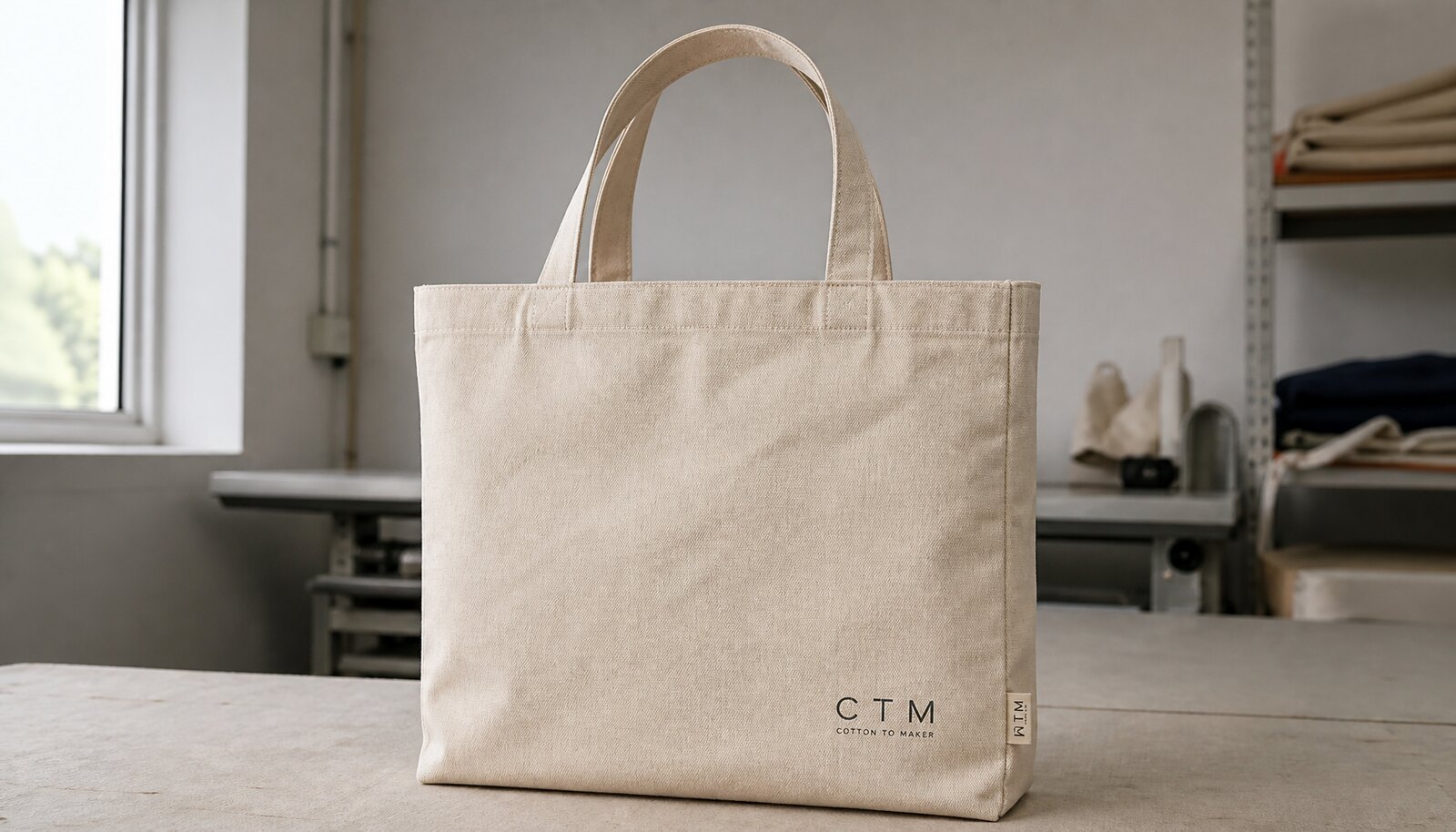
1. Why gift shops compare canvas against other packaging routes
Gift-shop buyers are not just purchasing a carrier. They are choosing a packaging object that can influence basket value, shelf presentation, and how the customer leaves the store. That is why canvas retail bags for gift shops sit in a different category from ordinary checkout bags. The decision is not only about sustainability. It is about whether the bag supports the store’s brand, pricing, and replenishment model without creating extra work at receiving, storage, or checkout.
A paper bag can be the right answer when the purchase is light, the trip is short, and the store wants the packaging to stay inexpensive. A canvas bag becomes more compelling when the bag itself has retail value, is given with purchase, or is expected to be reused enough times that the higher first cost can be justified. Jute and nonwoven cover some of the same use cases, but they do not automatically outperform canvas on presentation or repeat use.
Procurement teams should start by defining what the bag must do in the store. Is it only a carrier? Is it a branded souvenir? Will it be sold as a merchandise item? Will it be kept by customers and reused? Those answers determine whether the correct sourcing target is lowest first cost, best shelf image, or best total value over the bag’s useful life.
A useful way to avoid a weak RFQ is to separate the bag’s function into three roles: carry performance, retail value, and brand visibility. A single program may need all three, but not every store does. If the team forces every program into the same commercial mold, the result is usually a quote that looks cheap on paper but underperforms in the store.
Mini decision trigger: if the bag is part of the customer’s purchase experience and may be reused after the sale, canvas is usually worth a closer look. If the bag is strictly disposable and the order is highly price-sensitive, paper or nonwoven may be the better procurement path.
- Treat the bag as packaging, merchandise, and brand media only if the retail model supports all three roles.
- Compare reusable and disposable options on total use value, not just first invoice cost.
- Keep the RFQ focused on one primary use case so suppliers do not quote mismatched constructions.
2. Canvas spec basics: what weight and construction change in practice
For most gift-shop programs, the real decision is not canvas versus no canvas. It is which canvas weight and construction level match the products being carried. Lighter canvas reduces cost and can work for soft goods, small gifts, and simple checkout use. Heavier canvas adds body, improves shelf presence, and feels more premium in the hand, but it also increases material cost, sewing time, and shipping weight. The right choice depends on whether the bag will carry books, candles, ceramics, apparel, or mixed purchases.
The fabric weight should be specified clearly in the RFQ. Suppliers may quote by ounces per square yard or by GSM. Those numbers are not safe to compare unless the supplier states the basis and tolerance. Ask whether the canvas is natural, bleached, dyed, washed, or pre-shrunk. These choices affect hand feel, color stability, and whether the bag holds its shape after sewing or folds flat for retail display.
Construction details can matter as much as the fabric itself. Reinforced handle joins, neat top hems, stable gussets, and controlled seam allowances will make a bag look more expensive even if the fabric is not the heaviest option. On the other hand, an overbuilt tote may be technically strong but commercially awkward if it becomes stiff, bulky, or too expensive for the sales target. Buyers should specify the balance they want instead of assuming heavier always means better.
Ask suppliers to show a simple construction sketch with the following items labeled: handle length, handle width, seam allowance, gusset depth, top hem finish, and any label or print position. This makes it easier to compare samples and catch silent changes between quotation, sample, and mass production.
Mini decision trigger: if the tote is expected to carry mixed retail items and be seen as part of the brand, the construction spec matters almost as much as the fabric weight. If the program is purely functional, you may be able to simplify the build and reduce cost.
- 10 oz canvas: suitable for lighter retail merchandise and budget-sensitive programs.
- 12 oz canvas: a balanced option for many gift shops because it gives more body without becoming overly heavy.
- 14 oz canvas: better for heavier loads, premium souvenir presentation, or multi-item orders.
- Ask for exact construction details: hem style, seam allowance, handle reinforcement, and gusset depth.
3. Sustainable packaging comparison: canvas vs paper, jute, and nonwoven
A useful sustainable packaging comparison needs to show how each option behaves in the real supply chain, not just how it sounds in a marketing deck. Paper bags are easy to source, print, and pack, and they usually win on first cost. Their weakness is durability: they crease, tear under sharp or wet loads, and are normally treated as single-use packaging. For a gift shop with light purchases and fast checkout, paper can be commercially sensible. For a store that wants the packaging to remain visible after the purchase, paper usually stops working quickly.
Jute offers a strong natural look and a clear eco signal in the right setting. It often fits rustic retail themes or heavier visual merchandising. The tradeoff is that jute can be coarse, less comfortable on the shoulder, and harder to print cleanly when the artwork uses fine detail. It may also be heavier and bulkier to ship than buyers expect. If the retailer wants an artisanal appearance, jute can be a good fit. If the retailer wants clean logos and a smoother finish, canvas is usually easier to control.
Nonwoven bags are popular because they are lightweight and can be economical at scale. In gift-shop retail, though, they can read as promotional rather than merchandise-grade unless the print, die-cut, and binding are handled carefully. The buyer should ask whether the category needs a bag that disappears into the transaction or one that stays in use after the customer leaves. That single decision often changes the correct material route more than any sustainability claim does.
Canvas is strongest when the bag is part of the store story. It gives a better balance of reuse potential, print stability, and perceived value when the shop wants customers to keep using the bag. The drawback is that canvas has more sewing labor than paper, more quality-control points than a simple nonwoven bag, and more sensitivity to fabric variation if the supplier is not disciplined.
Buyer note: don’t compare materials by environmental language alone. Compare them by expected reuse, print durability, packaging behavior, and the likelihood that the customer will keep the bag in use. That is where the commercial difference usually shows up.
- Paper: lowest first cost, least reuse, most sensitive to moisture and creasing.
- Jute: strong natural identity, but rougher handling and more print limitations.
- Nonwoven: economical and lightweight, but often reads as promotional rather than premium retail.
- Canvas: strongest choice when the bag is meant to be reused, sold, or displayed as part of the brand.
4. Print, branding, and decoration: where quotes and quality often diverge
Decoration is one of the easiest places for quotes to drift apart. Two bags can look similar in an email and still price very differently once print setup, color count, and placement are specified. For gift-shop canvas bags, bold and simple artwork is usually the safest commercial choice. A logo with one or two colors, strong contrast, and enough line thickness will reproduce more reliably than fine illustration detail. Canvas texture can absorb ink unevenly and make very small text harder to read.
Screen print is usually the most practical method when the bag needs simple branding and controlled unit cost. It is repeatable, easy to inspect, and efficient on repeat orders once the setup is done. Embroidery can add a premium feel, especially for a smaller logo or boutique presentation, but it changes the cost structure and may slow output. Woven labels or side labels are useful when the retailer wants subtle branding without a large inked area. They also reduce the risk of print issues on textured fabric, though they create their own sewing and position checks.
Decoration placement deserves the same attention as the method. Artwork too close to seams can distort during sewing and folding. A logo that looks centered on a flat mockup may end up too low or too close to the side seam in the finished bag. Buyers should ask for a production drawing with exact distances from edge, seam, and base line, then verify that the sample matches the drawing. This is especially important when the tote is being sold in-store, because the front-facing image is part of the retail value.
One practical rule helps more than most buyers expect: set a minimum line thickness and a minimum text height before artwork is accepted for production. If the artwork is too fine for the canvas weight and print process, the supplier should flag it before sampling. This prevents the common problem of approving a beautiful digital mockup that becomes muddy once it hits the weave.
Mini decision trigger: if the logo is small, simple, and repeatable, screen print is usually the most controllable route. If the brand position relies on a premium textile feel, consider embroidery or a woven label, but expect a different cost and inspection profile.
- Screen print: best for simple logos, repeat orders, and clear cost control.
- Embroidery: better for premium presentation, but more expensive and slower.
- Woven label: useful when the brand should feel subtle and textile-led.
- Keep artwork away from seams and folds; ask for a dimensioned placement diagram, not only a mockup.
5. Quote comparison: how to make suppliers truly comparable
Many RFQs fail because they collect prices without fixing the assumptions behind them. A canvas quote is only meaningful if suppliers are pricing the same fabric weight, same size, same handle length, same print method, and same packing standard. If one quote uses 10 oz canvas and another uses 12 oz, or if one includes a woven label and another includes only a single-color screen print, the comparison is not commercial. It is just a list of numbers.
The cleanest way to compare suppliers is to build one spec sheet and ask for step pricing at realistic order volumes. Request pricing at the quantity you expect to buy now, then at the next two replenishment levels you might reorder. This shows where setup costs begin to flatten out. It also reveals which supplier is offering a genuine manufacturing advantage and which one is using a low headline number to win the first conversation. Separate line items for sample charge, print setup, packing method, and carton fees help prevent hidden costs from being buried in the unit price.
A fair quote comparison should also separate the bag price from the total delivered cost. Freight term, inland movement, inspection, and any special packing can materially change the final landed cost. If one supplier is closer to the destination or already has carton configurations that fit pallet limits better, the ex-factory price may not tell the real story. Procurement buyers should compare quote sheets on the same Incoterm and document any assumptions about shipping mode, warehouse delivery, or color-matching retries.
The best internal practice is to score each quote on three axes: spec fit, cost clarity, and delivery confidence. A supplier who is slightly more expensive but can show consistent dimensions, clean sample approval, and a transparent production schedule may be lower risk than the cheapest bidder. That is especially true for seasonal gift-shop buys, where a late delivery can create lost sales that dwarf the difference between two tote quotes.
Mini decision trigger: if two quotes differ by more than a few percentage points, ask what changed in fabric weight, decoration, or packing before you compare price. The answer is often more valuable than the discount itself.
- Quote the same size, same fabric weight, same print method, and same carton plan across suppliers.
- Request separate line items for unit price, setup cost, sample cost, and packing changes.
- Compare the same delivery term and the same shipping basis before judging price.
- Ask for stepped pricing at your real reorder volumes, not only at one arbitrary MOQ.
6. MOQ, lead time, and supplier route: what matters beyond the headline number
MOQ should be treated as part of the sourcing strategy, not just a factory restriction. A low MOQ can help with a holiday test run, a new store opening, or a limited-edition gift-shop assortment. But if the supplier achieves that MOQ by charging a high setup fee or by using inconsistent fabric lots, the apparent flexibility may not be worth it. Ask what actually drives the MOQ: fabric sourcing, screen setup, cutting efficiency, or sewing line changeover. The answer tells you whether the supplier is fit for replenishment business or mainly for one-off orders.
Lead time should be broken into stages rather than quoted as a single number. A useful schedule includes sample approval time, material booking, production time, inspection time, and dispatch time. If the supplier only gives a total calendar estimate, ask for the longest-risk step. In canvas tote programs, that risk often sits in material availability, printing queue, or packing. Buyers who leave the schedule vague often discover too late that the factory assumed a later ship window than the sales team did.
Supplier route matters because different sellers control different parts of the risk. A direct factory is usually the best route for repeat orders with a fixed spec because it offers clearer visibility into fabric, sewing, and print workflow. A trading company can be useful when the buyer needs mixed sourcing or consolidated logistics, but traceability can be harder. A local converter may be the best route for urgent programs, small runs, or fast artwork changes, even if the unit price is higher. The right supplier is the one that matches the commercial timeline, not the one with the lowest quote at first glance.
If the program is seasonal, ask what happens when production is delayed by a fabric or dye-lot issue. Some suppliers can switch to another stock quickly; others cannot without changing hand feel or color tone. That question is more useful than asking only for a promised date, because it shows whether the supplier manages exceptions or simply assumes they will not happen.
Mini decision trigger: if the store has a fixed launch date, choose the supplier who can explain the recovery plan, not just the nominal lead time.
- Ask the supplier to explain what really drives the MOQ.
- Get lead time split into sample, material, production, inspection, and dispatch stages.
- Choose supplier route based on repeatability, urgency, and visibility into materials.
- Ask how the factory handles fabric substitution, dye-lot changes, or late artwork corrections.
7. QC thresholds and inspection standards to write into the PO
General quality statements are not enough for procurement. A tote program needs measurable acceptance criteria because small errors can create real commercial problems. If a gift-shop bag arrives with a short handle, a shifted print, or a distorted gusset, it may still be usable in a warehouse sense but unacceptable at retail. QC should be written as specific checkpoints that inspectors can apply consistently.
Finished dimensions should be checked after pressing, not only while the bag is still fresh off the sewing line. The buyer should define the acceptable tolerance band for width, height, gusset, and handle drop in the purchase order or spec sheet. Handle length deserves special attention because uneven or short handles change both appearance and usability. Stitching at the handle join should be examined for bartack consistency, seam alignment, and thread cleanliness. For bags meant to carry heavier items, the buyer can request a pull test on the handle attachment area for the first production batch.
Print quality needs its own criteria. Specify acceptable registration, opacity, and readability at normal retail distance. For simple logos, the inspection should check whether the mark is centered within the agreed placement zone and whether line edges are clean. On textured canvas, some print softening is normal, but the artwork should still be legible and consistent across the lot. If the logo is small, the supplier should confirm the minimum line thickness that the process can hold before production begins.
Defect control should also cover the fabric itself. Natural canvas can include yarn variation, but visible oil stains, holes, severe slubs in the print area, or dirty folding should be rejected based on the agreed standard. Carton checks matter too: count accuracy, carton compression, moisture protection, and label accuracy should all be included in the inspection plan. If the bags are being shipped long distance, the receiving team should know what to expect before cartons arrive. A clean inspection checklist reduces disputes and protects the reorder relationship.
For a first order, the strongest sequence is pre-production sample approval, first-article inspection, then pre-shipment inspection before balance payment or release. That sequence catches most visible and dimensional issues early enough to correct them and gives the buyer a paper trail if the bulk order later differs from the sample.
Mini decision trigger: if the bag will be sold or carried by customers outside the store, tighten QC on handles, stitching, and print legibility before you negotiate price.
- Write tolerances for width, height, gusset, and handle drop in the PO.
- Check bartacks, seam finish, and handle attachment under pull stress on the first lot.
- Define print readability, placement window, and opacity as measurable inspection items.
- Include carton count, moisture condition, and carton mark checks, not only bag appearance.
8. Packing, carton loading, and logistics: where small choices affect landed cost
Packing is often treated as a back-office detail, but it affects both cost and quality. Canvas bags are usually packed folded in export cartons because that keeps labor manageable and protects the product during transport. The buyer should decide whether the folding method is only for shipping or whether the bag must arrive retail-ready. If the bag will be displayed immediately in-store, the fold line, wrinkle level, and surface scuffing become commercial issues, not just logistics issues.
Carton loading should be set with the destination in mind. If the bags are going to a distribution center, carton count and pallet efficiency may matter more than perfect retail presentation. If the goods are going straight to a gift shop or a chain of small stores, carton labels and easy receiving may matter more than maximizing every cubic centimeter. Buyers should ask the supplier to show carton dimensions, gross weight, and estimated pallet count before production, because this information affects freight planning and warehouse handling.
Moisture protection deserves more attention than it usually gets. Canvas itself is not fragile, but long transit, humid warehouses, and damp containers can create odor, creasing, or surface marks that become visible when cartons are opened. Depending on the route and season, a simple liner, desiccant, or carton strengthening step can prevent avoidable receiving issues. That extra protection should be justified in the quote rather than added casually after the order is confirmed.
Retail-ready packing, such as individual polybagging or tissue inserts, should only be used when the channel really needs it. Those steps add labor, material, and waste. They can also weaken the sustainability message if they are used automatically. Buyers should ask whether the extra presentation benefit is worth the cost and whether the gift shop actually needs shelf-ready units or can handle bulk folded cartons efficiently.
Mini decision trigger: if the bags are going to a warehouse with limited receiving capacity, ask for simpler, clearly marked cartons rather than decorative packing extras.
- Specify fold style and whether visible crease marks are acceptable.
- Ask for carton dimensions, gross weight, and pallet count before confirming freight.
- Use moisture protection only where route or climate justifies it.
- Do not add retail polybagging unless the channel or decoration requires it.
9. Cost drivers and a practical landed-cost comparison buyers can use
The most useful procurement question is not, ‘What is the unit price?’ It is, ‘What is the total cost to get a bag that performs in our store and arrives on time?’ For canvas bags, the biggest cost drivers are fabric weight, decoration complexity, handle and seam construction, packing method, and the logistics path. A higher fabric weight increases material cost directly. More colors or a second print location increase setup and labor. Better carton protection adds packing cost. A slower shipment or a last-minute rework adds hidden cost that is easy to miss when reviewing only the ex-factory number.
A simple landed-cost comparison should start with one common spec and then show how each material route changes the economics. For example, if a gift shop is comparing a reusable canvas tote against paper, jute, and nonwoven, the buyer should ask for the same approximate carry size and the same print requirement on each route. Then the team should note not only the unit price but also expected reuse, shelf value, and risk of customer dissatisfaction. The goal is to understand which option is cheapest per useful carry, not only per carton.
Here is the kind of internal comparison that helps: if paper is low-cost but single-use, its effective cost rises when the store needs a premium branded look or when customers carry multiple items. If jute has the right natural look but requires simpler artwork, the buyer may need to rework the design to keep production stable. If nonwoven is cheapest on paper but weaker in perceived value, it may be a poor fit for a boutique gift environment. Canvas often wins when the bag can be resold, gifted, or reused often enough to justify the higher first cost.
The best procurement habit is to ask suppliers for a cost breakdown that separates material, labor, decoration, packing, sample, and logistics assumptions. Once those elements are visible, the buyer can decide whether to negotiate fabric weight, simplify decoration, change packing, or switch supplier route. Without that breakdown, a low quote can look attractive even when the actual landed cost and retail performance are weaker than the alternatives.
Mini decision trigger: if a slightly higher-cost bag will materially improve repeat use or in-store presentation, compare cost per useful carry instead of chasing the lowest invoice.
- Compare unit cost, reuse value, decoration complexity, and freight impact together.
- Ask suppliers to separate material, labor, decoration, packing, and logistics assumptions.
- Use one internal landed-cost sheet for all material routes so the comparison is defensible.
- Evaluate cost per useful carry, not just cost per bag.
10. Final buyer checklist before issuing the PO
Before placing a purchase order, procurement teams should be able to answer a short list of commercial questions without going back to the supplier. What is the bag for: resale, giveaway, or carrier only? What fabric weight and construction best match the products being carried? What decoration method can be repeated without quality drift? What QC checks will be applied if the first lot arrives out of spec? If the buyer cannot answer those questions, the RFQ is probably too loose.
The strongest POs for gift-shop canvas bags leave as few assumptions open as possible. They name the fabric weight, bag dimensions, handle length, print placement, packing method, and inspection criteria. They also state what happens if the bulk lot deviates from the approved sample. This is not about making the process rigid; it is about reducing the chance that the supplier and the buyer are imagining different products when they sign the same order.
Buyers should also keep a record of the exact approved sample, color reference, and carton mark format. If the product is reordered later, that documentation becomes the fastest path to consistency. Seasonal gift-shop programs often repeat, and repeatability is worth more than a small saving gained by loosening the spec too far on the first order.
A last practical step is to decide the order of priorities before the supplier starts cutting fabric. If delivery date matters most, say so. If shelf presentation matters most, say so. If the bag will be sold to customers rather than handed out, say so. Suppliers can optimize much better when the priority is explicit.
Mini decision trigger: if the program will repeat next season, protect your spec sheet and golden sample now. That saves time and reduces variation later.
- Define the bag’s commercial role before approving material and decoration.
- Attach the approved sample, measurement sheet, and packing instructions to the PO.
- Keep one reference color and one reference print file for reorder continuity.
- Use explicit acceptance criteria for any deviation from the sample.
Specification comparison for buyers
| Buying criterion | Canvas tote | Paper bag | Jute bag | Nonwoven bag |
|---|---|---|---|---|
| Typical gift-shop role | Best when the bag is part of the product mix: resale, premium checkout carrier, or reusable souvenir bag | Best for short-trip carry, low-cost checkout, and one-time packing | Best for rustic, natural-positioned retail programs and heavier visual texture | Best for budget promotional carry and simple event-style packaging |
| Typical material spec | Usually 10–14 oz cotton canvas; lighter builds for soft goods, heavier builds for premium or heavier purchases | Usually 80–150 gsm or equivalent board/stock spec depending on style | Commonly 5–12 oz equivalent, but yarn density and weave matter more than a simple fabric label | Commonly 80–120 gsm; lower GSM reduces cost but increases softness and collapse risk |
| Indicative cost band at custom print level | Mid to high: often higher first cost, but better value when reused or resold | Low: usually the lowest first-cost option | Mid: material and sewing can exceed simple paper, especially with print complexity | Low to mid: economical at scale, especially for simple one-color branding |
| Reuse potential | High if fabric weight, handle reinforcement, and stitching are specified well | Low: typically limited by moisture sensitivity, creasing, and tearing | Moderate: durable but bulkier and less comfortable for repeat use | Moderate: reusable, but visual appeal and durability vary widely by GSM and finish |
| Print quality and detail | Good for bold logos and simple art; textured weave needs larger strokes and stronger contrast | Good for flat graphics, but folds, scuffing, and ink rub can show quickly | Good for bold graphics, but rough texture can reduce fine detail | Good for large simple prints; heat and registration control matter |
| Common failure mode | Soft or underweight canvas can bag out, distort at the seam, or feel cheap in retail display | Creasing, edge fray, moisture damage, and tearing under mixed purchases | Coarse hand feel, loose yarns, uneven surface, and print distortion around seams | Surface deformation, weak handle areas, inconsistent print opacity, and a promo-only look |
| Shelf and retail presentation | Strong if cut and sewn neatly; stands better on display than soft alternatives | Adequate for short-term presentation, but dents and creases during handling | Strong visual identity for rustic themes, but less refined for premium boutiques | Functional but often reads as promotional rather than merchandise-grade |
| Packing and logistics profile | Predictable but bulkier than paper; folds well into export cartons if crease control is acceptable | Very cube-efficient and lightweight, but vulnerable to moisture and crushing | Bulkier and heavier than paper; can increase carton volume and freight impact | Lightweight and compact, but needs care to avoid deformation and corner crush |
Buyer checklist before sampling
- Lock the bag size, gusset, handle drop, and target fill weight before requesting quotes.
- Specify fabric weight in GSM or oz, plus tolerance, and note whether the canvas is natural, bleached, dyed, washed, or pre-shrunk.
- Define the decoration method, print area, Pantone references, and minimum line thickness for all text and artwork.
- Confirm whether the bag is intended to be sold, gifted, or used only as checkout packaging; the use case changes the construction and cost target.
- Request a pre-production sample, a retained golden sample, and a measurement sheet covering all critical dimensions.
- State packing requirements clearly: folding method, carton count, barcode labels, inner protection, and whether retail-ready bagging is required.
- Set QC acceptance criteria for seam strength, print registration, size tolerance, stain limit, thread trimming, and carton condition.
- Ask for landed-cost assumptions in writing, including freight term, sample charges, packing surcharges, and any color or size change fees.
- Compare at least two quotes on the same spec sheet rather than comparing supplier descriptions line by line.
- Document lead time by stage: sample approval, material booking, production, inspection, and dispatch.
Factory quote questions to send
- What exact fabric weight do you propose in GSM or oz, and what tolerance applies to the incoming rolls and finished bags?
- Is the quoted price based on one print location and one color, and what is the surcharge for extra colors or a second decoration area?
- What are the finished size tolerances for width, height, gusset, and handle drop, and how do you measure them before packing?
- How many pieces per carton are included, what is the carton size, and what changes if we request retail polybagging, tissue, or barcode stickers?
- What pre-production sample is included, what is charged separately, and do you retain a golden sample for production reference?
- What is the production schedule after artwork approval, and which steps are most likely to delay the shipment?
- Which QC standard do you use for sewing, print, stains, and count accuracy, and can you share an inspection report sample?
- Are the prices firm for repeat orders, or do they depend on fabric market changes, dye lot changes, or carton allocation?
- If we change handle length or print position after sample approval, what retooling or re-screening cost applies?
- Can you quote the same bag in paper, jute, and nonwoven on the same packing basis so we can compare total landed cost fairly?
Quality-control points to confirm
- Finished size: check width, height, and gusset after pressing, not only straight off the sewing line. Set the tolerance band in the PO so there is no later dispute.
- Handle length and drop: measure both handles from seam point to seam point and confirm symmetry. Uneven handles affect both shelf appearance and wear.
- Stitching: inspect stitch density, seam straightness, thread trimming, and bartack placement at handle joins and stress points. For heavier retail loads, request a pull test on the first lot.
- Print quality: check registration, opacity, edge sharpness, and readability under retail lighting. Small text should remain legible at normal shelf distance.
- Fabric defects: reject oil marks, holes, severe slubs in the print area, color contamination, and visible dirt on retail-facing panels. Use agreed AQL criteria for the lot.
- Packing condition: verify fold consistency, moisture condition, carton compression, and count accuracy. Open cartons from different pallet positions, not just the top layer.
- Carton marking: confirm SKU, color, quantity, gross/net weight, destination mark, and PO number. Missing carton marks slow warehouse receiving.
- Inspection method: use pre-production sample approval, first-article check, and pre-shipment inspection on the first order. Reduce frequency only after the supplier proves stability.