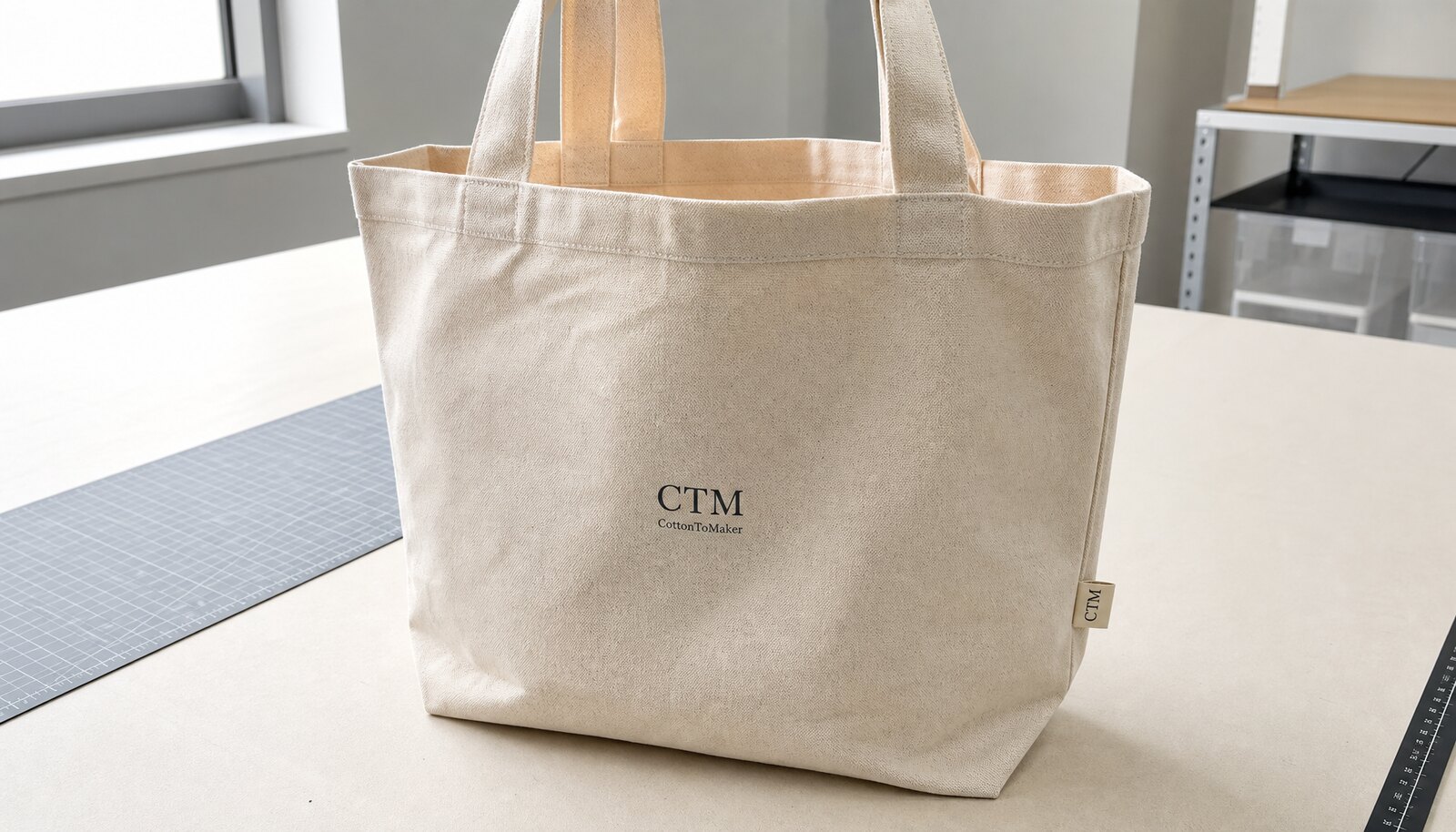
Start With the Retail Job, Not the Bag
For farmers markets, the bag is doing more than carrying produce. It is a retail merchandise item, a walking brand impression, and often a resale bag that needs to feel sturdy enough for repeat use. That changes the sourcing brief. If the product is only meant to hold brochures or a lightweight purchase, you can keep the fabric lighter. If it needs to carry bottles, root vegetables, candles, or jars, the handle and seam construction matter more than a decorative print spec.
The cleanest private label plan starts by defining the load, the shopping environment, and the shelf position. A market shopper usually buys with one hand, carries the bag by hand or shoulder, and places it in a car trunk or stroller. That means the tote has to open easily, hold shape well enough to be usable, and look good after repeated folding. A bag that is technically cheap but collapses, wrinkles badly, or prints poorly will create return risk for the buyer and weak sell-through for the brand.
- Define the real use case: produce carry, retail gift purchase, branded merchandise, or mixed use.
- Specify expected load range so the factory does not build an underweight bag that fails in use.
- Decide early whether the buyer is purchasing for shelf resale, event distribution, or in-market resale by vendors.
Choose the Fabric Weight That Matches the Margin
Canvas is not one material; it is a cost ladder. For retail merchandise bags, the practical range often sits around 8 oz to 12 oz, or roughly 270 GSM to 400 GSM depending on construction and weave. An 8 oz bag can work for lightweight market merchandise and seasonal programs, but the body will feel softer and may wrinkle more. A 10 oz to 12 oz bag usually gives better shelf presence, better print clarity, and a more premium hand feel without pushing the bag into a heavy industrial look.
If you want the bag to sell as a branded retail item instead of a throw-in freebie, pay attention to more than weight alone. Yarn count, weave density, pre-shrunk finishing, and the amount of garment washing or enzyme treatment all affect how the bag lands in a store. Two suppliers can quote the same GSM and still deliver very different results. Ask for the fabric construction, not just the headline weight, and tie the quote to a sealed approved sample.
- 8-9 oz: useful for lightweight retail, giveaway-plus programs, and lower-cost market bags.
- 10-12 oz: better for standard private label resale, stronger hand feel, and cleaner logo presentation.
- Above 12 oz: suitable when the product itself is a premium merchandise item and the buyer wants a heavier, more structured tote.
Select the Print Method by Order Size and Brand Risk
For canvas retail merchandise bags, screen print is still the workhorse for most private label programs. It is economical on repeat orders, handles bold logos well, and gives the buyer control over ink opacity on natural fabric. One-color and two-color prints are usually the sweet spot when the brand wants a clean market-ready look without high artwork setup cost. If the artwork is fine-lined, gradient-heavy, or needs a photographic effect, you should expect more decoration cost and more rejection risk.
Heat transfer can work when the order is small or the design changes often, but it usually does not match the long-term wear of a well-cured screen print on canvas. Embroidery can be useful for premium merchandise bags, but it adds cost and may distort lighter fabrics unless the base cloth is strong enough. Woven labels, side labels, and sewn patches are often the best answer when the buyer wants brand identity without a large ink area. The right choice depends on how the bag is sold, how often it is reordered, and how much handling the print must survive.
- Screen print: best for repeat volume and simple logos.
- Heat transfer: better for small runs or artwork changes, but verify durability.
- Woven or sewn label: useful when the bag itself should feel like a branded retail item.
Build the RFQ Around Quoteable Data
Most quote problems come from vague RFQs. If the supplier has to guess the fabric weight, handle length, branding location, fold method, and pack format, the quote will either come back padded or will look cheap and then change later. A usable RFQ for canvas retail merchandise bags should include finished measurements, seam allowance expectations, artwork files, desired fabric finish, print locations, carton pack count, and target delivery window. If the bag has a gusset, say whether the gusset should be boxed, flat, or rounded. If the handle is meant for shoulder carry, specify the drop length rather than assuming the factory will size it correctly.
Quote data should be structured so you can compare supplier offers line by line. Ask for base bag price, print price per color, label cost, sample cost, packaging cost, and any surcharge for rush production or special fabric sourcing. For private label sourcing, the real comparison is not just the unit price. It is the cost to get a retail-ready bag that matches the approved sample and does not trigger rework, relabeling, or carton relabeling at destination.
- Include artwork format, Pantone targets if relevant, and print size in centimeters or inches.
- Specify whether the bag is folded flat, stuffed, polybagged, or retail-hung.
- Request pricing at at least three volume breaks, such as 500, 1,000, and 3,000 pieces.
Compare Supplier Routes Before You Compare Price
The cheapest quote is often the wrong supplier route. For a farmers market program, your real choices usually sit between stock blanks with local decoration, a direct cut-and-sew factory, a trading company, or a hybrid import-plus-local-finish model. Each route changes your control over quality, lead time, and packaging. A stock blank can be fast, but the shade, hand feel, and measurement control are limited. A factory-direct private label order gives better consistency, but only if the buyer provides a tight spec and does not treat the first sample as a casual reference.
The sourcing route should match the maturity of the product line. If the bag is a test SKU, you may want speed and flexibility. If the bag is a continuing retail item, you need repeatability, carton discipline, and the ability to hold the same branding treatment across reorders. The right supplier is the one that can reproduce the approved sample, not the one that wrote the lowest number on the first page of the quote.
- Use a stock blank route only when speed matters more than brand control.
- Use factory-direct sourcing when you need repeat orders, private label consistency, and tighter packing control.
- Use a trading company only if you need multi-factory coordination or mixed product assembly that a single factory cannot manage well.
What to Accept in a Sample, and What to Reject
A sample approval should be more than a visual yes or no. Measure the finished size, compare the handle placement, inspect the seam finish, and test whether the bag opens and closes the way your buyer expects. A good sample for a retail merchandise tote should also show the actual print method, actual fabric hand, and the same folding and packing method the bulk order will use. If the supplier shows a hand-finished sample with better stitching than the production line can repeat, that sample will create problems later rather than reduce them.
Set your sample gate before bulk production starts. Reject any sample that hides inconsistent print density, crooked handle attachment, excessive shrinkage, or a color shade that will not work with your brand system. For natural canvas, slight variation is normal, but the variation must be inside your acceptance range. The buyer should not accept a sample just because it looks close. The question is whether the factory can make the same bag again at scale without changing the fabric or rushing the print cure.
- Measure the sample against the spec sheet, not against memory.
- Check handle symmetry, stitch density, logo centering, and bag opening shape.
- Hold the sample under the same pack and retail presentation you expect in the final shipment.
Packing and Retail Readiness Decide the Hidden Cost
Packing is not a small detail. For retail merchandise bags, the way the product is folded, packed, labeled, and cartonized can change freight cost, warehouse labor, and retail presentation. A loosely packed bag may be cheap at the factory and expensive at destination because it takes more cube space and slows receiving. A clean flat-fold with stable carton counts reduces warehouse variation and makes reorders easier to manage.
If the bag will be sold through a market vendor, a farm shop, or a gift shop, decide whether it needs a hang tag, belly band, barcode sticker, or polybag with warning text. If the product is destined for a retail chain or distributor, carton marks and barcode discipline matter just as much as print quality. Ask the factory to quote the exact pack format, not just 'standard packing.' The difference between bulk-packed and retail-ready often decides whether the first shipment lands on time or gets reworked after arrival.
- Ask for carton dimensions, carton weight, and piece count per carton before approval.
- Confirm whether each bag will be folded the same way in every carton.
- If using retail labeling, verify barcode placement and legibility on the actual pack sample.
Lead Time, MOQ, and the Reorder Curve
MOQ logic should be tied to print method, fabric sourcing, and pack complexity. A simple stock blank with local print can support small starts, but a cut-and-sew private label tote often needs a higher first-order minimum because the factory has to source fabric, set up cutting, run the print screens, and plan the sewing line. If you need multiple logo colors, multiple hang tags, or different retail labels, the MOQ should be evaluated per artwork version rather than as one blended number. That is how buyers avoid underquoting a SKU that looks small on paper and becomes expensive in production.
Lead time should be quoted as a sequence, not one vague number. You need sample approval time, material purchase time, production time, packing time, and shipping time. A realistic factory quote should tell you what happens if artwork approval slips by a week or the color strike-off needs revision. For seasonal farmers market programs, even a short delay can push a product past its selling window. That is why repeat orders should be planned before stock runs out, not after the last carton is opened.
- Separate first-order MOQ from reorder MOQ.
- Tie lead time to approval milestones, not only to the production calendar.
- Reserve buffer time for artwork corrections, print checks, and carton label revisions.
Landed Cost Needs to Include Rework Risk
A private label tote can look affordable at ex-factory and still be expensive at destination. To compare offers properly, add sample fees, print setup, inner packing, carton supply, freight mode, duty or brokerage where relevant, destination handling, and the cost of any re-labeling you may need after receipt. If one supplier is 8 percent cheaper on unit price but has weak packing or inconsistent print, the landed cost can move the other way after inspection, repacking, or write-off.
The best landed-cost comparison is built from the exact quote structure you will approve: bag body, decoration, labels, pack format, carton count, and shipping method. For a farmers market line, the retailer usually values a bag that sells cleanly and reorders without surprises. That means you should compare the cost of failure too. If a supplier cannot control measurement or print placement on the first batch, the margin you thought you saved on paper will disappear in the first receiving report.
- Compare ex-factory price, decoration cost, pack cost, and freight together.
- Estimate rework or relabel cost before you choose the supplier route.
- Track reorder pricing separately so the first order does not hide the long-term cost structure.
Specification comparison for buyers
| Supplier option | What to verify | Commercial advantage | Buyer risk to control |
|---|---|---|---|
| Direct sewing factory | fabric swatch, approved sample, seam close-ups, logo test photos, packing pilot, and final inspection evidence | Better sample-to-bulk control and faster production feedback | May be weaker on export paperwork or branded packing unless checked early |
| Trading company | Factory name, production photos, trim-source proof, and who owns QC decisions | Can coordinate small mixed orders and extra services | Markup can hide real factory capability and slow defect decisions |
| Specialized bag workshop | bag size, gusset, handle drop, seam allowance, stitch density, reinforcement patch, and loading expectation | More practical for detailed construction, trims, and repeat programs | Capacity may be limited during peak seasons |
| Low-price general supplier | 8-12 oz cotton canvas, 120-220 gsm cotton, recycled cotton, or blended fabric selected by use case and target price | Useful for simple promotional runs with loose specs | Material downgrades, weak packing, and vague inspection scope can erase savings |
| Retail-ready supplier | fold method, inner bundle, carton count, carton mark, moisture protection, SKU separation, and warehouse receiving needs | Can handle labels, SKU separation, carton marks, and receiving rules | Higher unit cost must be compared against reduced warehouse work |
| Compliance-focused supplier | Fabric records, labeling review, test plan, and production traceability | Safer for retail programs and repeat brand orders | Documentation claims need evidence, not only sales language |
| Local sample room plus bulk factory | Signed sample, bulk factory handoff, first-piece photos, and deviation owner | Good for complex branding before large production | Sample room quality may not match bulk line unless handoff is controlled |
Buyer checklist before sampling
- Confirm finished size, gusset depth, handle drop, and whether the bag must stand upright on a table.
- Set fabric weight in oz or GSM, then specify whether the fabric is natural, bleached, dyed, or pre-shrunk.
- Choose branding method first: screen print, heat transfer, woven label, embroidery, or a mix.
- State the target MOQ by artwork version and by colorway, not just the total order quantity.
- Define pack format: bulk packed, individual polybag, belly band, hang tag, barcode, and carton mark.
- Ask for a pre-production sample from the actual fabric and print method, not a generic reference sample.
Factory quote questions to send
- What fabric weight, weave count, and shrinkage allowance did you price?
- How many print colors are included, and what is the cost for a second location or second colorway?
- What are the MOQ breakpoints for first order, reorder, and mixed-size production?
- Does the quote include sample fee, plate or screen fee, packing fee, and carton labeling?
- What is the production lead time after artwork approval, and what changes it if we approve later than planned?
- How do you control measurements, stitching, and print registration before bulk packing?
Quality-control points to confirm
- Fabric weight should stay within an agreed tolerance, usually around plus or minus 5 percent of spec for routine commercial programs.
- Handle attachment must survive a practical load test without seam pop, bartack failure, or thread breakage.
- Logo placement should stay centered and consistent; small retail bags cannot hide a logo that sits too high or too low.
- Print should cure fully with no tackiness, peeling, or visible ink cracking after light folding.
- Finished size should match the approved sample within the agreed tolerance, typically tight enough to avoid shelf and carton issues.
- Cartons should match the packing list exactly, with clear carton marks, inner pack counts, and barcode verification.