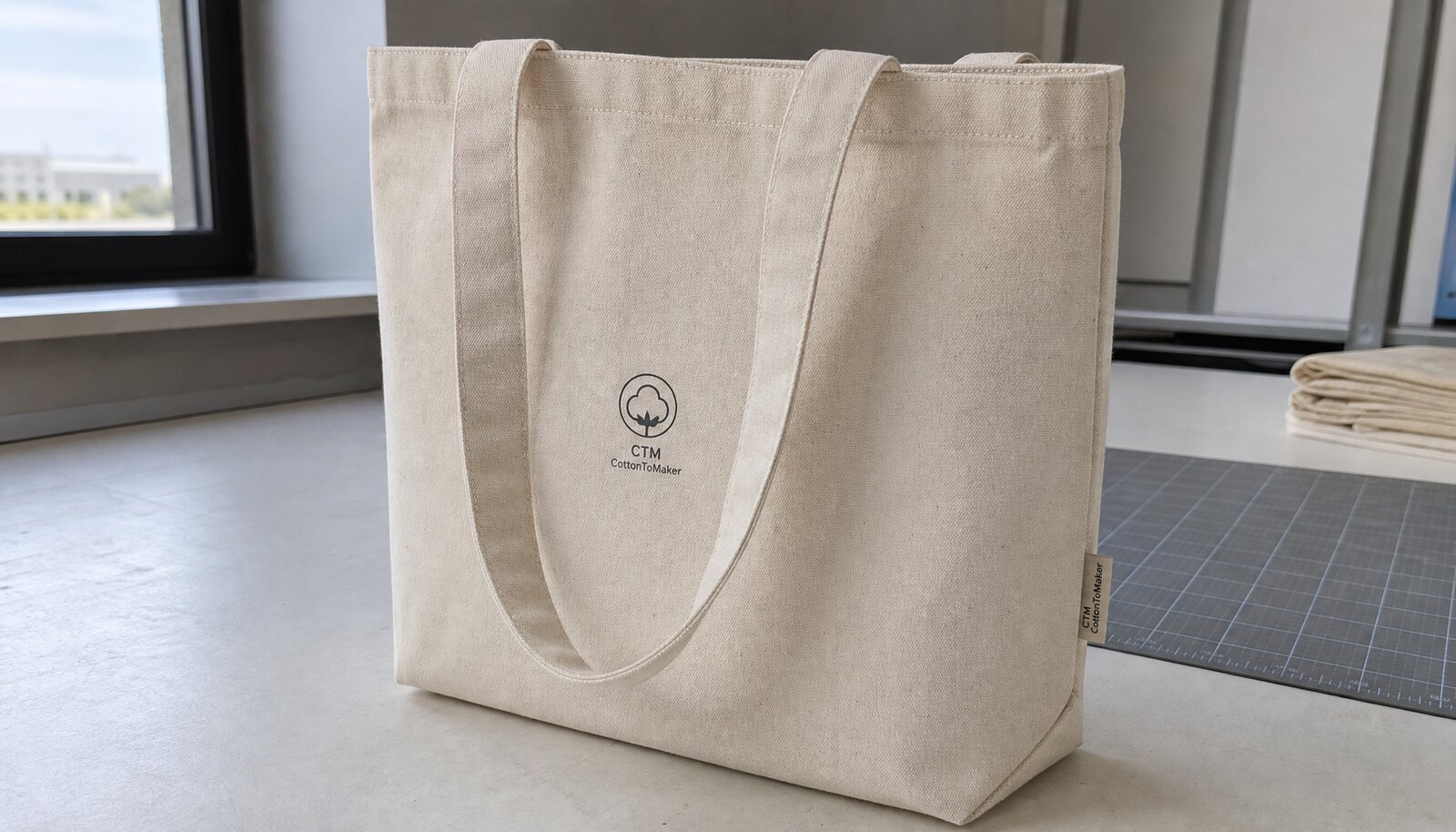
Start With The Use Case, Not The Logo
A farmers market bag is not a generic promo tote. It may carry produce, packaged food, glass jars, bottled drinks, event leaflets, or retail purchases in one trip, and the buyer usually wants the same bag to do all of that without feeling flimsy. That is why the approval process for canvas retail merchandise bags for farmers markets should start with use case, not artwork. If the buyer only reviews the logo placement, the first production run can still fail on load performance, handle comfort, or how the bag holds its shape when displayed on a market table or hung on a peg.
The use case also determines what the factory should optimize. A bag sold as retail merchandise needs to look clean, stand upright reasonably well, and survive repeated customer handling. A bag used as a market carrier may need more seam strength and a wider gusset. A bag intended as a branded giveaway can tolerate simpler packing and lighter construction, but a resale tote cannot. Write the channel into the spec: retail resale, in-store merchandise, event carry bag, or mixed-use market bag. That one sentence should drive fabric weight, handle length, reinforcement, and packaging style.
Procurement teams should also define the load profile in plain language. “Can hold groceries” is too vague. The supplier needs to know whether the bag must carry three glass jars, two bottles, leafy produce, or a mix of items with sharp corners. If the use case is not written down, the sample gets judged on appearance alone, and the production order becomes a guessing game. A good sample approval checklist starts by proving the bag fits the real buyer problem, not by confirming that the logo looks centered.
For farmers market programs, it is also worth stating how often the bag is expected to be reused. A one-season bag can be specified differently from a long-life retail item that should stay in rotation across many visits. Reuse expectations affect the fabric weight, stitch density, thread strength, and how carefully the print must be cured so it does not crack after folding. This is the difference between a tote that looks good in a photo and one that performs as a sellable product at market.
- Define the primary load: produce, jars, bottled drinks, folded apparel, or mixed retail goods.
- State whether the bag must look premium on a shelf or simply function as a utility carrier.
- Write the user behavior into the spec, such as shoulder carry, hand carry, repeated folding, or open-carry use.
- Record whether the bag will be resold, given away, or used as packaging, because that changes quality expectations and packing rules.
Translate End Use Into Real Dimensions And Capacity
Once the use case is clear, the next approval step is dimensional. Buyers often ask for a “standard tote size,” but standard means different things to different factories. For canvas retail merchandise bags for farmers markets, a bag can be the correct height and still fail if the gusset is too shallow, the handles are too short, or the opening is too narrow for packed produce. The sample should be measured on the same flat surface every time, with the same method used on the signed spec sheet.
Do not measure only the outside perimeter. A useful approval sheet should list body height, body width, gusset depth, handle length, handle drop, seam allowance, and top hem width. Handle drop is especially important for market buyers because shoulder carry and hand carry feel very different in real use. A bag can technically meet size if the handles are long enough on paper, yet still dig into the shoulder if the drop is off by just a small amount. This is one of the most common reasons a sample is “almost approved” but not truly production ready.
For procurement teams, dimensional tolerance matters as much as nominal size. If the sample is 14 inches wide, the factory should know whether the acceptable range is plus or minus 1/8 inch, 1/4 inch, or something broader. That tolerance should be written for width, height, and gusset separately because each dimension affects the final appearance and capacity differently. On a retail merchandise bag, a loose tolerance can produce a visibly uneven shelf presentation, while on a reusable market carrier, a tighter tolerance helps the program stay consistent across reorders.
A practical way to avoid disputes is to require the factory to measure a pre-production sample in the same format as the buyer’s spec sheet. Ask for the measurement method, not just the number. For example, confirm whether the factory measures across seam points, finished edge points, or inside panel width. A supplier who cannot explain how the sample was measured is likely to create measurement arguments later when the bulk shipment arrives. For larger programs, use a photo of the bag laid flat with a tape measure visible so both sides can reference the same geometry.
Capacity should also be reviewed in relation to structure. A deeper gusset improves volume, but only if the bottom seam and handle reinforcement can support the extra load. A taller bag may hold more retail merchandise but become awkward if the handles are too short. In farmers market sourcing, the dimensions are not a style choice; they are the first functional test of whether the bag suits the channel.
- Write finished size, gusset depth, handle length, and handle drop on the approved spec.
- Set separate tolerances for width, height, gusset, and handle drop instead of using one loose general tolerance.
- Ask the factory to explain the measurement method used on the sample.
- Approve a flat-lay measurement photo with tape measure visible for the golden sample.
Choose Fabric Weight, Weave, And Finishing Before Reviewing Print
Fabric is the main cost and quality driver in canvas tote sourcing, and many buyers underestimate how much the cloth itself changes the final approval result. A 10 oz / about 340 gsm canvas is often the most balanced choice for farmers market retail merchandise bags because it offers enough body to stand up well, yet it is still practical to sew and print at scale. A 12 oz / about 400 gsm cloth feels more premium and generally handles heavier loads better, but it also raises sewing difficulty, slows production, and increases the risk of heavy seams looking bulky if the factory is not accustomed to thicker material. An 8 oz / about 280 gsm option may be acceptable for lighter-duty promotional use, but it is easier to overpack and harder to keep looking premium after repeated use.
Fabric weight alone is not the whole story. Buyers should ask whether the canvas is natural, bleached, dyed, pre-washed, or pre-shrunk, because those finishing steps change shrinkage, softness, and print behavior. A washed canvas can feel nicer and may reduce the stiff “new fabric” look, but it can also introduce variation in shade or handle. A pre-shrunk fabric helps protect finished dimensions, especially when buyers care about exact retail shelf presentation. Natural unbleached canvas is common because it prints well and keeps the bag visually neutral, but the buyer should inspect for slubs, thin streaks, lint, and weave irregularity before moving ahead.
The sample approval should include a real fabric check, not just a visual look. Ask for a swatch cut from the same roll family as the sample, and if the order is large enough, ask for a roll reference or lot reference. That way, if the sample is approved on a clean-looking lot but the bulk uses a different cloth lot, the change can be caught early. For procurement, the risk is not simply that the bag looks different; it is that shrinkage, print absorption, or seam response changes during production. The sample should confirm the cloth can support the program, not merely prove the bag can be sewn.
Weave density matters in retail perception. Two bags with the same nominal weight can feel very different if one has a denser weave and better yarn quality. Dense canvas can make print edges look sharper and reduce visible show-through on lighter inks. Looser weave can be acceptable for budget programs but may telegraph the fabric structure through the logo or create a rougher handfeel. When buyers are comparing quotes, they should ask not just for “10 oz canvas” but for the full material description, because the lowest price often hides a lighter or looser cloth than the one used on the approved sample.
- Use 10 oz / about 340 gsm for a balanced retail farmers market bag in many programs.
- Use 12 oz / about 400 gsm when the bag must feel premium or carry heavier contents.
- Ask whether the cloth is pre-shrunk, washed, heat-set, or untreated natural canvas.
- Request a swatch from the same lot family used for the sample, not a generic fabric chip.
Specify Seam Construction And Handle Reinforcement Like A Buyer, Not A Designer
For canvas retail merchandise bags for farmers markets, seam construction is one of the easiest places for a sample to look fine while hiding future failure. A buyer should not approve a bag by touch alone. Inspect the side seams, bottom seam, gusset transitions, and top hem under good light and with the bag turned inside out if needed. The goal is to understand where load is actually being carried. If the fabric is heavy but the seam is weak, the bag may fail at the exact point where shoppers lift it with a full market load.
Handle construction deserves its own approval line because handle failure is one of the most visible defects in the category. Ask whether the handles are self-fabric, webbing, or contrast tape; each option has a different look, feel, and cost profile. Self-fabric handles are common for a cleaner retail appearance, but they need strong reinforcement at the attachment point. Webbing can improve strength and reduce stretch, while contrast tape may help with branding but can be less visually integrated. The sample should show the exact reinforcement style, whether that is bar tacks, box-X stitching, multiple topstitches, or an internal facing method.
Stitch count should be part of the spec, not a casual comment. Buyers do not need to specify machine model, but they do need an agreed standard for stitch density and thread behavior. Too few stitches can lead to opening at stress points; too many can perforate lighter canvas or create a puckered seam. Thread color should also be approved because a mismatch can make a bag look lower quality even when the construction is fine. If the bag is a retail item rather than a backstage carrier, the buyer should treat seam appearance as part of the product finish, not as an invisible internal detail.
A strong sample approval workflow should include a small stress test. Fill the bag with the heaviest realistic load the market customer is likely to carry, then lift it by the handles repeatedly and watch the seam line, handle base, and top edge. Look for twisting, opening, fabric pull, or odd distortion after the bag is loaded. This does not replace formal lab testing, but it does tell the buyer whether the seam and handle pattern are realistic for the end use. If a sample cannot survive a simple buyer-side load check, it is not ready for bulk approval.
If the order will be reordered later, it is worth documenting the exact reinforcement pattern with a close-up photo. A written description of “reinforced handles” is too vague. The factory should know whether the reinforcement is an X-box, rectangle stitch, double bar tack, or other pattern, and that pattern should be visible on the golden sample. Reorder stability starts with construction being described precisely enough that a different operator can reproduce it without guessing.
- Inspect side seams, bottom seam, gusset joins, and top hem separately.
- State the handle material, reinforcement pattern, and visible stitch color on the spec sheet.
- Use a simple load test with the heaviest realistic market load before approval.
- Photo-document reinforcement details so reorder bags can be matched exactly.
Choose Branding And Print Methods Based On Artwork Complexity And Volume
Print method should be chosen from the artwork and the volume, not from habit. For most farmers market merchandise bags, one- or two-color screen print is still the most dependable option because it gives stable color, repeatable placement, and predictable unit economics at scale. It works especially well when the logo has bold shapes, readable type, and a clear margin around the graphic. The sample should be checked for ink coverage, edge sharpness, and whether the weave of the canvas shows through more than the buyer considers acceptable. On natural canvas, a slightly textured print is normal, but the buyer should decide how much texture is acceptable before bulk starts.
When artwork becomes more complex, the buyer has to balance appearance with manufacturability. Heat transfer or digital transfer can handle small text, multicolor artwork, or short-run graphics better than traditional screen print, but they introduce different risks such as edge lift, cracking after folding, and a softer or more plastic handfeel. Those risks matter if the bag is sold as retail merchandise rather than just used as an event carrier. Embroidery, woven labels, and sewn patches can improve the perception of value, but they also add thickness and can distort lighter canvas. A bag does not become better simply because more decoration was added; it becomes better when the branding method matches the channel and the material.
Buyers should also be specific about placement. A front graphic, side label, and inside care label are three separate decisions with separate cost and quality implications. If a woven side label is used as the brand signature, the label dimensions, fold type, sewing position, and visible edge finish should all be approved. The same applies to a hangtag or care label. For a retail bag program, a supplier who can show the final logo position on a pre-production sample reduces the risk of late disputes about centering, scale, or alignment with the seam lines.
The quote should include the ink color count, screen setup or plate cost, and the print placement tolerance. Ask whether the supplier is using Pantone matching, a physical reference sample, or an in-house color target. If the buyer expects an exact brand color, that expectation must be written down. If the ink coverage is too weak on natural canvas, the sample may look washed out even though the artwork proof looked correct. In practice, a good sample approval process for bag printing is about comparing how the print behaves on the actual cloth, not only whether the logo file is correct.
Buyers should be careful with large solid areas and tiny reversed type. Canvas weave can soften fine detail, and a printer may hand-finish a sample that cannot be repeated at volume. If the sample has extremely sharp print edges but the factory cannot explain how that will be achieved in production, treat the sample as a demonstration rather than proof. Production-ready means the result can be repeated across the order with normal line controls.
- Match the print method to logo complexity and order volume, not to preference alone.
- Require Pantone targets or a clearly approved color reference for every print color.
- Check opacity on natural canvas so the weave does not show through the logo more than intended.
- Approve placement separately for front art, side label, and care label.
Compare Supplier Routes Before You Send Artwork Or Pay For Sampling
The supplier route affects not just price, but how reliable the sample approval process will be. A direct cut-and-sew canvas factory usually gives the best visibility into fabric sourcing, stitch quality, and handle reinforcement. That matters when a buyer needs the same bag reordered later and cannot afford to discover that the sample came from a different production path than the bulk order. A trading company or sourcing agent can be efficient when you are buying multiple products or need consolidated shipping, but the buyer has to insist on seeing the actual factory identity, production region, and whether the factory itself controls the sewing and printing rather than just subcontracting them out.
A local printer with outsourced sewing can be useful for small domestic test runs or urgent art changes, especially when marketing needs a quick visual prototype. But this route is operationally split: one company may own printing, another sewing, and a third packing. If the logo looks right but the seams fail, the buyer can lose time deciding which party owns the problem. That is why the sample approval checklist should include a question about process control: who cuts the fabric, who prints it, who sews it, and who packs it? A supplier who cannot answer that clearly is harder to manage once the order is released.
For procurement buyers, the route should be matched to risk. If the order is a repeatable farmers market retail program with fixed dimensions, fixed art, and annual replenishment, a direct factory usually offers the cleanest approval path. If the program is exploratory and the buyer only wants to test demand at local markets, a simpler route may be fine, provided the buyer understands that the pilot bag is not the final production bag. The danger is treating all supplier routes as equivalent and then comparing prices without understanding where quality control actually happens.
Before sending artwork, request a factory capability snapshot rather than a marketing promise. Useful evidence includes photos of the sewing line, examples of similar canvas work, a sample inspection report template, and a short explanation of how samples are revised. Buyers do not need a glossy presentation. They need evidence that the supplier can reproduce the approved sample without reinterpreting the spec every time a new operator touches the order. The more detailed the order, the more important it becomes to know who actually controls the process.
- Direct factory: strongest control, best for repeatable production and reorder consistency.
- Trading company: useful for coordination, but require factory disclosure and line-item detail.
- Printer plus outsourced sewing: good for quick prototypes, but define ownership of defects before approval.
- Request factory evidence before sampling: line photos, similar product photos, sample report format, and revision process.
Treat The Sample As A Production Test, Not A Showroom Piece
The approval sample should be judged like a production part. It is not enough that the bag looks nice on a table or that the logo appears centered in a photo. The sample must prove the factory can make a bag that matches the written spec under normal production conditions. That means checking finished dimensions, seam symmetry, handle drop, print placement, folding behavior, and the inside of the bag as carefully as the front face. A buyer who only inspects the front panel is approving an incomplete product.
The most reliable approach is to create a golden sample and a spec sheet together. The sample is the physical reference; the sheet is the documented agreement. The sheet should include measurements, tolerances, material description, print method, reinforcement pattern, packing format, and any allowed variation. Once both are signed off, future changes should be treated as formal revisions. That sounds obvious, but many small bag programs drift because a buyer asks for “just one small adjustment” after approval and never resets the document set. The result is a production run nobody can describe accurately later.
A practical sample review should include a simple defect sweep. Check for loose threads, fabric stains, oil marks, odor, misaligned seams, puckering, weak handle attachment, print smudging, and poor folding. Then do a real handling check: put the intended items in the bag, lift it by the handles, set it down, refold it, and see whether the shape remains acceptable. This is especially useful for farmers market bags because the customer experience is tactile. A bag that looks good but feels awkward will not perform well as retail merchandise.
When the sample includes a side label, hangtag, or care instruction, inspect those components as part of the same approval. Buyers often separate “bag quality” from “label quality,” but the customer receives one product. A crooked label, wrong barcode, or careless hangtag position can make the whole item feel less premium. If the bag is going into retail channels, the sample should also be reviewed under the actual shelf or display conditions where it will be sold. For example, a tote that hangs nicely may look compressed when flat-packed; both states matter depending on the channel.
A final point on sample control: keep one retained reference sample with the signed date, revision number, and any approval notes. Store a second digital record with front, back, inside seam, label, and packing images. If the supplier later claims a different interpretation of the spec, the buyer needs a reference package that is stronger than memory or email threads. Good sample approval is a document control exercise as much as a product review.
- Measure the sample on a flat surface and compare it to the written spec, not to memory.
- Use a golden sample plus signed spec sheet; keep both under revision control.
- Inspect front, back, inside seams, handles, print, label, and fold performance as one product.
- Retain dated photo records and a physical reference sample for reorder use.
Define An Inspection Workflow Before Bulk Production Starts
Many tote bag programs fail not because the sample was bad, but because the buyer never defined how bulk production would be checked. If canvas retail merchandise bags for farmers markets are going to be ordered at scale, the approval checklist should include an inspection workflow that can actually be executed on the factory floor or by a third-party inspector. The minimum structure is simple: incoming material check, first-article review, inline check, final random inspection, and carton verification. Each step should have a purpose. Material check confirms the cloth and accessories are what was approved. First-article review confirms the line can reproduce the sample. Inline check catches drift before the whole lot is sewn. Final random inspection confirms the shipping cartons match the spec.
A useful procurement document also needs defect classification. Define which problems are critical, major, and minor before production starts. A critical defect might be a broken handle, wrong product, or severe contamination that makes the bag unsellable. A major defect might be wrong print placement, open seam, or a wrong color that affects retail value. A minor defect might be a loose thread or a slight folding inconsistency that does not change function. The point of classification is not to create bureaucracy. It is to prevent arguments after the fact and to make sure the supplier understands what can be reworked and what must be rejected.
If the order is important enough to inspect, the buyer should also agree on the inspection sample size or AQL level rather than saying “please check carefully.” Even if the exact number varies by program, the principle is the same: inspection must be repeatable, not subjective. Ask the supplier whether they use an internal AQL process or can accommodate a third-party inspection standard. Then confirm how many cartons will be opened, how defects will be counted, and what happens if the lot fails. Without those rules, the factory and buyer can both claim they inspected the order while still disagreeing on whether it passed.
Measurement procedure matters as much as the inspection level. Decide whether dimensions are checked on folded bags, laid-flat bags, or a mix of both, and make sure the inspector uses the same method the buyer used on the sample. For print, define whether placement is measured from the seam, the hem, or the centerline. For packing, confirm carton count by physical count, not by pack label only. If barcode labels are part of the program, test whether they scan and match the packing list before cartons are sealed. These details sound small, but they are what turn a sample approval into a production control system.
A buyer who wants better factory accountability should ask for a sample inspection report format before placing the order. Even a basic report with photos, measurements, defect counts, and carton status is better than a verbal “all good.” If the supplier can provide that level of evidence before bulk shipping, procurement has a stronger basis for acceptance or rejection. If they cannot, the buyer should expect more risk at destination.
- Use a simple workflow: material check, first article, inline check, final random inspection, carton verification.
- Define critical, major, and minor defects before production starts.
- Agree on an inspection level or AQL reference instead of asking for a general quality check.
- Test barcode scan, carton counts, and measurement procedure before cartons are sealed.
Lock Packing, Cartons, And Retail Presentation Before The PO Is Released
Packing often determines whether a good canvas bag arrives as a sellable retail item or as a wrinkled warehouse product. For a farmers market program, the buyer must decide whether bags are packed flat, polybagged, tagged, tissue-wrapped, or bulk loose. Each choice affects labor cost, carton size, transit damage, and the first impression on arrival. A simple flat-fold bulk pack may be the best landed-cost option for distributors or warehouse operations, while retail resale usually needs a more controlled presentation. The approval checklist should therefore specify not only how many bags go in each carton, but how each bag should be folded and whether any insert or tissue is required.
If the bags are sold at retail, packaging details become part of the product. Barcode stickers, hangtags, care labels, SKU codes, and carton marks need to be aligned before production begins. The buyer should approve label text, label placement, and the exact barcode format. If the factory is responsible for applying labels, ask for a labeled sample photo before bulk starts. If the buyer supplies the labels, confirm delivery timing and whether the factory will apply them during sewing or packing. Small label mistakes can create costly warehouse rework, especially when the SKU is part of a larger merchandise program.
Carton control deserves the same attention. Ask for master carton size, inner count, carton count, carton material strength, and the allowable overfill or underfill. Overpacked cartons can crush bag corners and distort the fold; underpacked cartons can shift in transit and rub the print. Carton marks should include buyer item code, style name, quantity, country of origin, and any handling marks the destination warehouse requires. If the item will ship through a fulfillment center, the carton label format may be more important than the retail hangtag because the warehouse will receive the carton first.
The buyer should also inspect a packed sample carton, not just a loose bag. A good sewn sample can still be packed poorly, and poor packing can ruin the bag’s shelf-ready appearance. Check whether the folded bag springs open, whether the print rubs against another bag, and whether the carton holds its shape when stacked. For imported programs, carton handling is part of the quality promise because it affects whether the product arrives in a condition that can be sold immediately or requires rework.
In short, the sample approval checklist should cover what the customer sees, what the warehouse receives, and what the factory packs. Those are not separate questions; they are all part of the same bag program.
- Specify fold method, inner count, master carton count, and carton dimensions.
- Require barcode, SKU, and carton mark approval before production starts.
- Approve a packed sample carton, not just a loose bag.
- Confirm whether presentation uses polybags, tissue, hangtags, or bulk loose packing.
Compare Quotes On The Same Assumptions And Ask For Evidence, Not Promises
Quote comparison is where many procurement teams lose time. One supplier may quote a heavier canvas but simpler print, another may include a label while a third omits it, and the lowest unit price may not represent the same product at all. For canvas retail merchandise bags for farmers markets, the only fair way to compare quotes is to normalize the assumptions: same fabric weight, same bag size, same handle type, same print method, same packing, same carton spec, and same Incoterm. If any of those differ, the buyer should adjust the quote or ask the supplier to re-quote on the same basis.
The quote should also separate one-time charges from recurring unit costs. Setup fees, sample fees, screen charges, color matching, artwork revisions, carton tooling, and custom labels are not the same as production unit price. Buyers need to know whether a low unit cost is being subsidized by a large setup charge or whether the sample cost will be credited later. Ask each supplier to mark what is included and what is excluded. If a quote says “all in” but cannot define whether cartons, labels, or testing are included, it is not yet procurement-ready.
Evidence matters as much as the number. Ask for a fabric swatch, print strike-off or photo of the strike-off, sample measurement sheet, and a packing photo showing the fold and carton count. If the supplier says they can meet a certain tolerance, ask how they verify it in production. If they say they can match a Pantone shade, ask whether they have the actual ink system and lighting conditions to do it consistently. Good suppliers do not mind these questions because they already use the answers internally. Weak suppliers often answer in generalities because they have not controlled the process tightly enough to quote precisely.
Lead time should be compared in the same way. A faster quote is not automatically better if it depends on changing fabric, simplifying packing, or excluding a label that the buyer actually needs. Ask when the lead time starts: deposit date, artwork approval, sample sign-off, or material receipt. A quote that starts the clock after the supplier’s favorite milestone may look shorter than it is in practice. When a farmers market launch is time-sensitive, that detail matters more than a small unit-price difference.
The most useful comparison is the quote that helps the buyer see hidden tradeoffs. If one factory is cheaper because it uses lighter cloth, less reinforcement, or simpler packing, that should be obvious from the quote structure. Procurement should not need to reverse-engineer the difference after the first shipment arrives. The supplier who documents the assumptions clearly is often the safer partner, even when they are not the lowest price on paper.
- Compare the same bag spec across suppliers before judging unit price.
- Separate setup, sample, and recurring production costs.
- Request fabric swatch, strike-off, measurement sheet, and packed-carton photo as quote evidence.
- Ask when the lead-time clock starts and what conditions can restart it.
Specification comparison for buyers
| Spec decision | Recommended option | When it fits | Buyer risk to check |
|---|---|---|---|
| Supplier route | Direct cut-and-sew canvas factory | Best for repeat orders where stitch consistency, handle reinforcement, and carton packing need to stay identical across reorders. | Ask whether sampling, cutting, sewing, printing, and packing are controlled in-house or split across subcontractors. If split, confirm who owns final QC and who pays for corrections. |
| Supplier route | Trading company or sourcing agent | Useful when you are buying several SKUs, need one coordination point, or want consolidated shipping across mixed products. | Request the actual factory name, production location, and evidence that the quoted line items match the factory’s real process. Watch for padded quotes, missing setup fees, and vague sample ownership. |
| Supplier route | Local printer with outsourced sewing | Can work for quick artwork changes, domestic reorder programs, or very small test batches where speed matters more than full manufacturing control. | Confirm who is responsible if print quality is acceptable but seam quality, fabric shade, or handle attachment fails after the sewing subcontractor changes. |
| Fabric weight | 10 oz / about 340 gsm unbleached canvas | A practical middle ground for farmers market retail bags that need a clean look, enough body to hold shape, and manageable sewing cost. | Check whether the supplier is quoting true fabric weight or only a nominal label. Thin weave density, heavy finishing loss, or weak yarn can make 10 oz behave lighter than expected. |
| Fabric weight | 12 oz / about 400 gsm canvas | Fits premium retail programs, heavier produce loads, and bags intended to feel more substantial on shelf and in hand. | Verify that the factory regularly sews heavier canvas and can keep seam alignment, folding, and topstitch quality stable at the thicker weight. |
| Fabric weight | 8 oz / about 280 gsm canvas | Only suitable when the bag is light-duty, price-sensitive, and not expected to carry heavy jars, bottled drinks, or repeated market use. | Measure whether the bag stands up, whether the bottom sags under load, and whether the print shows through more than the buyer can accept. |
| Print method | One- or two-color screen print | Best for simple logos, repeat orders, and stable unit cost when the artwork has clean shapes and limited detail. | Request print placement tolerance, ink opacity target, and cure method. Fine lines, tight registration, and large solid areas need a real production sample, not just an art proof. |
| Print method | Heat transfer / digital transfer | Useful for short runs, frequent artwork changes, or highly detailed graphics that are not economical in screens. | Ask about wash resistance, edge lift, handfeel, and whether the transfer will crack or peel after folding and repeated handling. |
| Packing route | Flat-fold bulk pack with carton marks and barcode labels | Good for importers, distributors, and warehouse programs where destination repacking or internal labeling is handled later. | Specify fold direction, count per inner pack, and allowable carton overfill. Poor folding can cause creases, scuffing, or crushed corners on arrival. |
Buyer checklist before sampling
- Finished bag size with body width, gusset depth, height, handle drop, and seam allowance written on the spec sheet.
- Fabric weight in oz and gsm, plus whether the canvas is natural, bleached, dyed, washed, or pre-shrunk.
- Weave density, yarn thickness, and any finishing treatment that changes shrinkage, softness, or print absorption.
- Print method, number of colors, Pantone references, print area, and acceptable registration tolerance.
- Artwork file type, resolution, line thickness minimum, and whether overprint or knock-out rules were agreed.
- Handle construction, reinforcement style, stitch count, thread color, and whether handles are self-fabric, webbing, or contrast tape.
- Target carrying load and intended use, such as produce, bottled goods, folded apparel, or mixed market merchandise.
- Sample type required: development sample, pre-production sample, or golden sample, with the role of each sample clearly stated.
- Packing format, inner count, carton count, carton dimensions, barcode placement, and carton marking rules.
- Approved side label, woven label, hangtag, or care label content, if any branding elements other than the front print are required.
Factory quote questions to send
- What exact fabric weight, weave density, and finishing are included in the quoted price, and is the canvas pre-shrunk, washed, or heat-set?
- What is the MOQ at each price tier, and what specifically changes the MOQ if we alter size, gusset depth, handle length, or print complexity?
- Is the sample fee separate, and can any part of it be credited against bulk production if the order is confirmed within a stated period?
- How many print colors are included, what are the screen, plate, or setup costs, and what happens if artwork changes after the first sample?
- What print placement tolerance do you commit to, and how do you measure registration on the production line?
- What stitch standard do you use for handles and side seams, and can you share a sample stitch count or seam construction photo?
- What is the quoted lead time for sample approval and for bulk production after the approved sample is signed off, and what date is considered the start point?
- What packing format is included by default, and what is the added cost for polybag, hangtag, barcode sticker, tissue, or retail-ready folding?
- What are the dimensional tolerances, print tolerances, and acceptable defect thresholds on the bulk order?
- Which inspection standard or internal QC method do you use, and can you share a recent sample inspection report format?
Quality-control points to confirm
- Finished dimensions must match the signed sample or written spec within the agreed tolerance, and measurement should be taken on a flat bag with no contents inside.
- Fabric weight should be verified by supplier mill certificate or an in-house weigh check on a cut sample, not only by visual inspection.
- Fabric handfeel and visual consistency should match the approved material, with no thin streaks, obvious weave gaps, or shade jumps between panels.
- Handle attachment must be reinforced evenly, with no loose stitches, skipped stitches, weak bar tacks, or twisting that changes the handle drop.
- Print color, registration, opacity, and placement must match the approved artwork and reference sample under the same lighting used for approval.
- Side seams, bottom seams, and gusset lines must be straight, secure, and free of puckering, seam opening, broken thread, or uneven topstitching.
- Loose threads, oil marks, stains, odor, and dust contamination must be controlled before packing; if contamination is found, define rework or reject rules.
- Fold shape, insert placement, and carton count must stay consistent across the order, and the factory should use one folding method only unless the PO says otherwise.
- Barcode labels, carton marks, and buyer item codes must scan and match the packing list, with label position and readability checked before cartons are sealed.
- A pre-production sample should match the golden sample before the bulk run starts, and any discrepancy must be corrected before mass sewing continues.