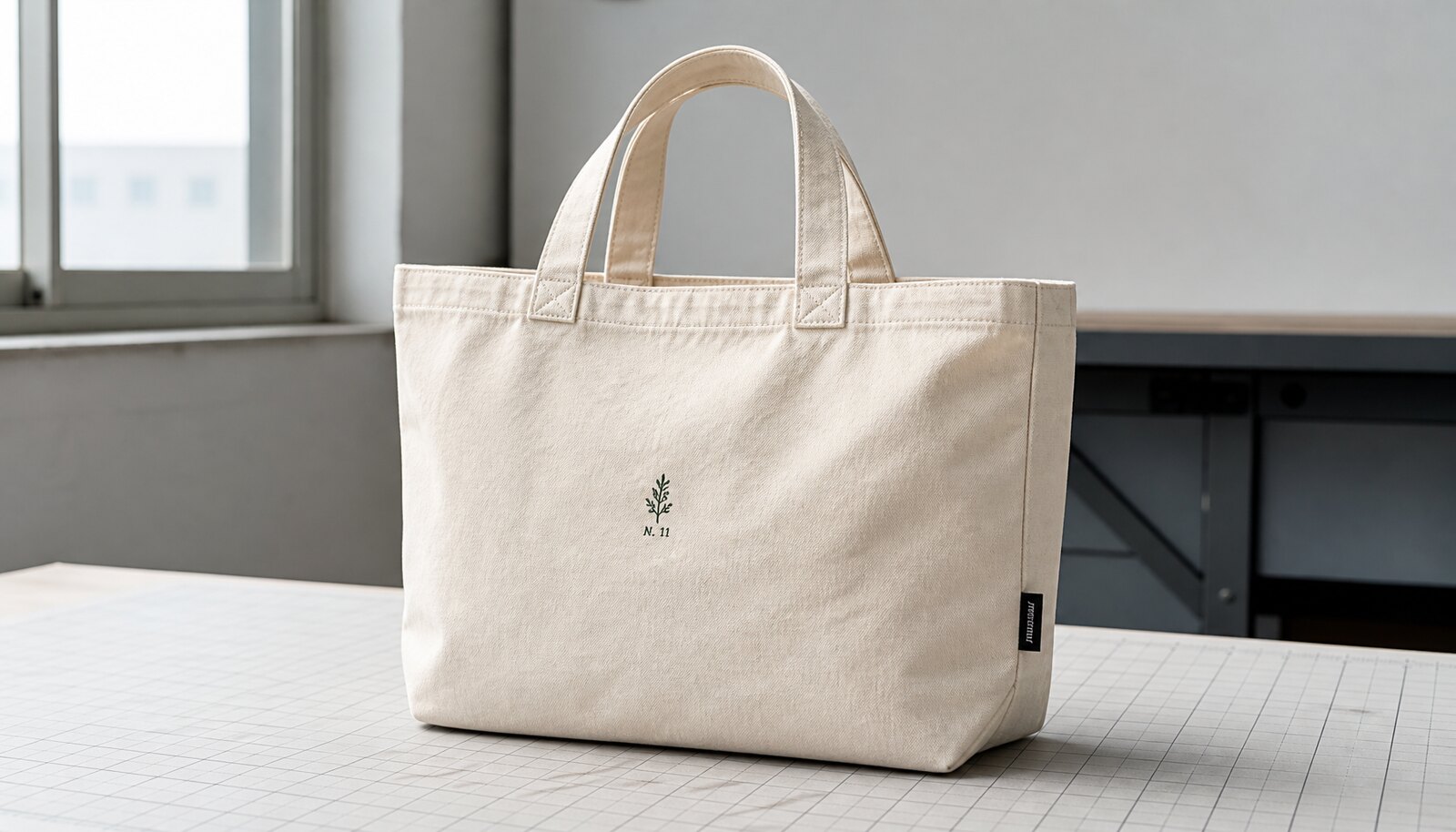
Define the bag's job before you compare suppliers
Canvas retail merchandise bags can mean different things in practice: a product insert, a gift-with-purchase, an ecommerce packing bag, or a resale tote that the customer keeps using. Each job changes the spec. If the bag ships inside a parcel, you care more about foldability, print rub, and how the bag sits in carton pack. If it is sold or handed over as a branded product, the seam line, handle feel, and top edge finish matter more than a low unit price. A sample can look fine in a photo and still be the wrong product for the channel.
The cheapest quote usually comes from a bag that only works as a sample. A procurement team should start with the operating context: what the bag carries, whether it is folded flat or displayed upright, how often it will be reused, and whether it must protect another item during shipping. Once that is clear, supplier quotes become comparable because the factory is no longer guessing whether you need a light promotion item or a retail-ready private label product.
- If the bag ships with an order, prioritize flat pack size, crease resistance, and carton density.
- If the bag sits on a shelf, prioritize shape retention, clean print edges, and visible branding.
- If the bag is a core product, prioritize handle comfort, seam reinforcement, and repeatability across reorders.
Pick canvas weight, structure, and dimensions with intent
For most ecommerce merchandise programs, the practical range is 10oz/340 gsm to 12oz/400 gsm unbleached canvas. Ten-ounce canvas is lighter, easier to pack, and usually enough for apparel accessories, folded merchandise, or lower-cost gift programs. Twelve-ounce canvas gives a firmer body, better print clarity, and a more premium hand, which is why it is often the default for private label retail bags. Sixteen-ounce or roughly 500 gsm makes sense when the bag itself is the product or when the bag must carry heavier gift sets and survive repeated use.
Weight alone is not enough. Two bags with the same GSM can feel different if one uses a tighter weave, heavier thread, or wider hems. That is why the spec must include finished size, gusset depth, handle length, handle drop, seam allowance, and whether the bag is lined or unlined. A tall narrow bag can look premium but miss your carton plan. A wide bag can consume more fabric, raise freight weight, and create a unit cost problem that was not visible in the initial quote.
- 10oz/340 gsm: use for lightweight retail inserts or low-cost promotional runs.
- 12oz/400 gsm: use for standard private label ecommerce totes with a clean retail feel.
- 16oz/500 gsm: use for premium totes or heavier carry use where stiffness matters.
- Specify seam allowance, gusset, and handle reinforcement instead of relying on a bag name only.
Choose the print method by art complexity and volume
Screen printing is still the default for one- or two-color logos on natural canvas because it is durable, cost-efficient, and easy to repeat. It works best when the artwork is simple and the print area is stable across seasons. If the design has many colors, gradients, or frequent changes, digital transfer or heat transfer can be the better low-MOQ route, but the buyer needs to test hand feel, crack resistance, and rub resistance before committing. A printed logo that scuffs during packing is not acceptable just because the sample looked sharp on day one.
Embroidery, woven labels, and sewn patches are useful when the brand wants a more tactile look, but each one adds labor, needle marks, or extra trim management. Many private label programs work better with a mixed method: a small front print, a woven side label with the CTM/CottonToMaker mark, and a clean bag body. That keeps the product readable as a brand item without forcing the factory into an overcomplicated decoration stack that increases failure points.
- Use screen print for stable artwork and repeat SKUs.
- Use transfer or digital print for short runs or artwork that changes by drop.
- Use woven labels or side labels when the main face must stay visually clean.
- Approve the Pantone target against the actual canvas color, not against white paper.
Read the quote like a cost model, not a unit price
A useful quote separates the bag body, decoration, packing, and carton work. If a supplier only gives one number, you cannot tell whether the saving came from lighter canvas, smaller print area, thinner handles, or simplified packing. The biggest hidden cost is usually not the sewing line itself. It is the mix of setup charges, packing changes, artwork revisions, and freight weight. A clean comparison starts with a fully locked spec and a quote that shows every production step the buyer is paying for.
MOQ is not a single number. It changes by fabric color, print color count, label style, and pack configuration. A factory may accept 500 pieces for a stock natural canvas bag but require 2,000 or more when you need custom dyed fabric, a woven label, and retail polybagging. That is normal, not a supplier excuse. The real question is whether the MOQ matches your launch plan and whether the setup cost is spread across enough units to protect margin.
- Ask for separate lines on bag body, print setup, label, packing, and carton.
- Compare MOQ by size, color, and print version, not by the product family name.
- Treat a low MOQ with a high setup fee as a launch test, not a long-term cost base.
- If the supplier changes thread color or label style without notice, the quote is not comparable.
Choose the sourcing route that matches your launch risk
Direct factory sourcing gives the best control when the bag is a recurring private label item and you can manage sampling discipline. Trading companies are useful when you need product consolidation or a single point of contact across more than one factory, but they usually add margin and can blur where the real production risk sits. Domestic decorators can move fast for urgent launches, but their blanks and finishing options may limit the exact spec you can achieve. The right route is not the one with the best story; it is the one that matches your timeline, your quality tolerance, and your inventory risk.
If your brand needs 10,000 bags with the same construction every quarter, move toward direct factory control. If you need a test run of several art versions, a hybrid route may be safer because it keeps the core bag stable while allowing local finishing or relabeling. The comparison table is there to reduce debate and force a decision based on evidence, not habit. Once the route is chosen, lock the route and the spec at the same time, or the quote comparison will drift.
- Use direct factory sourcing for repeat, spec-driven private label programs.
- Use a trader or hybrid route when multi-SKU coordination matters more than lowest cost.
- Use domestic finishing when speed is more important than the lowest landed cost.
- Avoid changing supplier route and product spec in the same launch cycle.
Set sample approval rules before the first piece is cut
There are usually three stages: development sample, pre-production sample, and production audit sample. Buyers lose time when they treat any one sample as final. For this product, the golden sample should lock the fabric weight, finished size, print placement, handle length, label position, and pack method. Without that reference, the bulk order will drift. If the supplier later says a different seam or lighter fabric is normal, you will have no proof that the sample was the approved standard.
Inspect the sample like a retail buyer, not like a designer. The key issue is whether the bag stands neatly, whether the print sits square, whether the seams sit on the load path, and whether the handle feels comfortable in hand. If the bag will be sold to consumers, also check odor, lint, and how the face panel looks after folding and refolding. Small flaws show up in ecommerce photography and produce avoidable returns if they are not stopped before bulk.
- Measure finished size, handle drop, and gusset against the approved spec sheet.
- Compare print color on the actual canvas base, not in isolation on white paper.
- Pull on the handles and side seams by hand before approval.
- Keep one signed golden sample with the PO and the QC photo record.
Specify packing so ecommerce operations do not rework it
Packing decisions can erase the savings from a good bag quote. If the bags go directly to consumers, they may need individual polybags, barcode stickers, carton labels, and moisture protection. If they are inserted into parcels at your warehouse, bulk flat pack may be enough. The wrong pack format creates creasing, print rub, and extra labor at receiving. In many programs, the bag itself is acceptable, but the pack-out is what creates warehouse friction and hidden cost.
The factory should state how many pieces go into a carton, how they are oriented, what the carton dimensions are, and whether desiccant or internal paper is included. For private label, the outer pack needs to protect the product and support scanning. A clean carton spec also reduces chargebacks when the shipment reaches a retail DC or 3PL. If your operation uses SKU-level labels, the label position and barcode grade should be part of the approval, not added after production starts.
- Confirm whether each unit needs a polybag, barcode, or hangtag.
- Lock the carton count so warehouse labor can forecast handling time.
- Ask for carton marks that match your PO and SKU system.
- Use stack direction that avoids heavy creasing on the front print.
Build the schedule around the slowest production step
For standard canvas bags, sampling may take about one to two weeks and bulk production often lands in the four to six week range after approval, but the real schedule depends on fabric availability, print method, and packing complexity. Custom dyed fabric, new labels, and detailed retail packing all add calendar days. The supplier quote should show the critical path, not just a delivery promise. If the factory cannot explain where the schedule time sits, it is probably not managing your order at a detail level that is safe for a launch.
The biggest schedule risks are predictable: color approvals that drag on, missing artwork files, late changes to carton copy, and peak-season factory congestion. If the launch date is fixed, freeze the spec earlier than you think you need to. It is cheaper to hold one extra week for approval than to airfreight a bad production run. Replenishment planning should start before the first order lands, because a strong selling tote often creates a second-order need faster than the factory expected.
- Separate sample time, bulk time, packing time, and transit time in the schedule.
- Build buffer for lab dips, artwork corrections, and carton revisions.
- Avoid final design changes after the pre-production sample is approved.
- Plan replenishment before sell-through, not after inventory runs low.
Use landed cost to decide whether the bag is worth carrying
The true comparison is landed cost per sellable unit, not ex-factory price. Add bag cost, decoration, packing, inspection, freight, import duty, and any warehouse relabeling. A bag that is slightly cheaper at source can become more expensive if it requires extra handling or if the carton pack does not fit your warehouse process. This is why procurement teams should compare the full route, not just the factory invoice. A short quote that ignores packing or freight assumptions usually looks better than it performs.
When you request quotes, use the same spec across at least three quantities and ask each supplier to state the assumptions. If the supplier cannot explain how the price changes with higher volume, they have probably not quoted the production route you actually need. This is where a disciplined RFQ protects margin. It also helps the team decide whether to buy the bag as a branded item, a shipping insert, or a disposable promotional add-on.
- Compare the same fabric weight, same size, same print version, and same pack.
- Request pricing at multiple quantities to reveal the setup cost curve.
- Ask for the exact incoterm and any excluded domestic charges.
- Use one artwork revision across all suppliers so the comparison stays clean.
Specification comparison for buyers
| Supplier option | What to verify | Commercial advantage | Buyer risk to control |
|---|---|---|---|
| Direct sewing factory | fabric swatch, approved sample, seam close-ups, logo test photos, packing pilot, and final inspection evidence | Better sample-to-bulk control and faster production feedback | May be weaker on export paperwork or branded packing unless checked early |
| Trading company | Factory name, production photos, trim-source proof, and who owns QC decisions | Can coordinate small mixed orders and extra services | Markup can hide real factory capability and slow defect decisions |
| Specialized bag workshop | bag size, gusset, handle drop, seam allowance, stitch density, reinforcement patch, and loading expectation | More practical for detailed construction, trims, and repeat programs | Capacity may be limited during peak seasons |
| Low-price general supplier | 8-12 oz cotton canvas, 120-220 gsm cotton, recycled cotton, or blended fabric selected by use case and target price | Useful for simple promotional runs with loose specs | Material downgrades, weak packing, and vague inspection scope can erase savings |
| Retail-ready supplier | fold method, inner bundle, carton count, carton mark, moisture protection, SKU separation, and warehouse receiving needs | Can handle labels, SKU separation, carton marks, and receiving rules | Higher unit cost must be compared against reduced warehouse work |
| Compliance-focused supplier | Fabric records, labeling review, test plan, and production traceability | Safer for retail programs and repeat brand orders | Documentation claims need evidence, not only sales language |
| Local sample room plus bulk factory | Signed sample, bulk factory handoff, first-piece photos, and deviation owner | Good for complex branding before large production | Sample room quality may not match bulk line unless handoff is controlled |
Buyer checklist before sampling
- Define the bag role clearly: product insert, resale item, gift-with-purchase, or shipping protector.
- Lock finished size, gusset depth, handle length, handle drop, and target load before requesting quotes.
- Choose one canvas weight and finish, such as 10oz/340 gsm, 12oz/400 gsm, or 16oz/500 gsm.
- Select one primary decoration method and do not let suppliers substitute another method without approval.
- Decide pack format: bulk flat pack, individual polybag, barcode label, hangtag, and carton count.
- Prepare vector artwork, Pantone references, and print placement dimensions for the approved side of the bag.
- Set launch quantity, MOQ target, and replenishment forecast by size, color, and print version.
- Approve a golden sample and retain a sealed reference sample with the purchase order and QC photos.
Factory quote questions to send
- What exact fabric weight, weave, and finished bag weight are included in the quoted price?
- Is the quote based on the same finished size, gusset, handle length, and print placement as the sample?
- What setup charge applies for each print color, label style, embroidery position, or woven patch?
- What MOQ applies by bag size, fabric color, print version, and packing method?
- What packing format is included, and what carton size, carton count, and carton mark standard will you use?
- What is the sample lead time, bulk lead time, and the main reasons that timeline could slip?
- Which incoterm is quoted, and which domestic charges are excluded from the price?
- Can you share photos or inspection notes from a similar canvas bag run with the same construction method?
Quality-control points to confirm
- Fabric weight must stay within an agreed tolerance, usually within 5 percent of the approved GSM or oz spec.
- Finished dimensions should stay within +/- 0.5 cm for small bags or +/- 1 cm for larger totes unless the spec says otherwise.
- Handle length and handle drop must match the golden sample, and the reinforced seam must show no puckering or twist.
- Stitch density on load-bearing seams should be consistent, with no skipped stitches, loose threads, or broken backtacks.
- Print registration should stay within 2 mm, and the color should match the approved reference on the actual canvas base.
- Load test should hold the agreed weight, such as 5 kg for standard merch bags or 8 kg for heavier retail totes, for at least 30 seconds without seam failure.
- Bag surface should be clean, dry, and free of oil marks, odor, lint clumps, or visible fabric flaws in the front panel.
- Carton count, barcode readability, and outer carton marks must match the purchase order with zero mixed-SKU cartons unless approved.