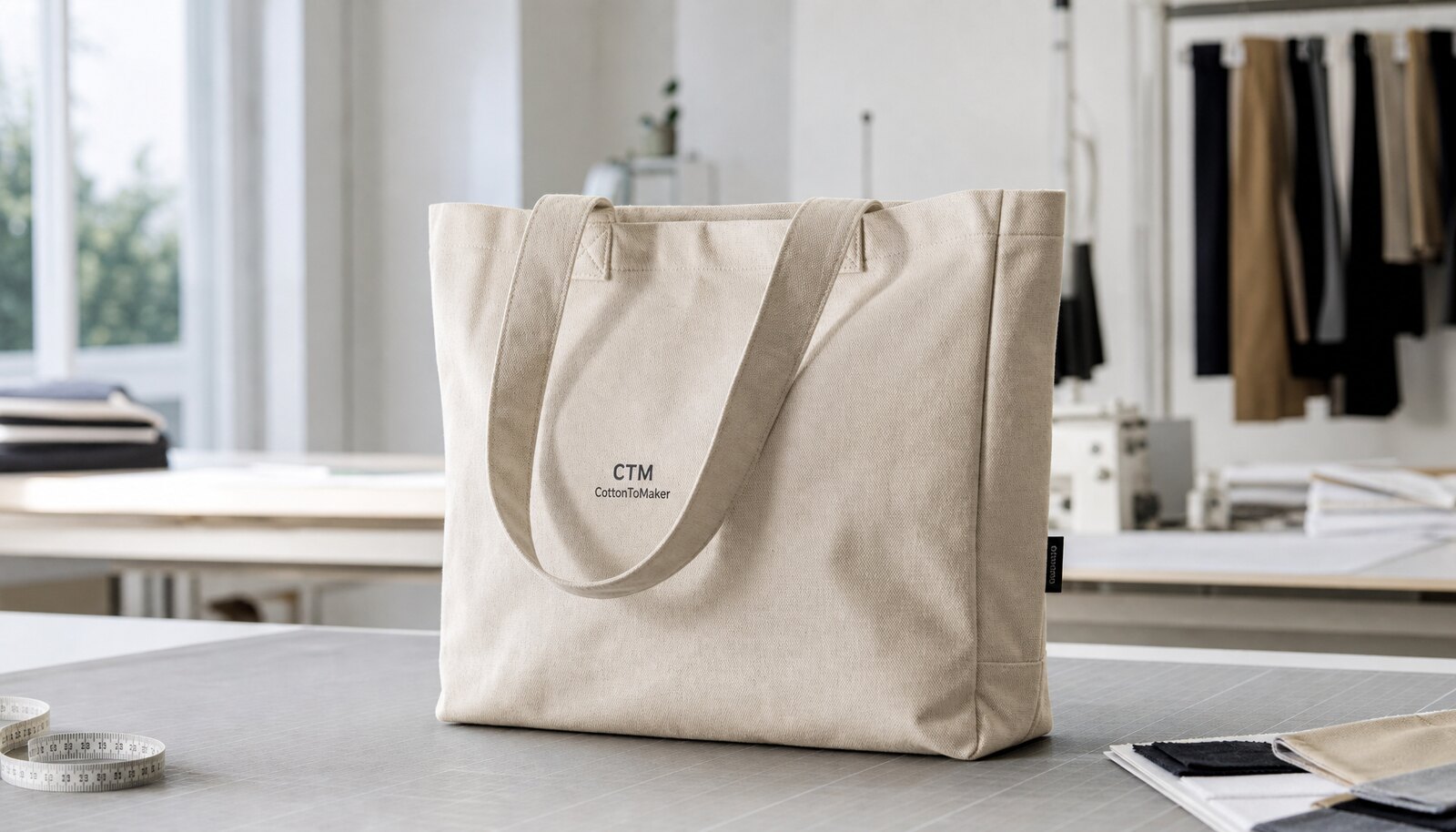
Start With The Retail Job, Not The Bag Description
When a buyer asks for canvas retail merchandise bags for ecommerce brands, the real question is not only what the bag looks like. The factory needs to know where the bag will live in the customer journey: as a retail carry bag, a merch insert, a pop-up store purchase bag, or a branded pack-out item shipped inside an ecommerce parcel. Each use case changes the spec. A bag that is only meant to hold a lightweight tee does not need the same fabric weight, stitch margin, or handle reinforcement as a bag that sits on a retail floor all day.
A good RFQ starts with the use case, then translates it into measurable requirements. That means finished size, gusset, handle drop, print area, and how the bag should be packed for receipt. If the buyer does not define those points, every supplier will quote a different assumption. One may quote a thin promotional tote, another may quote a heavier retail-grade canvas bag, and the cheapest price will usually belong to the wrong spec.
- Define the main use: retail checkout, ecommerce insert, event merchandise, or replenishment stock.
- State whether the bag must stand up on shelf, fold flat in shipper cartons, or survive daily customer carry.
- Identify the product weight or bundle the bag must carry so the factory can size the handle and seam reinforcement.
Choose Fabric Weight By Load, Brand Feel, And Return Risk
Canvas weight is one of the fastest ways to create quote confusion. A buyer may say “canvas tote,” but the supplier may interpret that as a light 10 oz body, a 12 oz retail bag, or a much heavier 14 oz or 16 oz construction. In practical terms, lighter canvas lowers material cost and can fold flatter for ecommerce shipping, while heavier canvas improves structure, print opacity, and the perceived value at retail. For many brand programs, 12 oz or 14 oz is the most balanced starting point because it gives a better hand feel without making the bag unnecessarily rigid or expensive.
The right answer depends on how the bag will be used. A boutique merchandise bag for a small apparel order can work well in a 10 oz to 12 oz range, especially if the buyer wants a soft fold and lower freight weight. A premium retail program with strong visual branding often moves into 14 oz or 16 oz because the bag needs to hold shape on shelf and tolerate repeated customer use. If the buyer needs a washed look, pre-shrunk body, or a very white print base, that should be stated early because those choices affect both cost and lead time.
- 10 oz canvas is usually better for light merch and promotional use where cost and packing volume matter more than structure.
- 12 oz canvas often works for standard retail totes and ecommerce brand giveaways with moderate load requirements.
- 14 oz to 16 oz canvas is better when the bag needs a more premium feel, better structure, or a stronger handle anchor.
- Ask whether the fabric is bleached, natural, dyed, or pre-washed because each version prints and shrinks differently.
Lock The Branding Method Before You Compare Prices
Print method changes both the quote and the result. Screen print is still the most practical option for many canvas bags because it gives solid coverage, works well at volume, and is predictable on natural canvas. If the artwork is one or two colors and the order size is meaningful, screen print usually gives the best balance of cost and durability. For more detailed graphics or smaller launch runs, a heat transfer or digital approach may be easier to sample, but the buyer should test rub resistance and edge wear before assuming it is retail-ready.
Branding is not only about the front logo. Buyers should also decide whether the brand mark appears on a woven label, side seam label, interior care label, or direct print on the body. A simple CTM-style side tab can look more polished than a large front graphic when the bag is sold as a retail accessory rather than a free giveaway. The point is to specify the brand application that matches the selling price and audience, then hold suppliers to that exact placement in sample approval.
- Use screen print for solid logos, clean color blocks, and larger orders where setup cost can be spread across volume.
- Use transfer or digital methods only when the art requires fine detail, frequent artwork changes, or very low MOQ.
- If PMS accuracy matters, say so in the RFQ and include a reference target or approved physical sample.
- If the bag will be washed or handled repeatedly, require rub and adhesion checks on the print area.
Build The RFQ So Every Factory Quotes The Same Item
Most quote problems happen because the RFQ is incomplete, not because the supplier is careless. A quote that lists only bag size and logo will produce numbers that are impossible to compare. The factory should be pricing the same fabric, the same sewing structure, the same print method, the same label type, and the same packing standard. If any of those pieces are missing, the supplier will fill the gap with its own assumption, and the buyer will discover the difference only after sample approval or bulk shipment.
A clean RFQ should read like a production instruction, not a marketing brief. Include the finished dimensions, canvas weight, handle type, reinforcement method, number of print colors, carton pack, barcode needs, and destination market. If the buyer wants the quote to include sample cost, tooling, and packing materials, those should be separated into lines. That way procurement can compare direct factory offers, trading company offers, and domestic finishing routes without mixing unit price with hidden extras.
- Include a simple tech pack with flat sketch, measurements, logo placement, and packing photo if possible.
- State the acceptable tolerance for size, print position, and color variation before asking for unit price.
- Separate sample fee, tooling fee, and bulk price so the commercial comparison stays clean.
- Request that the supplier state any assumptions in writing if they are quoting against missing data.
Understand MOQ Logic And The Real Cost Drivers
MOQ for canvas retail merchandise bags is rarely arbitrary. It usually comes from three places: fabric purchase minimums, print setup economics, and sewing line efficiency. If the fabric is woven in a standard width and the pattern nests efficiently, MOQ can be manageable. If the buyer wants a special dye lot, multiple print colors, custom labels, or a nonstandard bag shape, the factory may need to increase the order to absorb setup time and material waste. That is why two seemingly similar quotes can have very different minimums.
From a buyer perspective, the right approach is to separate the product cost drivers from the commercial noise. The biggest cost shifts usually come from fabric weight, bag size, gusset depth, handle reinforcement, print color count, and the amount of manual packing required. A bag with a simple one-color logo, standard fold, and bulk carton pack will usually quote more efficiently than a fully retail-ready bag with individual polybags, hangtags, barcode stickers, and special insert cards. If the order is small, simplify the spec before asking the supplier to force a premium retail finish into a low-MOQ program.
- More print colors usually mean more screens, more setup, and higher scrap risk during registration.
- Gussets, lining, zippers, and inside pockets increase sewing time and inspection complexity.
- Special labels, custom cartons, and retail inserts can push MOQ up even when the bag body is simple.
- If the launch quantity is modest, reduce variables before cutting fabric to keep the order viable.
Approve The Sample Against Retail QC Standards
A sample should prove that the spec is manufacturable, not just attractive in a photo. Buyers should measure the finished body, handle drop, seam allowance, and print location on the physical sample. Then they should check how the bag feels when loaded, because a tote can look correct on the table but distort once it is filled. The sample is also the right time to verify whether the canvas is too soft, too rough, or too thin for the intended shelf position. If the hand feel is wrong at sample stage, bulk production will only magnify the problem.
The sample approval step should be treated as a controlled gate. If the print looks strong but the handles twist, or the dimensions are right but the bag collapses flat, the sample is not approved. Buyers should write down the exact acceptance criteria and send them back to the factory in a marked-up image or approval note. That prevents the common argument where the factory says the bag matches the artwork while the buyer is judging the retail outcome.
- Measure body size, gusset depth, and handle drop on the same sample and record the numbers.
- Check stitch density and reinforcement at the handle base and side seams with a pull test.
- Compare print placement against the approved artwork and reject visible drift at the logo edge.
- Confirm the sample includes the exact label, hangtag, and packaging that will be used in bulk.
Plan Packing For Ecommerce And Shelf Receipt
Packing is often the hidden reason a quote looks cheap. A supplier may quote the bag body correctly and still miss the real program cost if the buyer needs polybags, fold standards, carton marks, desiccant, barcode stickers, or retail inserts. Canvas bags can arrive wrinkled, dusty, or over-compressed if the packing method is not specified. For ecommerce brands, the bag may need to look clean the moment the customer opens the parcel. For retail buyers, the carton must move smoothly through receiving and store replenishment without manual rework.
The buyer should define how the bag is folded, counted, and packed before bulk production begins. If each bag must arrive ready for shelf display, then the supplier needs to pack to that standard and the quote should include the labor. If the destination warehouse repacks cartons anyway, it may be smarter to reduce pack complexity at origin. Packing should serve the channel, not the factory's convenience.
- State whether each bag needs individual polybagging, tissue, or no inner pack at all.
- Specify carton count, master carton size limit, and whether the cartons must fit parcel or pallet rules.
- Require barcode placement and carton marks if the bags go directly into retail receiving.
- Ask the supplier to confirm moisture control if the route includes long ocean transit.
Build A Realistic Lead Time And Freeze Points
Lead time should be measured from sample approval and material confirmation, not from the date the inquiry was sent. A factory can often move fast on a simple tote, but canvas order schedules are still shaped by fabric booking, print screen preparation, pre-production sample approval, and packing material availability. If the buyer changes artwork late, the schedule shifts immediately because the print setup and approval chain have to restart. That is where launch windows get missed.
The safest way to manage timing is to define freeze points. Once the fabric weight, print method, artwork, packing, and carton marks are approved, those items should not move unless the buyer accepts a schedule impact. If the order is tied to a retail launch or ecommerce campaign, buffer time is not optional. The right quote should expose where the schedule can slip so procurement can manage risk before the shipping date becomes a problem.
- Ask the supplier to separate sample lead time, bulk production time, and shipping time.
- Freeze artwork and packing before the factory commits to screen setup or label printing.
- Build a buffer for first article approval, especially when the bag has multiple print colors or special packing.
- Request the factory's typical bottleneck, because it is usually fabric or print setup rather than sewing alone.
Compare Quotes On Landed Cost, Not Just Unit Price
For procurement, the unit price is only one part of the decision. A quote that looks lower may leave out sample fees, packaging, label application, carton strengthening, domestic handling, or a freight term that shifts all transport risk to the buyer. When comparing a direct factory, a trading company, and a local decorator, the only fair method is to normalize the offers into landed cost with the same bag spec, same packout, and same destination basis. Otherwise the buyer is not comparing suppliers, only comparing what each supplier chose to include.
A useful quote review also looks for what is not written down. If the supplier cannot explain the fabric weight, print setup, or carton pack in plain terms, the commercial offer is not stable yet. Buyers should ask for separate line items when the order is complex, because that reveals whether the margin sits in the product, the packing, or the logistics. This matters most on repeat programs, where a small hidden difference becomes a meaningful budget issue across multiple reorders.
- Normalize every quote to the same incoterm and destination before choosing a winner.
- Compare included items line by line: bag body, print, labels, packing, sample fee, and freight basis.
- Watch for suppliers who quote a low bag price but leave critical packing or compliance steps as add-ons.
- Use one approved sample and one spec sheet across all quotes so the comparison is clean.
Specification comparison for buyers
| Spec decision | Recommended option | When it fits | Buyer risk to check |
|---|---|---|---|
| Direct factory, fully custom sewn bag | Best when you need exact size, handle spec, print placement, and carton packing control | Mid to high volume programs, private label retail, ecommerce insert bags, and replenishment orders | Confirm the factory owns the sewing line, print process, and packing step instead of outsourcing the critical work |
| Trading company or sourcing office | Useful when you need one contact to manage multiple factories or product add-ons | Complex programs with mixed accessories, multiple SKUs, or buyers without local sourcing staff | Check whether the quote includes hidden markups, unclear factory identity, or duplicated quality checks |
| Stock blank bag plus local overprint | Fastest route when artwork is simple and the bag body can be standard | Short launches, seasonal retail drops, and tests where speed matters more than exact construction | Blanks may vary in color, weave, and handle length; confirm the base bag is stable across lots |
| Domestic decorator using imported blanks | Good for small runs and quick reorders when domestic freight time is the main issue | Low to medium volumes with simple logo placement and frequent artwork changes | The blank bag cost can drift and the final landed cost often rises after print, packing, and domestic handling |
| Hybrid split production: factory body, local finishing | Works when you want factory sewing quality but local packout or barcode application | Programs with retail compliance steps that are easier to finish near the destination market | Split responsibility can create blame gaps; define who owns print approval, carton marks, and final inspection |
| Small-run digital print vendor | Appropriate for sampling, influencer packs, or low MOQ launch tests | Very small orders, multi-color graphics, and changing seasonal art | Print durability on canvas may be weaker than screen print; confirm rub resistance and wash behavior |
| Integrated packaging supplier with bag add-ons | Useful when the tote is one piece of a larger retail packaging kit | Ecommerce brands bundling bags with tissue, labels, or inserts from one vendor | Suppliers may be strong in cartons but weak in sewing details; verify bag workmanship separately |
| Dual-source program with a primary and backup factory | Best for core SKUs that cannot stop shipping if one site has a delay | Established retail programs with repeat demand and strict replenishment windows | Lock the same spec sheet and approval sample against both sources or the bag will drift over time |
Buyer checklist before sampling
- State the finished bag size, gusset depth, and handle drop in millimeters, not just in general terms.
- Specify canvas weight in oz or GSM and note whether the fabric is bleached, natural, dyed, washed, or pre-shrunk.
- Identify the print method, number of colors, print area, and required Pantone match or tolerance.
- Define the label type, placement, and whether the logo must appear on the bag body, side seam, or woven tab.
- Request sample photos and one physical pre-production sample with actual stitching, print, and packing materials.
- Ask for MOQ at the fabric level, print screen level, and packaging level so the factory does not hide setup limits.
- Confirm carton pack, inner polybag requirements, barcode application, master carton marks, and moisture protection.
- Ask for lead time from sample approval to bulk completion, not from the date of inquiry.
- Request separate pricing for bag body, print, label, packaging, and freight terms if the supplier can split them.
- State the destination market, incoterm, and any retail compliance needs before quote comparison starts.
Factory quote questions to send
- What is the finished size, handle length, and gusset after sewing, and what tolerance do you quote?
- What exact canvas weight, weave count, and fiber composition will you use for the bulk order?
- Which print method is included in the quote, how many colors are included, and what happens if the artwork changes?
- Is the quoted MOQ based on fabric purchase, print setup, or sewing line efficiency?
- What is included in the sample fee, and will that fee be credited back after bulk order confirmation?
- What carton pack, inner pack, and barcode application are included in the quote?
- What is the production lead time after sample approval, and what part of the schedule is usually the bottleneck?
- Which quality checks do you perform before shipment, and can you share your inspection criteria?
- What is excluded from the quote, such as labels, hangtags, packing inserts, or special test reports?
- Can you separate unit price, setup cost, packaging cost, and freight basis so we can compare offers line by line?
Quality-control points to confirm
- Finished size must stay within the agreed tolerance for body width, height, and gusset depth.
- Handle length and handle drop must be checked on a full bag, not on a cut strap before sewing.
- Canvas weight should match the approved spec and feel consistent across the lot, especially near seams and handles.
- Stitch density, backtack length, and seam alignment should hold under a firm pull test on the handles and side seams.
- Print placement should match the approved artwork position, with no visible misregistration on the edge of the logo.
- Color should stay within the agreed reference, and any natural canvas variation should be within the buyer-approved range.
- Woven labels, side labels, or care labels must be straight, legible, and fixed in the right location.
- Carton count, inner pack count, and barcode labels must match the retail receiving requirement exactly.
- Polybags, if used, should be the agreed thickness and size, with no trapped moisture or dirt inside the pack.
- A shipment sample should be pulled from finished cartons before dispatch so packing defects do not reach the buyer's warehouse.