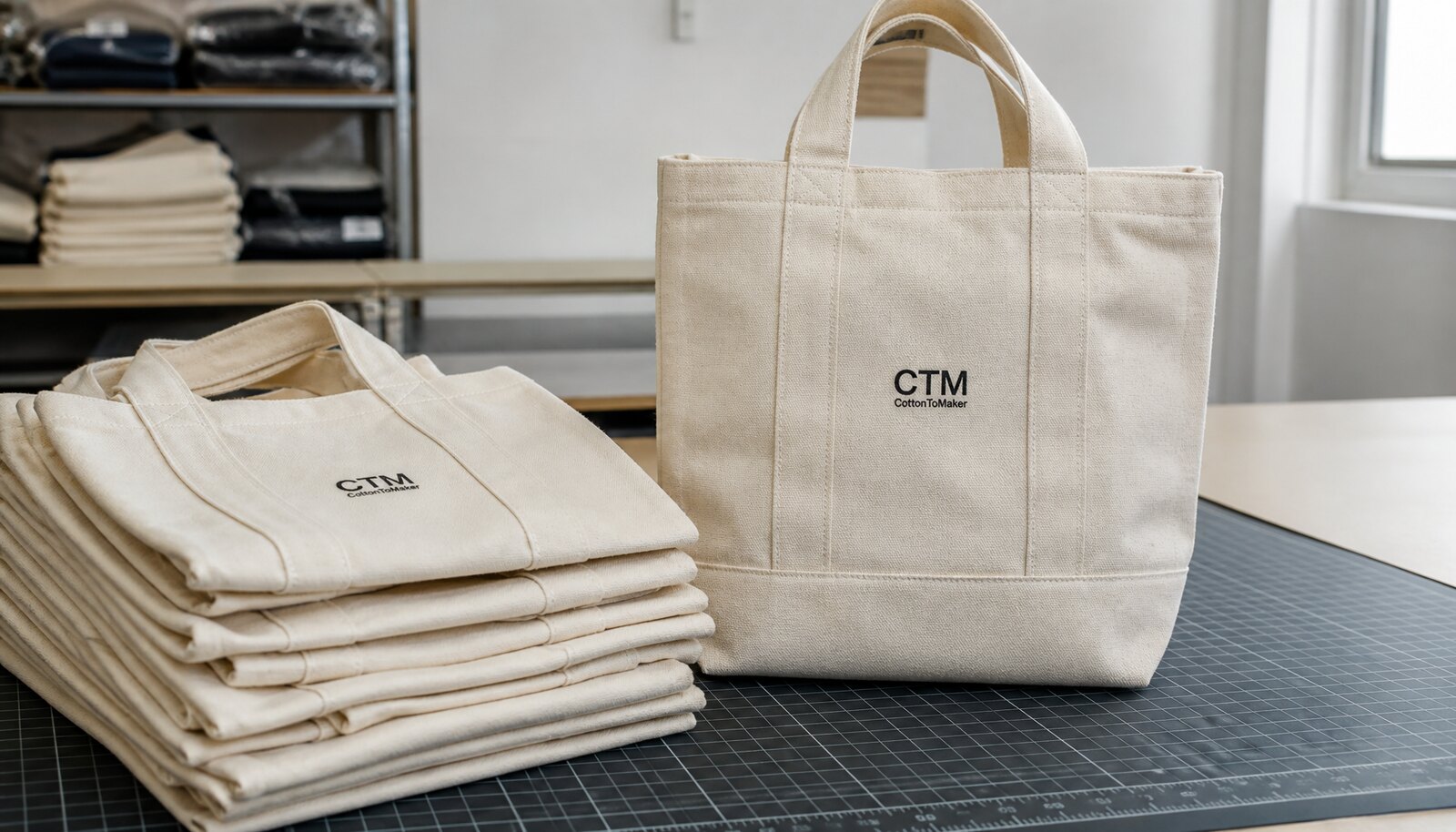
Why canvas tote pricing varies so much for ecommerce merchandising programs
Canvas retail merchandise bags for ecommerce brands can look like a low-complexity item, but they are actually a bundle of cost decisions: cloth, cutting, sewing, printing, handling, packing, and shipping. Buyers often receive quote sheets that collapse these steps into one line, which makes the unit price appear simpler than it really is. That simplicity is dangerous in procurement because two bags that look identical from a distance can have very different material density, stitch quality, and freight cost once they are produced at scale.
For ecommerce buyers, the bag is usually not a disposable giveaway. It may be sold as branded merchandise, included in a bundle, used for retail checkout, or shipped as a premium add-on that must arrive presentable and consistent. That means the buying decision should be based on retail appearance, repeatability, and total landed cost, not only on the cheapest ex-factory number. A strong bulk pricing plan starts with a finished spec, then asks each supplier to price that exact spec without substitutions.
The main procurement trap is quote comparison without spec normalization. If one supplier prices a lighter fabric, bulk-only packing, or a one-color print while another includes retail folding, barcode labels, and carton marking, the lower quote is not truly lower. The buyer needs a controlled RFQ basis before cost negotiation begins. That is especially important for ecommerce brands, where reorders are frequent and consistency matters more than novelty. A good initial order should be easy to repeat, easy to inspect, and easy to warehouse.
- Treat the tote as a finished retail product, not only a sewn textile item.
- Normalize all supplier quotes to the same finished size, decoration, packing, and delivery term.
- Use landed cost and quality risk together when comparing offers.
Build the spec first: the minimum data needed for a usable RFQ
A procurement-grade RFQ for canvas tote bags should leave little room for interpretation. At minimum, the buyer should define finished dimensions, gusset depth, handle drop, fabric weight, weave basis, color, print area, print placement, and packing format. If any of those elements are missing, the supplier will fill the gap with an assumption that may not match the buyer’s commercial target. Those assumptions are one reason tote quotes often differ by 20% or more even when the bags look similar.
The fabric description should go beyond the word canvas. Many factories use different cotton or cotton-blend constructions and still market them as canvas. Ask for the weight in oz or GSM, the weave type, whether the cloth is pre-shrunk or stabilized, and whether the fabric is dyed, bleached, or left natural. If the bag is intended for repeated retail use, ask for acceptable shrinkage and seam stability after handling or washing. Even if the bag is not designed as a washable item, the buyer benefits from knowing whether the cloth has been treated or finished in a way that could affect feel or print adhesion.
The dimensional spec should be written with tolerances. A reasonable tolerance table helps procurement avoid disputes over normal variation while still protecting retail presentation. For example, a buyer may allow a small range on width and height but require a tighter limit on handle placement and logo position. Without written tolerances, a supplier can claim the batch is acceptable even when the bag looks inconsistent in a retail stack or ecommerce photo shoot.
- Specify finished size, not only a sketch or template.
- Ask for cloth weight, weave basis, finishing, and shrinkage expectation.
- Write tolerances for the dimensions that affect retail appearance and use.
Cost drivers you can actually negotiate: fabric, construction, and decoration
The strongest lever in a bulk pricing plan is not squeezing every cent from the sewing line; it is understanding which elements create cost and which do not. Fabric weight is one of the biggest drivers. Moving from a lighter canvas to a denser cloth raises material cost and often increases freight volume and carton weight. It can also improve perceived value, which matters for ecommerce brands selling the bag as a merchandise item rather than a free insert. For many programs, the right answer is not the thickest cloth available, but the lightest cloth that still holds shape and prints cleanly.
Construction details also affect cost more than many buyers expect. A plain tote with self-fabric handles and standard side seams is easier to price and produce than a bag with contrast binding, lined interiors, zipper closures, interior pockets, or complicated pattern pieces. If the buyer’s primary goal is retail branding and repeatability, simple construction usually wins. If the product needs a premium gift-like feel, then the buyer should expect labor cost to rise and should ask the factory which operations add the most time per piece.
Decoration is another major cost fork. Screen print is typically the most efficient route for stable artwork because setup cost can be spread across volume. However, its economics depend on color count, print coverage, and registration complexity. A one-color front logo on a controlled natural canvas body is easier to price than a full-coverage print, a large tonal graphic, or small text with fine linework. When a buyer asks for a quote, the print area should be measured in centimeters and the color count should be fixed. Otherwise the supplier may quote an optimistic sample version and then add charges for the actual production art.
Packing and post-production labor are frequently hidden cost centers. Folding, inserting tissue, adding a label, barcoding, or polybagging each bag may seem minor, but on a large order those steps can materially change labor cost and carton efficiency. Procurement teams should make those requirements explicit and negotiate them as separate line items if possible. That way the base tote price remains visible, and the buyer can decide whether the added presentation is worth the extra spend.
- Fabric weight drives material cost, shape retention, and freight volume.
- Complex construction increases labor cost faster than most buyers expect.
- Decoration price depends on colors, coverage, and registration complexity.
- Packing steps should be priced separately when they are not standard bulk pack.
Price bands and sourcing scenarios: how to think about the bulk pricing plan
For canvas retail merchandise bags, the useful question is not 'What is the price?' but 'What price band fits this sourcing scenario?' A simple natural canvas tote with one-color print, bulk packing, and a standard handle construction will usually sit in a different commercial band from a premium retail-ready bag with dyed cloth, two-sided print, and barcode labeling. Buyers should therefore build their pricing plan around use case rather than generic tote language.
Scenario one is a launch or test program. In that case, the buyer should prioritize sample speed, manageable MOQ, and simple construction. The most cost-effective route is usually a standard size, one fabric color, and one print position with a straightforward packing requirement. This keeps setup charges low and makes it easier to validate sell-through before committing to higher volume. The tradeoff is that the unit cost may be slightly higher than a much larger order, but the inventory risk is lower.
Scenario two is a stable replenishment program. Here, the buyer can negotiate better pricing by committing to a repeatable spec and clearer forecast windows. A direct factory often performs well in this scenario because the pattern, screens, and packing process can be reused. The buyer should ask for a reorder price schedule and confirm whether the factory will keep artwork or screens on file, how long they will store them, and whether a long-gap reorder triggers a rescreen or retool fee.
Scenario three is a multi-SKU retail merch line. This is where quote complexity rises quickly. Multiple colors, multiple logos, or multiple bag variants can look efficient from a brand perspective but usually raise costs through separate setup, longer line changeovers, and smaller batch sizes per SKU. Procurement can still make the program work, but only by deciding which elements are truly variable and which should be standardized. Standardizing the body fabric, handle style, and carton format while varying only the print can preserve margin without making the line look identical.
A practical pricing plan should therefore list the cost drivers that justify a premium. Common ones include dyed cloth, two-sided print, retail folding, barcode labels, higher inspection frequency, and market-specific compliance tests. Buyers should make those premiums visible in the quote so that future negotiations focus on real scope changes instead of vague price pressure.
- Launch programs should favor speed, low complexity, and moderate MOQ.
- Replenishment programs should negotiate re-order pricing and artwork retention.
- Multi-SKU lines need standardization in body spec, packing, and carton format.
Supplier qualification: direct factory, trading company, and what evidence to request
Choosing a supplier route is not just a pricing decision; it affects traceability, speed of issue resolution, and quality control. A direct factory is usually the stronger choice when the buyer wants stable repeat production, direct access to sewing or printing capability, and clearer accountability for defects. The factory should be able to show the actual production site, sample room, quality checkpoints, and who manages cutting, stitching, printing, and packing. If those functions are outsourced, the buyer should know it before quoting.
A trading company can still be appropriate when the buyer needs to bundle several items, coordinate across factories, or simplify communication for a small team. The tradeoff is transparency. Buyers should not assume the trading company owns the equipment or controls all process steps. Ask which operations are in-house, which are subcontracted, and which supplier is responsible if the fabric or printing work does not meet spec. A low quote with unclear ownership is a commercial risk, not a bargain.
Supplier qualification should include evidence, not only promises. Ask for a business license, factory address, production photos, and a recent audit summary if available. If the product is intended for a regulated or brand-sensitive market, ask for compliance documents relevant to the destination country and to the material content of the bag. You are not asking for marketing language; you are asking for proof that the supplier can ship the goods without compliance surprises. For many buyers, it is also worth asking for the last three comparable orders so the supplier can demonstrate real production history in a similar bag construction.
When possible, request one named contact who owns the project from sample to shipment. That person should understand the quote basis, the sampling milestones, the inspection plan, and the re-order rules. If the supplier changes contacts repeatedly, the program becomes harder to manage and quality consistency often suffers. Procurement teams should treat communication reliability as part of supplier qualification, not as an administrative detail.
- Direct factory sourcing usually offers better control and traceability for repeat orders.
- Trading companies can work for consolidation, but confirm who owns production and defects.
- Request evidence: business license, factory address, audit summary, and comparable order history.
- Assign one project owner on the supplier side for sample, production, and shipment control.
How to compare quotes without missing hidden or excluded costs
A good quote should be line-item clear enough that a buyer can see where the money goes. The quote should state the finished bag spec, the decoration method, the unit price, the setup charge, the sample charge, the packing standard, the carton data, and the delivery term. If those pieces are not explicit, the supplier may be leaving room to add charges later. That is not always intentional; often it reflects a quote prepared from incomplete RFQ data. But the result is the same: the buyer cannot compare offers on equal terms.
One practical method is to ask every supplier to quote the same commercial template. Include the same fabric basis, same artwork file, same print size, same unit count, same packaging format, and same delivery term such as EXW, FOB, or DDP. Then require them to state what is included and what is excluded. Common exclusions are shipping, customs clearance, duties, cartons, barcode labels, and third-party testing. If a supplier will not list exclusions clearly, the quote should be treated as incomplete even if the number looks attractive.
For e-commerce brands, freight assumptions matter because canvas bags are lightweight but often bulky. Two quotes with identical unit prices can produce different landed costs if the cartons differ in size or the packing is looser. Ask for carton dimensions, gross weight, and units per carton so you can calculate volume and compare logistics implications. Also ask whether the supplier packs efficiently for export or leaves extra air space. The difference may not change the factory unit price, but it can change the total shipped cost meaningfully.
The quote should also identify any cost that changes with order size. Setup charges may decline as volume rises, while packing labor, testing, and special labeling may remain fixed or step down only partially. Buyers should separate one-time costs from recurring costs so they can estimate the true repeat-order price. That is especially important if the first order is promotional and the second order is intended to replenish a proven SKU.
- Insist on a quote template that identifies included and excluded costs.
- Compare only identical finished specs and identical delivery terms.
- Use carton size and gross weight to evaluate freight impact.
- Separate one-time setup costs from recurring unit costs before negotiating.
Sample approval, testing, and acceptance criteria before mass production
The sample stage is where procurement saves the most money per hour. A pre-production sample should prove the actual material, decoration, and construction that will be used in the bulk run. It should not be a generic bag with approximate details. The approved sample should reflect the same fabric weight, the same handle style, the same print method, and the same packing format that will appear in production. If a supplier cannot provide that, the buyer is not approving a real production standard.
The physical sample review should be structured. Measure the bag, inspect the seams, look at the handle reinforcement, and check the print under good light. If the bag is intended for display or ecommerce photography, check how it folds and whether it creases unevenly. If the bag is intended to carry weight, request a basic load or pull check that matches the product’s intended use. The specific test may differ by market and by load claim, but the principle is the same: the sample should demonstrate that the tote can survive the expected use without seam or handle failure.
Testing and compliance requirements should be market-specific. A brand selling in a regulated market may need a material content declaration, restricted substances screening, or other documentation tied to destination rules. Even when formal lab testing is not mandatory, it can still be prudent for a load-bearing retail product. Buyers should ask whether the quoted price includes testing, whether the lab is third-party, and what happens if the sample passes but the production lot varies. If testing is excluded, the buyer should budget it separately instead of assuming it is bundled into the unit price.
The approval record should include a signed or otherwise retained reference sample, the final artwork file, the sample date, and the exact packing standard. This is the benchmark for future disputes. When a reorder arrives, procurement should compare the new lot against the same reference rather than against memory. That discipline is often the difference between a smooth replenishment and a time-consuming quality argument.
- Approve a real pre-production sample that matches bulk material and construction.
- Use structured checks for dimensions, seams, handles, print, and fold behavior.
- Clarify whether testing is included and which market-specific documents are required.
- Keep the signed sample, artwork, and packing standard as the reorder baseline.
QC planning for bulk orders: tolerances, AQL, and failure handling
Quality control for canvas retail bags should be defined before production starts. The buyer needs two things: a defect definition and an acceptance rule. The defect definition says what is unacceptable; the acceptance rule says how many defects can appear in a lot before the lot is rejected or reworked. Without both, inspection becomes subjective. For bulk orders, a formal inspection plan using AQL or a buyer-specific sampling method is the safest approach because it creates a repeatable decision standard.
For acceptance criteria, the buyer should write down measurable tolerances. Examples include acceptable variation on finished size, print position, and handle placement. The tolerance should be tight enough to protect retail presentation but realistic enough to reflect sewn goods variation. The bigger problem is usually not one bag slightly outside the ideal line; it is a batch with inconsistent dimensions, crooked handles, or multiple visible defects across the lot. Procurement should define what constitutes a major defect versus a minor defect, and what threshold triggers additional sorting or full rejection.
The most common tote defects are fabric contamination, visible stains, loose threads on retail-facing surfaces, skipped stitches, handle seam weakness, print blur, print misregistration, and carton count errors. Each one has a commercial consequence. A stain may be a retail reject even if the bag is structurally sound. A handle failure may create claims or returns. A carton count mismatch can disrupt warehouse receiving and force costly recounts. The QC plan should therefore include both product defects and pack-out defects.
Failure handling should be written into the purchase order or quality agreement. If a lot fails inspection, who pays for rework, re-inspection, replacement, or additional freight? Does the supplier have to sort the lot before shipment, or does the buyer reserve the right to reject the full shipment? What evidence must the supplier provide for corrective action? These are not theoretical questions. They directly affect how quickly a launch can recover if a shipment misses the standard. A clear failure clause makes the supplier’s incentive structure visible and prevents last-minute argument over responsibility.
- Use an inspection method with a written acceptance rule, not ad hoc visual approval.
- Define major and minor defects before production starts.
- Set size, print, stitch, and packing tolerances in writing.
- Decide in advance who pays if the lot needs rework or replacement.
A practical landed-cost model for procurement teams
A useful bulk pricing plan should translate the quote into a landed-cost view. That means starting with the unit price and then adding the elements that determine the real cost to receive sellable inventory. At minimum, include product cost, setup charges amortized across the order, packing materials, testing if applicable, freight basis, and any customs or destination handling costs that sit outside the supplier’s invoice. Once those are on paper, a buyer can compare suppliers more honestly and negotiate with facts rather than impressions.
The landed-cost model also needs a quality allowance. If one supplier has a slightly lower price but weaker QC evidence, the buyer should estimate the likely cost of sorting, rework, or replacements. A cheap quote that leads to one extra round of inspection or a partial remake can quickly become more expensive than a cleaner quote from a more reliable source. Procurement should not treat quality risk as abstract; it should be part of the commercial calculation.
A simple internal planning worksheet can include five fields: factory unit price, setup and sample amortization, packing adders, freight estimate, and risk allowance. Then compare the total against expected selling price or internal transfer value. If the resulting margin is too thin, the team can decide whether to reduce decoration, simplify packing, standardize color, or increase quantity to spread fixed costs. That is a more strategic decision than simply asking the supplier to cut a few cents off the unit price.
For reorder planning, keep the same accounting logic but replace setup and sampling with the historical recurring cost. This is where buyers often find savings. If the original order required artwork setup, packaging development, or compliance testing, those costs should not be counted as recurring on the next buy unless the spec changes. A clean reorder model separates one-time onboarding cost from repeat production cost and gives procurement a clearer basis for forecasting.
- Build landed cost from product, setup, packing, freight, and risk allowance.
- Treat poor QC evidence as a commercial cost, not just an operational issue.
- Use a separate reorder model so one-time onboarding charges are not repeated in forecasts.
Negotiation playbook and a procurement-ready buying decision checklist
If the goal is to secure a stable supply of canvas retail merchandise bags for ecommerce brands, negotiation should focus on scope control rather than only on price. Ask the supplier which elements are flexible and which are fixed. In many cases, the best savings come from standardizing the body color, reducing decoration complexity, and simplifying packing. If the brand wants a premium look, then the correct negotiation is to trade volume certainty for a better unit price, not to strip out quality controls that protect the end customer.
A procurement-ready checklist should conclude the RFQ process. First, verify the spec is complete and signed off. Second, confirm the quote includes or excludes all relevant lines. Third, verify the sample matches the intended production method. Fourth, confirm the QC standard, failure disposition, and reorder terms. Fifth, decide whether the supplier can support the forecast across the next replenishment cycle. That sequence makes the decision auditable and easier to defend internally.
The final buying decision should be made on consistency and commercial clarity, not on presentation alone. A polished sample is useful, but it is not enough if the supplier cannot explain how they will reproduce it at volume. Likewise, a very low quote is not useful if it depends on assumptions the buyer never approved. The strongest bulk pricing plan is the one that makes the next reorder as predictable as the first order. That is the real procurement value in a canvas tote program.
When the order is ready to move, keep the file package simple but complete: finished spec, approved sample, artwork, quote version, inspection standard, packing standard, and delivery term. Those documents are what turn a bag idea into a manageable sourcing program. They also reduce the risk that a future buyer, planner, or supplier contact will have to reconstruct the order from memory.
- Negotiate on standardization, volume certainty, and scope clarity.
- Use a final checklist to confirm spec, quote basis, QC rules, and reorder terms.
- Keep the approved file package together so the program can be repeated without ambiguity.
Specification comparison for buyers
| Spec decision | Preferred procurement choice | Commercial impact | What to verify in the quote |
|---|---|---|---|
| Fabric grade | 10 oz to 12 oz plain weave cotton canvas for most ecommerce retail programs; specify GSM/oz plus weave count or construction reference if the supplier uses it | Lower weights improve price and freight volume; heavier weights improve structure, print opacity, and perceived retail value | Exact fabric weight basis, natural vs bleached vs dyed cloth, shrinkage allowance, and any finishing such as pre-shrunk, singed, or washed fabric |
| Bag format | Standard open-top tote with side gusset and reinforced self-fabric handles unless the program needs a zipper or flat pouch conversion | Standard tote construction gives the widest factory pool and the lowest setup complexity | Finished size, gusset depth, handle drop, seam allowance, and whether the pattern is copied from an existing approved sample |
| Decoration method | Screen print for stable, simple artwork; transfer or digital print only when the art requires fine detail, gradients, or frequent version changes | Screen print usually has the best unit economics on larger runs; digital methods reduce setup for short runs but can raise unit cost | Print size in centimeters, print positions, number of colors, ink type, hand-feel expectation, and whether setup is charged per color or per side |
| Handle construction | Self-fabric handles with box stitch or X-box reinforcement at stress points; bartacks only where the factory can show a consistent standard | Handle failure is one of the most common retail complaints and a costly returns risk | Handle width, handle length, stitch pattern, stitch count or reinforcement format, and pull-test expectation |
| Color control | Natural, black, or one controlled stock color for the first buy; custom dyed cloth only after demand is proven | Stock colors reduce color-matching risk and keep MOQ and lead time more predictable | Pantone reference if dyed, approved lab dip standard, shade tolerance, and whether batch-to-batch variation is acceptable |
| Packing route | Bulk packed unless the bags must arrive shelf-ready or as individual ecommerce units | Bulk packing is usually cheaper and more space efficient; retail-ready packing adds labor and carton volume | Units per inner pack, units per carton, whether bags are folded, polybagged, barcoded, or tissue wrapped, and who pays for each packing step |
| Supplier type | Direct factory for repeat programs; trading company only when consolidating multiple SKUs or when factory access is not a priority | Direct factory usually gives better visibility into capacity, quality, and tooling; trading can add coordination but may reduce transparency | Factory name and address, production ownership, sample-room evidence, audit status, and who is responsible for defects or delays |
| Quote basis | Quote on identical finished spec, identical artwork, identical packing, and identical delivery term | This is the only way to compare real unit economics rather than fragmented price points | Incoterm, included packaging, setup, testing, freight, duties, and any excluded line items |
| Quality standard | Pre-production sample plus measurable inspection criteria using AQL or buyer-defined acceptance limits | Clear acceptance limits reduce dispute risk and make rework decisions faster | Inspection level, major/minor defect definitions, tolerance table, and disposition rules if a lot fails |
Buyer checklist before sampling
- Lock the finished bag spec before requesting quotes: size, gusset, handle drop, fabric weight, color, and decoration area.
- Ask every supplier to price the exact same basis: same fabric, same print method, same packing, same Incoterm, same sample policy.
- Request fabric composition, weave basis, shrinkage allowance, and finishing details instead of accepting the word 'canvas' alone.
- Require a physical pre-production sample or strike-off before mass approval, not just a digital mockup.
- Define acceptance criteria for stitching, print alignment, stain limits, and bag dimensions, including tolerances.
- Confirm whether cartons, inner packs, labels, polybags, barcodes, and testing are included or excluded.
- Ask for factory evidence: business license, export capability, recent audit summary, and production photos of the actual line used.
- Set a reorder file that includes the approved sample, final artwork, quote version, and packing standard.
- Estimate landed cost with freight volume, carton count, and expected waste or rejection allowance, not only factory unit price.
Factory quote questions to send
- What exact fabric construction are you quoting: weight in oz or GSM, weave type, finishing, and expected shrinkage after production or washing?
- What are the finished dimensions, seam allowance, gusset depth, and handle drop you have priced? Please confirm the tolerances you can hold.
- Is your price based on one-side or two-side decoration, and what is the setup charge per color, per side, or per screen?
- What print method is included in the quote, what ink type is used, and what line thickness or text size is the minimum you can hold cleanly?
- What is the MOQ by size, color, and artwork version, and what price change applies if we reduce or split the quantity?
- Which costs are included in the unit price and which are excluded: cartons, inner packs, hangtags, labels, polybags, testing, and freight?
- What sample will you provide before production, what is the sample charge, and is the charge refundable if the order is placed?
- Can you share recent audit evidence, quality photos, and the name of the production facility that will actually make the bag?
- What inspection method do you use at shipment, what AQL level is standard, and what happens if the lot fails inspection?
- How do you handle color matching for dyed fabric or printed logos, and what is the acceptable shade variation between batches?
Quality-control points to confirm
- Fabric verification: confirm weight, weave uniformity, and finishing against the approved sample; reject fabric that is visibly uneven, contaminated, or materially lighter than spec.
- Size tolerance: inspect finished length, width, gusset, and handle drop against a written tolerance table; do not approve lots that drift outside the agreed range.
- Stitching: check seam alignment, thread tension, backstitch integrity, and reinforcement at handle joins; loose threads on visible retail faces should be trimmed, and repeated seam gaps should be treated as major defects.
- Handle strength: verify the reinforcement method matches the PO and request a pull-test or production-standard load check; any sign of tearing, seam popping, or crooked attachment is a fail condition.
- Print quality: inspect registration, opacity, edge sharpness, and ink curing; reject smudging, pinholes, excessive bleeding, ghosting, or color shifts beyond the approved standard.
- Cleanliness and presentation: inspect for oil marks, chalk marks, broken threads, stains, and fabric snags, especially if the bags will be photographed or retailed directly.
- Packing accuracy: count cartons, inner packs, and units per carton; carton labels, item codes, and quantity should match the packing list exactly.
- Lot inspection method: use a written AQL or buyer-specific sampling plan; require clear dispositions for pass, rework, or reject so the supplier cannot substitute an informal visual check.
- Failure response: define who pays for sorting, rework, replacement, or re-inspection if a lot fails; hold back final payment or shipment release until corrective action is documented.
- Reorder control: keep the approved sample, lab dip, print strike-off, and packing spec as the master reference so future lots can be judged against the same baseline.