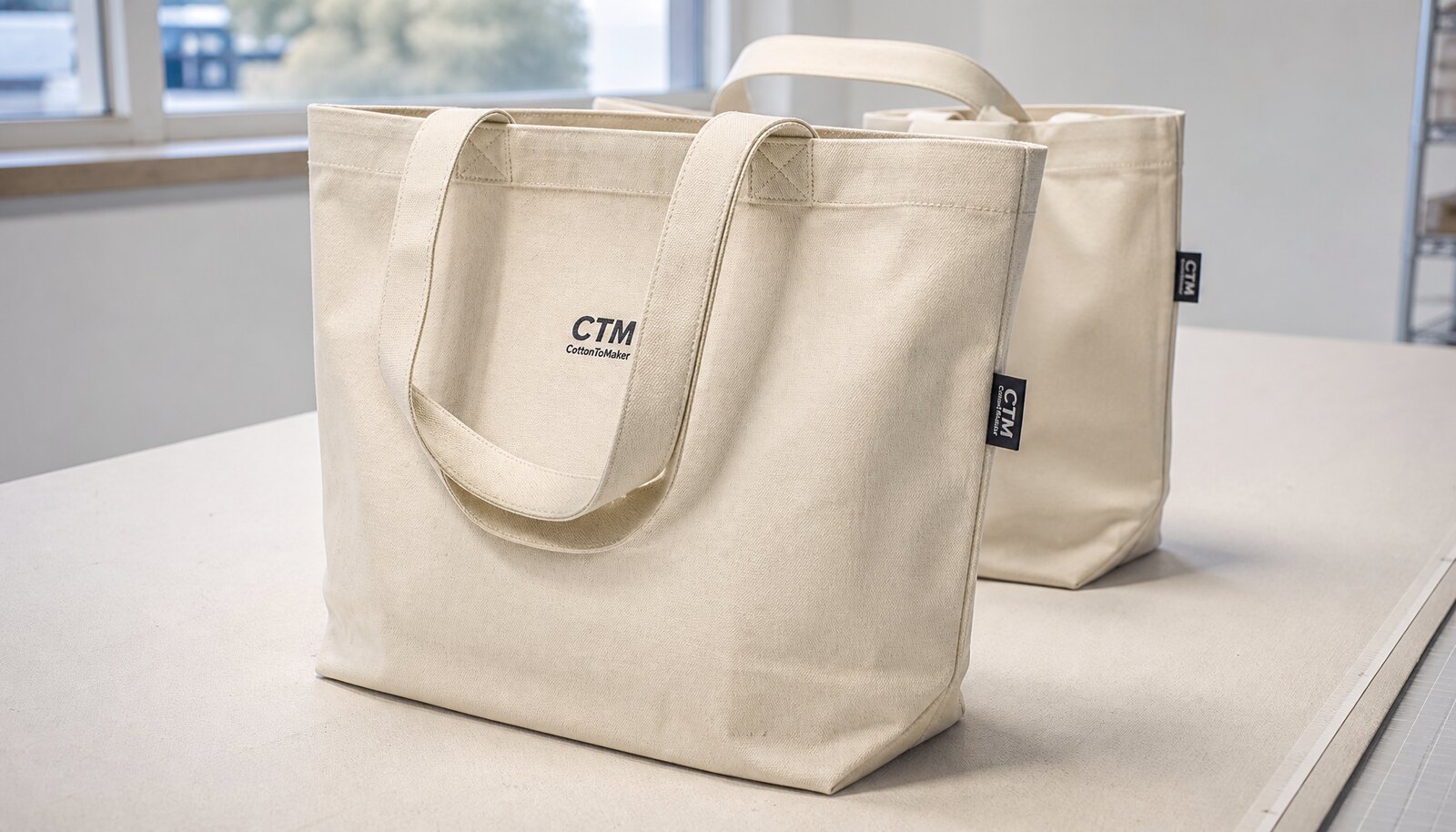
Why the sample matters more than the quote
For canvas retail merchandise bags, the sample is not a courtesy step. It is the moment where the quote becomes a real product specification. If the bag is meant to support ecommerce merchandising, the sample has to prove more than appearance. It has to confirm that the bag ships flat, presents cleanly in product photos, survives fulfillment handling, and still feels like a retail item when a customer opens the parcel.
A low unit price can hide a lot of problems if the sample is not used as the approval standard. The usual failure points are not dramatic; they are small spec gaps that become expensive in bulk, such as a handle drop that feels wrong, a print that sits too high, a bottom seam that twists under load, or a canvas weight that looks thinner than the quote implied.
- Use the sample to lock the build, not just to approve the artwork.
- Treat the approved sample as the reference for the purchase order and inspection report.
- Measure the bag under the same conditions the customer will see it, not only in a factory hand-off photo.
Lock the spec before you request quotes
The fastest way to get inconsistent quotes is to send a vague brief such as a medium canvas tote with logo printing. That leaves too much open to interpretation. Before asking for pricing, define the bag size, gusset, handle style, fabric weight, artwork count, and packing format. For ecommerce brands, the bag has to work as a merch item and as a fulfillment item, so the spec should reflect both shelf appeal and warehouse efficiency.
Canvas weight is the first decision that changes the entire cost structure. A light promotional bag might sit around 8 oz or 240 to 280 GSM. A standard retail merch bag often lands near 10 oz or 300 to 340 GSM. A more structured premium bag may move into 12 oz or 340 to 380 GSM, and heavier builds can go above that. If the bag must hold boxed merchandise, do not approve a light fabric just because the print looks good on a sample.
- Specify finished size in millimeters or inches, plus the allowed tolerance.
- State the canvas weight in both oz and GSM if your supplier works across regions.
- Clarify whether the bag is raw, bleached, washed, or dyed, because that changes hand feel, shrinkage, and cost.
Choose the right sourcing route for the sample stage
The cheapest supplier is not always the lowest-risk route for a sample approval process. Some buyers need a direct factory with in-house sewing and printing because that keeps accountability clear. Others need a sample house first, then a bulk factory later. The right route depends on whether the main risk is fit, artwork accuracy, packaging logic, or lead time.
The comparison below is useful because it separates commercial convenience from production control. If the sample needs to be approved by a merch team, a fulfillment team, and a brand team, choose the route that reduces handoff errors. A slightly higher sample cost is often cheaper than a bulk run with a wrong logo placement or a packaging format that slows warehouse handling.
- Prefer one accountable owner when the design is simple and repeat orders matter.
- Use a sample specialist when the bag shape or retail presentation is still being refined.
- Use a packaging-capable source when barcode labels, inserts, and carton logic are part of the product.
What the physical sample must prove
The sample should answer a set of practical questions. Does the bag stand straight when filled? Do the handles sit evenly? Does the canvas body look balanced, or does it pull and distort around the seam line? Does the bag still look retail-ready after it is folded, packed, and reopened? If the answer to any of those is unclear, the sample is not ready for approval.
Structural checks matter because canvas bags often fail in small but visible ways. A weak bottom seam or loose bar tack may not show up in a showroom photo, but it will show up after repeated loading. Look closely at the stitch path, seam allowance, corner reinforcement, and the tension where handles join the body. If the bag has lining, pockets, zippers, or contrast panels, inspect how those interfaces sit under strain.
- Compare the sample against the drawing and confirm size, panel symmetry, and handle drop.
- Inspect seam density at stress points, especially bottom corners and handle joins.
- Check for fabric defects such as slubs, thin spots, stains, and loose yarns before any approval is signed.
Approve the print and branding separately from the bag body
Many buyers focus on the tote shape and then discover too late that the print is the part customers actually see first. For simple retail merchandise bags, one- or two-color screen printing is usually the cleanest route because the ink holds up well and the brand mark stays sharp. If the artwork is complex, a gradient, or a photographic treatment, you need to confirm whether the chosen method can survive abrasion and folding without cracking or looking muddy.
Print placement is just as important as print method. A logo that is technically correct but sits too low, too high, or slightly off-center can make the bag look like a sample-room mistake. Set the exact print area, edge offsets, and color reference before approval. If your brand uses Pantone targets, ask the factory how they will match and how much drift they allow between the sample and bulk run.
- Use screen print for most simple retail logos because it is durable and repeatable.
- Use transfer, embroidery, patching, or woven labels only when the visual or hand-feel benefit is clear.
- Check rubbing, folding, and light abrasion on the sample so the logo does not fail after packaging.
Packing and retail readiness are part of the product
For ecommerce brands, the bag is rarely just a bag. It often lands in a warehouse, gets scanned, repacked, and placed in a customer parcel. That means the approval sample should include the full packing method, not just the bag itself. Flat packing, tissue, fold direction, barcode placement, and master carton marking all affect how the item moves through the supply chain.
If the sample looks good but the packaging is awkward, the cost shows up later in warehouse labor and damaged presentation. A bag packed too tightly can hold a permanent crease. A barcode sticker placed on the wrong panel can slow receiving. A carton that is too large can waste freight and increase the risk of corner damage. Approve the retail pack as if you were receiving the product at the warehouse dock, not as if you were holding a single sample in the office.
- Approve the fold method, inner pack, and carton count before bulk starts.
- Make sure barcode labels, SKU codes, and case marks match the buyer's fulfillment system.
- Check that carton dimensions and gross weight fit the shipper's handling limits and storage plan.
Read the quote for what it leaves out
A useful quote should separate material, labor, print, packing, and tooling. If everything is rolled into one line, you cannot tell where the supplier is making assumptions. That becomes a problem when the sample is approved and the factory later says the artwork needs another screen charge, the packaging needs a new insert, or the canvas weight is higher than originally discussed.
The safest quote is one that names the exact fabric weight, bag dimensions, print method, and packaging unit. It should also make MOQ logic visible. A supplier may quote a low unit cost for one print color and a completely different structure for a second colorway, because screens, fabric dye lots, and packing configurations all drive setup work. Buyers should compare routes, not just final prices.
- Ask which items are included in the unit price and which items are separate setup charges.
- Request the MOQ by material color, artwork color count, and packaging format.
- Make the supplier state whether sample fees, screen charges, or tooling are deductible on bulk.
Use acceptance criteria, not opinions, for bulk QC
A sample approval checklist is strongest when it leads directly into an inspection standard. If the sample is approved on vague language such as looks fine, bulk quality will drift. Define the measurable points now: dimension tolerance, stitch consistency, print alignment, color match, packaging format, and acceptable defect levels. That way the factory knows where the line is before production begins.
For a first bulk run, buyers should also decide which issues are major and which are minor. A small thread tail may be acceptable if it is trimmed cleanly. A broken seam, misprinted logo, or shade mismatch should not be treated as a cosmetic issue. If the bag is part of a retail launch, the standard should be tight enough that the warehouse team does not need to rework the product before it reaches the customer.
- Set major and minor defect definitions before the order is placed.
- Keep one signed master sample and one sealed packaging reference for comparison.
- If possible, inspect a pre-production sample and the first production lot against the same reference.
Plan lead time and MOQ around the real bottleneck
The biggest schedule mistake is to think lead time starts when the order is placed. In practice, lead time starts when the spec is frozen. If the bag needs custom fabric, a new print screen, a special pack format, or multiple labels, each of those steps can add time. Sample approval should therefore include the actions that create delay: artwork sign-off, print strike-off, packaging sign-off, and carton label approval.
MOQ should be read as a production logic question, not just a factory demand. A supplier may quote a lower MOQ for one natural canvas color and a higher MOQ for dyed fabric, because dye lots and setup changes raise risk. The same is true for multiple print colors, inner linings, or custom inserts. Buyers who understand those drivers can negotiate a cleaner order structure and reduce the chance of paying for unnecessary setup work.
- Expect the sample stage to move faster than bulk, but do not compress approval just to save a week.
- For repeat programs, keep the same spec and same packing logic so reorders stay efficient.
- If freight timing matters, compare sea and air only after the sample is approved and the final pack size is known.
Specification comparison for buyers
| Spec decision | Recommended option | When it fits | Buyer risk to check |
|---|---|---|---|
| Direct factory with in-house sewing and printing | Best for one accountable supplier and cleaner sample revisions | Standard ecommerce merch runs with stable artwork and repeat orders | Confirm the sample is made on the same line that will run bulk |
| Cut-and-sew factory plus outside printer | Use when the bag build and the artwork need different specialists | Complex logos, short test runs, or limited internal print capability | Watch handoff errors on print placement, curing, and ownership of defects |
| Trading company sourcing from multiple factories | Useful for buyers who want one commercial contact and flexible sourcing | Multi-style programs or brands that need several bag constructions at once | Verify the real maker, not just the quote source, and ask for factory photos |
| Local decorator or domestic sample shop | Best for rapid prototypes and urgent retail launch decisions | Early-stage validation, small drops, or artwork changes that are still moving | Unit cost is usually higher and the final bulk process may differ from the sample |
| Nearshore cut-and-sew supplier | Good balance of speed and communication for replenishable programs | Mid-volume orders where freight timing matters more than lowest unit cost | Check fabric availability, labor consistency, and whether repeat orders hold the same spec |
| Offshore bulk factory with long-run capacity | Best when the design is stable and cost target matters most | Repeat ecommerce merchandise bags with predictable demand | Sample timing can be slower, so lock the spec before asking for a final quote |
| Prototype or sample house first, then bulk factory | Use when fit, shape, or branding placement is hard to get right | First launches, premium merch, or bags with strict shelf presentation rules | Make sure the bulk factory can duplicate the approved sample without re-engineering it |
| Hybrid source with packaging specialist | Useful when the bag must arrive retail-ready for fulfillment and barcode handling | Ecommerce brands that need polybagging, inserts, SKU labels, and carton logic | Confirm who owns final packing specs so labels, case packs, and carton marks stay consistent |
Buyer checklist before sampling
- Lock finished size, gusset, handle drop, and allowed tolerances before sampling starts
- Confirm canvas weight in oz and GSM, and note whether the fabric is raw, bleached, washed, or dyed
- Approve the print method, artwork file, color target, and exact placement on the bag
- Check seam reinforcement, handle stitch count, and bottom construction on the physical sample
- Review sample packaging, barcode label placement, and carton marks against the ecommerce fulfillment plan
- Request the factory's quote by material, labor, print, packing, and tooling so hidden costs are visible
- Define acceptable defects and the inspection standard for the first bulk run
- Keep one signed master sample and one sealed packaging reference for production comparison
- Test the sample with the intended product load, not an empty bag carry test
- Confirm MOQ, lead time, sample fee policy, and the repeat-order path before approving artwork
Factory quote questions to send
- What exact canvas weight are you quoting in oz and GSM, and what tolerance do you allow?
- Is the fabric raw, bleached, washed, pre-shrunk, or dyed, and does that change the hand feel or shrinkage?
- What bag dimensions, gusset, and handle drop are included in the quote?
- Which print method is priced, how many colors are included, and what setup charges apply?
- How many bar tacks, seam rows, or reinforcement points are built into the construction?
- What is the MOQ per color, per print version, and per packaging configuration?
- What sample charges, screen charges, plate charges, or tooling costs are refundable or deductible on bulk?
- What packing unit is included: bulk pack, single polybag, tissue, barcode sticker, or retail insert?
- What is the sample lead time, bulk lead time, and the main causes of delay?
- Can you share photos of the pre-production sample, in-line checks, or similar previous production?
Quality-control points to confirm
- Finished dimensions should stay within the agreed tolerance on width, height, gusset, and handle drop; the sample becomes the measured reference.
- Stitching at handle joins and bottom corners should be even, with no skipped stitches, loose thread clusters, or weak backtacks.
- Fabric weight should match the quoted canvas weight closely enough that the bag hand feel and body match the approved sample.
- Print placement should stay aligned to the approved artwork position, with no visible drift that makes the logo look off-center in retail photos.
- Color should match the approved sample under normal daylight and warehouse lighting; large shade swings between panels are not acceptable.
- Any critical carry point should pass a loaded stress test using the intended retail contents plus a safety margin.
- There should be no holes, oil marks, broken yarns, open seams, or visible contamination on the outside panels or inside seam lines.
- Cartons, labels, and inner packs should match the approved packing spec so warehouse receiving does not need to relabel or repack