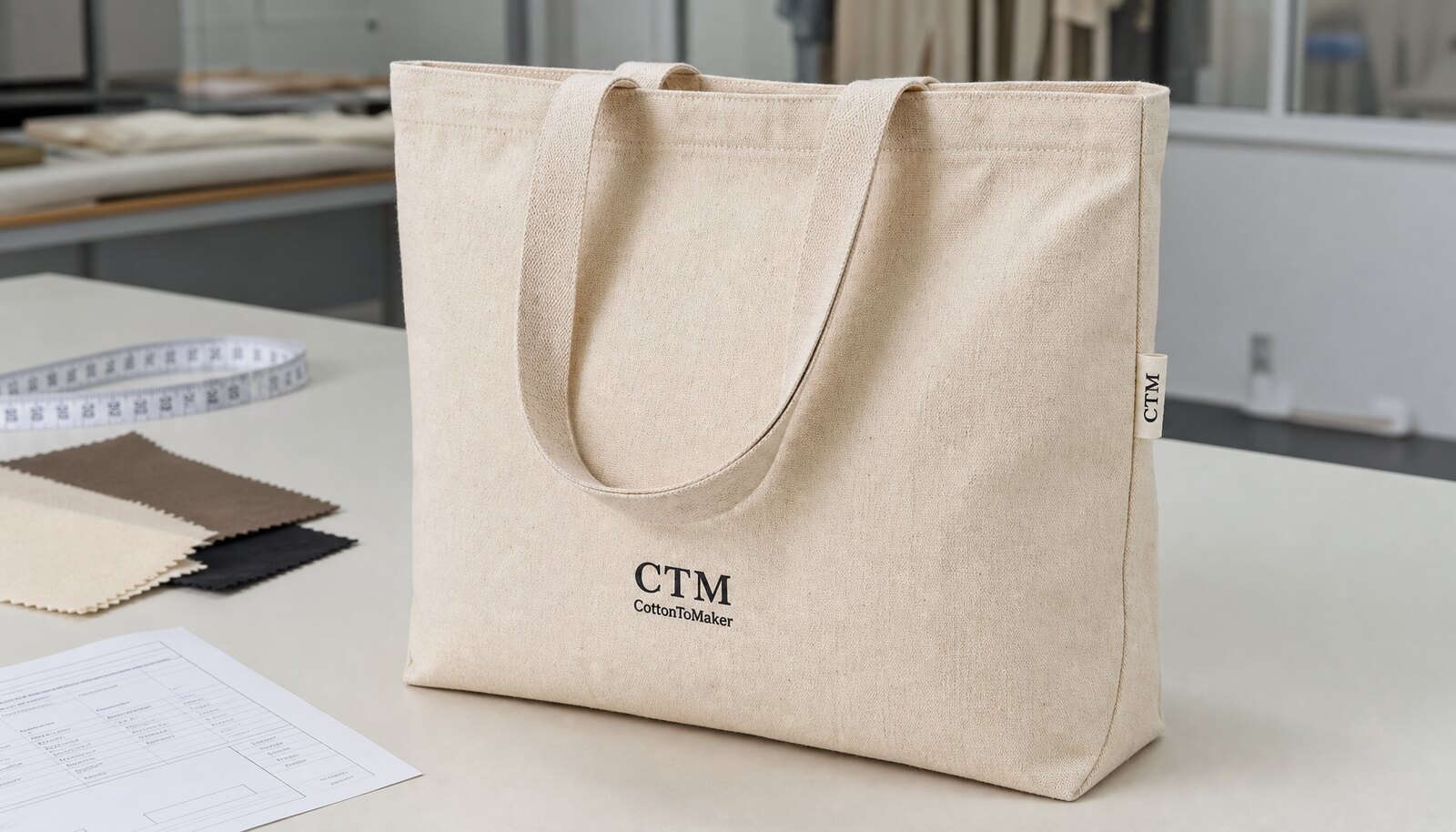
Why cosmetic brands need a procurement spec, not a style brief
Canvas retail merchandise bags for cosmetic brands sit in a strange middle ground. They are packaging, but they are also a brand-facing retail item that has to hold shape, print cleanly, and survive handling by distribution teams, store staff, and end customers. A style brief usually describes the look. A procurement spec has to control the look, the build, and the commercial reality at the same time.
That distinction matters because most quote problems begin with missing details rather than with bad suppliers. If the request only says "canvas tote with logo," each factory fills the gaps differently. One supplier assumes a lighter fabric, another chooses a wider seam allowance, and a third changes handle width to fit their own standard line. The result is a set of quotes that appear comparable but are not actually quoting the same product.
For cosmetic brands, the spec also needs to reflect the contents. A bag carrying a lipstick set is a different build problem from a bag carrying boxed skincare, a fragrance sample pack, or a premium promotion kit. The first may be judged by shelf presentation; the second by carrying performance and dimensional stability; the third by how reliably it protects the contents from scuffing and collapse. Once you define the actual use case, you can control the bag design around it instead of trying to correct it later in sampling.
The practical goal is simple: make the supplier quote the same product the first time. That means defining the bag's size, fabric, construction, print, and packing in terms that a factory can build against and a QC team can inspect against. The tighter the spec, the easier it is to compare suppliers on real value instead of on wording.
- Treat the bag as a retail item and a packaging component, not just a giveaway tote.
- Align the spec to the contents, the sales channel, and the way the bag will be handled after packing.
- Use the spec to eliminate quote ambiguity before sample development begins.
Start with the use case: what the bag must carry and how it will be handled
The fastest way to get a useful quote is to tell the factory what the bag is expected to do. If the bag will hold a boxed gift set, a few jars, a folded leaflet, or a product bundle with irregular shapes, the supplier can size the gusset, choose the handle reinforcement, and decide whether a flat bottom or boxed bottom is needed. Without that context, the factory guesses, and the guess often pushes cost or performance in the wrong direction.
A cosmetic brand also needs to decide whether the bag is purely for merchandise or whether it has to support display value. A merch bag that sits in an e-commerce carton can be simpler. A retail bag that is seen in a store needs cleaner lines, better edge control, and a finish that does not look collapsed when the bag is empty. This is where procurement and brand teams need one shared brief; otherwise the brand asks for premium presence while procurement approves the lowest-cost structure.
Content weight matters more than many buyers expect. A cosmetic bag carrying one small sample set does not need the same reinforcement as a bag carrying glass jars or a boxed skincare trio. The load profile determines the handle spec, the stitch density at the stress points, and whether a single-layer base is acceptable. If you skip that step, you may save a few cents per unit and lose the bag in pre-shipment QC or, worse, after customer use.
A good RFQ names the intended contents, approximate filled weight, target use environment, and whether the bag must stand upright when packed. Those details do more to shape the quote than vague style language ever will.
- State the intended contents and approximate filled weight in the RFQ.
- Specify whether the bag is for retail display, merchandise packing, or customer carry use.
- Say whether the bag must stand upright or keep a structured profile when filled.
- Do not rely on the seller to infer how much reinforcement the bag needs.
Define the fabric first: weight, weave, finish, and shrink control
For most canvas retail merchandise bags, 12 oz / 340 gsm is a practical baseline. It gives enough body for shelf presentation, enough durability for regular handling, and a reasonable cost profile for repeat production. When the bag is expected to carry heavier boxed cosmetics, layered promotional inserts, or a premium product bundle, 14 oz / 400 gsm is often a safer starting point because it holds shape better and is less likely to look thin once printed.
Fabric weight is only part of the story. Weave density and finishing have a direct effect on how the bag looks and how the print behaves. A tighter weave gives cleaner edges for logos and finer type, while a loose weave can leave ink sitting unevenly on the surface or make small lettering look fuzzy. Pre-shrunk or stabilized fabric is worth asking for when the bag will be steamed, pressed, folded, or reworked in a warehouse. Untreated canvas can shrink enough to change the final dimensions and throw off the gusset alignment.
Color is another procurement issue, not just a brand issue. Natural canvas gives a familiar premium-rustic look and usually prints well for simple brand marks. Dyed canvas can better match campaign colors, but it introduces more shade variation risk and can complicate reorders if the dye lot changes. If the bag is part of a retail program that will be repeated across seasons, ask the supplier to identify how they control fabric lot matching and whether reorders will come from the same mill or a substituted source.
The buyer should ask for a real fabric swatch before approving the print. Photos hide weave texture, hand feel, and the way ink will sit on the canvas. That is especially true for beauty packaging, where the product is often judged visually before it is even used.
- Use 12 oz / 340 gsm for standard retail merch and 14 oz / 400 gsm for heavier or premium-filled bags.
- Ask for pre-shrunk or stabilized fabric when dimensional control matters after pressing or handling.
- Approve from an actual swatch, not just a digital render or a photographed sample.
- Confirm whether the supplier can repeat the same fabric lot on reorder.
Specify pattern, dimensions, seam allowance, and gusset depth in measurable terms
This is where many quotes become misleading. Nominal bag size tells you the intended outside size, but not the usable volume. Once the supplier adds seam allowance, top hem, and any reinforcement, the internal space is smaller than the headline dimension. If the product bundle is rigid, even a small reduction can create a bag that looks fine empty and performs poorly once packed.
A procurement-grade spec should include finished dimensions, usable internal dimensions, and the seam allowance the factory is expected to use. For canvas totes, a typical seam allowance may sit around 10-12 mm, but the important point is consistency, not the exact number alone. If the supplier changes seam allowance between the sample and bulk run, the bag may drift in size, handle drop, or fit. The same applies to gusset depth: a gusset that is too shallow can collapse the sidewall, while one that is too deep can make the bag balloon and lose the clean retail silhouette cosmetic brands usually want.
Flat totes are usually acceptable for lighter merchandise and launch materials. Once the bag starts holding boxed skincare, jars, or mixed gift sets, a gusseted or boxed-bottom structure gives better capacity and a more predictable shape. If you need the bag to stand upright in-store or in a distribution center, call that out explicitly. A lot of production disputes happen because the buyer assumed the bag would stand on its own while the factory only quoted a simple flat construction.
It is also worth defining tolerance up front. For small bags, a practical starting point is often around +/-0.5 cm on key dimensions; for larger totes, +/-1.0 cm may be more realistic, depending on fabric behavior and finishing. The key is to write the tolerance into the spec so the supplier knows what will pass and what will not.
- Specify finished dimensions, usable internal dimensions, and seam allowance separately.
- Call out gusset depth and whether the bag must stand upright when filled.
- Set a dimension tolerance in the RFQ so the factory is not guessing the acceptance line.
- Use flat construction only when the packed contents truly allow it.
Handles, reinforcement, and closure options should match the real load
Handle design is one of the easiest places to overspend or under-spec. For canvas retail merchandise bags, 25-30 mm cotton webbing handles are a practical default because they feel better in hand than thin self-fabric handles and usually carry load more comfortably. The important procurement detail is not just the material but the attachment method: bartacks, box-x stitching, or another agreed reinforcement pattern should be written into the spec so the factory cannot substitute a lighter treatment.
The handle drop should also be tied to the bag's intended use. A tote that will be carried by hand in a store may need a shorter drop than a bag intended to sit on the shoulder or be carried over a coat. If the handle is too short, the bag becomes awkward; if it is too long, the bag may swing too low and distort the silhouette. Handle length affects both user comfort and the visual proportion of the bag on shelf.
Closure choice should be functional, not decorative. Open-top bags are the simplest and usually the best fit for standard merchandise or promotional packs. A zipper is only worth adding when the bag protects smaller premium items, travel kits, or contents that need more security during transit. A closure can also change the usable interior volume and introduce alignment risk, so it should not be added casually just because it sounds more premium.
For performance, ask for a load test target. A common sourcing approach is to test the bag at or above its intended filled weight, then check for seam opening, handle tear, bartack failure, and permanent distortion. The bag should also be checked after the load is removed so the buyer can see whether the body recovers or stays warped.
- Use 25-30 mm cotton webbing handles when carry comfort and presentation matter.
- Specify the reinforcement pattern at the handle attachment point, not just the handle material.
- Choose open top unless the contents actually need a closure.
- Tie the load test to the intended filled weight and inspect after unloading for distortion.
Artwork files, print method, and color control should be written as production instructions
Print quality is one of the fastest ways a canvas retail merchandise bag can look expensive or cheap. Simple logos usually work best with screen print because the process can hold solid color and remains cost-efficient once the setup is absorbed. For short runs, launch tests, or artwork with multiple colors, digital print or heat transfer may be a better fit, but the buyer should not assume those methods will behave the same way on textured canvas as they do on paper or a smooth synthetic surface.
The artwork brief should be more specific than a file upload. The factory needs the final file format, vector or raster requirements, bleed expectations if any, the exact print area, the placement reference points, and the number of colors in the design. If the logo must match a Pantone reference, say so. If the brand accepts a close visual match instead of a strict ink formula, say that too. Without that instruction, the supplier may optimize for process convenience rather than for brand consistency.
Canvas is absorbent and slightly irregular by nature, so small typography and fine details deserve special attention. A logo that looks crisp on a screen may not hold edge clarity on a textured weave, especially if the print area is large or the canvas color is dark. For cosmetic brands, the safer approval path is to request a strike-off on the actual fabric and review it under neutral light. If the artwork uses halftones, gradients, or small legal copy, those elements should be tested before the bulk run because they are where readability often breaks down.
One practical rule: if the factory cannot explain how it will control print registration, edge coverage, and color consistency on the exact bag construction, the quote is not ready to compare. The buyer should insist on a sample that proves the production method, not just the artwork concept.
- Send vector artwork when possible and define the exact print area on the pattern piece.
- State the number of colors, Pantone references, and whether a close match is acceptable.
- Approve a strike-off on the actual canvas, under neutral light, before bulk production.
- Treat small type, gradients, and fine legal copy as test items rather than assumptions.
Compare supplier routes by process control, not by the first number on the quote
Two suppliers can quote the same-looking canvas tote and still be offering very different products. A direct factory with in-house cutting, sewing, and printing usually gives better control over fabric substitution, stitch consistency, and packing accuracy. A trader or broker may simplify communication, especially if the brand is buying multiple SKUs, but the commercial risk is that the real maker, the print process, and the QC owner are less visible. A small workshop may be flexible and responsive, but it can also have less line discipline and fewer standardized inspection records.
Procurement should compare the complete route, not just the per-piece price. Ask who buys the fabric, who prints the logo, who signs off the pre-production sample, and who controls carton packing. Then compare the consequences if something changes mid-order. If a factory runs out of the original fabric lot, can it match the reorder shade? If print registration drifts, who corrects it? If the bag count is short in a carton, who owns the correction before shipment?
The strongest supplier relationship for a cosmetic brand is usually the one that can repeat the same bag with the same appearance over time. That matters more than a one-off low quote because retail packaging programs tend to reorder. A supplier that can document its process and explain its constraints is usually easier to manage than one that only answers with a number. This is where a buyer should ask for transparency on subcontracting, material sourcing, and any hidden processing steps that could affect lead time or quality.
If the quote looks unusually low, it often means one of three things: the fabric is lighter than expected, the print or packing standard is lower than assumed, or the supplier is not including a step that will reappear later as an add-on. The spec is the only way to tell which one it is.
- Direct factory sourcing usually gives the cleanest control over fabric, print, sewing, and packing.
- Trading routes can work, but they need clearer accountability for who owns each process step.
- Ask who buys materials, who prints, who inspects, and who signs the final shipment release.
- Compare total landed cost, not just unit price.
Use the sample stage to lock the production standard, not just the design
The sample stage should answer a business question: can this bag be reproduced at scale at the standard the brand needs? A nice-looking sample is not enough if it hides production problems. The pre-production sample should be made from the actual fabric, with the actual print method, actual handle construction, and actual packing approach. If the supplier changes those items later, the sample has limited value as a control document.
For cosmetics packaging, sample approval should include more than a visual review. Measure the body width, height, gusset depth, and handle drop after a light press so you know the final bag will not come up short. Put the intended contents in the bag and test whether it stands, sags, or distorts. Inspect the logo at close range and from the distance at which a shopper would normally see it, because beauty packaging is often judged first from shelf distance and then up close.
A useful approval record should include photographs, a signed sample sheet, a note on any acceptable variance, and confirmation that the bulk order will follow the same material and process plan. If the brand allows a tolerance exception during sampling, the exception should be written down. That prevents later debate about whether a slightly off-center logo or a slightly narrower bag was acceptable in the first place.
If the project includes multiple stakeholders, keep the approval chain short. Too many people commenting on a sample often creates a moving target. Procurement should collect comments, reconcile them, and return one clear decision. The factory can only build against one approved standard.
- Approve a pre-production sample made with final materials and production methods.
- Measure the bag after light pressing and after loading it with the intended contents.
- Document any acceptable variance in writing before bulk production begins.
- Keep the approval chain focused so the supplier receives one unambiguous standard.
QC needs measurable criteria: what to inspect, how to inspect it, and when to reject
QC coverage for canvas retail merchandise bags often stays too generic. Saying "check stitching" is not enough. The inspection plan should identify the critical points that matter for cosmetics brands: handle attachment, top hem, side seam integrity, print location, fabric shade, bag dimensions, and carton count accuracy. Each point should have a measurement method or a defect definition, otherwise different inspectors will judge the same bag differently.
A practical QC framework starts with visual and dimensional inspection, then moves to performance checks. Dimensional checks should be done on finished bags after pressing, using a repeatable method and the same reference points across lots. Print should be checked for registration, coverage, and obvious bleed. Stitching should be checked for skipped stitches, seam puckering, loose ends, and broken bartacks. For load testing, the bag should be filled to the agreed target weight or simulated with equivalent content and then inspected for seam opening, handle tear, base failure, or permanent deformation.
Rejection criteria should be written in plain language. Critical defects are the ones that make the bag unusable or unfit for retail, such as open seams, missing handles, broken zippers, severe print misplacement, or contamination that cannot be cleaned. Major defects are the ones that affect function or presentation materially, such as uneven handle length, obvious skew, or poor print coverage. Minor defects are cosmetic issues that do not materially affect use, such as a small loose thread that can be trimmed without damage. If your team uses AQL, define it in the RFQ or the purchase order so the supplier knows the gate before production starts.
Pre-shipment inspection should also cover count accuracy and carton labeling. Mixed sizes, missing pieces, and wrong carton marks create avoidable downstream cost because they consume warehouse time even if the bag itself is acceptable. For retail programs, that is not a small issue; it can delay launch or create internal repacking work that the buyer never budgeted for.
- Define critical, major, and minor defects before the order is placed.
- Measure finished dimensions after pressing, using consistent reference points.
- Load test sample bags against the agreed filled weight and inspect for damage after unloading.
- Verify carton counts, labels, and assortment before shipment release.
Write the RFQ like a production document, not a buying note
A good RFQ saves time because it tells the supplier what to quote, what to ignore, and where the acceptance line sits. For canvas retail merchandise bags for cosmetic brands, the RFQ should include the finished size, usable internal dimensions, fabric weight, weave or finish preference, handle spec, print method, artwork placement, packing method, target MOQ, and any inspection requirement. If the supplier has to guess any of those items, the quote will come back with exceptions that the buyer then has to decode.
Commercial detail belongs in the RFQ as well. Ask for unit price, sample fee, print setup fee, packing fee, carton cost, and the applicable incoterm so that different suppliers are speaking the same language. If lead time matters, ask for sample timing and bulk timing separately. If the product will be re-ordered, ask whether the same materials will be reserved for repeat production or whether the factory expects to re-source on each run. That answer tells you more about supply stability than a simple yes/no on capacity.
The most useful RFQ question is usually the one that forces the supplier to explain assumptions. For example: "What are you excluding from this quote?" or "Which part of the spec would change the price the most?" The first question reveals hidden add-ons. The second reveals cost sensitivity and helps procurement decide where to simplify the product without compromising the brand standard.
If the bag program is tied to a cosmetic launch, keep the first order simple and reproducible. One size, one print version, one handle spec, one packing method. That gives you a cleaner supply base and a better benchmark for future reorders. Complexity can be added later once the base SKU is proven.
- Put the full product spec, packing spec, and commercial terms into the RFQ.
- Ask suppliers what is excluded from the quote and what would trigger a price change.
- Compare unit price, sample fees, packing fees, and incoterm on the same basis.
- Keep the first order simple enough to reproduce without interpretation.
Specification comparison for buyers
| Spec decision | Best-fit option | Cost driver | Buyer tradeoff or risk to check |
|---|---|---|---|
| Fabric weight | 12 oz / 340 gsm cotton canvas for standard retail merch; 14 oz / 400 gsm for heavier gift sets | Heavier fabric increases raw material cost, sewing effort, and carton weight | Too-light canvas may collapse, show print strike-through, or wrinkle badly on display |
| Weave and finish | Tight, stabilized, pre-shrunk canvas with a clean surface | Better finishing usually adds mill cost but reduces dimensional drift and appearance issues | Loose weave can print unevenly and may distort after pressing or light washing |
| Print method | Screen print for simple one- or two-color logos; digital or heat transfer for short runs and complex art | Setup cost and color count drive price; small runs pay more per unit | Fine type, gradients, or dark ink on textured canvas can lose clarity if the method is mismatched |
| Bag structure | Flat tote for light merch; gusseted tote or boxed bottom for gift sets and boxed cosmetics | Added gusset depth and base reinforcement increase cut-and-sew labor | Undersized gussets reduce usable capacity and can make the bag look distorted in carton |
| Handle construction | 25-30 mm cotton webbing handles with bartack reinforcement | Webbing width, stitch count, and reinforcement add labor but improve carry comfort | Thin self-fabric handles can twist, cut into the hand, or fail earlier under load |
| Closure option | Open top for standard merchandise; zipper only when product security or premium presentation is needed | Zippers add hardware cost, alignment time, and QC risk | A poor zipper spec can cause snagging, uneven closure, and avoidable returns |
| Supplier route | Direct factory with in-house cutting, sewing, and print control | More process control can mean a higher initial quote but fewer hidden add-ons | Trading or brokerage layers can obscure who owns print quality, shade control, and packing accuracy |
| Order strategy | One size, one artwork version, one colorway for the first release | Lower complexity reduces setup, MOQ pressure, and sample churn | Early variant splitting raises cost and creates leftover inventory across multiple SKUs |
| Packing format | Bulk packed with agreed fold style and size-separated carton marks; polybag only if needed | More packing protection increases labor and carton volume | Overpacking can crush the canvas and underpacking can raise dust, creasing, or count errors |
Buyer checklist before sampling
- Final finished size, usable internal dimensions, gusset depth, and seam allowance, not just the nominal bag size
- Fabric weight in gsm or oz, plus whether the canvas is natural, bleached, dyed, pre-shrunk, or recycled
- Weave tightness, hand feel, and any finishing requirement that affects print sharpness or dimensional stability
- Artwork file format, print count, logo placement, Pantone references, and approved strike-off standard
- Handle length, handle width, reinforcement style, bartack count, and target load test requirement
- Closure type, zipper brand or hardware spec if applicable, and whether the bag must stand upright when filled
- Packing method, fold direction, carton count, carton mark format, and any retail-ready labeling requirement
- Target MOQ, sample stages, bulk lead time, re-order lead time, and whether peak season changes those timings
- Inspection standard for stitching, print registration, color tolerance, dimension tolerance, and carton count accuracy
- Incoterm, sample fee, tooling or screen fee, packing fee, and whether freight is based on actual or volumetric weight
Factory quote questions to send
- What exact fabric weight, weave density, and finishing treatment are you quoting for this bag?
- Is the print method in-house, and what changes in cost if we move from one-color screen print to multi-color digital print?
- What is your MOQ by fabric color, print color count, and artwork version?
- How many sample stages are included, and can you provide a pre-production sample made with final materials before bulk cutting?
- What is the finished size tolerance you will commit to after sewing and pressing?
- What handle reinforcement do you use, how many bartacks are applied, and what load test do you normally run?
- What are the standard carton pack count, carton dimensions, and outer carton gross weight?
- What is the bulk production lead time after sample approval, and how does that change during peak season or fabric re-order periods?
- Which QC points are inspected before shipment: stitch strength, print alignment, color tolerance, needle damage, and carton count accuracy?
- Can you separate landed-cost variables clearly: unit price, sample fee, screen or plate fee, packing fee, and special handling fee?
Quality-control points to confirm
- Fabric inspection against approved swatch, with shade, weave, and surface defects checked before cutting
- Finished dimensions measured after pressing, using the same method for every lot, and compared against the approved tolerance sheet
- Seam allowance verified on first-article pieces so the factory does not shrink the internal capacity below spec
- Handle bartacks and top-edge reinforcement checked on both stress points, with no skipped stitches, broken threads, or loose tails longer than the agreed standard
- Print position measured from the same reference edge on each panel, with any obvious skew, off-center placement, bleed, or poor edge definition rejected
- Color checked under neutral light against the approved strike-off, not only by eye in warehouse lighting
- Load test performed on sample units using the intended contents or an equivalent weight, with no seam opening, handle tear, or base distortion
- Zip or closure function tested across the full travel path, with snagging, misalignment, or missing hardware treated as defects
- Carton count and assortment verified against the packing list before sealing, with mixed sizes or missing pieces rejected
- Use AQL 2.5 or 4.0 only if it matches your internal QA standard; otherwise define critical, major, and minor defects explicitly before production starts