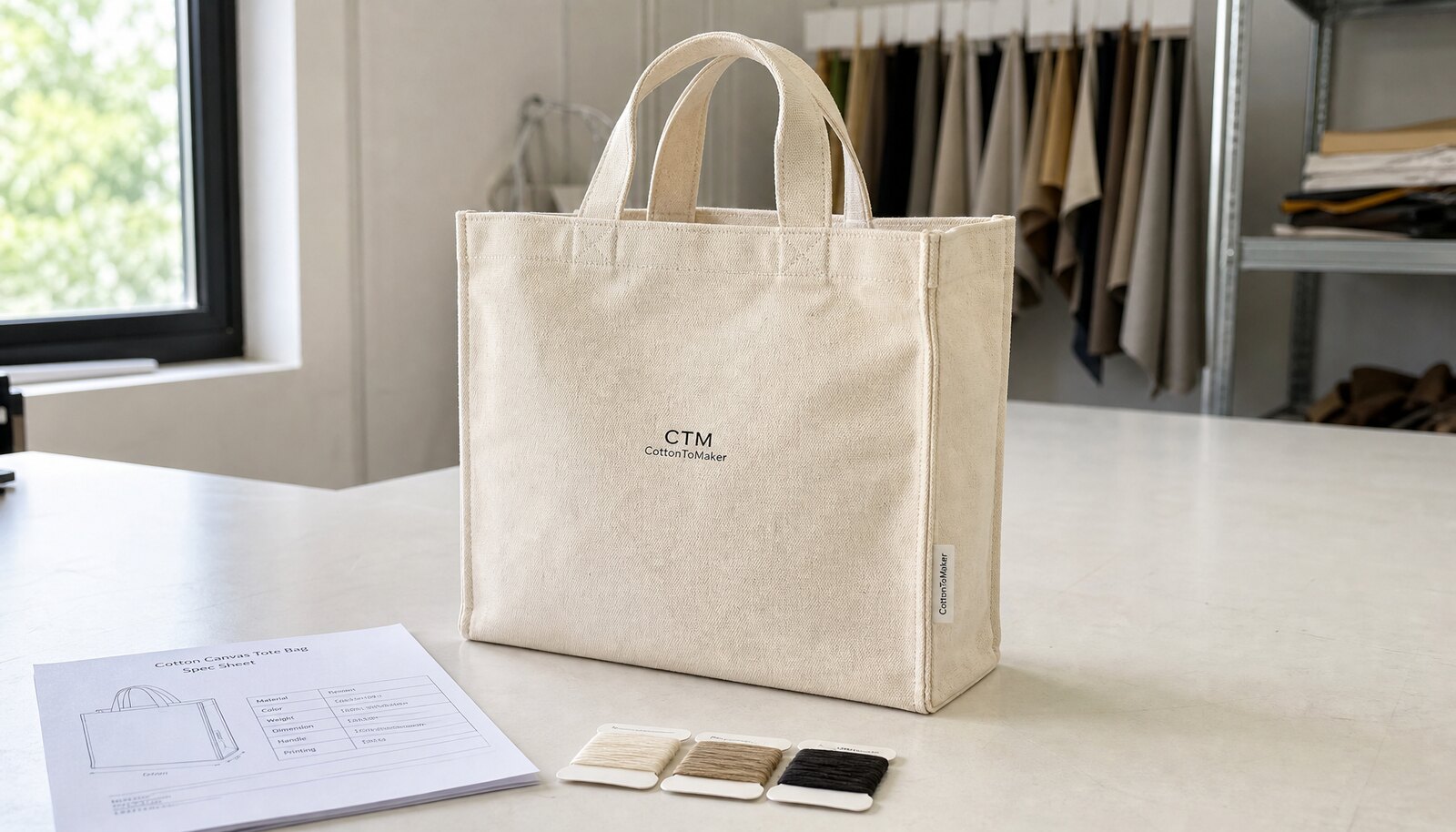
Start With the Retail Job, Not the Tote Type
For a coffee brand launch, the bag is usually doing more than carrying product. It may sit on a retail shelf as a paid merchandise item, move beans and a mug together at the register, or act as a branded gift bag in a cafe opening kit. Those are different jobs, and the spec should change with the job. A tote that works for a conference giveaway can look too thin for store resale, while a heavy structured bag may be too expensive for a promotion that only needs a simple carrier. The cleanest RFQ starts with the use case, then moves to size, fabric weight, and decoration.
The easiest mistake is to treat the bag as a generic canvas tote and leave the supplier to fill in the gaps. That usually creates quote apples-to-oranges problems: one factory prices a soft 10 oz bag, another prices a 12 oz structured bag with reinforced handles, and a third includes a woven side label without saying so. For coffee retail, buyers should define whether the bag needs to look premium on shelf, hold a specific bundle, or survive repeated consumer use. If the bag is sold at checkout, the visual standard is closer to a merch SKU than a shipping carrier.
- State the retail role: resale item, carrier, gift bag, or bundle pack.
- List the contents the bag must hold, including bottle, mug, and coffee pack size if relevant.
- Define whether the bag must stand upright or simply fold flat for storage.
- Decide early if the tote is part of the brand identity or only a functional add-on.
Choose Canvas Weight for Appearance, Not Just Cost
Canvas weight is one of the first cost drivers buyers can control. For most coffee brand merchandise programs, 10 oz canvas is the entry point for value-led retail, 12 oz canvas is the most common balanced option, and 14 oz canvas starts to feel more structured and premium. The right answer depends on what the bag must signal on the shelf. If your brand position is warm and artisanal, an unbleached 12 oz canvas with clean stitching usually looks credible without becoming expensive. If the bag is sold as a keepsake item, the extra body and better drape of heavier canvas can justify the cost.
Do not let canvas weight get described only in millimeters or vague marketing terms such as thick or heavy duty. Ask for GSM or ounces and clarify whether the weight is before or after finishing. A 10 oz bag can still feel acceptable if the pattern is well cut, the handles are reinforced, and the print is bold. But if the bag needs to hold coffee boxes, a ceramic mug, and daily use, a thin body will telegraph value problems immediately. Buyers should also ask whether the canvas is 100 percent cotton or blended, because that changes the sustainability story, the hand feel, and the way print ink sits on the fabric.
- Use 10 oz for lower-cost retail, quick launches, or lighter contents.
- Use 12 oz as the default spec when the bag is sold as branded merchandise.
- Use 14 oz when structure, shelf presence, and long-term reuse matter more than unit cost.
- If your brand story depends on natural fiber, confirm the exact composition and finishing treatment.
Size, Handles, and Structure Decide Sell-Through
A coffee tote fails in the store when it looks awkward to carry or does not fit the intended bundle. Common retail sizes are in the range of a compact shopper or medium tote, but the real decision is the internal volume created by the gusset and the handle drop. A narrow tote can look neat on a shelf and still be too shallow for a coffee box and mug. A deeper gusset improves utility, but too much depth can make the bag collapse unless the bottom construction is reinforced. If the bag is intended to be carried by hand and over the shoulder, the handle drop needs to match that use case, not just the visual design.
Construction details are where factories separate a decent sample from a retail-ready product. Ask for reinforced handle stitching, bar-tacks, or X-stitches at the stress points. If the bag will be opened and closed repeatedly at a register, side seams should be clean and internal edges should not fray aggressively. For unlined canvas, a neat overlock or binding on the inside is often enough, but the supplier should show you the inside finish in the sample. If you are targeting a premium coffee customer, the bag should feel deliberate when picked up, not like a simple utility sack.
- Specify body width, body height, and gusset depth in centimeters or inches, then repeat them in the artwork placement drawing.
- Set handle length by carrying method: hand carry, shoulder carry, or both.
- Require reinforcement at the handle attachment points and bottom stress points.
- Check that the bag looks balanced when full, not just when empty.
Print Method Should Match Artwork Complexity and Volume
For coffee branding, screen print is still the safest default for a clean logo on canvas. It gives good ink coverage, predictable color, and a lower risk of the artwork getting lost in the weave. If the design is a simple one-color or two-color logo, screen print is usually the best commercial choice. If the artwork includes gradients, small type, or a launch run that is too small to justify screens, heat transfer or a patch can work better. Each method changes the feel of the bag, so the decision should be tied to brand position, not just whether the art can be reproduced in one pass.
Artwork preparation matters as much as the method. Buyers should send vector files, outline all fonts, and specify exact logo placement from the top seam and side seam. On coarse canvas, fine lines can break up and tiny text can lose legibility, especially if the bag is washed or folded often. A factory should produce a strike-off or print sample that shows the actual opacity and edge quality on the chosen fabric. If the tote is a premium retail SKU, reject any sample that makes the logo look washed out, too glossy, or misaligned with the sewn structure of the bag.
- Use screen print for bold logos, repeat orders, and stable brand color control.
- Use heat transfer only when the art is more detailed than a screen print can handle at the launch MOQ.
- Use a woven label, sewn patch, or embroidery for small logo placement and a more premium finish.
- Reject artwork that relies on fine hairlines, soft gradients, or tiny legal copy on rough canvas.
Compare Supplier Routes by Control, Speed, and Quote Noise
The supplier you choose affects more than price. A direct factory usually gives the best control over sewing quality, canvas weight, and custom labeling, but it requires cleaner communication and a stronger spec package. A trading company or consolidator can simplify the purchase order if you are sourcing bags, hangtags, and carton packing together, but the buyer must verify who actually owns production and inspection. Domestic decoration on imported blanks is useful when the launch window is short, yet it often creates variation in bag body quality because the blank source may change between orders. The right route is the one that matches your launch window and forecast, not the one that looks cheapest on paper.
For coffee retail, a hybrid route can be efficient. One factory may sew the bag body and apply a woven label, while a local decorator handles final print or hangtags after the import lands. That can work if the handoff is controlled, but it also creates places where count errors and finish mismatches appear. If you use this route, insist on a single master spec sheet and a single carton list so the print vendor, the sewing factory, and the freight forwarder are all working from the same quantities. Quote comparisons become useful only when every supplier is pricing the same construction, the same packing format, and the same sample path.
- Direct factory: best for custom size, custom sewing, and stable reorder quality.
- Trading company: useful when you want one point of contact for several package components.
- Domestic decorator on blanks: useful for speed, but weaker on body-spec consistency.
- Hybrid route: useful when you need factory sewing quality plus local finishing speed.
Use MOQ Logic to Force Clean Quote Comparisons
MOQ is not just a factory policy; it is usually the point where fabric color, print setup, and labeling all collide. One color logo on a natural canvas bag can have a much lower MOQ than a full-color decorated bag with a custom woven label and bespoke carton marks. Buyers should ask each supplier to break MOQ by component, not just by finished bag. If a quote says the bag MOQ is 1,000 pieces, but the label MOQ is 3,000 and the print screen setup is charged again for every art change, you need to see that before you compare price. A clean RFQ separates bag body, decoration, labels, and packing into line items.
Quote data should tell you how the factory thinks. Ask for unit price by quantity tier, setup charges, sample charges, carton cost, and whether overrun allowance is included. If the supplier gives one blended price without details, you cannot tell whether the low number is driven by a cheaper bag body, cheaper print, or simply the removal of the packing components you actually need. For a launch, the best quote is rarely the cheapest one; it is the one that shows exactly where the cost is coming from and whether the same spec can be repeated for a reorder without a hidden spec drift.
- Request quote tiers at realistic launch quantities and at the next reorder break.
- Separate setup charges from recurring unit costs so you can compare suppliers fairly.
- Ask whether woven labels, hangtags, and barcodes have separate MOQs.
- Confirm if the factory prices the bag with or without individual polybags and inserts.
Approve Samples as a Production Tool, Not a Marketing Prop
A sample should tell you whether the factory can actually make the bag you will ship, not whether a photographer can make it look good. For a retail launch, the most important sample is the pre-production sample built from the actual materials, actual print method, and actual label method. A photo proof is not enough. On approval, the buyer should keep a sealed golden sample, because that is the reference the factory needs when the bulk run starts. If the supplier changes the fabric lot, print density, or label size later, you need something physical to compare against.
The sample checklist should be specific. Measure the finished dimensions, inspect the handle symmetry, verify the print position, and look inside the seams for loose threads or skipped stitches. If the bag uses a natural unbleached canvas, compare lot-to-lot shade variation because coffee brands often care about a natural, consistent tone. A small launch can tolerate a modest range, but not visible mismatches between the first carton and the last carton. A buyer who approves a vague sample and then expects retail consistency later is inviting a production dispute.
- Approve a physical sample built with the final fabric, print method, and label construction.
- Keep one sealed golden sample signed off by the buyer and supplier.
- Measure finished dimensions and compare them to the written tolerance band.
- Inspect print placement, stitch quality, handle balance, and shade consistency across bags.
Treat Packing as Part of the Retail Spec
Retail packaging is not an afterthought. A coffee brand tote that lands folded inconsistently or arrives with crushed edges can look cheap before the first customer touches it. The right pack format depends on how the bag will sell. If the tote is displayed on shelf, it may need a neat fold, tissue, a simple insert card, and a barcode sticker in a fixed location. If it is used only as a promotional carrier, bulk packing is often enough. The point is to match the pack method to the retail route, not to accept the factory's default folding habit.
Packing choices also affect freight and receiving. Carton count, inner pack count, and carton markings should be defined in the quote so the warehouse can receive the goods without rework. If a retailer has rules on polybags, recycled inserts, or barcode placement, those requirements belong in the spec before production starts. For coffee brands that care about sustainability, it is worth deciding whether the final packing should be minimal and recyclable or whether the customer-facing bag needs a more polished retail presentation. Either way, the factory should quote the pack format explicitly so it does not become a surprise later.
- Define fold method, inner pack, carton count, and label location before bulk production.
- Use insert cards or barcodes only if the retail channel requires them.
- Confirm whether individual polybags are allowed, required, or prohibited.
- Ask for carton marks that match the receiving warehouse and the retailer’s DC requirements.
Build the Schedule Backward From the Ship Date
Launch timing is where good tote specs still fail. A realistic timeline includes artwork finalization, sample approval, bulk sewing, decoration, inspection, and transit. If the bag needs a custom woven label or a special print setup, allow time for one revision loop before the bulk order is released. Coffee brand launches are often tied to a store opening, seasonal release, or product drop, so a two-week delay in sample approval can consume the entire buffer. Buyers should not ask the factory for a ship date before they know how many steps are outside normal production.
Landed cost should be compared route by route, not only supplier by supplier. A direct factory quote may look lower, but freight, inspection, packing, and a longer lead time may make the total less attractive than a domestic decoration option for a test launch. On the other hand, a fast local route can raise unit cost and still leave you with a weaker body spec. For a first release, build the comparison around the total landed cost at the warehouse, the reliability of the repeat spec, and the ability to reorder without redesigning the bag. That is the commercial number that matters to procurement.
- Work backward from the shelf date, not the PO date.
- Reserve time for sample approval, inspection, and transit delays.
- Compare landed cost at the receiving point, including freight and packing.
- Archive the approved spec so the reorder does not drift on fabric, print, or carton count.
Specification comparison for buyers
| Spec decision | Recommended option | When it fits | Buyer risk to check |
|---|---|---|---|
| Primary sourcing route | Direct factory with in-house sewing and print | Launch order needs custom size, custom label, and repeatable quality control | Confirm who owns sampling, what parts are outsourced, and whether the same factory will repeat the bulk run |
| Fastest launch route | Domestic decorator working from imported blank canvas bags | You need a short runway and the artwork is simple | Blank quality, handle stitching, and bag dimensions can vary across replenishment lots |
| Low-MOQ test route | Stock blank bag with local printing | You are testing a new coffee SKU, seasonal drop, or pop-up retail program | The tote may look generic and you may lose control over canvas weight, shape, and exact color |
| Premium retail route | Factory-made 12 oz to 14 oz canvas with woven label and clean screen print | The bag is sold as merchandise, not only used as a carrier | Check print opacity, label placement, and whether the bag stands upright on shelf |
| Decoration route | 1 to 2 color screen print for logo-led artwork | Artwork is bold, the logo must read clearly, and the order will repeat | Coarse canvas can blur fine lines, so approve line weight and registration on a strike-off |
| Artwork route | Heat transfer or patch for complex graphics or small launch quantities | You need detailed art, gradient elements, or short production runs | Test rub resistance, edge lift, and whether the decoration feels too plastic for a coffee brand |
| Packing route | Folded, counted, and carton-packed with barcode and size sticker | Retail buyers want shelf-ready cartons and clean receiving at DC or store level | Confirm carton count, inner pack count, and whether polybags are allowed or banned by the retailer |
| Quality route | Pre-production sample plus sealed golden sample and third-party inspection | You need a stable launch spec and a clear reference for future reorders | Do not rely on photos alone; compare stitching, dimensions, color, and print placement against the signed sample |
Buyer checklist before sampling
- Define the retail use case first: merch item, gift-with-purchase bag, coffee bundle carrier, or shelf-resale SKU.
- Lock the canvas weight target before requesting quotes, usually 10 oz for value, 12 oz for the default retail spec, and 14 oz for a more structured premium bag.
- Send a vector logo file with Pantone or exact color references, plus a simple placement drawing with measurements from seams and top edge.
- State the target size, gusset depth, handle drop, and whether the bag must stand upright on shelf.
- Ask every supplier to quote the same pack format, carton count, label method, and overrun allowance.
- Request a pre-production sample and keep one sealed golden sample after approval.
- Confirm what is included in the unit price: bag, decoration, woven label, hangtag, carton, inner pack, and local freight.
- Set the launch date backward from the ship date, not from the order date, and reserve time for one sample revision if artwork is not final.
Factory quote questions to send
- What canvas weight do you propose in GSM or oz, and is that weight before or after finishing?
- Is the quote for direct factory sewing, outsourced sewing, or a stock blank with decoration only?
- How many print colors are included, and what is the setup charge for each color or screen?
- What is the MOQ by colorway, print version, and packing format?
- What exact dimensions, handle length, and gusset depth are included in the quote?
- What sample stages are available, and is a pre-production sample charged separately from a strike-off?
- What is included in carton packing: fold method, inner polybag, barcode sticker, carton mark, and carton count?
- What is the estimated production lead time, and how does it change if I approve later artwork or a different label method?
- What overrun or underrun tolerance do you work to, and how is that handled on the invoice?
Quality-control points to confirm
- Verify canvas weight against the approved spec, not just the supplier description.
- Measure body width, height, and gusset on random finished bags and compare them to the signed sample.
- Check handle length, handle symmetry, and bar-tack or X-stitch quality at all load points.
- Inspect print placement, print density, and edge clarity on the first and last carton of the run.
- Confirm that the bag stands and folds as expected for retail display or shelf packing.
- Look for needle damage, loose threads, seam puckering, and frayed raw edges inside the bag.
- Check odor, stain marks, and color shading between bags from the same carton.
- Verify carton labeling, inner count, and barcode readability before shipment is released.