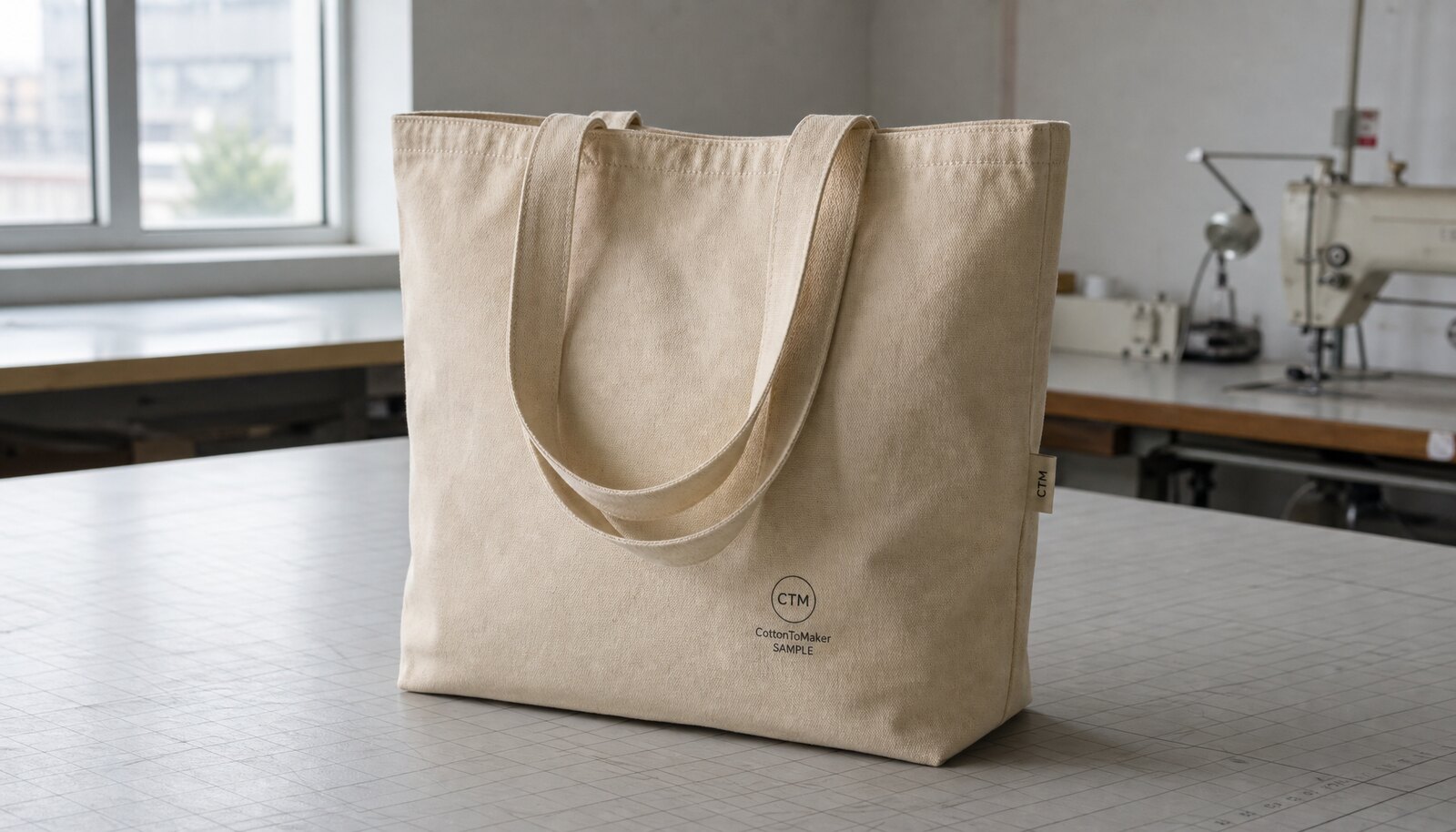
What This Bag Has To Do In A Charity Campaign
A canvas retail merchandise bag for a charity campaign has two jobs at once. It has to work as packaging because it carries the merch, donor kit, or event materials. It also has to work as a product because many campaigns sell the bag, give it as a premium, or use it as a visible symbol of the cause. That means the buyer should not treat it like a generic promo tote. It needs a spec that protects appearance, load performance, and reuse value in the same order.
The first sourcing mistake is defining the bag only by artwork and forgetting the use case. A checkout bag for folded T-shirts can be lighter than a retail bag that will hold books, bottles, or event kits. A fundraising bag that sits on a shelf needs cleaner stitching, better fold lines, and tighter print placement than a flat giveaway tote. If the charity wants sustainability to be believable, the bag must look durable enough to be used again, not like a disposable handout.
- Write down the final use: sell-through item, donor gift, event handout, or merch-pack carrier.
- Define the typical load weight before you compare prices.
- Decide whether the bag needs to stand upright, fold flat, or arrive retail-ready.
- Name the channel owner who will accept the final packaging and labeling format.
Compare Supplier Routes Before Comparing Unit Price
For sustainable packaging comparison, the sourcing route matters as much as the bag itself. A direct factory quote usually gives the best control over fabric weight, stitching, and packing, especially when the order is custom cut-and-sew and the buyer expects repeat business. A local decorator can be useful for urgent short runs or regional delivery, but decoration options may be limited and the upstream factory source may be harder to verify. A trading company can help with consolidation, but only if they can clearly show the actual maker, packing flow, and quality controls behind the quote.
The landed-cost trap is to compare only the ex-factory line. A supplier with a lower unit price can still cost more if the cartons are inefficient, the pack requires repacking, or the shipment misses the campaign date and forces air freight. For example, a slightly cheaper bag that ships in oversized cartons with low pack density can erase the savings quickly once freight and handling are added. Ask every supplier to quote the same carton count, the same shipping term, and the same pack format so the comparison is real.
- Direct factory: best for repeatable specs, tighter QC, and line-item cost control.
- Local decorator: best for urgent or low-volume programs with simple imprint needs.
- Trading company: acceptable only when the actual manufacturer is identified and auditable.
- Ask each supplier to quote the same carton count, the same pack format, and the same shipping term.
Build The Spec Around Load, Shape, And Shelf Life
Fabric weight drives most of the user experience. For many charity campaigns, 8 oz or about 250 gsm is enough for lightweight literature, folded apparel, or low-load event packs. It keeps the unit cost down and still gives the bag a proper canvas look. Once the bag is sold as retail merchandise or expected to carry daily-use items, 10 oz or about 340 gsm is the more balanced option. It feels more substantial in hand, resists creasing better, and usually supports a more premium logo finish. For a higher-end campaign or a bag that must carry heavier gifts, 12 oz or about 400 gsm is a safer spec.
Do not treat GSM as the only decision point. A natural unbleached canvas may look more sustainable, but it can also show slubs, fiber specks, and shade variation that affect print sharpness. A bleached or prewashed cloth can give cleaner artwork and a more retail-like finish, but the buyer should verify whether the surface treatment changes cost, shrinkage, or lead time. The practical spec is the one that matches the payload, the print method, and the shelf position, not the one that sounds greenest in a catalog.
- Use 8 oz / 250 gsm for light merchandise and lower-cost campaign packs.
- Use 10 oz / 340 gsm for most retail resale or reusable giveaway programs.
- Use 12 oz / 400 gsm when the bag must feel premium or carry heavier contents.
- Add gusset depth and reinforced seams before you simply increase cloth weight.
Pick Print And Decoration Around The Artwork, Not Habit
Screen print is still the practical default for most charity merch bags. It handles one- or two-color logos well, is cost-effective at higher volume, and gives good durability when the ink and curing are controlled. Water-based ink usually suits natural canvas because it keeps the fabric hand softer, which matters when the bag is meant to feel like a retail item. If the artwork is simple and the campaign volume is known, screen print is usually the safest balance of cost and quality.
The common mistake is choosing a decoration method before the artwork is locked. On canvas, fine lines, small type, and thin reversed details can fill in or break apart. Large solid blocks may need a stronger underbase or a different screen count. Embroidery can be suitable for a small logo, but it adds stiffness and can distort thin canvas panels. Buyers should request a strike-off on the actual fabric, not a paper proof, and should inspect the logo under normal store lighting. If the bag is intended for repeat use, ask how the print behaves after folding, flexing, and a basic abrasion check.
- Keep charity logos simple if the bag will be screen printed.
- Limit color count when you want a lower MOQ and cleaner registration.
- Specify Pantone references, print area, and acceptable shift in placement.
- Reject artwork that depends on tiny type or ultra-fine reversed lines.
Verify Sustainability Claims With Documents, Not Labels
A sustainability claim is only useful if the documents match the exact bag being bought. Ask for a material declaration that identifies the fiber content, fabric weight, and any finishing treatment. If the supplier says the cloth is recycled or organic, request the supporting file for the actual batch or mill reference, not a generic brochure. If the bag is sold into a market with specific chemical restrictions, ask for the relevant compliance file for that market, such as REACH, Prop 65, CPSIA, or other destination-specific declarations where applicable.
Do the same for inks, labels, and packaging. A recycled-fiber bag with a standard plastic overpack may not fit the charity's sustainability story as well as a slightly simpler pack with a paper band and a smaller carton footprint. Ask whether the ink has an SDS, whether the label material matches the pack claim, and whether the carton spec supports the campaign's waste-reduction target. If the supplier cannot provide the documents, the sustainability claim should not be used in buyer messaging.
- Request a material declaration for the fabric and any finishing treatment.
- Ask for current compliance files for the destination market, not a generic claim sheet.
- Verify ink and label details with supporting SDS or technical sheets where available.
- Check whether the packaging format supports the same sustainability story as the bag.
Read Quotes As Landed Cost, Not As A Single Number
A good quote comparison sheet should show the total delivered cost per usable bag, not just the ex-factory price. A cheaper unit price can become more expensive if the bags are underpacked, require extra repacking, or miss the campaign date and force air freight. The same logic applies to sustainability. A recycled-fiber bag with poor packing density or a high reject rate may create more waste than a simpler bag that is sewn well and shipped efficiently. Buyers should look at the cost of getting the right bag to the right place on time, not just the production number on the first page of the quote.
The cleanest way to compare suppliers is to ask every one of them for the same RFQ format. Use the same size, the same fabric weight, the same print locations, the same carton count, and the same delivery term. Then compare material, labor, setup, packing, inspection, inland freight, and documentation on one sheet. If a quote looks unusually low, read the exclusions carefully. Often the missing items are exactly where quality, schedule, or compliance risk gets transferred back to the buyer.
- Compare delivered cost per usable bag, not just ex-factory price.
- Include reject rate, repacking labor, carton inefficiency, and freight mode.
- Treat vague eco language as unverified until the bill of materials is clear.
- Use one RFQ template for every supplier so the comparison is actually fair.
Use Samples To Lock Dimensions, Color, And Build Quality
One pre-production sample is not enough if the bag has custom features. Keep a retained golden sample, sign off the measurement sheet, and store the approved artwork file in the same approval set. The sample should show the real cloth, real handles, real stitching, and real label placement. This matters because charity campaigns often depend on consistent presentation across stores or event locations. If the first batch arrives with slightly different handle length, logo height, or fold line, the discrepancy will be obvious when the bags are displayed side by side.
Define measurable acceptance criteria before bulk production begins. For most tote formats, a size tolerance of plus or minus 0.5 cm to 1 cm is reasonable depending on bag size, but the same tolerance should not be used blindly for every dimension. Print registration should stay tight enough that the logo does not look off-center from a normal viewing distance. Seam quality should be judged by structure, not just appearance: no skipped stitches, no loose bartacks, and no open seam ends. If the buyer expects a specific wash or rub behavior, ask the supplier what test method they use and whether they can share a result sheet.
- Compare the production sample against the signed artwork under daylight.
- Check handle pull points and bartacks on both sides of the bag.
- Measure body width, height, gusset depth, and handle drop.
- Treat a sample with notes as provisional until the notes are resolved in writing.
Make Packing A Procurement Decision, Not A Production Afterthought
Packing is not a minor detail. It affects labor, shelf presentation, carton efficiency, and sometimes the sustainability story itself. For most charity campaign bags, flat bulk packing is the cleanest option. It uses less material, is easier to palletize, and reduces repacking at destination. If the bag must go straight to a retail floor or e-commerce pick line, then add only the minimum extra components required: a recycled paper band, barcode label, hang tag, or size sticker. Individual polybags should be a deliberate choice, not the default.
The carton spec should be part of the quote, not a side note. If the factory packs too few bags per carton, freight cost rises and the landed cost gets worse even when the bag price looks competitive. If the cartons are too large, the bags can crease or lose their fold shape. Ask for carton size, pack count, gross weight, pallet pattern if relevant, and whether the outer carton carries retail marks or only shipping marks. If the shipment will move by sea in humid conditions, ask whether the supplier uses a moisture plan or desiccant strategy.
- Prefer flat pack unless the channel specifically requires retail hanging or individual protection.
- Use a paper band or label when the buyer wants a lower-impact pack format.
- Confirm carton count and carton dimensions before approving the final pack plan.
- Do not let packaging decisions be made after production has already started.
Set Lead Time Around Approval Gates, Not Wishful Dates
The real schedule starts after the buyer approves artwork and the sample, not on the day the inquiry is sent. If the bag uses standard canvas and a simple print, production can move quickly once the approvals are complete. If the order includes custom dyeing, a special woven label, or a complex carton instruction, the production clock becomes longer and less forgiving. Charity campaigns often have a fixed event date, so schedule planning should begin with the latest approval deadline, not with the earliest optimistic factory estimate.
Most delays come from the buyer side or the handoff between buyer and supplier. One late logo edit can force a new screen, a new strike-off, and a new carton label. A missing Pantone reference can slow everything down because the factory has to guess at color intent. The best protection is to lock one final PDF, one final size sheet, and one final pack instruction before bulk starts. If the campaign date is hard, build in buffer for sample approval, production, and shipping separately instead of treating lead time as one number.
- Ask the factory to map lead time by stage: sample, bulk, packing, and ship.
- Confirm whether fabric is in stock or must be woven, dyed, or finished first.
- Require an updated schedule after any artwork or spec revision.
- Keep one person responsible for approvals so the file trail stays clean.
When Canvas Is The Right Sustainable Packaging Choice
Canvas is the right choice when the campaign needs retail appeal, visible branding, and repeat use. It is usually stronger and more shelf-worthy than light promotional fabric, and it can support a cleaner print result when the artwork is simple. It is not automatically the best choice for every charity program, though. If the bag will only carry a single flyer set or a low-value handout, a lighter option may be more appropriate and easier to justify on cost and waste.
A useful sustainable packaging comparison is not canvas versus everything else. It is canvas versus the job the bag actually has to do. If the program needs a bag that becomes part of the merchandise, canvas is defensible. If the program only needs temporary transport, overbuilding the spec creates cost and material waste. The buyer should choose the lightest option that still protects the brand, the payload, and the campaign date. That is the practical sustainability test.
- Choose canvas when the bag must be reused and displayed, not just carried once.
- Choose a lighter option when the use case is temporary and low-load.
- Do not pay for premium construction if the channel does not need it.
- Match the material choice to the real merchandising and logistics plan.
Specification comparison for buyers
| Procurement choice | Best fit supplier profile | Cost driver and landed-cost impact | Verification before award |
|---|---|---|---|
| Direct factory with in-house sewing and printing | Best when the bag will be repeated across campaigns and the spec needs stable color and construction | Usually the best repeat-order value because there is no reseller margin, but the quote must include cartons, packing, and inspection or the landed cost will be understated | Ask for factory identity, production photos, machine list, and sample traceability |
| Trading company with a named factory back-end | Useful when you need one contact for multiple SKUs or consolidated shipment handling | Can simplify communication, but a low unit price may hide management fees, subcontracting risk, or weaker rework control | Require factory name, subcontract list, and a clear statement of who signs off the final QC release |
| Local decorator or regional converter | Best for urgent short runs or onshore delivery windows | Higher unit price is common, but the tradeoff is lower customs risk and less transit time; this can still win on landed cost if the event date is fixed | Confirm whether they cut and sew or only decorate imported blanks |
| 8 oz / 250 gsm canvas | Best for light inserts, literature packs, and lower-cost handouts | Lower material cost and freight weight, but less premium handfeel and lower shelf appeal if the bag is sold as merchandise | Confirm finished weight, shrink allowance, and whether the cloth is single-fill or double-fill |
| 10 oz / 340 gsm canvas | Best balance for retail merchandise and charity resale | Usually the sweet spot for appearance, durability, and freight efficiency without moving into a premium cost tier | Ask for fabric width, GSM tolerance, and shade control by lot |
| One-color screen print | Best for simple logos, event names, and sponsor marks | Lowest setup cost and best repeatability; extra colors increase screens, registration risk, and setup time | Request strike-off, Pantone match plan, and cure method |
| Bulk flat pack with paper band | Best for store-ready but low-waste programs | Cuts packing labor and carton waste, but it requires tight count control and clear label placement | Verify pack count, band stock, and carton marks |
| Individual polybag or hang-tag pack | Best only when the channel, moisture, or presentation requirement makes it necessary | Adds material, labor, and disposal burden, and can raise freight cost if the pack becomes bulky | Ask why it is needed and who pays for the extra handling |
Buyer checklist before sampling
- The RFQ states finished size, gusset depth, handle length, and acceptable tolerance in writing.
- Fabric weight is specified in gsm or oz, and the buyer knows whether the cloth is natural, bleached, dyed, or prewashed.
- The artwork file includes Pantone references, print area, number of colors, and the exact logo placement.
- The buyer has chosen the channel requirement for packing: flat pack, paper band, barcode label, hang tag, or individual polybag.
- The supplier must provide a pre-production sample and keep a signed golden sample for reference.
- The quote separates fabric, cutting, sewing, print, labels, packing, cartons, inspection, and freight so landed cost can be compared fairly.
- The production calendar shows sample approval, bulk start, packing, and ship date, not just a single promised lead time.
- The supplier has listed which compliance files are available for the destination market, such as REACH, Prop 65, CPSIA, or equivalent declarations where relevant.
- Carton size, gross weight, pack count, and outer carton marks are approved before bulk begins.
- The inspection standard, AQL level if used, and the buyer's reject criteria are written into the PO or quality agreement.
Factory quote questions to send
- What is the actual finished fabric weight, and is it measured before or after finishing?
- Is the quoted price for one-side print or two-side print, and how many colors are included?
- What MOQ applies to stock fabric, custom size, woven label, and multi-color artwork?
- Can you provide a pre-production sample, what is the charge, and is it refundable against bulk?
- What are the carton size, pack count per carton, gross weight, and carton mark details?
- What tolerance do you accept for finished size, handle placement, and print alignment?
- What inspection standard do you use for stitch quality, seam strength, and print durability?
- Please identify the actual factory that will cut, sew, print, and pack the order.
- Which compliance documents can you provide for the destination market, and are they current for the exact fabric and ink used?
- What is the production calendar after artwork approval, sample approval, deposit, and final packing sign-off?
Quality-control points to confirm
- Fabric weight, hand feel, and weave density match the approved sample with no obvious lot-to-lot shade jump.
- Seams are even, no skipped stitches are visible, and bartacks are present at every handle stress point.
- Finished size, gusset depth, and handle drop stay within the agreed tolerance.
- Print placement is centered or aligned to the approved artwork, with no smearing, pinholes, or visible misregistration.
- Curing is sufficient for the selected ink system, and the print does not crack or transfer under normal flexing.
- Loose threads, oil marks, and edge fray are removed before packing.
- The bag opens and folds cleanly, with no distortion at the side seam or bottom seam.
- Carton count, SKU label, and pack method match the approved packing instruction.
- Retail labels, side labels, or hang tags are attached securely and remain readable after handling.
- If the buyer requires a third-party inspection, the report covers measurements, appearance, workmanship, carton count, and sampling method at the agreed AQL or buyer standard.