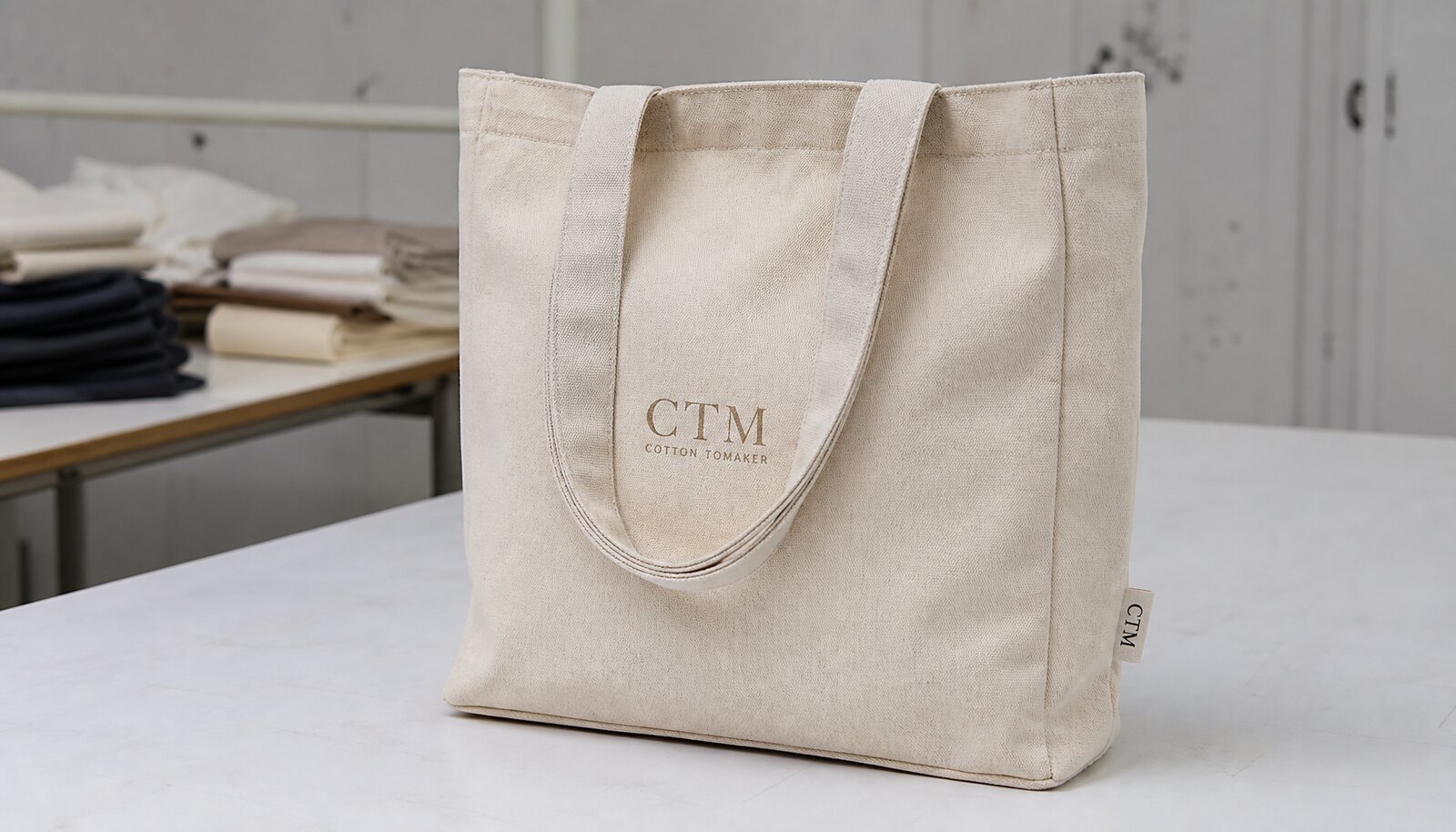
Why canvas tote sourcing is a different procurement job
For apparel brands, a merchandise bag is not just packaging. It is part of the product story, the event experience, and often the last branded item a guest keeps in hand after the booth or launch ends. That makes the tote more visible than many buyers initially expect. A logo bag that looks acceptable in a quote can still disappoint if the canvas is too thin, the handles twist under load, or the print lands too close to a seam.
The procurement challenge is therefore broader than choosing a tote style. Buyers need to align the bag with the apparel it will carry, the kind of event it will support, the required shelf or handout appearance, and the acceptable cost per impression. A bag for folded tees at a pop-up has very different requirements from a bag that will accompany a premium retail drop, a customer-membership gift, or a media kit. If the brief is vague, the supplier will quote a generic tote. If the brief is clear, sourcing becomes much easier to compare and much easier to inspect.
- Think of the tote as a brand touchpoint, not just a carrier.
- The best spec depends on what goes inside the bag and how long the bag must last after the event.
- A clean procurement brief prevents suppliers from quoting different assumptions and calling them the same product.
Start with the use case, quantity profile, and content load
The fastest way to waste budget is to request quotes before the use case is defined. A folded T-shirt, a hoodie, a boxed set, and a lookbook all create different volume and weight requirements. A bag that is technically large enough may still feel wrong if it sags when filled, wrinkles the apparel, or requires the attendee to hold it awkwardly by the end of the event.
It helps to define the expected payload in simple terms: what goes inside, how many items, approximate weight, and whether the bag must remain attractive after being reused. For simple event giveaways, 10 oz canvas often works when the contents are light. For mixed apparel kits or bags that may be reused many times, 12 oz or a heavier finish may be more appropriate. The more the bag must represent the brand beyond a one-day event, the more the fabric, stitching, and finishing matter.
Procurement also needs to know the quantity profile. A one-time 3,000-piece event run can justify a different supplier route than a quarterly rollout with repeat orders. If the bag is a recurring part of brand activations, you want a spec that can be locked and repeated. If it is a one-off launch, speed may matter more than exact long-term consistency, but the spec still needs to be explicit enough to avoid surprises.
- Single folded tee giveaway: light to midweight canvas may be enough if print and handles are controlled.
- Mixed apparel plus insert card or brochure: choose a gusseted tote so the contents do not strain the seams.
- Retail resale or premium membership gift: prioritize finish quality, handle reinforcement, and better dimensional stability.
Fabric, weave, and finish choices that affect look, cost, and print quality
Canvas is not one thing. The quoted GSM or ounce weight only tells part of the story. Weave density, yarn quality, surface texture, and finishing treatment all affect how the bag prints, how it drapes, and how it feels in the hand. A loosely woven canvas may technically match the target weight but still look rough or print unevenly. A tighter weave usually gives cleaner graphics and a more retail-ready finish, especially when the artwork has small text or fine lines.
For apparel merch, a buyer usually needs to decide whether the visual priority is a crisp brand impression or a more relaxed, natural look. Natural unbleached canvas can be attractive, but it may show more variance between batches and can influence logo color. Dyed canvas gives a more controlled look but adds sourcing complexity and can raise MOQ. Softened or washed finishes can make the bag feel nicer in hand, yet they also need to be checked for dimensional change and color consistency.
If the bag will carry heavier apparel or be reused many times, ask the supplier how the canvas behaves after sewing and pressing. Finished dimensions can shift because seam take-up and shrinkage affect the actual size. This is one reason procurement should never approve fabric alone and assume the bag will match the cut sample without checking the sewn sample.
- Tighter weave usually helps with logo clarity and a cleaner retail look.
- Natural canvas reduces color control risk only if the buyer accepts more base variation.
- Softening or washing improves hand feel but should trigger a dimensional and shrinkage check.
Decoration methods: choose for durability, speed, and visual return
Decoration is where many quotes diverge. Screen printing, embroidery, woven labels, heat transfer, and stitched-on patches all create different cost structures and different failure risks. The right answer depends on the logo, the quantity, the desired finish, and how the bag will be used after distribution.
Screen print remains the most practical option for many apparel-brand totes because it scales well and gives a clean, direct brand mark. It is usually the best value when the logo is simple and the quantity is high enough to absorb setup. The buyer should still specify the number of colors, the print area, and the required cure standard. On textured canvas, a very fine logo may need minor artwork simplification to avoid edge loss.
Heat transfer is useful when the artwork is too detailed for a screen setup or when the run is small. The tradeoff is that transfer quality depends heavily on the film, adhesive, press settings, and whether the canvas texture can support sharp edges. If the bag is expected to be reused often, ask how the transfer behaves over abrasion and folding. Embroidery delivers a premium feel, but it adds stitch time, can distort lighter canvas, and often works best for smaller marks rather than large front-panel graphics.
A woven label or side label can add brand value without overcomplicating the front graphic. For some apparel teams, that is the smarter spend: keep the front logo simple, add a high-quality side label or inside label, and use the saved budget for better fabric and reinforcement. The best decoration method is not always the most complex one; it is the one that survives event use and still looks intentional after the first few carries.
- Screen print: best for repeat volume and simple logos.
- Heat transfer: best for short runs or complex artwork, but durability must be defined.
- Embroidery: premium appearance, but higher cost and slower production.
- Woven or side labels: useful when the brand wants extra detail without large print complexity.
A practical comparison of bag specs and where each option fits
The most useful buyer comparison is not about tote style in the abstract. It is about tradeoffs between cost, presentation, durability, and production control. If your brand team wants a simple giveaway bag, the cheapest workable spec may be enough. If the bag is part of a premium launch, a retailer handout, or a reusable customer carrier, the more robust spec often saves money later by reducing rejects and complaints.
The table below is a procurement view of common canvas tote choices for apparel programs. Use it as a starting point, not a fixed rule. The real value is in seeing where each option introduces risk: print durability, seam strength, closure complexity, lining, or sustainability documentation. When you compare quotes, make sure each supplier is pricing the same exact build rather than a close approximation.
- Do not compare bags until the build is normalized line by line.
- Ask what each feature does to lead time, MOQ, and inspection effort.
- Use the table to decide when a basic tote is enough and when the spec should be upgraded.
Sourcing models: direct factory, trading company, or mixed-category vendor
A tote bag can be bought through different channels, and the right route depends on how much control procurement wants. Direct factory sourcing gives the most visibility into fabric, stitching, decoration, and sample revision. It is the best route when the bag will be reordered, standardized across campaigns, or used in a premium retail environment where consistency matters.
Trading companies can be useful when the purchase is small, the timeline is compressed, or the buyer is bundling multiple merchandise categories into one PO stream. The tradeoff is that you may lose some visibility into actual factory constraints. If a defect appears later, the root-cause conversation is often slower because the trading layer sits between buyer and production. For highly visible apparel-brand giveaways, that lack of direct traceability can matter.
There is also a hybrid sourcing model: use a known factory for the tote and let a sourcing partner manage packing, labeling, or consolidation. This can work when the brand wants factory-level control but needs help coordinating multiple SKUs. Procurement should choose the route based on risk and repeatability, not on habit. If the same tote will be produced again in six months, direct factory control usually wins. If the order is a one-off and simplicity matters more than long-term consistency, the trade route may be acceptable.
- Direct factory: best for repeat programs, spec control, and defect traceability.
- Trading company: better for mixed orders or compressed timelines, but less transparent.
- Hybrid model: useful when you need factory control plus coordination help.
How to compare quotes on a landed-spec basis
A low unit price is not useful if it is quoting the wrong product. Procurement should normalize every supplier quote to the same bag size, fabric weight, decoration method, packing format, and shipping term. If one supplier includes individual polybags and another quotes bulk packing, you are not comparing the same commercial offer. The same is true when one quote quietly assumes 8 oz canvas while another prices 12 oz.
The quote should make the excluded items visible. Ask whether setup charges, screens, color matching, sample freight, carton labeling, or overrun/underrun tolerance are included. A quote that looks cheaper on paper can become more expensive once these items are added. This is especially true for event-driven apparel programs, where the window to rework a mistake is narrow and the cost of a late correction can be higher than the price difference itself.
A good comparison spreadsheet should include at least these lines: fabric spec, finished size, handle length, print colors, decoration method, sample cost, MOQ, carton pack count, lead time to sample, lead time to bulk, and shipping term. If the supplier cannot state these cleanly, that is a signal that the quote may not be production-ready.
- Normalize every quote to one spec before looking at price.
- Separate recurring production cost from one-time setup cost.
- Ask for anything excluded so procurement can model the true landed cost.
Samples, acceptance criteria, and the threshold for moving to bulk
A sample is not just a visual reference. It is the control point that tells you whether the supplier can reproduce the tote at scale. For a canvas merch bag, the sequence is usually fabric swatch first, then a printed strike-off, then a pre-production sample if the order is important enough to justify the extra step. The sample flow should match the risk level of the program rather than the convenience of the factory.
The acceptance criteria should be written in buyer language. Decide in advance what matters most: dimension tolerance, print placement, logo sharpness, handle symmetry, seam appearance, or overall hand feel. If the bag will be held in photos or on a retail counter, appearance may outrank everything else. If it will carry heavy garments, reinforcement and load behavior may outrank appearance. Either way, the sample should be measured, not just approved by eye.
A useful rule is to upgrade from sample approval to pre-production sign-off when any of the following are true: the order is above your standard risk threshold, the bag uses a new factory, the artwork is sensitive to color matching, or the shipment date cannot move. In those cases, paying for one more control step is cheaper than discovering a mismatch after bulk cutting has started.
When reviewing samples, check the sewn dimensions after pressing, the alignment of handles to body centerline, the cleanliness of the cut edge, and the appearance of the print under neutral daylight. If there is a lining, pocket, zipper, or closure, load the sample with real contents to see how it behaves in use. The best sample is one that answers the questions procurement will have later during inspection.
- Approve a printed strike-off before bulk when color accuracy matters.
- Use a pre-production sample when the launch date is fixed or the order is high visibility.
- Measure the sample after sewing and pressing, not just before assembly.
- Load the sample with real contents if the bag will carry apparel kits or heavier items.
Inspection standards, QC checks, and load-testing guidance
Quality control is stronger when it is specific. General phrases such as “good workmanship” are not enough for a production bag that will be handed to customers in public. Procurement should ask the factory how it defines defects, how many pieces are checked, and what happens if the production line drifts from the approved sample. A clear AQL plan helps, but only if the team also defines the critical visual and functional checks.
For many apparel-brand tote programs, a practical inspection setup is to treat visible appearance issues, dimensional mismatch, and function failures as the core defect groups. Appearance covers stains, loose threads, print smudging, broken stitches, and uneven handle placement. Dimensional checks should compare the finished bag against the approved spec within a defined tolerance band. Functional checks should focus on handle security, seam integrity, and whether the bag can actually carry the intended load without distortion.
A simple but useful load test is to fill the bag with representative contents or an agreed test weight and hold or carry it long enough to expose weak stitching or handle twist. The exact test weight should match the design, but even a modest static hold can reveal handle bar-tack issues or seam puckering. For printed bags, a tape-adhesion or rub check on the cured print can identify curing problems before the shipment leaves the factory. On canvas, also inspect for oil stains, needle damage, and unwanted shade difference between panels.
If your brand has a strict receiving standard, specify it in the PO or QC annex. Include AQL level, key defect definitions, acceptable dimension range, stitch density target, print acceptance method, and packing count verification. That gives the factory a clear target and gives procurement a defensible receiving standard if the order needs a claim later.
- Use AQL 2.5 for general defects as a starting point, and tighten critical defect rules when the bag must perform or look premium.
- Target a visible seam standard, not just a pass/fail note.
- Ask for load testing on a filled sample or agreed test weight.
- Include print adhesion, thread trimming, stain checks, and carton count verification in the inspection plan.
Packing, carton planning, and shipping choices that affect landed cost
Packing decisions are often treated as logistics detail, but they directly affect cost, appearance, and damage risk. Flat-packed canvas totes are usually the most efficient for event programs and warehouse distribution because they reduce carton size and keep receiving simple. If the bag is going into retail, the team may want a cleaner folded presentation or an individual polybag, but that should be a conscious tradeoff rather than an assumption.
The carton plan should be designed around how the bags will move after arrival. If the bags are going to a fulfillment center, carton labels and count consistency matter more than shelf appearance. If they are going to multiple event sites, carton markings by location or SKU can save significant labor. Ask the supplier to state carton dimensions, gross weight, and pieces per carton before production begins so freight can be estimated accurately.
Do not add individual polybags unless they have a clear purpose. They can help protect retail presentation and reduce scuffing, but they also add plastic, labor, and volume. For many internal giveaways, a simple bulk flat pack is enough. If the brand wants a more premium unboxing feel, consider a printed belly band or insert card rather than defaulting to full individual packaging.
- Set pieces per carton before cutting starts.
- Confirm whether cartons need barcode labels, color stickers, or destination marks.
- Use individual polybags only when the retail or presentation benefit is worth the added cost.
- Ask for carton dimension data so freight and pallet planning are not guesswork.
Specification comparison for buyers
| Spec decision | Recommended option | When it fits | Buyer risk to check |
|---|---|---|---|
| Fabric weight | 10 oz to 12 oz canvas, or about 280 to 340 GSM | Most apparel-brand event giveaways, retail handouts, and premium merch bags | Too light can look flimsy and show print distortion; too heavy can raise cost, slow sewing, and make the bag feel bulky when folded |
| Weave and finish | Tight plain weave with minimal slub for cleaner logo edges | Brands prioritizing a crisp print and a cleaner retail look | Loose weave or heavy slub can blur fine text and make color blocks uneven |
| Print method | 1-color or 2-color screen print for volume; heat transfer only for short runs or complex art | Simple logos, event marks, and repeat campaigns | Transfer can crack, lift, or feel plasticky if durability expectations are not defined; screen print needs accurate registration and cure control |
| Decoration placement | Front panel center or lower-center print, with a controlled print area | Launch events, retail giveaways, and photo-friendly handouts | Overly large artwork can distort on seams or gussets; small marks may disappear on a retail-sized tote |
| Bag size | 38 x 42 cm to 40 x 45 cm with 8 to 10 cm gusset for apparel inserts | Folded tees, hoodies, lookbooks, and event swag | Oversized bags waste fabric and freight; undersized bags wrinkle contents and feel less premium |
| Handle length | 60 to 70 cm shoulder-carry handles for event use | Retail giveaways where guests may keep carrying the bag after the event | Handles that are too short are impractical; handles that are too long can drag and look untidy |
| Reinforcement | Bar-tack or cross-stitch reinforcement at handle joins | Bags expected to carry apparel, inserts, or repeated customer use | Weak handle attachment is one of the most common failure points in giveaway totes |
| Lining and closure | Unlined open-top for cost control; add lining, zipper, or snap only when presentation or security justifies it | Premium retail merch, higher-value kits, or resale-ready bags | Lining and closures increase sewing time, MOQ, and lead time; they can also complicate inspection |
| Sustainability spec | Natural or recycled-content canvas only when the claim can be documented and the supplier can state the fiber composition clearly | Brands with sustainability messaging or retail resale positioning | Do not rely on vague eco language; ask for composition, certification documents if claimed, and what exactly is being represented |
Buyer checklist before sampling
- Confirm finished bag size, fabric GSM, handle length, gusset depth, and whether the bag must stand upright when filled.
- Send vector artwork, a clear print area map, and one Pantone reference if color accuracy matters.
- State the end use clearly: one-time event giveaway, retail resale, or repeated customer carry. The spec changes depending on that answer.
- Ask for fabric swatches, a print strike-off, and a pre-production sample when the order is above your risk threshold or the launch date is immovable.
- Define packing requirements before quoting: flat count per carton, carton dimensions, gross weight target, moisture protection, and any barcode or label requirement.
- Set acceptance rules for shade variation, print registration, stitch density, handle symmetry, and loose-thread trimming.
- Compare MOQ, unit price, setup charges, and packing costs together instead of judging the quote by unit cost alone.
- Ask for the supplier’s defect check method and whether they use AQL sampling before shipment.
Factory quote questions to send
- What exact canvas construction are you quoting, including GSM, weave type, and any prewash, wash, or softening treatment?
- Is the price based on one finished bag size, one print location, and one color, or does it include setup, screen charges, and packing?
- What is your MOQ for this exact spec, and how does it change if we add a gusset, lining, zipper, pocket, embroidery, or extra print location?
- What sample sequence do you recommend: fabric swatch, printed strike-off, or pre-production sample, and how long does each step take?
- What carton pack plan do you recommend, and what are the carton dimensions, gross weight, and pallet count per order?
- Which part of the lead time is fixed, and which part depends on artwork approval, fabric sourcing, trim availability, or sample sign-off?
- What QC points do you inspect before shipment, and can you share your AQL level or defect acceptance method for stitching, print, and dimensions?
- Can you confirm the exact material composition and whether any sustainability claim can be documented in writing?
- What is excluded from the quote, such as freight, local taxes, sample charges, color matching, or overrun/underrun allowances?
Quality-control points to confirm
- Use a written AQL plan before production starts. For general appearance and sewing defects, many apparel buyers use AQL 2.5; for critical defects that affect use or safety, use a tighter rule such as AQL 1.0 or zero-tolerance depending on your risk policy.
- Finished dimensions should be checked after sewing and pressing, not just at cut stage. Measure at least the width, height, and gusset across a defined tolerance band.
- Stitch density should be specified, not assumed. A practical procurement target for tote seams is often around 7 to 10 stitches per inch, with reinforcement at stress points. The exact target should match the fabric weight and sewing method.
- Handle attachment needs a load check. Ask the factory how they validate handles; a practical buyer request is a static hang or pull test on a filled sample using the intended contents or an agreed test load, such as 5 to 8 kg for a standard merch tote, if appropriate to the design.
- Print quality should include registration, coverage, cure, and adhesion checks. On screen print, request a simple tape-adhesion test on cured samples and a visual review for smudging, pinholes, or ghosting under neutral light.
- Thread cleanup and needle damage are common visible defects on canvas. Require trimming of loose threads, no oil stains, and no broken needle marks on the finished face panel.
- Corner and handle seams should be inspected for puckering, twisting, skipped stitches, or asymmetry. A bag can pass a visual quick glance and still fail under carry stress if these points are weak.
- Packing should be counted by carton and verified against the packing list, with overpack and underpack controlled by documented checks. If the bags are imported in bulk, ask for carton markings and outer box condition photos before dispatch.