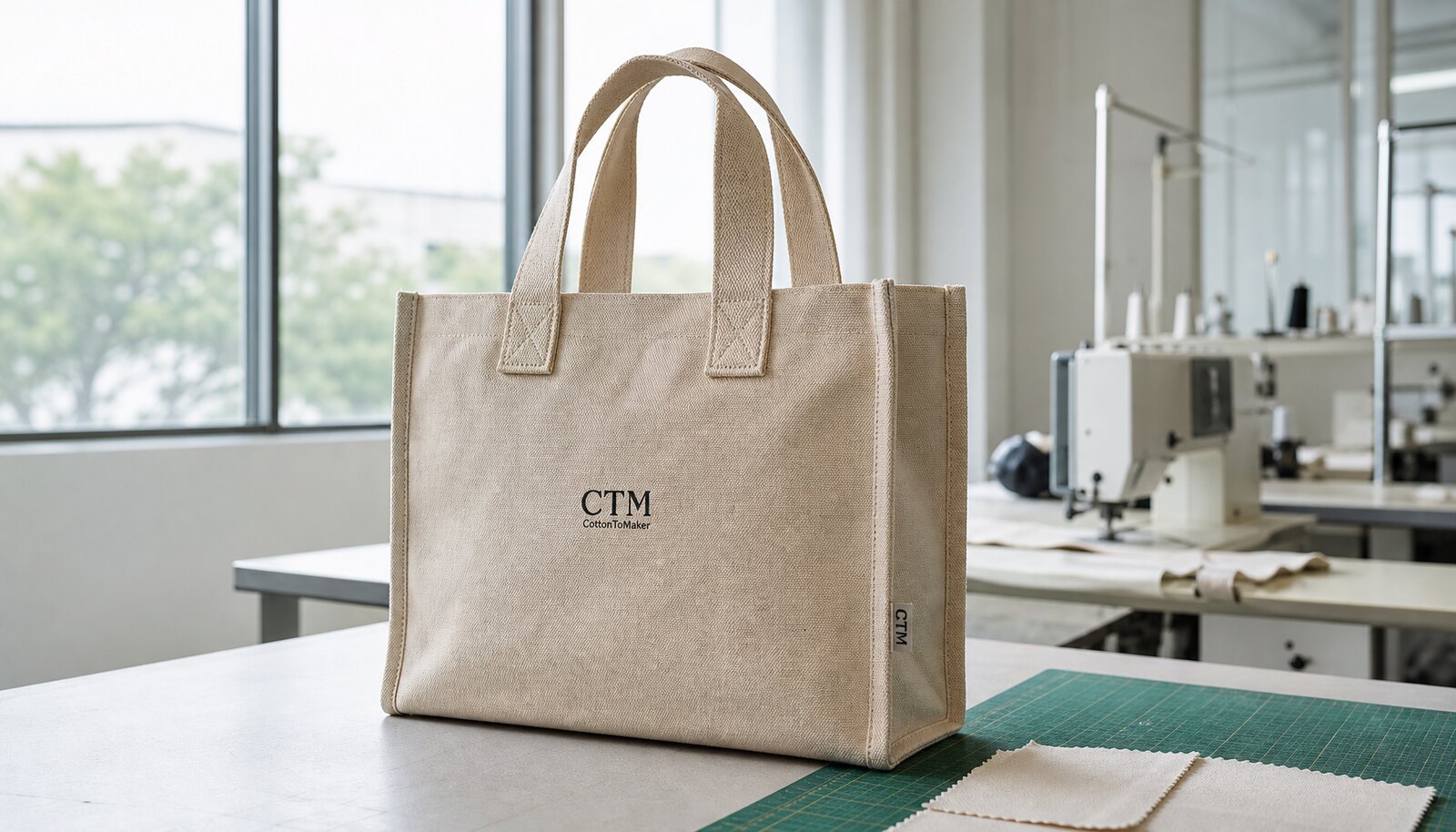
What the bag has to do in a retail launch
A canvas retail merchandise bag is doing more than carrying a purchase from the register to the door. In an apparel launch, it may also protect folded garments, keep a premium presentation consistent across stores, support click-and-collect packing, and act as walking media after the sale. That makes it a functional retail item, not a generic tote. If procurement starts with artwork alone, the order often ends up with the wrong size, the wrong fabric hand, or the wrong packing format for the store team.
The best launch spec starts from use case. A flat folded tee, a denim stack, a box of accessories, and a premium gift set each create different bag needs. A pop-up store may care most about easy handout and compact storage. A flagship may care more about structure, a crisp print, and a heavier canvas feel. A direct-to-consumer bundle may care about carton efficiency and damage reduction. Write that operating context into the RFQ so every supplier quotes the same job.
For procurement teams, the bag should be treated like part of the merchandising system. If the tote is too small, the apparel bundle will crease. If it is too soft, it looks cheap on the sales floor. If it is too heavy or complicated, the bag itself can add cost without adding value. The target is a spec that is strong enough for retail use, clean enough for the brand, and simple enough to repeat on the next order.
A useful internal brief should define the intended channel, the garment type inside the bag, the expected carry duration, and whether the bag is disposable, reusable, or saleable as a separate merchandise item. That one page saves a lot of quote churn later.
Useful launch definition checklist:
- Purchase carryout, premium merchandise, or package insert?
- What apparel item or bundle must fit inside?
- Is the bag a one-time launch item or a replenishable retail SKU?
- Does the store team need flat-packed stock, shelf-ready stock, or both?
Fabric weight, weave, and finishing determine how the bag behaves
Canvas weight changes the whole feel of the bag. Lightweight canvas in the 8 oz range, roughly 270–300 gsm, can work for lower-cost launch support or simple folded apparel, but it may hang too softly if the logo is large or the bag must stand up on a counter. Midweight canvas, typically 10–12 oz or about 340–400 gsm, is the most practical range for apparel brands because it balances structure, cost, and ease of sewing. Heavy canvas at 16 oz or around 540 gsm delivers a premium hand, but it is slower to sew, costs more to ship, and can be more bag than a simple launch needs.
The weave and finishing matter almost as much as the weight. Natural unbleached canvas gives a casual retail look, but its color can vary from lot to lot more than buyers expect. Bleached or optically brightened fabric can make logos pop, yet it may need tighter color approval. Dyed canvas can look more premium or more brand-specific, but the buyer has to lock the shade carefully because reorders are harder to match. If the launch includes more than one store wave, ask for fabric swatches from the actual dye lot or finishing lot, not just a stock photo.
Construction details are where functional failures usually show up. Reinforced handles, bartacks at stress points, consistent seam allowance, and a gusset when needed are more valuable than an extra ounce of fabric that adds cost but not usability. If the bag needs to fit inside a branded box or a fold-out display, define finished dimensions and tolerance rather than asking for a “standard tote.” Canvas relaxes after sewing and finishing, so suppliers should quote a finished-size tolerance and explain whether shrinkage is expected after laundering, washing, or heat setting.
If the bag is going to carry a heavier apparel bundle, ask the factory to state the load assumption in writing. Even a simple line such as “handles and top seam tested to a defined pull or hang load before shipment” is better than no standard at all. That gives QC something measurable to work against.
Fabric and build specification points to lock early:
- Target GSM and an acceptable tolerance range.
- Weave and color: natural, bleached, dyed, or piece-dyed.
- Reinforcement method: bartack, cross-stitch, binding, or double seam.
- Finished size and handle drop, not only cut size.
- Whether washing, pre-shrinking, or special softening is allowed.
Choose decoration based on the artwork, not the default method
Screen print is still the workhorse for canvas retail merchandise bags because it is usually the cleanest commercial answer for simple logos. It handles solid shapes well, gives strong color coverage, and scales efficiently when the launch has a meaningful volume. For apparel brands, that matters because the tote often sits next to higher-value products and should look intentional rather than like a rushed promo item. If the artwork is one or two colors with clear edges, screen print is usually the first method to quote.
Transfer methods make sense when the artwork includes gradients, tiny text, or a more complex graphic that would be expensive or messy to screen print. The tradeoff is that the handfeel can change and durability may be different from a printed ink system directly on the fabric. For a retail launch, that tradeoff is worth testing with a physical sample, not just a digital proof. Canvas texture, seam crossings, and gussets can all influence how a transfer sits on the bag.
Embroidery can lift the perceived value of a bag, but it is best for a small logo or emblem rather than a large graphic. It adds stitch count, can distort fine detail, and may stiffen the bag face in ways that are either desirable or distracting. If the brand wants a premium look but the budget is tight, a small embroidered mark paired with clean construction may be a better spend than a large multi-color print. The key is to match the method to the graphic and the channel.
Placement matters too. A logo near a seam, handle, gusset, or pocket opening needs careful strike-off approval because canvas is not a flat rigid surface. A supplier that can show a real placement sample on the actual fabric is usually a better partner than one that only emails artwork simulations.
Decoration decision guide:
- Screen print: best for simple logos, scale pricing, and predictable color.
- Transfer: best for detail-heavy art, gradients, or faster artwork revisions.
- Embroidery: best for small premium marks, not for large fills or tiny lettering.
- Placement sample: essential if the graphic touches seams or gussets.
Comparison table: what each supplier route really changes
The supplier route changes more than unit price. It affects lead time, revision control, compliance documentation, and how much risk the buyer carries on production consistency. The table at the top is meant to support an actual sourcing decision, not just a vendor shortlist. For a procurement team, the main question is whether the supplier can produce the exact bag repeatedly and prove it with samples, process notes, and inspection evidence.
Factory-direct sources usually give the best control over sewing and printing because the buyer can write a spec against the actual line that makes the product. That matters when the tote is a launch asset and needs to be reorderable. Trading companies are useful when several launch items need coordination, but the buyer should confirm where sewing, print, and packing happen. Local decorators are valuable when the launch is urgent and the blank bag is already approved, but the landed cost can rise quickly once the blank, shipping, and decoration are combined. General merchandise exporters may quote aggressively, but their quality spread is often too wide for a brand-defining retail item.
A practical way to evaluate a source is to ask for proof, not just a promise. Ask for real photos of sewing, a fabric swatch, a sample carton, and the name of the factory if the seller is not the factory. Ask what they outsource. Ask who signs off on QC. If they cannot answer those questions cleanly, the sourcing route is probably too loose for a launch program that needs consistency across stores or regions.
What to verify by supplier type:
- Who owns the sewing line and who owns the printing line?
- Where does final inspection happen and who signs it off?
- Are samples made on the same line as mass production?
- Can the supplier repeat the same spec for a replenishment order six months later?
Read the RFQ like a production document
A good RFQ makes quote comparison easy because it gives each supplier the same information in the same format. The most common problem in canvas bag sourcing is not that quotes are unavailable; it is that they are not comparable. One supplier prices a blank tote, another includes print, another includes pack-out, and another assumes a different fabric weight. The result is a spreadsheet that looks complete but does not actually answer the buying question.
For a launch bag, the RFQ should specify finished size, target GSM, fabric color, handle construction, print method, print size, number of colors, packing format, carton count, and ship-to market. Add the expected order quantity by color or style, not only the total. A supplier quoting 5,000 pieces of one style will often look much better than one quoting 1,500 pieces across three colorways because setup is spread differently. If the launch is still uncertain, ask for at least two price breaks and one replenishment quote so the cost curve is visible.
The quote should also separate material cost from setup cost. Screens, embroidery digitizing, special labels, tissue, barcodes, inner polybags, and export cartons often drive the hidden cost in short-run launch orders. If a supplier gives only one FOB number, the buyer has no way to tell whether the number is low because the bag is simple or because the supplier omitted part of the work. A line-item quote takes longer to prepare, but it saves time later when the order needs revision.
A useful procurement rule: if the quote cannot be explained in five minutes, the RFQ was not specific enough or the supplier is hiding complexity. Either way, the buyer needs more detail.
RFQ fields that improve comparability:
- Material specification with target GSM and color.
- Finished dimensions and handle drop.
- Decoration method, size, and color count.
- Packing, barcode, and carton mark instructions.
- Quantity split by color or artwork version.
- Replenishment pricing or re-order assumptions.
Sample approval should use measurable limits, not vague comments
One digital proof is not enough to release production. A physical sample tells the buyer how the canvas feels, how the seams sit, how the logo registers on textured fabric, and whether the bag works with the apparel bundle it is meant to carry. A better sequence is proto sample, corrected sample, and pre-production sample. The proto sample proves the general shape. The corrected sample proves the changes. The pre-production sample should match final fabric, final decoration, and final packing. For a large or sensitive order, keep a sealed control sample from the approved version so that production can be checked against it later.
The approval criteria need measurable points. Finished dimensions should be within the agreed tolerance. Handle length and handle drop should be verified on the actual sample, not just guessed from the cut piece. Logo placement should be measured from a seam or centerline. Stitch quality should be inspected at bartacks, top seam, gusset corners, and handle joins. If print coverage matters, check ink opacity and edge sharpness under the same light the store team would use when receiving product. Approval should be based on the written standard, not on a general impression that the bag is “pretty close.”
For brands with a tight launch calendar, it helps to define a revision limit before sampling begins. For example, if the first proto needs a size change and the second sample needs a print adjustment, the factory knows the next version should be the final approval sample. That keeps the process from drifting. If the supplier changes any major element after approval, require either a revised sample or a written deviation notice before the order moves forward.
Sample approval checklist:
- Verify size, handle drop, print placement, and fabric color together.
- Compare the sample to the approved artwork and spec sheet, not memory.
- Keep one approved control sample with the PO file.
- If the supplier changes the fabric lot or print method, reset approval.
QC needs an incoming material checklist and a defect severity framework
QC on canvas bags is strongest when it begins before cutting, not after packing. A procurement team should define what gets checked when fabric and trims arrive: fabric weight, weave consistency, shade, contamination, holes, thread quality, label accuracy, and carton material if packing is included. That incoming check helps catch problems before they turn into hundreds or thousands of flawed bags. It also gives the supplier a clear signal that the buyer is paying attention to the right failure points.
The defect framework should separate critical, major, and minor issues. A critical defect would be something that makes the bag unusable or unacceptable for retail, such as a broken handle, open seam, missing logo on a branded item, or dangerous contamination. A major defect could be a wrong size, obvious print misregistration, weak bartack, or carton count error that affects receiving or use. A minor defect could be a small loose thread, a slight fold mark, or a cosmetic variance that does not change function. If the team defines those categories before production, both the supplier and the inspector know what counts and what does not.
Inspection standard matters too. For launch orders, many buyers use an AQL-based visual inspection on a carton sample set, combined with a functional check on handles and seams. The exact AQL level depends on brand tolerance and market risk, but the important thing is to name the method in the PO or QC appendix rather than leaving it informal. If the order is first-time or the supplier is new, some teams also require a tighter first-article review or full inspection on a pilot batch before release. That is often cheaper than dealing with store returns or receiving rejections later.
An inspection sheet should include size, fabric, print, seam, packing, and carton checks in one place. That reduces the chance that a good-looking bag slips through with the wrong barcode or the wrong master pack ratio.
Incoming material and defect control checklist:
- Fabric GSM, weave, and shade checked against master swatch.
- Labels, thread, and packing materials verified against BOM.
- Defects sorted as critical, major, or minor before shipment.
- AQL or inspection method named in the PO.
- Load-bearing areas tested on sampled bags before release.
Packing can protect margin or create rework cost
Packing affects more than appearance. It affects damage rate, warehouse efficiency, and whether store teams can receive the product quickly. A flat-folded bag in a simple polybag may be enough for a warehouse replenishment program, but a store launch or a premium merchandise item may need cleaner folding, a barcode sticker, a tissue insert, or a more controlled pack-out so the product looks ready when it comes out of the carton. If the buyer wants shelf-ready or display-ready presentation, that has to be built into the RFQ from the start. Repacking at destination is slow, expensive, and often rough on the bags.
Carton planning should reflect the receiving environment. Distribution centers usually want optimized master cartons, clean carton marks, and predictable counts for pallet efficiency. Smaller stores may need lighter cartons that are easier to move and open. If the bag is going direct to retail, moisture protection matters too, especially on long shipments or humid routes. A simple inner polybag and a well-sized outer carton often do more than a decorative insert that adds cost but not protection.
For procurement, the packing spec should also define the acceptable fold direction and whether the logo face must sit outward. Those details seem small until the distribution team opens a carton and every bag needs to be reworked. Clear packing instructions save labor and reduce inconsistency.
Packing decision points:
- Flat fold, retail fold, or display-ready fold?
- Polybag yes or no, and if yes, what thickness or closure?
- Barcode sticker or printed carton label?
- Master carton count and carton dimensions?
- Humidity protection or desiccant needed for the route?
Use landed cost and replenishment risk to choose order quantity
A low factory quote can still produce a high-risk order if the launch quantity is too small or the setup is spread across too many variants. The buyer should compare landed cost per sellable bag, not only factory FOB. Include samples, setup charges, freight, duty, packing materials, warehouse handling, and likely damage or rework. That is the number that matters to a launch budget. A smaller order may look affordable until setup and freight are spread across too few pieces. A larger order may look efficient until the buyer realizes the design will not repeat cleanly for replenishment.
A launch often works best when core stock and test stock are split. Core stock is the stable spec: one color, one decoration version, one packing standard. Test stock is the variant used for flagship stores, influencer events, or bundled online orders. Splitting the program this way keeps setup efficient while preserving flexibility. It also gives the team a cleaner read on demand before committing to a larger replenishment order.
Procurement should also pressure-test the supplier on reorder timing. If the first run is successful, how fast can the same spec be reproduced? If the answer depends on a different fabric lot or a different print screen setup, the buyer should know that before the launch. Replenishment planning matters because a merchandise bag often sells through in waves, not all at once. A supplier who can support the second order without reworking the spec is usually more valuable than one who only wins on the first quote.
Commercial planning checklist:
- Compare total landed cost, not just unit price.
- Build in setup, freight, duty, and handling before approving budget.
- Separate core launch stock from test or event stock if demand is uncertain.
- Ask for a reorder lead time and second-order price before placing the first PO.
What strong vendor evaluation looks like before award
The best supplier evaluation is practical, not ceremonial. Procurement should look for evidence that the supplier can control the process that matters: fabric sourcing, sewing, printing, packing, and inspection. A clean website or a low quote is not evidence. Real evidence is a complete sample trail, a factory address, a named process owner, a clear answer on outsourcing, and a willingness to share how QC is done. If the supplier cannot explain where the fabric comes from or how the batch is inspected, the risk sits with the buyer.
Useful audit questions are direct. Who owns the sewing line? Who owns the print line? Is the sample made on the same equipment as production? What happens if fabric shade changes mid-run? How are carton counts checked? What is the response if one carton is short? A competent supplier answers without slipping into vague marketing language. A red flag is when every answer points back to “we can do it” but no one can show the process or the control point.
Red flags worth acting on early include inconsistent quote formats, reluctance to name the actual factory, refusal to show production photos, overly broad QC claims with no inspection sheet, and sample quality that is noticeably better than the factory’s willingness to commit in writing. Another warning sign is when the supplier keeps changing the spec during quoting instead of quoting against the buyer’s version. That usually means the team is not disciplined enough to hold the line during production.
Vendor evaluation questions that save time:
- Which parts of the build are made in-house and which are outsourced?
- Can you show a real production photo of sewing, printing, and packing?
- What is the named QC step before shipment and who signs it?
- If the fabric lot changes, how do you preserve shade and size consistency?
- Can you support a second order with the same spec, and what would change?
Specification comparison for buyers
| Supplier route | Typical pricing profile | Typical lead time | Decoration limits / strengths | Compliance and QC differences |
|---|---|---|---|---|
| Factory-direct tote producer | Usually lowest unit cost at stable volume; setup charges are clearer but may still be separate | About 25–45 days after sample approval for standard builds; longer if yarn-dyed, washed, or multi-process | Strong for screen print, woven labels, embroidery patches, gussets, reinforced handles; best when the tote itself is the product | Can control fabric GSM, stitch spec, and load testing if the buyer writes them in; verify in-house vs outsourced sewing/printing |
| Trading company with factory network | Unit price often includes margin stacking; may look convenient but not always cheapest landed cost | About 30–55 days depending on factory allocation and revision cycles | Useful for mixed packaging bundles, limited artwork changes, and sourcing several SKUs together | Need clearer audit trail on where fabric, sewing, print, and packing happen; revision control can be weaker |
| Local decorator using imported blanks | Higher unit cost, but can reduce transit time and help with very small runs | Often 5–15 days once blanks are in stock and artwork is approved | Good for one-color logos, quick event stock, simple overprints; less flexible on bag construction | QC depends on blank bag source and in-country print control; ask for blank origin and lot consistency |
| Integrated bag and packaging supplier | Mid-range pricing; sometimes efficient when packing is complex | About 30–50 days if both sewing and packing are in-house | Strong on retail folding, barcoding, master cartons, and shelf-ready packing; decoration may be secondary | Best when packing accuracy matters; confirm print quality does not drop when production is optimized for pack-out |
| General merchandise exporter | Often the lowest quoted price, but the widest quality spread | About 20–40 days depending on factory load, though revision loops can extend it | Can do simple logos and standard sizes; not ideal for premium handfeel or tight construction specs | GSM, thread trim, stitch density, and color control may vary by lot; request inspection evidence |
| Canvas specialist factory | Usually higher than commodity suppliers because material and sewing control are tighter | About 30–50 days; sampling may take longer because changes affect sewing and print setups | Best for heavier canvas, better drape, cleaner seam control, and premium finishing | Often stronger on fabric consistency, bartack placement, and repeat QC; confirm compliance documents if shipping to regulated markets |
| Digital-first sourcing platform | Useful for benchmark shopping; quoted price may not reflect final production reality | Sampling may be fast, but mass production depends on the real maker behind the platform | Good for early art comparison, blank-bag scanning, and request consolidation | Need to verify who actually makes the bag and where QC occurs; samples can differ from factory output |
| Split-source strategy | Can balance cost and responsiveness; one source may be cheaper for replenishment, another faster for launch | Launch source may be slower or pricier; replenishment source can be optimized later | Lets the buyer separate premium flagship bags from standard store replenishment | Requires tighter spec control because slight differences in color, weave, and construction can appear across vendors |
Buyer checklist before sampling
- Define the bag’s role in the launch: purchase carryout, premium merchandise, bundle packaging, or event handout.
- Match finished size to the actual folded apparel package, including tissue, insert cards, and hangtags.
- Choose one primary fabric weight and one backup option before requesting quotes.
- Specify weave, GSM target, color, and finishing state in the RFQ rather than saying only “canvas.”
- State the print method, print size, ink count, and placement distance from seams.
- Lock handle length, handle drop, reinforcement points, and expected load range.
- Confirm fold style, polybag use, barcode placement, carton mark format, and master carton count.
- Request physical samples, not only photos, and keep one approved control sample with the PO file.
- Ask for line-item pricing for bag, decoration, packaging, setup, and freight assumptions.
- If the order will replenish, include a second-order price and lead-time quote in the first RFQ.
Factory quote questions to send
- What exact canvas spec are you pricing, including GSM, weave, color, and finishing?
- What tolerance do you hold on fabric weight, cut size, and finished size?
- Is sewing, printing, and packing done in-house, and if not, what work is outsourced?
- Which decoration method do you recommend for this artwork, and why?
- What is the MOQ by color, by print version, and by packing configuration?
- Please break out unit cost for blank bag, decoration, packaging, and cartonization.
- What sample stages are available, what do they cost, and is any sample charge refundable against PO?
- What is the realistic lead time after sample approval and deposit, and what usually delays it?
- Can you quote a second lead time for replenishment if the same spec is reordered later?
- What inspection standard do you use before shipment: AQL, full inspection for first order, or internal process checks?
Quality-control points to confirm
- Fabric weight, weave, and color lot match the approved master sample and stay within the agreed tolerance.
- Incoming fabric inspection checks for shade variation, weave slubs, contamination, holes, and obvious yardage damage before cutting.
- Cut size is within tolerance on body width, body height, gusset depth, handle length, and handle drop.
- Stitching is even, seam allowance is consistent, and bartacks or reinforcement stitching are secure at load points.
- Thread tails are trimmed; no loose loops, skipped stitches, seam puckering, or needle damage appear on the visible face.
- Print placement, registration, edge sharpness, and ink opacity match the approved strike-off or pre-production sample.
- Bag color and print shade remain consistent across cartons, with no obvious lot-to-lot jump inside the same shipment.
- Handle and top-seam strength pass the agreed load test before shipment.
- Bags are clean, odor-free, and free of oil marks, lint clumps, adhesive residue, or folding creases that would fail retail receiving.
- Labels, hangtags, barcodes, and carton marks match the packing list and buyer instructions exactly.