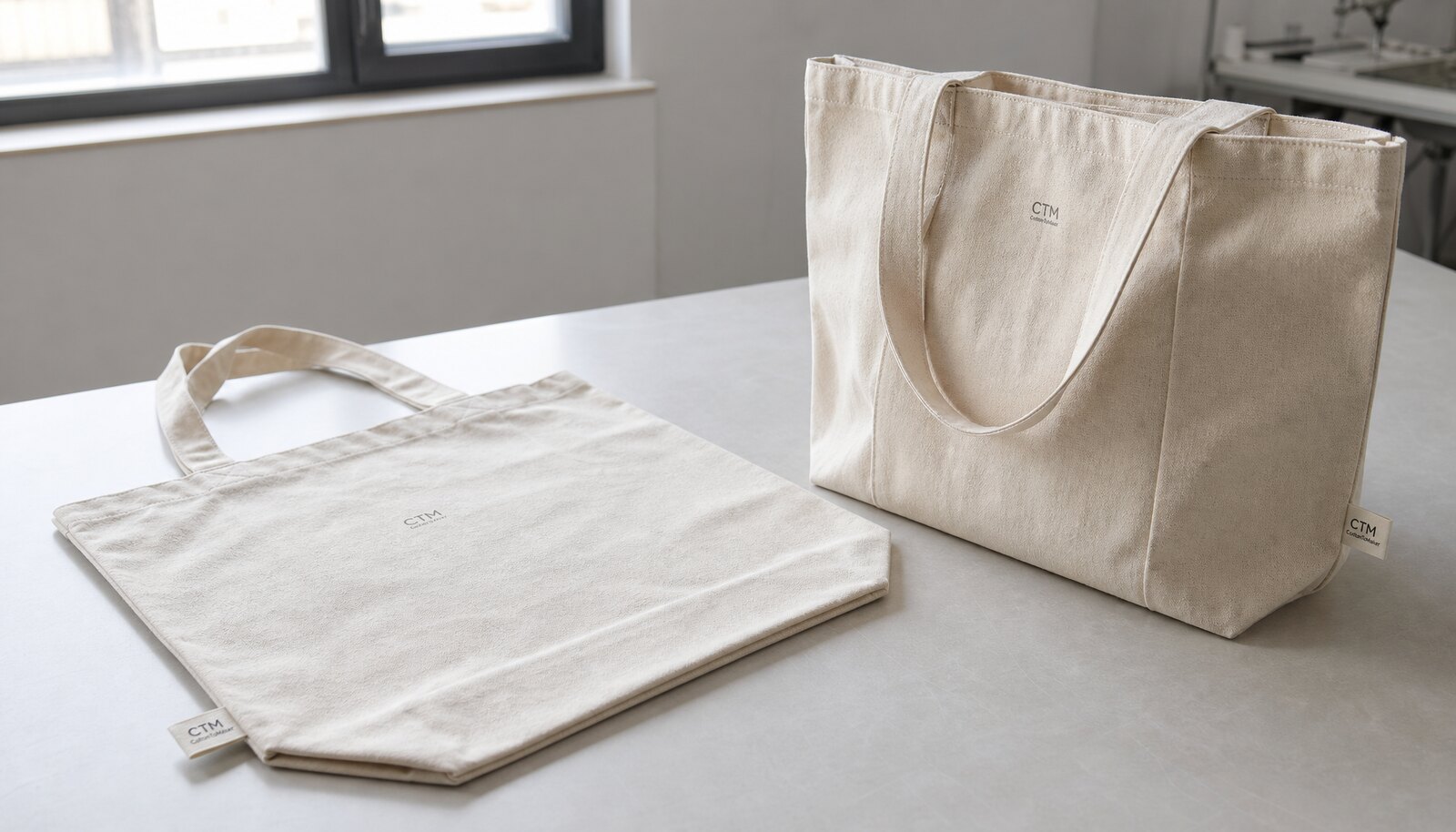
Why this bag type needs a buyer spec, not a loose style brief
Canvas retail merchandise bags are usually bought for two different jobs at once: they must look presentable enough for a retail launch, and they must be simple enough to pack quickly for a corporate event. That creates a common sourcing mistake. Buyers describe the design in broad terms, then discover that the factory quoted a bag that feels too soft, prints too dull, or costs too much to land in time for the campaign.
The better approach is to write the bag as a production spec. The supplier needs to know the target use case, the contents inside the bag, the number of carry cycles you expect, and whether the bag is a giveaway, a retail item, or a premium merchandise insert. Those decisions determine fabric weight, handle construction, print method, carton loading, and whether a low-MOQ route actually fits the schedule.
- For event handouts, prioritize fill speed, stackability, and clean print.
- For retail launches, prioritize feel, shelf appearance, and repeat-use durability.
- For premium merchandise, the bag often needs a heavier canvas, tighter stitching, and better label presentation.
Choose the canvas weight based on carry load and brand position
The most useful first decision is fabric weight. For most canvas retail merchandise bags, finished fabric in the 10 oz to 12 oz range is the practical middle ground. It holds shape better than lightweight promotional cloth, prints cleanly, and still keeps carton weight manageable for export. If the bag is expected to carry product samples, hardback catalogs, beverage packs, or boxed gifts, move toward 12 oz to 14 oz finished canvas.
Do not let the supplier quote only yarn count or raw fabric terms without explaining the finished cloth. Finish matters because washing, shrinkage, and coating can change the final hand feel and dimensions. A 10 oz bag made with poor finishing can look thinner than a well-constructed 8 oz bag, while an over-heavy 14 oz version may be unnecessary if the bag only holds folded apparel or brochures.
- 10 oz to 12 oz: balanced for event merchandise, launch kits, and general retail use.
- 12 oz to 14 oz: better for reusable shopping-style merch bags and premium branding.
- If the bag is sold at retail, ask for a fabric swatch and a packed sample to judge drape and print surface.
Print method should follow volume, artwork, and resale expectations
Print is often where a quote looks attractive on paper but fails in production. Screen print remains the most reliable route for one-color or two-color logos at volume because it gives strong opacity and better unit economics once setup is spread across the order. For simple event artwork and repeated brand marks, screen printing usually delivers the best balance of cost and durability.
Heat transfer becomes more useful when art is variable, when the order is short, or when the design includes fine details that would be difficult to screen cleanly. Embroidery and woven labels give a more premium feel, but they add labor, longer sampling time, and more risk of misalignment. For a retail launch, that premium may be worth it if the bag is part of the merchandise line rather than a disposable promotional item.
- Screen print: best for stable brand logos, larger runs, and strong unit-cost control.
- Heat transfer: useful for short runs, multi-color art, and variable event graphics.
- Embroidery or woven label: useful when the bag itself is a sellable merchandise item, not just a pack-out item.
MOQ logic: the cheapest quote is often the least flexible one
MOQ should be read by version, not by total order. A factory can quote 10,000 bags overall, but if that means 5,000 per color and 5,000 per print version, the order may be too rigid for a retail launch with multiple channels. Buyers need to know whether the factory is basing MOQ on fabric dye lots, print screens, cutting efficiency, or carton build. Each of those affects flexibility differently.
A low MOQ looks helpful when you are testing a launch. Still, the unit price can climb quickly if the supplier is buying special fabric, building a custom print screen for each version, or adding manual packing. The better comparison is the net landed cost per sellable unit. A slightly higher MOQ can sometimes lower your real cost if it reduces setup charges and avoids duplicate materials.
- Ask for MOQ by size, color, and print version separately.
- Confirm whether the quoted MOQ includes a full production run or a pilot batch.
- If testing a market, compare one standard bag with one print variant before multiplying SKUs.
Use supplier options to control risk, not just to chase the lowest ex-works price
For procurement teams, there are usually three sourcing routes: direct factory, factory-plus-trading layer, or mixed-category consolidator. Direct factory sourcing is best when the program will repeat and you need consistent control over fabric, print, and corrective actions. That route usually gives better technical transparency, easier sample alignment, and clearer accountability when a stitch or print issue appears.
A trading route can help when the order is small, the buyer needs several product categories in one shipment, or the team wants one contact for consolidation. The tradeoff is less visibility into the actual sewing line, dye lot, and QC process. For canvas retail merchandise bags, that matters because small variations in handle length, print cure, and seam tension become visible very quickly in a retail environment.
- Direct factory: better for repeat launches, better price visibility, stronger corrective action.
- Trading or consolidator: better for mixed SKUs, smaller test orders, and simplified communication.
- Hybrid sourcing: possible when a direct factory handles the bag and another supplier handles inserts or hangtags.
Compare sourcing routes before you lock the RFQ
The comparison below is useful when the same bag is offered by more than one type of supplier. One route may look cheaper, but the landed result can be worse if the carton pack, sample quality, or lead time control is weak. Compare suppliers on the buying outcome you need, not only on unit price.
If your launch date is fixed, schedule risk should weigh as much as price. If your bag is going into a retail assortment, print consistency and shelf appearance matter more than a small unit discount. That is why a quote comparison should include the method of making, not just the final number.
- Compare on fabric source, print method, MOQ structure, and sample turnaround.
- Treat carton dimensions and gross weight as quote data, not as shipping afterthoughts.
- Use one reference sample across all suppliers so the comparison stays fair.
Buyer comparison table for supplier routes and quote quality
Packing rules should cover fold method, inner bundle, carton count, carton mark, moisture protection, SKU separation, and warehouse receiving needs. These details affect cost, damage rate, receiving speed, and whether the goods can move directly into retail or distribution.
A custom bag can pass product QC and still create claims if cartons are mislabeled, overpacked, crushed, damp, or mixed. Treat packing as part of the specification, not an afterthought.
- Write decisions in measurable language, not only descriptive wording.
- Ask for sample photos plus one physical approval sample for important orders.
- Keep quotation, sample approval, and inspection notes tied to the same spec version.
Sample approval should test feel, balance, and print behavior, not just appearance
A photo of the sample is not enough for this bag category. Canvas has a tactile feel, and that feel changes the buying decision. The pre-production sample should use the actual fabric weight, actual thread color, actual print method, and final sewing construction. If the bag will be sold retail, check how it stands when filled and how the handles sit under load.
The sample should also be used to lock down dimensions. Buyers often approve a bag based on width and height numbers but forget shrinkage, seam take-up, and top hem behavior. The result is a bag that loses internal volume after finishing. A good approval process records the measured sample dimensions and compares them to the approved tolerance rather than relying on visual similarity alone.
- Flex the printed area to see whether the ink cracks or lifts at the edges.
- Load the bag with a realistic sample pack and judge handle pull and body balance.
- Measure actual bag dimensions after finishing, not from the cutting pattern.
Packing choices affect damage rate, warehousing speed, and freight cost
Packing is a commercial issue, not just a warehouse detail. If the bags are printed, the print surfaces need protection from scuffing during carton movement. If the order is for retail launch stock, the bags should arrive flat, countable, and easy to reconcile by carton. Excessively compressed packing can leave permanent crease marks, especially on heavier canvas, while loose packing inflates the freight bill.
For most corporate event and retail launch programs, flat bulk packing in export cartons is the right baseline. Add individual polybags only when the brand or retailer requires it, or when dust control and shelf presentation justify the extra cost. If hangtags or barcode stickers are part of the retail plan, define their placement before production, because last-minute additions often slow down packing and create carton count errors.
- Agree carton quantity per size and print version before production starts.
- Confirm outer carton marks, gross weight limits, and palletization if the shipment is warehouse-direct.
- If retail-ready packing is needed, define barcode, hangtag, and fold direction in the sample stage.
Lead time usually slips at the same three points
Most delays on canvas retail merchandise bags come from fabric booking, print approval, and packing changes. Fabric is often the first bottleneck if the buyer wants a special color or a heavier cloth than the factory keeps in stock. Printing becomes a schedule risk when artwork changes after the screen or transfer file is already prepared. Packing slips happen when the buyer changes carton counts, inserts, or retail labeling late in the process.
A realistic plan should include sample time, approval time, production time, and shipping buffer. For a simple standard bag using stock fabric and a single print color, the total cycle can be relatively short. For custom fabric color, multiple print hits, or retail-ready packing, the schedule should be longer. The important point is to separate factory lead time from freight lead time so the business team does not confuse production completion with arrival at the destination warehouse.
- Short-run standard bags move faster when fabric and trims are already available.
- Custom dyeing, multiple print colors, and special packing extend the timeline.
- Always build a buffer for sample sign-off and transit delay during peak shipment seasons.
Specification comparison for buyers
| Spec decision | Recommended option | When it fits | Buyer risk to check |
|---|---|---|---|
| Fabric weight / GSM | 10 oz to 12 oz finished canvas for retail handout bags; 12 oz to 14 oz for repeat-use merchandise bags | Corporate events, retail launches, and brand activations where the bag must survive multiple uses and hold brochure packs, samples, or small boxed goods | Light fabric can collapse, print may wave on thin cloth, and very heavy cloth raises cost and carton weight; confirm finished GSM, not only yarn count |
| Construction style | Single-compartment tote with reinforced stress points and hemmed top edge | Most merchandise and retail launch programs that need simple filling, fast packing, and low sewing risk | Avoid overcomplicated pockets or closures unless they are part of the retail concept; extra seams increase needle damage, thread breaks, and labor cost |
| Print method | 1-color or 2-color screen print for volume; heat transfer for short runs with complex art; woven label or embroidery only for premium positioning | Use screen print for strong brand marks and stable reorders; use heat transfer when art changes often or includes fine gradients | Match method to bag color and wash/rub requirements; weak ink cure or poor film adhesion causes cracking and rub-off in transit |
| Handle length and drop | Shoulder-length handles around 26 to 30 cm drop for event carry; shorter hand-carry handles only for lightweight retail gifts | Best for venue traffic, post-event reuse, and shopping-center launches where attendees carry the bag for long periods | If drop is too short, the bag is awkward over coats; if too long, the bag hangs low and looks untidy on retail shelves |
| Closure / opening | Open top for easy packing unless high-value contents require zipper or magnet closure | Launch kits, press packs, and event giveaways where pack-out speed matters more than security | Adding closures changes sewing sequence and MOQ; for retail sales, confirm whether closure affects shelf presentation and carton count |
| MOQ route | Use stock fabric with standard size and one print position for lowest MOQ; use custom fabric color or specialty trim for higher MOQ | Best when the buyer needs a fast market test, channel-specific launch, or seasonal event with uncertain volume | Low MOQ quotes may hide higher unit cost, setup fees, or limited color control; compare net landed cost, not only ex-works price |
| Sampling route | Pre-production sample with actual fabric, print, thread, and label; keep photo sample only for initial visual alignment | Any program with retail packaging, color-critical branding, or a first-time supplier relationship | Photo approvals miss handle feel, seam balance, and print hand; require a physical sample before bulk release |
| Packing method | Bulk packed flat in outer cartons with polybag protection if required by brand standards | Works for most distribution and retail launch programs where warehouse speed and carton efficiency matter | Loose packing can scuff print and contaminate bags; over-packing into small cartons can crush handles and raise freight cost |
| Supplier route | Factory-direct sourcing for repeat volumes; trading company only when you need mixed-category consolidation or very small trial orders | Best for procurement teams that want direct QC ownership, stable pricing, and repeat production control | Trading layers can mask factory details, increase response time, and blur accountability on corrective actions and shade consistency |
Buyer checklist before sampling
- Confirm finished fabric weight, bag size, handle length, and seam reinforcement before quoting.
- Specify print method, print area, and acceptable color tolerance from a physical reference.
- State target MOQ by size/color/print version, not only total quantity across all SKUs.
- Request a pre-production sample made with actual fabric and real artwork output.
- Define packing format, carton quantity, carton mark, and whether individual polybags are needed.
- Set a sample approval gate for stitch quality, print cure, and handle pull feel before bulk release.
Factory quote questions to send
- What is the finished GSM or oz weight of the canvas after finishing, and what weave density is used?
- How much does the price change by size, print color count, handle length, and bottom gusset?
- Is the quote based on stock fabric, dyed fabric, or greige fabric with post-dye finishing?
- What is the MOQ per size and per print version, and what setup charges apply if we split colors?
- Which print method is included in the base price, and what is the cure or wash resistance standard?
- What sample can you provide before production, and will it use the same fabric, thread, label, and print method?
- How are the bags packed, how many per carton, and what are the carton dimensions and gross weight?
- What is the standard lead time after sample approval, and what factors extend it during peak season?
- Which parts of the quote are excluded, such as freight, testing, inserts, hangtags, or special packing?
Quality-control points to confirm
- Fabric weight should be within the agreed range; thin spots, slubs, and visual streaking should be limited to acceptable textile tolerance.
- Stitching at handle joins and side seams should be straight, secure, and free of skipped stitches or loose thread ends.
- Print edges should be clean with no pinholes, smearing, under-cure gloss, or visible cracking after hand flexing.
- Bag opening should be square enough for easy filling and retail display; twisted body panels indicate sewing drift.
- Handle symmetry should stay within a practical tolerance so the bag hangs level and does not lean to one side.
- Carton packing should protect print surfaces from abrasion and keep the counted quantity consistent across cartons.