Canvas messenger wholesale supplier business continuity planning for Canada
By Vincent Xi, Editorial Author
For Canadian buyers, canvas messenger wholesale supplier business continuity planning is the process of deciding how a repeatable wholesale supply arrangement will continue through an internal or external disruption. It is not a promise that disruption will not occur. It is a documented set of buyer requirements, supplier responsibilities, approval points, and fallback decisions that apply before an order is released and again when goods are received.
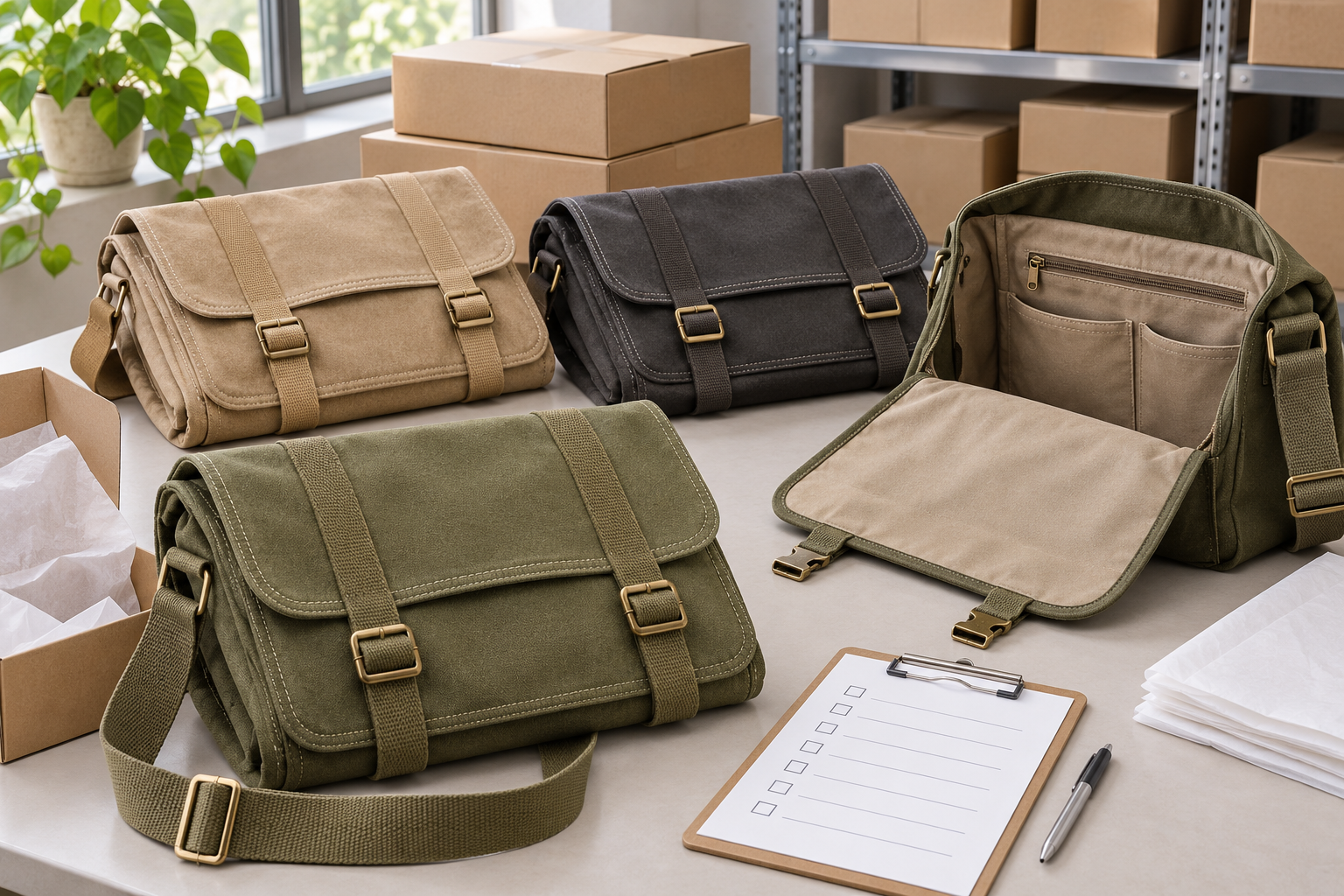
Canvas messenger bags combine visible materials and construction details with packaging, labeling, and delivery handoffs. The plan therefore protects the approved specification as well as the flow of cartons to Canada. The buyer's task is to state those requirements in the RFQ, compare supplier responses against the same fields, and record what has been agreed before purchase order approval.
Business continuity planning for canvas messenger wholesale supply in Canada
Begin with the arrangement the buyer needs to protect: the approved bag specification, the assortment and order quantities to be released, the packaging and label content, the Canadian ship-to locations, and the people authorized to approve a change. These are buyer-defined fields, not assumptions to leave to a supplier's sales presentation.
A continuity plan separates normal order handling from exception handling. Normal handling covers quotation, sample approval, order confirmation, production release, packing, and delivery documentation. Exception handling covers what happens when an input, a production step, a packing material, a label, or a shipping handoff cannot follow the original plan. Both should be written into the RFQ response so the buyer can compare answers side by side.
Start with the buyer's continuity requirements
The buyer should define the requirement before asking a supplier to describe a plan. Otherwise, responses are difficult to compare. A practical requirement set covers:
- The approved canvas messenger specification, including body fabric, lining, flap construction, seams, strap, hardware, closure, color, and visible workmanship.
- The approved sample or reference record that defines what the bulk order must match.
- The material and component list, with permitted alternatives and the approval process for using them.
- Packaging, label content, language requirements, carton marks, and packing method, tied to the buyer's own market requirements.
- The order-release fields, shipment handoff points, Canadian delivery addresses, and document responsibilities.
- The acceptance checks the buyer will use at receipt and the records that must accompany each shipment.
These requirements give the supplier a clear structure for its response and prevent a vague continuity statement from being mistaken for an agreed operating process.
Buyer decision table for canvas messenger wholesale supply
Use the same table for every supplier. Record the question asked, the information received, the agreement reached, and the owner of the next action. A response that does not identify a record, an approver, or an acceptance point remains an open item.
| Decision area | Buyer question | Information to request from supplier | Agreement to record |
|---|---|---|---|
| Order release and allocation | How will the supplier confirm the styles, quantities, and delivery destinations covered by each order? | Order-confirmation template, named order approver, and the sequence from buyer release to supplier acceptance | Required order fields, confirmation method, and the buyer contact authorized to release or amend an order |
| Material and component continuity | Which canvas, lining, webbing, thread, closure, and hardware inputs are critical to the approved bag, and which alternatives may be proposed? | Material and component list, alternative-approval process, and sample or swatch submission steps | Approved inputs, permitted substitution categories, approval authority, and the record that proves approval |
| Construction and sample control | Which construction details and visible workmanship points must remain unchanged between the approved reference and bulk production? | Sample-control procedure, change-notification form, and the person responsible for comparing bulk work to the approved reference | Approved sample record, change-approval sequence, and the buyer's hold point before production or packing proceeds |
| Packaging, labeling, and carton marks | What label content, language, packing method, and carton marks must appear on the finished order? | Artwork-approval steps, packing specification, carton-mark proof, and the document list for each shipment | Signed packaging and labeling specification, approval owner, and the rule for handling any post-approval change |
| Shipment and delivery handoff | Which shipping points, consolidation steps, and Canadian delivery addresses apply, and who prepares each document? | Routing plan, handoff contacts, shipment-document list, and the procedure for notifying the buyer of a change | Agreed delivery terms, document responsibilities, notification sequence, and the buyer's acceptance point at receipt |
| Communication and escalation | Who represents commercial, production, packing, and shipping matters, and how are exceptions escalated? | Contact matrix, meeting cadence, issue log format, and escalation sequence | Named contacts, response expectations, escalation order, and the record used to close an open issue |
| Acceptance and corrective action | What visible checks will the buyer perform at receipt, and how will a discrepancy be handled? | Packing record, shipment-document list, discrepancy form, and corrective-action template | Acceptance checklist, hold authority, replacement or rework decision process, and the close-out record |
The table is a buyer control, not a supplier scorecard. A supplier may answer with a process, a partial answer, or a stated limitation. Each answer should be compared with the same field in the RFQ and marked as agreed, clarification required, or not accepted.
Questions to put to a potential supplier
Ask the same questions in writing and request answers in the same format.
- How would the supplier handle an order if a specified canvas, lining, strap, closure, or hardware input were unavailable?
- Which changes require buyer approval before production, packing, or shipment, and who is authorized to give that approval?
- How does the supplier record the approved sample, and how does it compare bulk work with that record?
- What would trigger an exception review, and who joins it from the supplier's commercial, production, packing, and shipping sides?
- How are partial shipments, order holds, and delivery re-planning authorized, and what information does the buyer receive?
- Which documents accompany each order, and who prepares, checks, and sends them?
- How does the supplier communicate a change to a material, construction detail, label, carton mark, or delivery address?
- What records will the buyer receive when an issue is closed, and how is the close-out approved?
The buyer should not treat an oral assurance as a control. If an answer cannot be tied to a named record, a responsible contact, and an approval point, it remains a clarification item.
RFQ Checklist
- Ask the supplier to provide a written continuity plan covering order intake, material and component planning, production, packing, and shipment handoff.
- Require the supplier to identify the approved canvas messenger specification, reference sample, and permitted material alternatives before quotation comparison.
- Specify the buyer's packaging, label, carton-mark, and shipment-document requirements, including who approves each item.
- Require the supplier to describe how changes to materials, construction, packaging, labeling, or delivery will be notified, approved, and recorded.
- Ask the supplier to name the commercial, production, packing, and shipping contacts and the escalation sequence for an exception.
- Specify the buyer's receipt checks for visible workmanship, construction, color, labeling, packing, and carton condition.
- Require the supplier to state how order holds, partial shipments, and delivery re-planning will be authorized and documented.
- Ask the supplier to include a shipment-document list and a close-out record for any accepted discrepancy.
Reviewing responses and setting acceptance points
Compare responses against the same buyer requirements. Separate what is documented from what is proposed, what is conditional, and what is missing. Do not fill a gap with an assumption based on a sample or a sales conversation. Mark the gap and decide whether to request clarification, change the requirement, or stop the evaluation.
Set acceptance points before order placement: approved specification; approved sample or reference record; approved packaging and label content; confirmed order and delivery destinations; approved shipment-document list; and receipt checks with a defined close-out record. Each point should have a buyer owner and a supplier contact. If a point is not closed, the buyer should know whether the order may proceed, must be held, or needs written exception approval.
For Canadian buyers, the delivery plan should name the Canadian receiving locations and handoff contacts without assuming that a supplier's standard route fits the buyer's distribution. The buyer should confirm which language and label content requirements apply to its own sales channel and pass them to the supplier in the RFQ rather than relying on a general statement.
A continuity plan should include a review date and a change log. The review need not be complex: it shows which requirements were checked, contacts confirmed, documents received, and open items remain. That record helps a new buyer, a new supplier contact, or a repeat order follow the same decisions.
Limitations and buyer verification
This article offers a buyer-side process for structuring questions and agreements. It does not verify any supplier's capabilities, production arrangements, documentation, or delivery performance. The buyer should request current written answers, review the records offered, and confirm every specification, approval, and acceptance point before placing an order. Where a requirement depends on the buyer's Canadian sales channel, packaging, label content, or delivery arrangement, the buyer should define it and obtain written supplier confirmation rather than infer it.
Discuss Your Requirements
Review our manufacturing capabilities, then share your specifications for a supplier-fit review.