Canvas Messenger OEM Quality Control Inspection for New Zealand RFQs
By Vincent Xi, Editorial Author
For New Zealand B2B buyers, quality control inspection for a canvas messenger OEM order is a documented shipment-release gate: it verifies the identified manufacturing lot against buyer-approved materials, dimensions, sewn construction, reinforcement, strap assembly, hardware, branding, packing, and quantities. The RFQ should require sampling instructions, actual results, observed defects, incomplete checks, and the named buyer representative authorised to approve release.
Set those controls in the RFQ, before production starts. Ask the supplier to return proposed materials, tolerances, test methods, inspection records, substitutions, and exceptions. The purchase order should identify who may authorise shipment and what happens when evidence is missing or a result falls outside an approved limit.
Keep the scope specific to the ordered canvas messenger: canvas, dimensions, sewn construction, reinforcement, strap assembly, hardware, branding, labels, unit packing, cartons, quantities, and shipment records. Each requirement needs a controlled reference, an inspection method, and a defined release, clarification, rework, or rejection consequence.
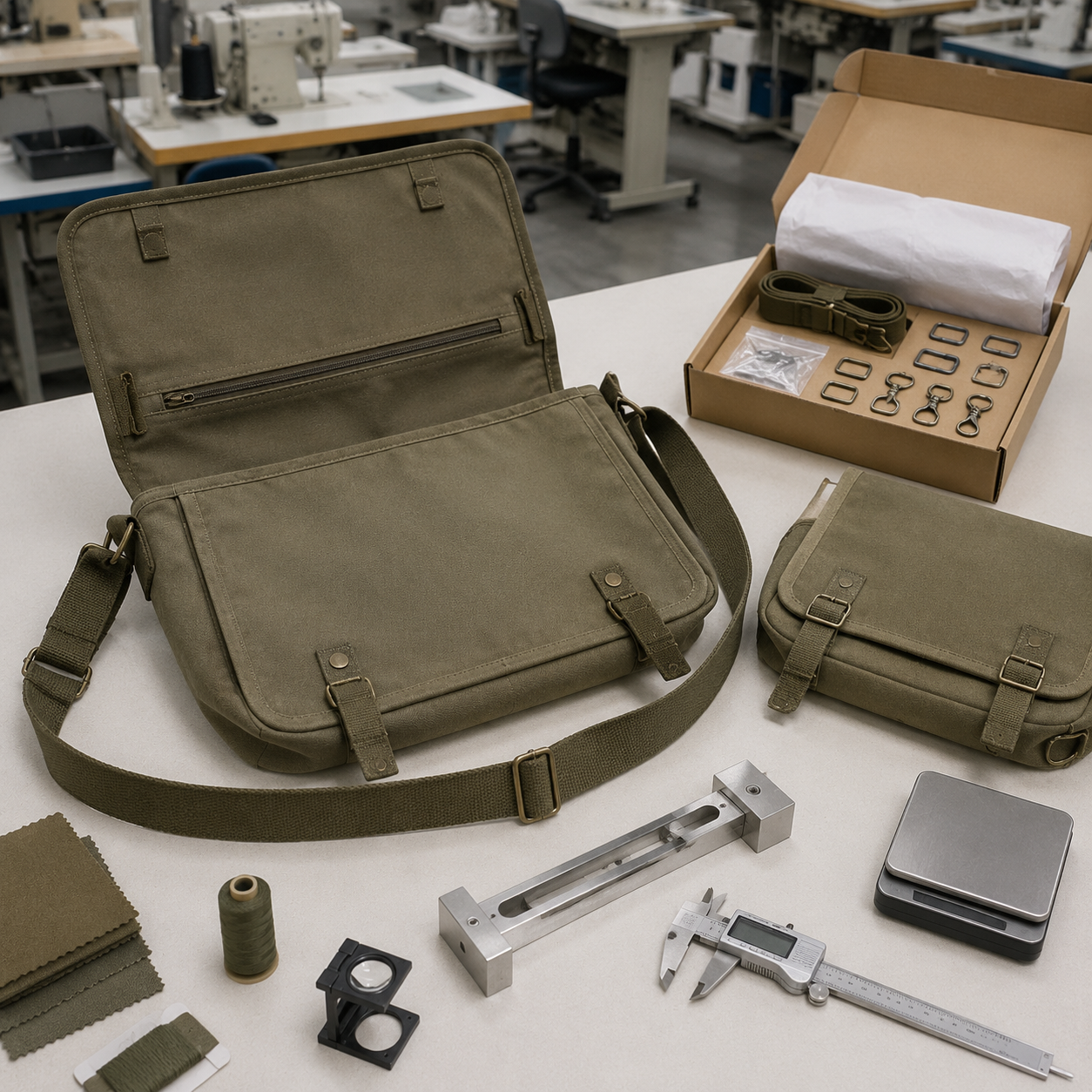
New Zealand canvas messenger quality control inspection release gate
Define each disposition and its evidence threshold in the RFQ and purchase order.
| Disposition | Evidence condition | RFQ control |
|---|---|---|
| Release | The report identifies the inspected lot and controlled references; required checks are complete; results meet buyer-approved limits; quantities and packing reconcile | Name the buyer representative with release authority and state whether an inspection provider may recommend, but not authorise, release |
| Hold for clarification | A specification, drawing, approved sample identifier, defect rule, lot record, or required result is missing or contradictory | Prevent collection or shipment booking until the buyer records a decision against the affected requirement |
| Hold for rework and reinspection | A result exceeds an agreed limit, a prohibited defect is recorded, or packing and quantities do not reconcile | Define containment, affected quantity, rework evidence, reinspection scope, replacement of tested units, and cost allocation |
| Buyer rejection review | The contractual rejection condition is reached or the presented goods materially differ from controlled order references | Define replacement, cancellation, concession, evidence retention, and dispute procedures in the commercial documents |
Use a written reference hierarchy. The purchase order should control commercial terms; the technical specification should control measurable product requirements; drawings and artwork should control geometry and branding; the approved sample should support visual and tactile comparison; the defect sheet should control classifications; and the packing file should control shipment preparation. Record conflicts and their approved resolution before inspection.
The AUSEK pre-shipment QC article supports the limited process principle of comparing finished goods, included items, packaging, and shipment details with confirmed order references. Its subject is cameras, so its product-specific checks do not support claims about canvas, sewing, straps, or messenger-bag performance.
Build the canvas messenger manufacturing RFQ around inspectable evidence
| Order feature | Requirement to freeze | Supplier quotation response | Inspection evidence and hold trigger |
|---|---|---|---|
| Canvas | Fiber declaration, weave, finished mass per area and unit, finish, colour reference, usable width, lot rule, measurement basis, and tolerance | Proposed material reference, supporting mill or converter document, swatch, lot-identification method, and substitution process | Record the presented lot and compare it with the approved requirement; hold an undeclared substitution or unresolved lot mismatch |
| Body geometry | Finished width, height, gusset, flap, pockets, strap endpoints, measurement points, bag condition, instruments, and tolerances | Dimension table, pattern revision, measurement method, and proposed manufacturing tolerances | Record actual measurements; hold any result outside its buyer-approved interval |
| Sewn construction | Seam type, allowance, stitch-density measurement basis, thread requirement, lining capture, edge treatment, and prohibited conditions | Construction drawing or controlled sample reference, inspection stage, and repair rule | Photograph representative exterior and interior construction; record each defined defect by unit and location |
| Reinforcement | Required locations, pattern, orientation, backing material, concealed-construction evidence, and appearance limits | Construction detail, in-process evidence proposal, and substitution control | Check the required locations on units selected under the approved inspection plan; hold missing or misplaced reinforcement under the defect rule |
| Strap assembly | Webbing material, width, adjustment range, attachment method, hardware orientation, and buyer-approved test protocol | Component reference, proposed load, duration, operation count, fixture, failure criteria, and treatment of tested units | Record the setup, result, post-test condition, and tested-unit identity; hold a result that reaches the agreed failure criterion |
| Closures and hardware | Component material or declaration, finish, dimensions, colour reference, orientation, operating criteria, and surface limits | Controlled component reference, finish declaration, replacement component, and approval process | Compare with the approved reference and perform the agreed operation check; classify loose, damaged, sharp, incorrect, or non-operating parts under the defect sheet |
| Branding and labels | Artwork revision, dimensions, position, orientation, colour reference, attachment, approved content, and placement tolerance | Artwork proof, production method, approval stage, and remake rule | Verify revision, content, placement, orientation, and attachment; hold unapproved artwork or a missing buyer-required label |
| Workmanship | Order-specific definitions and limits for stains, shade variation, puckering, abrasion, loose threads, asymmetry, pressure marks, and contamination | Supplier defect examples, internal checkpoint, repair method, and final presentation proposal | Record each observed condition by sampled unit, location, image, count, and buyer-defined classification |
| Unit and carton packing | Folding method, strap restraint, hardware protection, unit protection, assortment, carton construction, closure, marks, weight limit, and dimension limits | Packing diagram, materials, units per carton, nominal carton data, and freight assumptions | Record actual assortment, count, dimensions, and weights from cartons selected under the approved method; hold unexplained differences from the packing file |
Terms such as standard tolerance, export packing, or normal inspection do not provide measurable acceptance criteria. The quotation should return actual proposed values, methods, records, and exceptions for buyer review.
Canvas data and example dimensional controls
The Dreamway Canvas Manufacturing Guides group the source's commercial content around canvas selection, pattern development, sewing construction, reinforcement, hardware, inspection, and sampling. Those topics can help organise RFQ checkpoints. The source does not establish a proposed supplier's process, an order-specific result, or certification of a factory, material, or product.
The Canvas ETC wholesale canvas sourcing guide lists the following seller-specific cotton-duck reference values. The cited page does not state a publication date. The values are transcribed without conversion or averaging and should not be treated as universal grades or as specifications for this order.
| Source, scope, and date context | Source designation | Source-listed mass per area |
|---|---|---|
| Canvas ETC cotton-duck reference list; page publication date not stated | Number One designation | 30 oz/sq yd |
| Canvas ETC cotton-duck reference list; page publication date not stated | Number Four designation | 24 oz/sq yd |
| Canvas ETC cotton-duck reference list; page publication date not stated | Number Ten designation | 14.75 oz/sq yd |
| Canvas ETC cotton-duck reference list; page publication date not stated | Number Twelve designation | 11.5 oz/sq yd |
The Canvas ETC source also discusses canvas type, weight, colour, quantity, supplier selection, samples, and logistics as sourcing variables. Because it is a commercial seller's guide, verify the proposed material against scope-matched supplier or mill documentation and an approved physical sample. A source-listed weight does not by itself control fiber, weave, finish, colour, measurement basis, tolerance, lot variation, or suitability for the approved construction.
Example RFQ calculation to verify in the supplier quotation
The following values are illustrative assumptions for a canvas messenger RFQ and must be verified in the supplier quotation. They are not recommended dimensions, production tolerances, or measured results.
| Example scope | Example nominal requirement | Example assumed tolerance | Example calculated interval |
|---|---|---|---|
| Finished body width measured at buyer-defined endpoints and in the specified bag condition | 360 mm nominal | +/- 3 mm | 357 mm through 363 mm |
| Finished body height measured at buyer-defined endpoints and in the specified bag condition | 280 mm nominal | +/- 3 mm | 277 mm through 283 mm |
Each interval is calculated by subtracting and adding the assumed tolerance to the assumed nominal value. Apply the same buyer-approved structure to gusset depth, flap geometry, pocket placement, strap width, adjustment range, hardware position, and branding position. The supplier should identify the measurement points, bag condition, instrument, proposed tolerance, and dimensions considered critical to fit or function.
Quality control inspection checkpoints by production stage
Incoming canvas and components
Request lot or batch identifiers for the proposed canvas, thread, webbing, closures, hardware, lining, labels, and packing materials. For each item, the supplier should state the approved reference, incoming check, record owner, retained evidence, and process for obtaining buyer approval before substitution.
For canvas, obtain the declared composition, weave, finished mass per area, finish, shade reference, usable width, visible-fault criteria, measurement basis, tolerance, and lot identity. For hardware and closures, obtain the component reference, material or finish declaration, critical dimensions, mating-part check, orientation, and controlled visual sample.
Review any declaration or report for the named material, tested property, method, report date, issuing body, applicant, and scope. A document covering a facility or different material should not be treated as evidence for the ordered canvas, coating, webbing, hardware, packaging, or finished bag. Do not imply certification without a current, scope-matched document.
Cutting, sewing, and assembly
Set checkpoints for pattern revision, panel orientation, flap and pocket placement, seam allowance, stitch formation, edge finishing, reinforcement, strap alignment, hardware orientation, lining capture, and label placement. The quotation should identify when each check occurs, who records it, and how the record links to the production lot.
Use a clearly identified initial production unit or in-process sample as an approval gate. It can support visual and tactile requirements, but it should not replace the dimension table, tolerance rules, construction details, artwork controls, or defect sheet.
Ask for in-process evidence wherever reinforcement will be concealed. An exterior final-inspection image cannot show construction hidden beneath a seam or lining.
Finished and packed lot
State the required production and packing status before inspection. Samples should be drawn from the identified lot and accessible cartons under the buyer-approved selection instruction. The report should disclose unavailable stock, inaccessible cartons, supplier-selected samples, substituted references, interrupted checks, and tests that could not be completed.
Separate non-destructive checks from load, pull, seam-opening, or other potentially destructive procedures. State whether tested units may ship, how they will be identified, who supplies replacements, and whether reinspection includes those replacements.
Define sampling, defects, and report contents
The inspection instruction should define the lot, styles and colour variants, carton-selection method, unit-selection method, sample plan, defect classes, acceptance and rejection values, escalation rule, and reinspection method. Approve these terms before finished results are available.
The Dreamway source includes sampling and quality-inspection topics in its commercial canvas content. That reference does not set a sample size, acceptance level, defect limit, or factory practice for this order. If the buyer selects a sampling standard, the contract should identify the standard and edition, lot basis, inspection level, sample plan, defect classes, and acceptance values. Naming a standard does not demonstrate product or factory certification.
Define defect classes through their contractual consequences and order-specific examples:
- Critical: a buyer-defined safety, legal, or severe use-risk condition that triggers the stated release rule.
- Major: a buyer-defined departure that prevents intended function, materially conflicts with a controlled requirement, or makes the unit commercially unacceptable under the approved criteria.
- Minor: a buyer-defined appearance or workmanship departure that exceeds the approved limit without materially preventing intended use.
Possible conditions for classification include insecure strap attachment, a non-operating closure, wrong material, missing buyer-required label, incorrect geometry, open seam, unapproved branding, staining, shade mismatch, puckering, exposed raw edge, sharp point, loose thread, or pressure mark. This list does not assign severity; the buyer-approved defect sheet must do so.
For every measurable characteristic, define the instrument or fixture, setup, measurement points, unit, tolerance, rounding rule where relevant, and treatment of borderline results. The report should record actual readings instead of pass or fail labels alone.
Require the completed inspection report to contain:
- Supplier, production-order, style, colour, and lot identifiers.
- Presented quantity and production and packing status when inspection began.
- Accessible and inaccessible carton quantities.
- Carton and unit selection methods, including supplier involvement.
- Instrument identification, setup, method, and actual measurements.
- Functional-test setup, actual result, and tested-unit identity.
- Defect location, classification, count, sampled-unit reference, and image.
- Packing, assortment, carton, and quantity reconciliation.
- Missing references, incomplete checks, unavailable stock, and supplier disagreements.
- Inspector recommendation separated from the buyer-authorised disposition.
For a failed or incomplete result, ask the supplier to identify the affected scope, containment action, proposed rework, replacement quantity, revised readiness date, and evidence offered for reinspection. Commercial terms should allocate reinspection, replacement, storage, booking-change, and delay costs.
New Zealand packing, freight, and document controls
The cited sources do not establish a current New Zealand tariff classification, duty or tax treatment, biosecurity outcome, mandatory label, import document, or clearance result for the proposed bag and packaging. This article therefore assigns none. Before order placement, the buyer should have its appointed New Zealand customs broker, freight forwarder, or compliance adviser confirm current requirements for the approved materials, intended use, packaging, route, origin, and delivery arrangement.
Keep physical inspection evidence separate from legal and customs determinations. Subject to instructions from the buyer's appointed adviser, the inspection scope can compare the physical lot with approved document fields for:
- Buyer, supplier, purchase-order, style, and lot references.
- Approved product and material descriptions.
- Unit quantity, assortment, carton count, and packing-list reconciliation.
- Measured carton dimensions and net or gross weights where requested.
- Carton identifiers and buyer-approved receiving marks.
- Origin wording or declarations after the appointed adviser confirms the required content and evidence.
- Records linking sampled cartons to the inspected production lot.
For the freight quotation, state the delivery term and applicable version, named handoff point, New Zealand delivery location, included and excluded charges, booking responsibility, cargo-ready evidence, document owner, and risk-transfer point. Ask the supplier to distinguish estimated carton data used for quotation from measurements taken from the approved packed configuration.
The packing specification should control folding, strap restraint, hardware separation, unit protection, moisture precautions, assortment, carton construction, closure, stacking orientation, gross-weight limit, dimension limits, and marks. Inspection records should contain actual observations and measurements rather than copied nominal values.
Canvas messenger quality control inspection RFQ decision checklist
- [ ] Attach the current purchase order, technical specification, dimension drawing, artwork, colour reference, packing file, defect sheet, and sample approval record.
- [ ] Define canvas composition, weave, finished mass-per-area unit, finish, colour, measurement basis, lot rule, and tolerance.
- [ ] Define dimensions by endpoints, bag condition, unit, instrument, and tolerance.
- [ ] Specify seams, reinforcement, strap assembly, hardware, closures, branding, labels, and prohibited workmanship conditions.
- [ ] Obtain proposed material and component references, manufacturing tolerances, checkpoints, records, and substitution controls in the quotation.
- [ ] Define the inspected lot, sample selection, defect classifications, acceptance values, escalation rule, and reinspection method.
- [ ] Separate non-destructive checks from destructive procedures and define replacement of tested units.
- [ ] Require actual measurements, test results, defect records, images, packing reconciliation, report limitations, and delivery timing.
- [ ] Define clarification, hold, concession, rework, reinspection, rejection, and final release authority.
- [ ] Allocate reinspection, replacement, storage, booking-change, and delay costs.
- [ ] Confirm measured packed-carton data before booking when dimensions or weights affect the freight quotation.
- [ ] Identify the New Zealand adviser responsible for confirming classification, import, documentation, labelling, tax, and biosecurity requirements.
- [ ] Request current, scope-matched evidence for every material, test, certification, or compliance claim in the quotation.
Sources, methodology, and evidence limits
| Source | Supported use | Evidence boundary |
|---|---|---|
| Dreamway Canvas Manufacturing Guides | Supplies source-attributed canvas production, construction, inspection, and sampling topics used to organise RFQ checkpoints | Does not prove a supplier's practice, an order-specific result, certification, or acceptance rule |
| Canvas ETC wholesale canvas sourcing guide | Supplies the seller-specific cotton-duck mass-per-area values and cited sourcing variables | Does not establish a universal grade system or verify material proposed for this order |
| AUSEK pre-shipment QC article | Supports the limited process of comparing finished goods, included items, packaging, and shipment details with approved order references | Camera-specific checks do not support canvas messenger construction or performance claims |
| Vincent Xi author profile | Supports the author name, role, and profile URL | Does not support a factory visit, inspection, test, certification, manufacturing credential, or customer outcome |
Methodology: Source statements were separated from buyer-selected controls. The Canvas ETC values were transcribed without conversion or averaging. The order's material, dimensions, construction, reinforcement, strap, hardware, branding, packing, lot identity, and shipment records were then mapped to evidence needed for a supplier quotation, inspection report, and buyer release decision. The dimensional intervals are explicitly labelled example calculations rather than sourced specifications.
Limitations and items to verify: No independent factory audit, physical product inspection, laboratory result, supplier quotation, freight booking, legal determination, certification, or New Zealand regulatory opinion supports this article. The cited Canvas ETC page does not state a publication date. Verify proposed materials, manufacturing tolerances, dimensions, test loads, durations, operation counts, sampling values, defect limits, packing configuration, carton limits, production status, charges, delivery terms, and required documents in the supplier quotation and controlled order package. Confirm current New Zealand import, documentation, labelling, tax, tariff, and biosecurity requirements with the buyer's appointed specialists for the actual materials, packaging, route, origin, and intended use.
Author basis: The Vincent Xi author profile identifies Vincent Xi as an Editorial Author. It does not document a factory visit, product inspection, test, certification, customer outcome, or manufacturing-experience claim, and none is made here.
Discuss Your Requirements
Review our manufacturing capabilities, then share your specifications for a supplier-fit review.