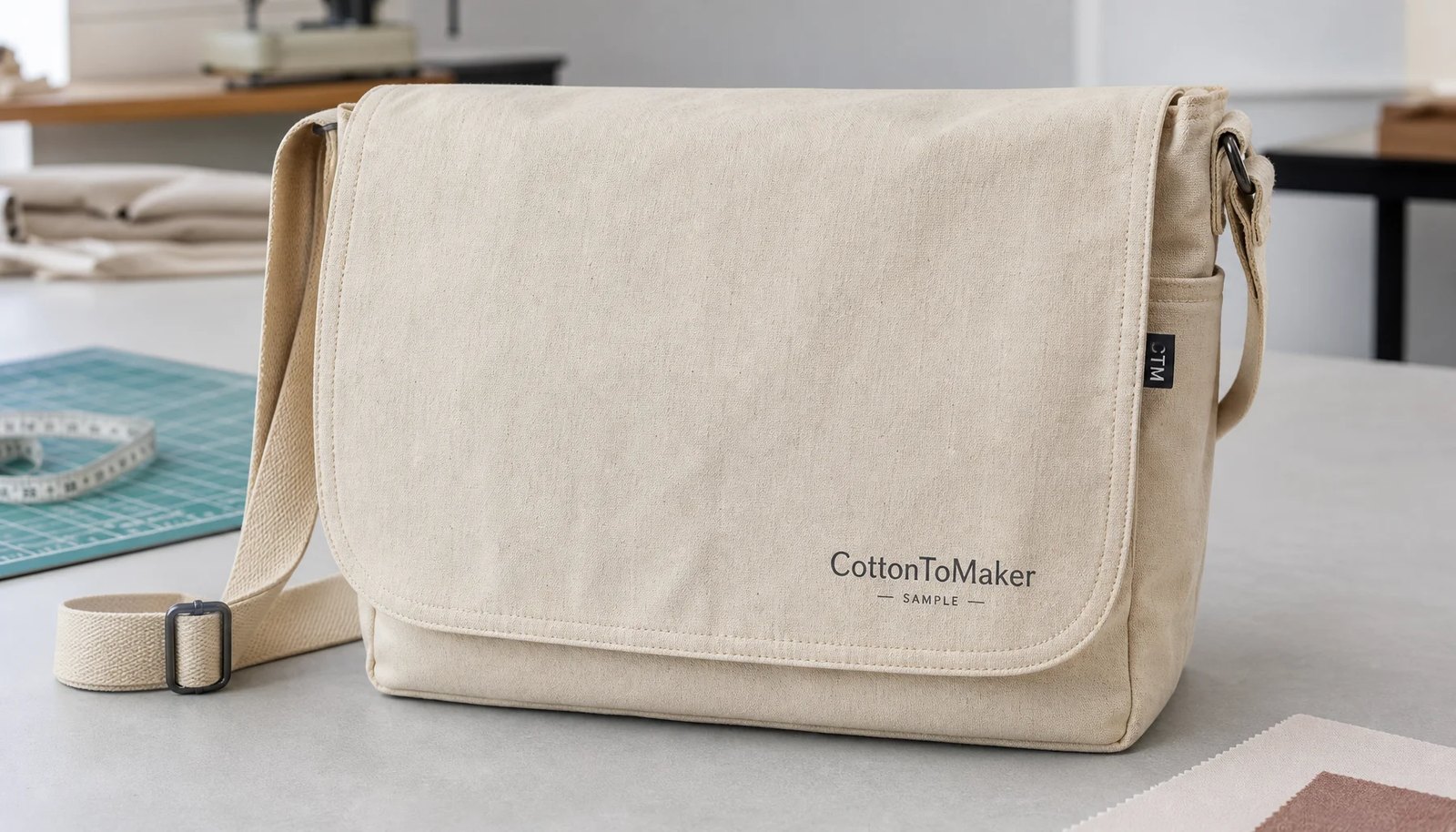
Start With the Bookstore Use Case
A university bookstore messenger bag is not the same purchase as a conference giveaway tote. Students may use it for notebooks, a tablet, a water bottle, headphones, and campus merchandise. Alumni buyers may judge it more like lifestyle retail. Before requesting prices, define whether the bag is a resale item, orientation kit item, department merchandise, or seasonal bookstore promotion.
This decision controls almost every factory choice: canvas weight, strap quality, closure type, print method, packaging, and acceptable unit price. If the RFQ only says canvas messenger bag with logo, suppliers will quote different constructions and the lowest price will often hide a lighter fabric, narrow strap, thinner hardware, or bulk packing that does not work for retail receiving.
- For resale: prioritize shape, print finish, strap comfort, barcode packing, and lower visible defect rate.
- For orientation gifts: prioritize cost control, reliable delivery date, bulk carton efficiency, and basic durability.
- For alumni merchandise: prioritize heavier canvas, clean logo execution, better hardware, and premium hangtag options.
- For department orders: consolidate the bag body and vary the logo to reduce fabric MOQ and sample cycles.
Choose Canvas Weight by Load and Retail Price
Canvas messenger bags are usually quoted by ounce weight or GSM, but buyers should request both. A 10 oz cotton canvas is commonly around 300-340 GSM, 12 oz is often around 380-410 GSM, and 14 oz can run around 450-480 GSM depending on yarn and finishing. These figures are practical ranges, not universal standards, so the approved fabric swatch should become part of the production file.
For university bookstores, 12 oz canvas is often the safe middle ground. It has enough body to hold the messenger shape, prints well, and does not push freight weight as high as premium canvas. A 10 oz bag can work for lightweight promotions if the strap and stress points are reinforced. A 14 oz bag looks more substantial on the shelf but needs a retail price that can absorb higher fabric cost, heavier cartons, and potentially slower sewing.
- Request fabric weight in oz and GSM on the quotation line, not buried in email notes.
- Use 12 oz canvas when the bag must feel retail-ready but still remain cost controlled.
- Use 10 oz only when the buyer accepts a softer, less structured messenger profile.
- Use 14 oz for premium bookstore programs where the selling price supports the added weight.
Lock the Construction Before Comparing Prices
Two messenger bags can share the same fabric weight and still have very different cost and durability. Finished size, gusset depth, flap length, lining, pockets, strap width, metal fittings, and sewing reinforcement all change the price. A quote without construction details is not a quote the procurement team can compare fairly.
A practical bookstore size should be based on what the customer will carry. If a laptop is expected, the RFQ should define the target laptop size and whether padding is required. If the bag is mainly for notebooks and campus merchandise, a lighter unlined construction may be enough. The more specific the construction drawing, the less room there is for suppliers to reduce cost in invisible areas.
- State finished body size such as width x height x gusset, plus acceptable measurement tolerance.
- Define flap coverage so the bag does not look short or expose contents when filled.
- Specify strap width, adjustable range, and whether the strap is cotton webbing or polyester webbing.
- Identify reinforcement at strap ends, side seams, bottom corners, and closure positions.
- List any inner pocket, zipper pocket, pen slot, laptop sleeve, or label requirement separately.
Match Print Method to Artwork and Canvas Color
Most campus bookstore artwork is a school logo, mascot, department mark, or short slogan. For solid-color artwork on canvas, screen printing is usually the most practical method because it gives strong coverage and stable cost at wholesale quantities. On natural canvas, dark ink usually prints cleanly. On navy, black, forest green, or maroon canvas, the factory may need an underbase or thicker ink system to keep the logo from looking dull.
Heat transfer can handle gradients, small text, and multi-color artwork, but the hand feel and edge finish must be approved on real canvas. Embroidery gives a premium look but can pull or pucker lighter canvas if the backing and stitch density are wrong. Woven labels are useful for subtle bookstore branding or side labels, but they do not replace a large front graphic when shelf visibility matters.
- Use screen print for one to three solid colors and repeat campus logo programs.
- Use heat transfer when the logo has gradients, fine outlines, or too many print colors.
- Use embroidery only after checking puckering, backing, and stitch density on the chosen GSM.
- Use woven labels for small CTM-style side branding, department tags, or premium trim details.
- Approve print position in centimeters from bag edges, not by visual description alone.
Understand MOQ Logic Before Splitting Designs
Wholesale canvas messenger bag MOQ is not only one number. It can apply by fabric color, bag size, print design, hardware color, packing method, or shipment schedule. A university bookstore may want one body style with different logos for the main store, athletics, alumni office, and departments. That is possible, but the RFQ must separate the base bag MOQ from the decoration split.
A common cost mistake is requesting many small design splits while expecting one large-quantity price. The factory still has screen setup, ink mixing, print alignment, production line changeover, sorting, and carton labeling work for each design. Buyers can protect margin by standardizing the blank bag and limiting variables. If the same natural canvas body, same strap, and same hardware are used, smaller logo splits become easier to price and control.
- Best cost control: one fabric color, one bag size, one strap color, several print designs.
- Higher cost risk: multiple dyed canvas colors with separate department logos and separate packing SKUs.
- Sampling risk: each print design may need its own approval if logo size, color, or placement changes.
- Inventory risk: bookstore demand may not be equal across departments, so avoid overproducing slow designs.
Build a Quote Sheet That Shows Real Cost Drivers
A clean RFQ should force suppliers to quote the same product, not their own interpretation of a messenger bag. Procurement teams should request line-item clarity for fabric, decoration, hardware, packing, sample charges, mold or screen charges if applicable, and freight-ready carton data. Without packed carton dimensions and gross weight, the buyer cannot estimate landed cost with confidence.
The lowest unit price can become expensive if it comes with oversized cartons, weak packing, high defect risk, or unclear decoration costs. For university bookstores, landed cost matters because retail margin is often fixed before the PO is placed. A useful quote sheet lets the buyer compare unit price and operational cost together.
- Include unit price by quantity tier, such as 500, 1,000, 2,500, and 5,000 pieces if relevant.
- Separate blank bag cost from print cost when multiple logo designs are planned.
- Request setup charges for screen, heat transfer film, woven label, embroidery tape, or cutting mold if used.
- Require carton quantity, carton size, gross weight, net weight, and total CBM.
- Ask for EXW and FOB terms if the importer wants to compare supplier handover cost accurately.
Use Samples to Prevent Production Drift
A sample is not only a sales photo. For canvas messenger bags, the sample should prove fabric body, flap shape, strap comfort, closure position, print method, and packing fold. The best approval path is a blank construction sample first if the design is new, followed by a printed pre-production sample using the correct bulk fabric and final decoration process.
Bookstore buyers should avoid approving a sample made from substitute fabric unless the supplier clearly labels it as a fit sample only. A substitute sample can be useful for checking size and structure, but it cannot approve print absorption, fabric color, shrinkage, or final hand feel. Once the pre-production sample is signed, one piece should stay with the buyer and one sealed piece should stay with the factory.
- Measure the sample flat and filled to see whether the flap still closes correctly.
- Load the sample with realistic contents for at least several minutes to test strap slip and comfort.
- Rub the printed area with a dry white cloth and a slightly damp cloth to screen for weak curing.
- Inspect the back side of embroidery for rough backing that may catch notebooks or tablets.
- Photograph the approved sample with measurement points and print placement for the production file.
Set Practical QC Thresholds for Bookstore Retail
Canvas is a natural textile, so buyers should define what is acceptable before inspection. Small yarn variations and minor slubs may be normal, especially on natural canvas. Large oil marks, obvious shade panels, broken stitches, crooked flaps, weak straps, and off-position logos are not acceptable for retail. The inspection standard should separate natural fabric character from defects that affect saleability.
For wholesale orders, use a written inspection checklist tied to the approved sample. Critical defects include unsafe metal edges, broken strap attachment, missing closures, wrong logo, or wrong SKU packing. Major defects include visible stains, poor print opacity, misaligned flap, loose hardware, and open seams. Minor defects may include small thread ends or very slight fabric specks outside the main logo area.
- Strap pull: no tearing, stitch failure, or slider slipping under agreed test load.
- Stitching: no skipped stitches at strap ends, flap corners, closure tabs, or side seams.
- Print: position tolerance commonly within plus or minus 5 mm when artwork and fixture allow.
- Color: compare fabric and print to approved swatch under consistent light, not mixed warehouse lighting.
- Retail appearance: front flap and logo area should be clean enough for direct shelf display.
Plan Packing for Campus Receiving
Packing is often treated as an afterthought, but it affects labor at the bookstore. Retail teams need to identify SKUs quickly, receive cartons cleanly, and place products on shelves without steaming or reshaping every bag. Flat packing usually works better than heavy compression. If the messenger bag has a structured flap or thick strap hardware, the carton quantity should not force deep creases into the front panel.
The RFQ should specify whether each bag needs a polybag, recycled polybag, paper band, hangtag, barcode sticker, or no individual packaging. Sustainability preferences vary by university, so this needs to be decided before costing. If the school requires plastic reduction, a paper belly band with a master carton liner may be acceptable, but it should still protect the print area from abrasion during transit.
- Mark cartons with PO number, SKU, color, logo design, quantity, gross weight, and carton sequence.
- Pack one SKU per carton when possible; if mixed cartons are necessary, require a clear inner packing list.
- Place barcode stickers where bookstore staff can scan without opening or unfolding the whole bag.
- Avoid tight folding across the printed logo, magnetic snap, or embroidered area.
- Request carton drop-resistant export cartons if goods move through multiple warehouses before campus delivery.
Protect the Lead Time Around Approval Gates
Canvas messenger bag lead time is controlled less by sewing time and more by approval timing, fabric availability, print setup, and packing complexity. A realistic schedule starts with artwork confirmation, then sample making, sample review, bulk material booking, cutting, printing, sewing, trimming, final inspection, packing, and shipment handover. If the bookstore needs goods before orientation week or homecoming, approval delays are usually the biggest risk.
Buyers should not treat a supplier's production lead time as the total project lead time. If the quotation says production takes 30 days after sample approval, that does not include artwork revision, sample courier time, buyer review, deposit processing, inspection scheduling, or vessel cutoff. A practical procurement calendar adds buffers at every approval point.
- Artwork review: allow time for vector cleanup, Pantone confirmation, and print size approval.
- Sample stage: separate construction approval from final printed sample approval when the bag is new.
- Bulk fabric: dyed canvas, custom webbing, or special hardware can extend the schedule beyond standard stock.
- Inspection: schedule final inspection before balance payment or shipment release.
- Seasonal risk: orientation, graduation, and holiday retail windows need earlier PO release than normal replenishment.
Specification comparison for buyers
| Spec decision | Recommended option | When it fits | Buyer risk to check |
|---|---|---|---|
| Main canvas fabric | 12 oz cotton canvas, about 380-410 GSM, pre-shrunk if washing is required | Good balance for campus retail, bookstore merch, orientation gifts, and daily student carry | Lower GSM may look acceptable in photos but collapse after packing a laptop, books, or water bottle |
| Economy fabric option | 10 oz cotton canvas, about 300-340 GSM, with reinforced stress points | Works for price-sensitive promotions, short-term events, or lightweight bookstore bundles | Handle anchoring and flap shape need stricter checking because thinner fabric shows distortion faster |
| Premium fabric option | 14 oz cotton canvas, about 450-480 GSM, with heavier webbing strap | Fits alumni retail, department merchandise, and higher ticket campus store products | Higher unit price and freight weight can reduce margin if retail price is already fixed |
| Bag closure | Metal snap, magnetic snap, or hook-and-loop depending on price point and noise tolerance | Magnetic snap gives cleaner retail appearance; hook-and-loop is cheaper and secure for casual use | Weak magnets, misaligned snaps, or noisy hook-and-loop can cause returns even when fabric is correct |
| Logo decoration | Screen print for solid campus logos; heat transfer for fine gradients; woven label for premium small branding | Screen print is usually best for one to three solid colors on canvas messenger bags | Ink opacity, registration, and curing must be approved on the actual canvas color, not only on paper artwork |
| Shoulder strap | 38 mm or 40 mm cotton webbing with adjustable slider and box stitching | Comfortable for student use and stable enough for bookstore retail display | Narrow straps cut into the shoulder; weak sliders slip when the bag is loaded |
| Retail packing | One bag in a recycled polybag or paper belly band, then flat packed by color and SKU | Best for bookstore receiving, shelf stocking, and barcode control | Over-compressed cartons create flap creases; mixed SKUs without carton marks slow campus receiving |
| MOQ planning | Consolidate fabric color and size, then split print designs by department or campus unit | Helps reach factory efficiency while giving the bookstore merchandising variety | Too many small color and logo splits raise setup cost, sampling rounds, and delivery risk |
Buyer checklist before sampling
- Define the retail use first: daily student carry, orientation gift, alumni merchandise, or department resale.
- Specify finished bag size, flap depth, gusset width, strap width, and whether a laptop or notebook must fit.
- List canvas weight in oz and GSM, not only the word canvas.
- State whether the canvas must be natural, dyed, washed, organic, recycled, or certified under a specific program.
- Send logo artwork as vector files and include Pantone references for each print color.
- Choose the print method based on artwork and fabric color before comparing quotes.
- Require a physical pre-production sample using bulk fabric, correct webbing, correct hardware, and final print method.
- Set acceptance criteria for seam strength, strap pull, print opacity, color tolerance, and finished measurements.
- Confirm retail packing method, carton quantity, carton marks, barcode placement, and SKU separation.
- Ask suppliers to quote EXW, FOB, and packed carton data so freight and landed cost can be compared properly.
Factory quote questions to send
- What exact canvas weight will be used in oz and GSM, and is it greige, dyed, washed, or pre-shrunk?
- What is the finished bag size, flap size, gusset width, and measurement tolerance after sewing?
- What webbing width and GSM will be used for the shoulder strap, and what hardware grade is included?
- Which print method is quoted, how many colors are included, and what is the maximum printable area on the flap?
- Is the quoted price based on existing fabric stock, newly dyed fabric, or reserved bulk fabric?
- What MOQ applies by fabric color, by bag size, by print design, and by packing SKU?
- What sample cost and sample lead time apply for artwork proof, blank sample, and printed pre-production sample?
- What quality tests are performed for strap strength, seam security, print adhesion, and metal hardware function?
- How many pieces fit per export carton, what are the carton dimensions, and what are the estimated gross and net weights?
- What is the production lead time after sample approval and deposit, and what events can extend the schedule?
Quality-control points to confirm
- Finished dimensions within agreed tolerance, commonly plus or minus 1 cm for body size and plus or minus 0.5 cm for flap alignment.
- Canvas weight verified against approved fabric swatch and purchase specification, not only supplier verbal confirmation.
- No broken yarns, oil stains, large slubs in visible logo areas, or shade mismatch between bag body and flap.
- Strap attachment reinforced with box stitch or bar tack, with no skipped stitches at load-bearing points.
- Magnetic snaps, metal snaps, sliders, and buckles aligned and functioning without sharp edges or loose plating.
- Print color, position, opacity, curing, and rub resistance matching the signed sample.
- Flap closes evenly without twisting, bubbling, or pulling caused by uneven tension during sewing.
- Inner seams trimmed cleanly with no loose threads that can catch notebooks, laptops, or retail inserts.
- Cartons packed flat enough to avoid permanent creasing, with SKU, color, quantity, and PO number clearly marked.
- Final random inspection performed before shipment using the approved sample and written AQL or buyer acceptance criteria.