Start With The Event Load
A trade show messenger bag is a carrying system before it is a branded giveaway. The right wholesale spec depends on what the bag must hold, how long attendees will carry it, and whether it will be used once at registration or repeatedly by booth staff. A photo reference can help with style, but it should not be the starting point for procurement. The first line of the brief should name the use case and load: for example, a canvas messenger bag for a 3 kg event kit with an A4 catalog, notebook, charger pouch, and sponsor inserts.
This is where many sourcing problems begin. A light registration bag, a staff work bag, and a distributor sample kit can look similar in a product gallery but require different fabric, gusset depth, strap reinforcement, closure, packing, and QC. If the event team will preload bags, send them to several booths, or store them in venue back rooms, include those details in the RFQ. They affect carton size, count accuracy, logo rub risk, and how easily staff can handle the shipment.
- Match the bag to the heaviest real contents, not the lightest marketing mockup.
- Use separate specs for attendee giveaways, staff bags, VIP kits, and sample-heavy distributor bags.
- Record the largest insert size, expected load, and whether bags will be preloaded.
- Treat venue handling, booth storage, and multi-site delivery as part of the product requirement.
Specify Canvas Without Guesswork
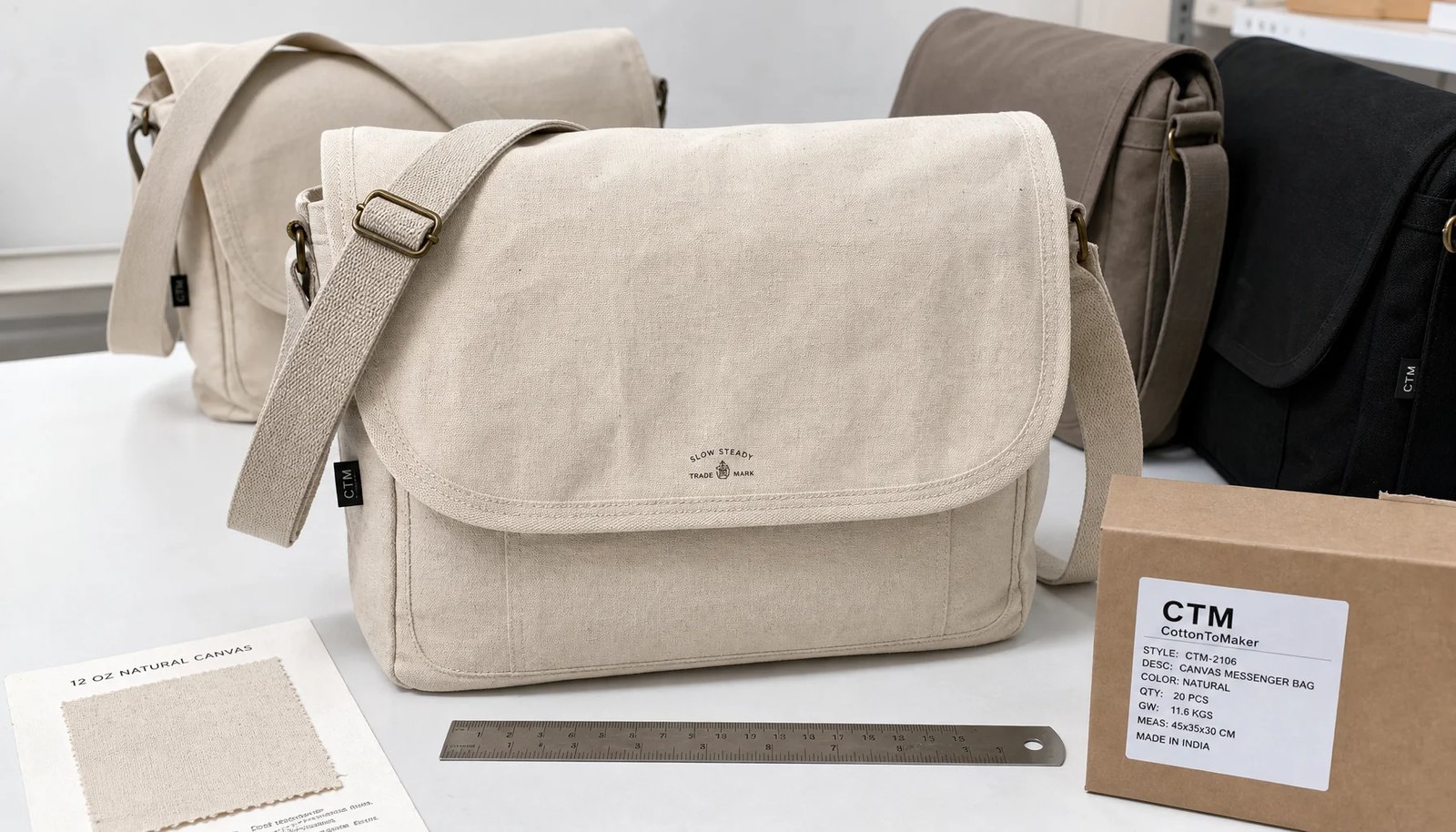
Canvas is often quoted by ounce rating, but ounce alone is not enough for a reliable comparison. Ask for both oz and GSM, then review a swatch. Suppliers may use different commercial shorthand for canvas weight, and two fabrics with the same quoted ounce can feel different because of weave, yarn, finish, or washing. For many canvas messenger bags wholesale buying programs, 12 oz to 16 oz is the practical middle range: strong enough for catalogs and tablets, but not so heavy that freight and sewing complexity rise sharply.
Lighter 10 oz to 12 oz canvas can work for high-volume giveaways with light inserts. It becomes less suitable when the bag carries binders, bottles, boxed samples, or laptops. Heavier 18 oz+ canvas can feel more premium and stronger, but it increases carton weight and may make the flap stiff after printing. Finish matters too. Natural canvas has visible flecks and shade movement; bleached canvas prints brighter; dyed canvas needs shade and rub testing. If recycled, organic, or water-resistant claims will be used in event materials, request documentation rather than relying on a verbal claim.
- Request oz, GSM, weave type, finish, shrinkage range, and fabric width in the same quote.
- Approve the acceptable level of seed flecks, slubs, knots, and shade variation for natural canvas.
- Check dark or bright dyed canvas for dry rub and wet rub against clothing and paper inserts.
- Judge stiffness, fold recovery, and print behavior, not thickness alone.
- Ask whether the fabric is stock, custom dyed, washed, coated, laminated, or untreated.
Define The Build Before Pricing
Two factories can quote the same finished size and still be pricing different bags. One quote may include a real gusset, reinforced strap joins, lined or bound internal seams, a proper pocket, and a stable flap. Another may price a flat envelope body with a narrow strap and minimal reinforcement. Procurement teams get cleaner comparisons when every supplier prices the same construction instead of filling in missing details independently.
A practical exhibitor baseline is a rectangular body, 6-10 cm gusset, full or three-quarter flap, adjustable shoulder strap, reinforced strap joins, and a closure suited to the contents. Define width x height x gusset as finished sewn dimensions, not cutting dimensions. List flap length separately because a short flap can expose contents and reduce logo visibility. If the bag must carry paper-heavy kits, bottom corners and strap anchors deserve special attention. If the bag is for staff or VIP use, pocket layout, comfort, and inside finish become more important than the lowest possible unit price.
- State finished sewn dimensions and measurement tolerances.
- Define flap length, coverage, strap width, and strap adjustment range.
- Base gusset depth on the thickest item, not only on catalog height and width.
- Require reinforcement at strap joins, bottom corners, flap corners, and closure points.
- Clarify seam finish because it affects both durability and perceived quality.
- Use the same technical drawing for every supplier quote.
Match Branding To The Material
The front flap is usually the strongest branding area because it remains visible when the bag is worn and looks orderly when bags are stacked. Screen printing is often the most efficient method for simple logos, sponsor marks, and bold event graphics. The RFQ should include vector artwork, Pantone reference, print size, and placement measured from fixed edges or seams. On textured canvas, small type and fine lines need extra review because they can fill in or look uneven.
Heat transfer is useful for gradients, photographic artwork, or high color counts, but it must be tested for hand feel, folding, and adhesion. Embroidery works best for small premium marks or patches; large filled embroidery can pucker lighter canvas and raise cost quickly. Woven labels and patches are useful for retail-style programs or repeat events because they keep the branding consistent even when natural canvas shade varies slightly between lots. Whatever method is chosen, approve the logo on the actual production fabric, not only on a digital proof.
- Use screen print for large solid logos and simple sponsor branding.
- Use heat transfer for gradients or multi-color artwork, then test folding and adhesion.
- Use embroidery for small marks rather than large filled logo areas.
- Use woven labels or patches for a cleaner retail-style finish.
- Set logo position tolerances before bulk decoration starts.
- Run rub, bend, and stacking checks after print curing.
Build A Quote You Can Compare
A useful RFQ separates the base bag from the upgrades. Otherwise, suppliers may quote different fabric grades, strap widths, hardware, closures, labels, pockets, decoration methods, and packing assumptions. That makes the lowest price hard to trust because it may be attached to a weaker product. For a focused canvas messenger bags wholesale buying checklist for trade show exhibitors, the RFQ should force each bidder to disclose the same cost drivers.
A clear base spec might be: 12 oz natural canvas, finished size 36 x 28 x 8 cm, flap length 24 cm, adjustable cotton webbing strap, hook-and-loop closure, one inner slip pocket, one-color screen print on flap, tissue separation, and bulk packing. Optional lines can price 16 oz canvas, dyed fabric, magnetic snap, zipper pocket, woven side label, patch, individual packing, or stronger export cartons. Ask for price breaks at realistic quantities and require carton data early. Unit price alone does not show landed cost when messenger bags are bulky.
- Request price breaks at realistic levels such as 500, 1000, 3000, and 5000 pcs.
- Itemize setup charges for screens, transfers, embroidery digitizing, labels, molds, and packing.
- Compare EXW, FOB, CIF, or delivered pricing only after freight responsibility is clear.
- Ask which components are stock and which require separate purchase minimums.
- Require carton dimensions, gross weight, net weight, units per carton, and total CBM.
- Compare sample support, inspection cooperation, payment terms, and lead time together.
Treat MOQ As Components
MOQ is not one simple number. It can be driven by sewing capacity, fabric purchase, dye-lot size, strap webbing, metal hardware, zipper pulls, woven labels, patches, printed packaging, and carton planning. A stock natural canvas messenger bag with one-color printing may support a lower minimum than a dyed retail-style bag with custom trim. When a supplier offers a very low MOQ, ask which parts are stock and which parts have been simplified.
Frame MOQ carefully with internal teams. A simple stock program may be possible at lower quantities, while dyed fabric, custom straps, special hardware, labels, and individual packing can push the minimum higher depending on region, supplier type, and customization level. Trade show buyers should also order a buffer for staff, sponsors, speakers, press, replacement cartons, and late registrations. For repeat programs, ask whether the factory can retain screens, label artwork, hardware references, and an approved sample for future reorders.
- Ask for the MOQ of the full bag and each custom component separately.
- Check whether low MOQ depends on stock fabric, stock trim, limited colors, or bulk-only packing.
- Request price breaks near the likely purchase quantity before budget approval.
- Confirm reorder support for artwork, screens, labels, trims, and approval samples.
- Add a practical quantity buffer for event staff, sponsor requests, replacements, and late adds.
Approve Samples Like A Contract
A sample is only useful when it represents the production order. Buyers sometimes approve a clean-looking sample made with temporary fabric, substitute hardware, or a different print method, then expect the bulk goods to match it exactly. The sample record should state what is final and what is temporary. Ideally, the pre-production sample uses the actual bulk fabric, final decoration, final strap, final hardware, final closure, final label, and intended packing.
Review the sample as it will be used. Load it with the real event contents, wear it, open and close it repeatedly, adjust the strap, and check whether the flap lies flat when full. Measure width, height, gusset, flap length, pocket depth, strap range, logo placement, and closure position. Sample feedback should be specific: move logo 20 mm higher, widen strap to 38 mm, deepen inner pocket to 18 cm, change strap joins to box-X stitching, or align snap under a 3 kg load. Keep one approved sample with the buyer and one with the factory for QC reference.
- Measure the relaxed sample, not only the pressed-flat sample photo.
- Compare shade, hand feel, and texture against the approved swatch under consistent light.
- Rub the print with a white cloth and bend the flap to check transfer and cracking.
- Load the sample with actual kit contents and inspect stress points.
- Write every change before bulk cutting, dyeing, or decoration starts.
- Retain a signed approval sample for final inspection.
Plan Packing For The Venue
Packing affects product condition, freight cost, count accuracy, and venue labor. A trade show team may hand bags out one by one, preload them with inserts, ship cartons to regional booths, or store stock behind a stand. A carton plan that is convenient for the factory may be awkward for event staff. Packing should be decided before production, not when goods are already sewn.
Individual packing keeps bags cleaner and can make multi-destination distribution easier, but it adds material, volume, and unpacking labor. Bulk packing reduces cost and packaging waste, but printed flaps may rub unless tissue or paper separation is used. Canvas can also absorb moisture and odor, so humid transit and long storage deserve attention. Many buyers prefer master cartons that stay under a practical handling weight, often around 15-18 kg gross depending on local warehouse rules and staff capacity.
- Use tissue or paper separation when printed flaps touch in bulk packing.
- Avoid compression that causes permanent flap creases or hardware marks.
- Request units per carton, carton size, gross weight, net weight, and total CBM before freight booking.
- Add event name, PO number, SKU, color, quantity, carton sequence, destination, and booth number to carton marks when relevant.
- Use carton-level packing lists for multi-booth or multi-city programs.
- Consider desiccant or stronger export cartons for humid routes and long transit.
Set QC Before Production
Quality control should be defined before bulk cutting starts. For canvas messenger bags, inspection should cover fabric consistency, finished dimensions, sewing strength, print quality, strap security, hardware function, cleanliness, packing accuracy, and carton marks. Put the standards in the purchase order or inspection brief so the factory and inspector work from the same expectations.
Defect classification makes decisions faster. Critical defects include broken strap joints, sharp hardware, severe mildew odor, wrong logo, or construction that cannot carry the agreed load. Major defects include open seams, heavy stains, print cracking, wrong finished size outside tolerance, missing pocket, wrong closure, or obvious mixed shade panels. Minor defects include small thread tails, slight shade movement within the approved range, or natural slubs accepted in the sample. Inspection should include handling: open pockets, adjust straps, pull stress points, bend printed flaps, and compare carton labels to the PO.
- Check fabric weight, shade, odor, weave tightness, and surface cleanliness against the approved sample.
- Measure finished dimensions from multiple cartons to catch shrinkage or sewing drift.
- Inspect strap anchors, bottom corners, flap corners, closure points, and pocket openings with practical pull checks.
- Bend, rub, and stack-test printed areas after curing.
- Open the bag and inspect internal seams, labels, zipper ends, and thread trimming.
- Verify carton count, carton marks, SKU separation, and shipping documents before release.
Protect The Trade Show Timeline
Trade show deadlines leave little room for vague schedules. Work backward from the date the bags must be at the venue, warehouse, or kitting center. Include artwork approval, sample making, sample shipping, revision time, deposit confirmation, material purchase, production queue, inspection, freight booking, customs clearance, and local delivery. A well-made bag that arrives after the show has no procurement value.
Custom dyed fabric, special hardware, woven labels, zipper pulls, individual packing, and retail-style finishing can all add time because outside suppliers may be involved. If the schedule is already tight, simplify the spec before relying on air freight; messenger bags are bulky, and rushing freight can erase the savings from a low unit price. Assign owners for artwork approval, sample sign-off, carton marks, inspection release, and balance payment. Many delays come from internal decision gaps rather than sewing time.
- Lock artwork before sampling so decoration files do not restart later.
- Approve fabric, strap, hardware, closure, and labels early because they often control production start.
- Schedule final inspection before balance payment and before goods leave the factory.
- Book freight using confirmed carton data, not rough estimates.
- Build buffer for customs exams, holiday closures, port congestion, and venue receiving windows.
- Simplify materials, trims, packing, or decoration first when the calendar is tight.
Specification comparison for buyers
| Buyer scenario | Practical spec target | Why it works | Tradeoff to watch |
|---|---|---|---|
| Budget attendee giveaway | 10 oz to 12 oz canvas, one-color screen print, basic shoulder strap, simple flap, bulk packing | Keeps cost controlled for high-volume registration bags carrying light handouts | Less structure and lower perceived value; not ideal for heavy catalogs, bottles, or sample kits |
| Standard exhibitor handout | 12 oz to 16 oz canvas, 6-10 cm gusset, adjustable strap, flap closure, one inner slip pocket | Balances cost, usability, and durability for A4 materials, notebooks, tablets, and sponsor inserts | Needs clear size and packing controls so the bag stacks cleanly and does not crease the print |
| Booth staff bag | 14 oz to 18 oz canvas, reinforced strap joins, secure closure, pocket layout for phone, badge, charger, and documents | Supports repeated daily use and helps staff keep event materials organized | Higher unit cost and more sample review time for comfort, closure alignment, and pocket placement |
| VIP, press, or partner kit | 14 oz to 18 oz cleaner canvas, woven label or patch, metal adjuster, magnetic snap or zipper, better inside finish | Feels more premium and can remain useful after the show instead of looking disposable | Custom trims, labels, dyed fabric, and individual packing may raise MOQ and lead time |
| Product sample or distributor kit | 16 oz+ canvas, deeper gusset, reinforced bottom corners, load-tested strap anchors, stronger cartons | Better suited to binders, boxed samples, catalogs, and multi-item kits | Freight weight, carton volume, and stress-point QC become more important |
| Multi-city event program | Stock canvas color, repeatable logo method, carton-level packing list, destination-specific carton marks | Makes distribution easier when the same bag ships to several venues or regional teams | Individual packing or carton sorting may add labor and packaging cost |
| Retail-style merchandise | Heavier canvas, cleaner weave, lining or bound seams, woven label, zipper pocket, barcode or hangtag if needed | Works when the bag will be sold, gifted to VIPs, or used beyond the event | Requires tighter finishing standards and more detailed pre-production approval |
| Fast-turn event order | Stock fabric, stock strap, stock hardware, one-color print, simple bulk packing | Reduces sourcing variables when the event date is close | Design flexibility is limited; rushing a complex spec can create cost and QC risk |
Buyer checklist before sampling
- Define the exact use case: attendee giveaway, registration bag, staff kit, VIP gift, press kit, distributor sample bag, or merchandise item.
- List the real contents by size and weight, including catalog format, tablet model, notebook, bottle, sample box, charger pouch, badge holder, and insert count.
- Set a load target in kilograms or pounds and match fabric weight, strap width, reinforcement, gusset depth, and closure style to that target.
- Specify finished dimensions as width x height x gusset, plus flap length, pocket size, strap length range, and measurement tolerances.
- State the canvas type: natural, bleached, dyed, washed, recycled, organic, blended, coated, laminated, or water-resistant finished.
- Request both oz and GSM, and ask how the supplier defines the canvas ounce rating.
- Choose the logo method based on artwork and use: screen print for simple marks, heat transfer for gradients, embroidery for small premium logos, woven label or patch for a cleaner retail look.
- Set logo placement from fixed measurement points such as flap edge, side seam, or bottom edge, with tolerance for position, size, skew, and color.
- Confirm closure type: none, hook-and-loop, magnetic snap, zipper, tuck lock, buckle, or side release buckle.
- Define pocket requirements by function, including badge, phone, document, tablet, or charger storage.
Factory quote questions to send
- What is the exact fabric weight in oz and GSM, and is the rating based on square yard, square meter conversion, or internal factory shorthand?
- Is the quoted canvas greige, natural, bleached, dyed, washed, recycled, organic, blended, laminated, coated, or water-resistant finished?
- Can you provide a technical drawing showing finished width, height, gusset, flap length, strap length range, pocket placement, closure position, seam allowance, and tolerances?
- Is the quoted size the finished sewn size after shrinkage and seam allowance, or the cutting size before sewing? Where will width, height, and gusset be measured?
- What load is this construction intended to carry, and what reinforcement will be used at strap joins, bottom corners, flap corners, closure points, and pocket openings?
- Which decoration method is included, how many colors are included, what is the maximum decoration area, what artwork format is required, and what setup charges apply?
- How will logo color be matched: Pantone coated, Pantone uncoated, physical swatch, previous approved sample, or digital proof? What variation is realistic on this canvas shade?
- Will the pre-production sample use actual bulk fabric, actual strap, final hardware, final closure, final label, final decoration method, and intended packing? If not, which parts are temporary?
- What MOQ applies separately to the full bag, dyed fabric, custom strap color, hardware, zipper pull, magnetic snap, woven label, patch, printed packaging, and individual polybag?
- What stitch density, thread type, seam allowance, reinforcement method, and inside seam finish will be used on the body, flap, strap anchors, pockets, and gusset?
Quality-control points to confirm
- Finished dimensions stay within the agreed tolerance for width, height, gusset, flap length, strap length, and pocket placement.
- Fabric weight, weave, hand feel, and shade match the approved swatch or pre-production sample, with no unexpected thin panels or loose weave.
- Natural canvas variation stays within the approved range for slubs, seed flecks, and shade movement, while stains, mildew odor, water marks, and oil marks are rejected.
- Dyed fabric panels match across body, flap, strap, and pocket, with no obvious lot mismatch unless the buyer approved that variation.
- Logo position is measured from fixed points such as the flap edge, side seam, or bottom edge, with no skew, ghosting, bleeding, cracking, or misregistration.
- Printed areas pass rub, bend, and stacking checks so the ink does not transfer, smear, or crack during packing and transit.
- Seams are clean and secure, with no skipped stitches, open seams, raw edges, broken thread clusters, or uneven seam allowance at stress points.
- Strap joins, bottom corners, flap corners, and closure points survive practical pull checks appropriate to the intended event load.
- Hardware moves smoothly and has no sharp edges, rust, plating stains, weak adjusters, loose rivets, or poor snap alignment.
- Closure alignment holds when the bag is filled with the real event contents, not only when the sample is empty.