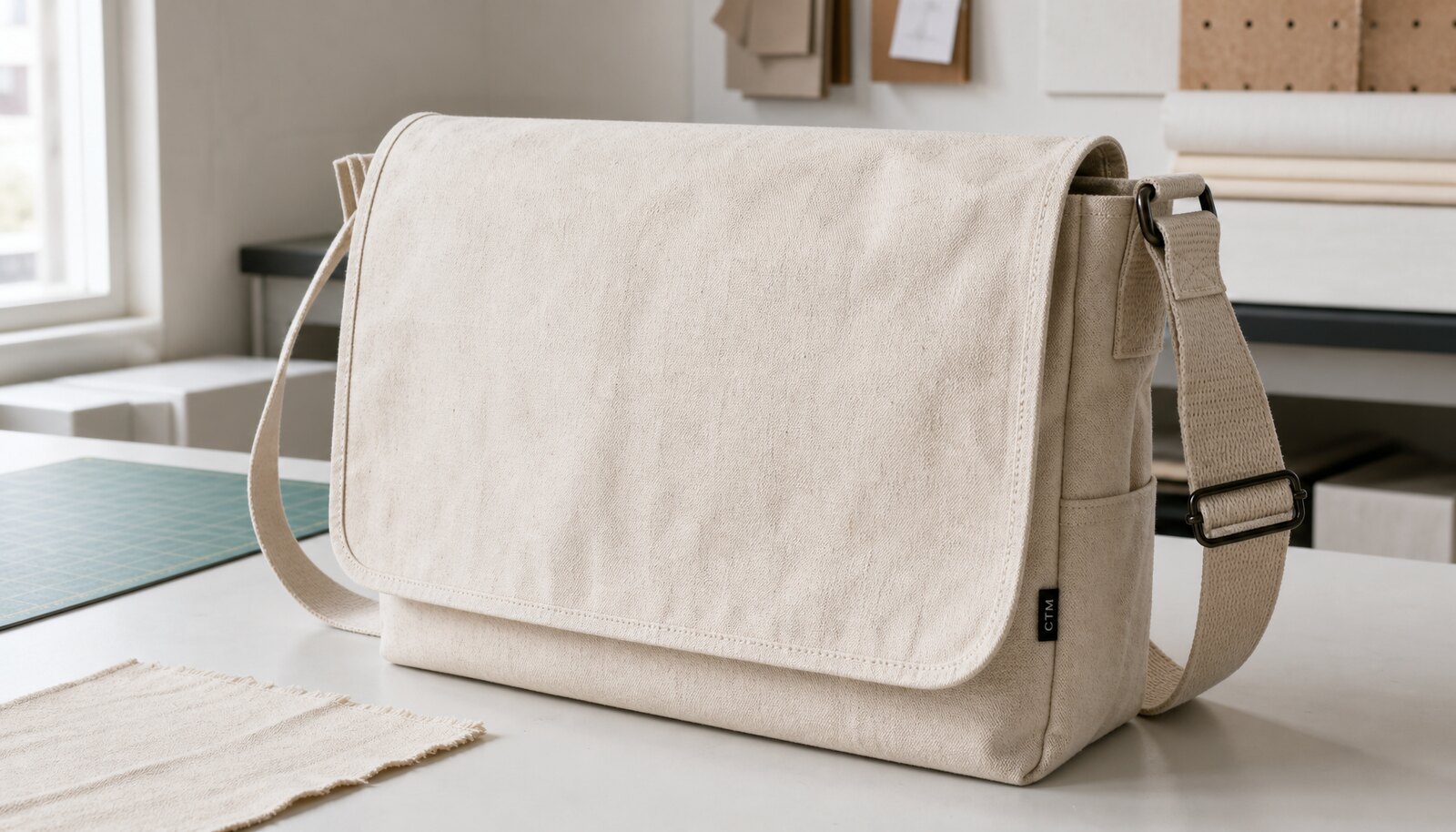
What gift shops actually need from a canvas messenger bag
Gift-shop buyers do not need the same messenger-bag spec as a commuter brand or a laptop accessories line. In retail gifting, the bag has to do three jobs at once: look attractive on a shelf or peg hook, carry enough weight for everyday customer use, and hold its shape well enough to justify the price point. That makes this category more than a fabric decision. It is a merchandising decision with a production spec attached.
The most common sourcing mistake is to buy either too lightly or too heavily. If the canvas is too soft, the bag collapses on display, wrinkles in transit, and feels inexpensive. If the construction is too heavy, the unit cost rises, the bag becomes bulky, and the retail shelf price can drift beyond what a gift-shop customer wants to pay. A strong procurement brief balances visual appeal, functional carry, and repeatable wholesale cost.
Gift shops also sell to different customer behaviors than general luggage or commuter channels. Some shoppers are buying a practical carry bag; others are buying a souvenir, a branded memory item, or a gift with a logo. That means the best spec is usually restrained, easy to merchandise, and reliable across replenishment cycles. A good wholesale buyer should care less about feature count and more about whether the product will be easy to approve, easy to receive, and easy to reorder without drift.
Before you talk to suppliers, decide what kind of shelf story the bag must tell. Is it a simple natural-canvas messenger with a small woven label? A tourist graphic on the flap? A premium-looking washed bag with cleaner stitching and a slightly heavier hand? Those choices determine the fabric, print method, and packaging, and they also determine which factories can make the bag efficiently without overpromising.
For procurement, the rule is simple: define the customer use case first, then build the bag around that use case. A gift shop does not need every possible feature. It needs a bag that looks right, feels right, and arrives with enough consistency that the same SKU can be reordered later without a second round of guesswork.
- Prioritize shelf appeal, not just carry capacity.
- Keep the silhouette simple enough to hang cleanly and photograph well.
- Treat print, strap, and closure choices as retail margin decisions, not just manufacturing details.
- Align the bag’s finish with the shop’s customer profile: souvenir, museum, boutique, or branded gift.
Start with the right body spec: fabric weight, hand feel, and structure
For most gift-shop messenger bags, a finished canvas weight in the 12–14 oz range is the most usable starting point. This weight class usually gives enough structure for retail display without turning the bag into a stiff utility item. If you are sourcing a souvenir-style program or a lower-ticket retail item, 10–12 oz can work, but you should expect a softer drape and more visible wrinkling. If you are building a premium gift item or a bag that must feel substantial in hand, 14–16 oz can be appropriate, provided the pattern is not too small and the sewing line can manage the bulk.
Do not stop at the fabric weight number. Ask the supplier to define the weave density, finishing method, and whether the fabric is pre-shrunk, washed, or coated. Two fabrics with the same ounce rating can behave very differently at sewing and during packing. A dense plain weave may look sharper than a loose weave. A washed canvas may feel softer but can distort differently if the process is not controlled. For procurement, the useful question is not only ‘What weight is it?’ but ‘How will it hold shape after sewing, folding, and carton compression?’
If the bag is meant to keep a clean retail profile, pay attention to pattern proportion as well as fabric weight. A small bag built in very heavy canvas can look overbuilt and expensive in the wrong way. A larger bag in light canvas can look floppy even if the price is attractive. The fabric should support the silhouette rather than fight it. That is why many gift-shop programs do better with a moderate-weight canvas and a straightforward construction profile rather than an aggressively thick body fabric.
In supplier conversations, ask for the exact production lot or mill source if the factory claims a repeatable stock fabric. If the supplier is switching between stock lots, you need to know how shade, softness, and shrinkage are controlled. If the fabric is custom dyed, ask what lead time is tied to greige sourcing and whether the dye lot is reserved for your PO. Those details matter when you want a reorderable wholesale program rather than a one-off sample.
A buyer-friendly fabric spec is one that can be compared across vendors without interpretation. Avoid vague language such as ‘good quality canvas’ or ‘premium cotton feel.’ Ask for measurable data, photo references, and sample swatches. The more specific the fabric brief, the less likely the first bulk shipment will arrive with a surprise hand feel, a different drape, or a display problem.
- Use finished canvas weight in GSM or oz, not marketing language alone.
- Ask whether the fabric is pre-shrunk, enzyme-washed, or coated.
- Match fabric stiffness to your display format and target price tier.
- Request stock-lot or mill-lot traceability if reorders matter.
Decide the construction details that change durability and perceived value
For a messenger bag, the visible sewing is part of the product value. Clean topstitching, straight seams, and reinforced load points signal quality immediately. Ask the factory to quote a stitch construction that includes explicit seam allowance, stitch density, and reinforcement points. In practice, that usually means bar-tacks or boxed reinforcements at the strap anchors, flap corners, and any pocket stress points. If the design includes a magnetic snap, buckle, zipper, or hook-and-loop closure, specify the reinforcement method at the hardware attachment point as well.
The goal is not to over-engineer the bag; it is to make sure the construction matches the use case. Gift-shop messenger bags are usually casual carry items, not heavy-load technical bags. But if the shop sells books, notebooks, or travel accessories, the strap anchors and side seams must still survive repeated use. Ask the supplier for stitch density in stitches per inch or stitches per centimeter, and request photos of reinforcement details on the sample. If the bag is unlined, the inside seam finish becomes more important because raw seam bulk can look messy and reduce perceived value.
A procurement-ready construction brief should also cover seam allowance consistency and needle damage risk. If a factory is sewing through dense canvas with multiple layers, it should show a stable line and a clean back side with no skipped stitches, no thread nests, and no obvious needle holes stretching beyond the seam line. This matters more on natural or undyed canvas, where any defect is easy to see.
When comparing vendors, look at how they build the stress points, not just the front view. Some factories can make a nice sample but do not maintain the same reinforcement on bulk production if they subcontract part of the sewing. Ask whether the same line, same operator group, and same reinforcement method will be used from sample to bulk. That is a more useful question than asking whether they ‘have experience’ with messenger bags.
If the bag includes a flap, measure how it closes when empty and when lightly loaded. A flap that looks neat on a table can gape, twist, or sit unevenly once the bag has shape. The best factories understand how seam thickness, flap width, and closure placement interact. Good procurement practice is to make those relationships part of the approval, not something the supplier fixes on the floor after cutting has started.
- Request stitch density and seam allowance in the quote.
- Inspect bar-tacks, strap anchors, flap corners, and hardware reinforcement.
- If unlined, pay closer attention to internal seam finish and loose threads.
- Ask whether the same production line will be used for sample and bulk.
Choose decoration based on sell-through, not just appearance
Decoration is one of the biggest drivers of both price and appearance. For a simple logo, one-color screen print is usually the most stable wholesale choice because it is repeatable, cost-efficient, and easy to approve against a reference. If the artwork is small and premium, a woven label or patch can look sharper than a large print field. Embroidery can elevate the bag, but it also adds density and can pucker lighter canvas if the backing and stitch direction are not right. Heat transfer and DTF are practical for short runs or more detailed art, but they need a clear durability expectation before you approve the method.
For gift shops, the decoration should support retail presentation first and branding second. A bag with too much print coverage can feel promotional instead of giftable. A small flap logo, side label, or restrained front graphic often gives better sell-through in museums, tourism shops, and boutique gift stores. In your RFQ, specify the placement, size in millimeters or inches, color count, and acceptable registration tolerance. If the supplier proposes a different method, make them explain how it changes rub resistance, wash behavior if relevant, and unit cost.
Do not let suppliers substitute decoration methods without a cost and quality comparison. A print that looks fine on a sample sheet can behave differently on textured canvas. Embroidery can be attractive but may require more stabilizer or a changed backing package. Woven labels are often cleaner for small marks, but they need a tidy stitch-in and a label size that does not make the bag look crowded. The best choice is the one that fits the artwork size, the retail price point, and the repeat-order risk.
If you sell into tourism or museum channels, keep in mind that the design often needs to be visually legible at a glance. This favors simple shapes, limited colors, and good contrast against natural canvas. A cluttered graphic can date quickly or disappear on a peg wall. A cleaner decoration strategy usually gives the buyer more flexibility to merchandise the bag as either a practical item or a gift.
Ask the supplier to show decoration on the actual body fabric, not only on a smooth proxy swatch. Some methods look crisp on a test card but soften, distort, or shadow on textured canvas. The more the supplier can prove on the exact fabric and exact placement, the less likely you are to discover registration or legibility issues after production is already committed.
- Use screen print for simple, repeatable artwork.
- Use woven labels or patches for a quieter premium look.
- Require a durability standard for transfer prints and embroidery backing.
- Approve decoration on the same canvas type that will be used in production.
Read MOQ and pricing as a production-setup problem
MOQ is not just a number; it is a reflection of how the factory has to run the line. The cheapest run is usually one body fabric, one strap webbing, one print version, one trim set, and one pack-out format. Every extra change adds cutting waste, setup time, and line complexity. That is why suppliers often quote a lower MOQ for a stock canvas body than for a custom-dyed color or a multi-placement decoration program. If you want a clean wholesale comparison, ask for MOQ separately by body color, print version, and trim combination.
Price comparisons also need a line-item view. A quote that looks low may omit print setup, label application, insert cards, carton marks, or sample freight. Another supplier may bundle those items into a higher unit price but deliver a more usable landed-cost number. For procurement buyers, the commercial question is simple: what will I actually pay per sellable unit after packing and logistics, and what assumptions does the supplier need to hold that price? If the quote does not show those assumptions, it is not yet ready for decision-making.
A useful way to compare offers is to ask each supplier to quote the same three scenarios: stock fabric with one-color print, custom color with one-color print, and stock fabric with premium label or patch. That immediately shows where the real cost drivers are. If one factory’s premium label version is only slightly more than the print version, it may have better internal efficiency. If another factory’s custom color version jumps sharply, you know the dye process or fabric sourcing is the bottleneck.
For gift-shop buying, MOQ should also be viewed through assortment planning. If your shop needs two body colors, two art versions, and a seasonal pack-out, the true commercial minimum may be higher than the factory’s stated MOQ for one SKU. Ask whether minimums can be shared across related SKUs or whether every change forces a separate production run. That distinction is more useful than just hearing a low headline MOQ.
The right quote lets you compare vendors on the same commercial floor. You want to see whether the supplier is strong on efficient stock material, strong on decoration, strong on packaging, or strong on all three. That makes the quote a management tool rather than a sales document.
- Ask for MOQ by color, artwork, and trim set.
- Separate setup charges from recurring unit costs.
- Compare suppliers on the same pack-out and carton assumptions.
- Request three scenario quotes to expose the true cost drivers.
Use a supplier evaluation lens that goes beyond standard RFQ prompts
A strong procurement decision depends on factory capability, not just a completed quotation form. For canvas messenger bags, the most relevant capability questions are usually about fabric control, sewing consistency, decoration control, and packing discipline. A factory that handles every step in-house may offer more consistent coordination if the order is complex. A factory that subcontracts print or finishing may still be fine, but only if the buyer understands where the handoffs occur and who owns quality at each stage.
Supplier location also matters because it affects fabric access, labor mix, and lead time risk. Factories in regions with dense textile ecosystems often have easier access to canvas, webbing, labels, and packing materials, which can shorten coordination. That does not automatically make them the best choice, but it changes how fast samples and bulk replenishment can move. A factory farther from trim suppliers may be slower on special hardware or custom labels, even if its sewing quality is good. Ask where the main material inputs come from, not just where the factory is registered.
Material tradeoffs are part of supplier differentiation. A factory that routinely works with washed or garment-dyed canvas may be better at achieving a softer retail hand and more even visual texture. A factory that mostly makes rigid promotional totes may be better at straight construction and simpler pack-outs, but less nuanced on premium finishing. Neither is universally better. The buyer’s job is to match the factory’s real process strengths to the bag’s retail role.
You can also compare factories by how they respond to deviation. Ask what happens if a fabric lot shifts in shade, a print plate needs revision, or the bag measures slightly over tolerance. Suppliers with mature systems will explain how they isolate the issue, rework the order, or hold an approval checkpoint before continuing. Vendors that answer only with ‘no problem’ often have weaker control. A procurement buyer wants an answer that shows process, not just confidence.
When regional or factory differences matter, do not frame them as stereotypes. Use them as operational questions: Which plant can keep the same canvas lot through the order? Which site can hold consistent stitching on heavier fabric? Which supplier can manage a reorder without changing the pack-out? Those questions create real differentiation and help you compare vendors on supply capability rather than brochure language.
- Ask which steps are in-house and which are subcontracted.
- Compare fabric sourcing, sewing discipline, and decoration control separately.
- Use location to assess lead time and material access, not as a quality shortcut.
- Ask how the factory handles shade shifts, size drift, or print revision during production.
Approve samples like a production reference, not a creative concept
Sampling should lock down the bag, not merely preview it. A pre-production sample must be checked against the finished size, decoration placement, seam quality, and strap length. Measure the width, height, gusset depth, flap overlap, and strap drop, then compare those values to the approved spec. If the bag changes shape too much when empty versus lightly loaded, the shelf presentation may disappoint even if the sample looks good on a worktable. The factory should know exactly which dimensions are fixed and which tolerances are acceptable before bulk cutting starts.
The practical test is simple: load the bag with a real use weight, open and close the closure several times, and inspect stress points for twisting, loose stitching, or distortion. If the bag carries a printed graphic, compare the art to a signed approval proof under both daylight and indoor light. Natural canvas can shift visually depending on the light source, so color approval should not rely on a screen alone. Once the golden sample is signed off, freeze the spec unless the change is deliberate and re-quoted.
Sampling should also reveal pack-out and finishing issues. A sample that looks clean loose on a table can still fail once folded, bagged, and carton-packed. Ask the supplier to show the exact fold and insert method that will be used in production. If the bag must be folded to fit a retail polybag or carton, check whether the fold creates a visible crease across the logo or flap. Many quality disputes start as packing problems, not sewing problems.
For any order above trial size, request a production reference sample if possible. That sample should represent the exact approved materials, print, trims, and pack-out. It is more useful than a design mockup because it shows what the bulk line is actually capable of producing. A clean approval process saves time later, especially when the order has multiple SKUs or seasonal timing pressure.
If a supplier pushes for bulk approval before all sample questions are closed, slow the process down. The cheapest correction is the one that happens before cutting. The most expensive correction is the one that requires rework after cartons have already been filled.
- Record the approved sample dimensions as the production reference.
- Test with a realistic carry load, not a random lab number.
- Freeze color, print position, and trim before bulk cutting.
- Check the fold and pack-out as part of sample approval.
Set explicit quality-control thresholds for stitching, abrasion, and colorfastness
Procurement teams get better results when they turn quality expectations into measurable checks. For stitching, ask for a clean seam with no skipped stitches, no loose thread clusters, no obvious puckering, and no weak bar-tacks at the strap anchors. For canvas messenger bags, the buyer should also ask how the supplier checks seam strength and load points. Even if a factory does not provide a full lab report, it should be able to describe its internal pull test or stress-check method for straps, flap closures, and side seams.
A practical acceptance standard for retail-grade canvas messenger bags should include three things. First, the bag should show no visible structural failure during a normal load check, such as filled handling and repeated strap tension. Second, abrasion should not produce premature thread breakage, corner wear-through, or obvious surface fuzzing in the first inspection window. Third, color should stay within the agreed shade band across the order so that different cartons do not look mismatched on the shelf. If the supplier cannot describe how it monitors these points, the buyer should treat that as a risk signal.
Abrasion and colorfastness are especially important if the bag will be handled a lot in a gift shop or sold into tourism channels where the item may be opened, tried on, and re-shelved many times. Ask whether the canvas or print has been checked for rub resistance, surface fuzzing, and color transfer. For natural or dyed canvas, color consistency across batches matters as much as the first sample. You do not need a technical lab lecture; you do need a supplier who can state the standard they use, what failure looks like, and how they prevent obvious wear in normal retail use.
Use acceptance thresholds that are concrete enough to keep the conversation focused. For example, approve only seams that show no skipped stitches, no bar-tack failure, and no visible seam opening under normal handling. For abrasion, ask the factory to show the test method it uses and where it expects the first visible wear to appear. For color, require one shade band within the approved reference, and do not accept uncontrolled shade mixing across cartons. If the factory uses internal testing instead of a named external standard, ask for the procedure, sample size, and fail criteria in writing.
This is where procurement value is created: not by demanding every possible lab certificate, but by asking for a repeatable quality logic that the supplier can actually execute. The best vendors can explain how they prevent defects, not just how they fix them after the buyer complains.
- Check stitch density, seam alignment, and bar-tack quality.
- Ask how the factory evaluates strap load and seam strength.
- Confirm rub resistance and color consistency across lots, not just on a single sample.
- Use explicit accept/reject language for structural failure, wear, and shade variation.
Specify packaging and carton pack-out as part of the product spec
Retail-ready packing should protect the bag without making it look overpacked or industrial. For many gift-shop programs, the bag should be folded flat, placed in a correctly sized polybag if required, and labeled in a way that supports store receiving. If the graphic or flap can crease, the fold method needs to be documented and approved. A bad fold can leave a visible line across the printed area, which is exactly the kind of defect that shows up after transit and creates avoidable rework.
Carton design is just as important. Ask for the master carton dimensions, units per carton, gross weight, and how much free space is left inside the carton. Too much compression can flatten the bag, distort the gusset, or press a crease into the front panel. Too little carton fill can allow movement and scuffing. For buyers shipping to chains, distributors, or DCs, also confirm outer labels, PO number format, country-of-origin marking, and whether palletization rules apply. In a wholesale purchase, carton integrity is part of product quality, not an afterthought.
A good packing spec should also define what happens after the bag is packed. Is the barcode on the polybag, on an insert card, or on the carton? Are units packed face-out or fold-out? Are tissue paper, stuffing, or silica gel included? If your receiving team is strict, these details matter because they affect unpacking speed and shelf readiness. If your shop operates lean, overcomplicated pack-out may slow receiving without adding value.
Where possible, ask the supplier to photograph the fully packed unit and the master carton before shipment. This creates a useful reference if there is a dispute later about fold direction, label placement, or quantity count. It also helps buyers compare whether different factories are quoting the same finished condition or merely the same bag pattern.
Packaging is one of the easiest places to remove ambiguity from a wholesale order. If the supplier can repeat the fold, pack, and carton format exactly, you lower the risk of receiving discrepancies and improve reorder consistency.
- Approve the fold method on a sample before bulk packing begins.
- Confirm units per carton, gross weight, and carton dimensions.
- Verify label, barcode, and PO marking rules for the destination receiving team.
- Ask for a photo of the packed unit and full master carton before shipment.
Plan lead time around materials, approvals, and seasonal congestion
Lead time is not determined by sewing alone. If the factory has the correct canvas in stock and the decoration is simple, the order can move quickly. If the program needs custom-dyed fabric, special hardware, or several rounds of artwork changes, the schedule stretches immediately. A realistic procurement timeline should include sample development, sample shipping, artwork correction, bulk material reservation, production, packing, and freight booking. When different vendors handle different steps, the buyer should add buffer time instead of assuming each handoff will be instant.
Seasonal demand is a real constraint in gift retail. Holiday orders, museum-shop refreshes, tourism peaks, and spring launch windows can all compete for fabric and line capacity. Ask the supplier when the raw material must be reserved, how much production capacity is already committed, and whether a partial shipment plan is possible if timing gets tight. If a program has a fixed in-store date, it is safer to lock the spec early and keep one backup colorway or backup packing option available than to over-customize and miss the window.
The best lead-time questions are specific. Which step is most likely to delay this bag: canvas reservation, print plate approval, sewing line scheduling, or carton labeling? What is the longest pole in the tent? If the supplier answers that clearly, you can manage the order proactively. If the answer is vague, the supplier may not have real control over its own production flow.
A practical sourcing strategy is to separate must-have custom elements from optional ones. For example, if the gift shop can accept stock natural canvas but wants a custom label, that keeps the order moving faster than custom dyeing the whole body fabric. If the artwork can be simplified without losing the retail story, you may save a full week or more depending on the process. Lead time is often reduced more by simplifying the specification than by negotiating harder on the factory calendar.
For buyers with recurring seasonal programs, build a reorder calendar early. The benefit of a controlled canvas messenger bag program is that it can be reissued with the same spec if the supplier retains the fabric, print, and packing references. That only works when the first order is documented well enough to repeat.
- Separate sample timing from bulk timing in the calendar.
- Reserve fabric early for custom color or finish programs.
- Build buffers for artwork approval, freight booking, and peak-season congestion.
- Ask which production step is most likely to delay the order.
Specification comparison for buyers
| Buyer’s decision point | Recommended spec or offer | Best-fit use case | Supplier detail to verify |
|---|---|---|---|
| Body fabric weight | 12–14 oz canvas for most gift-shop assortments; 14–16 oz only for premium, structured styles | Retail bags that need a firm hand without turning bulky or overly technical | Ask for measured GSM or oz, weave type, finish, and whether the fabric is pre-shrunk or washed |
| Fabric tradeoff | Plain weave for a cleaner retail look; tighter weave or washed canvas for a softer hand; avoid loose weave on low-price programs | Gift items that must balance shelf appeal and cost | Request weave density, shrinkage behavior, and whether the mill lot is stock or custom dyed |
| Stitch construction | Single-needle or lockstitch with bar-tacks or boxed reinforcements at strap anchors, flap stress points, and pockets | Everyday retail messenger bags with moderate carry load | Verify stitch density, seam allowance, reinforcement method, and sample seam consistency |
| Durability threshold | No visible seam failure after normal load handling; strap anchors should not twist, tear, or pop under routine retail use | Souvenir, museum shop, and branded gift programs | Ask for the factory’s internal pull-test method or load-check procedure, plus failure point notes |
| Color control | One approved shade band for body fabric and trims; no uncontrolled shade mixing across cartons | Programs that need reliable replenishment and repeatability | Confirm whether color is stock-dyed, custom dyed, and how lot-to-lot variation is controlled |
| Decoration method | One-color screen print for volume; woven label, patch, or small embroidery for premium positioning | Gift shops with logos, tourism graphics, or subtle branding | Verify print registration tolerance, curing method, backing, and whether decoration is in-house |
| Pack-out standard | Folded flat, individually bagged if required, labeled, and packed to a documented master carton count | Store receiving, DCs, and replenishment programs | Confirm fold method, insert card placement, barcode label location, and carton pack count |
| Carton sizing and load | Cartons sized to avoid crushing or over-compression; gross weight safe for warehouse handling | Shipments to chains, distributors, or warehouse receiving teams | Ask for carton dimensions, units per carton, gross/net weight, and pallet pattern |
| MOQ and price structure | MOQ shown separately for body color, print design, trim, and packaging version | Multi-SKU gift-shop buying or seasonal trial orders | Require a line-item quote with setup, sampling, packing, and freight assumptions separated |
Buyer checklist before sampling
- Lock finished dimensions first: body width, height, gusset depth, flap overlap, strap drop, and usable interior volume.
- Specify the body canvas weight in GSM or oz, and separate it from strap webbing weight and lining weight.
- Define the decoration method in the RFQ: screen print, embroidery, woven label, heat transfer, or patch.
- State the required stitch construction, including seam allowance, bar-tacks, and reinforcement at strap anchors and closure points.
- Set a measurable durability expectation: ask for the supplier’s abrasion reference and the wear point they consider acceptable for retail use.
- Set a color control rule: approved Pantone or lab dip, acceptable shade band, and whether cartons must stay within a single lot.
- Ask for MOQ by color, artwork, and trim combination instead of one total MOQ number.
- Require a pre-production sample, then a signed golden sample before bulk cutting starts.
- Specify pack-out details: folding method, individual polybag or no polybag, barcode placement, insert card, and master carton count.
- Confirm carton dimensions, units per carton, gross weight, palletization if needed, and any receiving label rules for the destination.
Factory quote questions to send
- What is the exact body fabric spec you are quoting: GSM or oz, weave density, finish, and whether it is pre-washed or pre-shrunk?
- Is the quoted canvas stock fabric, reserved fabric, or custom dyed fabric, and what shade tolerance should I expect between lots?
- What is the stitch specification, including seam allowance, stitch density, and bar-tack locations at strap and flap stress points?
- What abrasion or wear standard do you use internally for this bag type, and what failure do you expect first: corner wear, strap wear, or print wear?
- What minimum pull or load test do you use for strap anchors and side seams before you release a bulk order?
- Is the price based on one decoration method only, and what setup charges apply for extra colors, extra placements, or embroidery digitizing?
- Are lining, pocketing, hardware, and reinforcement included in the quote, or are any of these treated as optional upgrades?
- What is the MOQ per color, per artwork version, and per trim combination, and can any of those minimums be shared across SKUs?
- Which parts of the order are in-house and which are subcontracted: cutting, printing, sewing, labeling, packing, and carton making?
- What sampling stages do you recommend before bulk approval, and how long does each stage take, including sample freight?
Quality-control points to confirm
- Finished dimensions must match the approved sample within the agreed tolerance, with special attention to gusset depth, flap overlap, and strap drop.
- Fabric weight and hand feel should match the approved swatch; do not accept a lighter or looser weave unless the change was approved.
- Color should stay within the agreed shade band under daylight and indoor light; check body fabric, straps, lining, and labels together.
- Canvas surface should be free of major slubs, stains, holes, weaving defects, and visible shade patching across the same carton.
- Print placement must be centered and repeatable, with clean edges, consistent opacity, and no blur, double hit, or pinholes.
- Stitching should be even and continuous, with no skipped stitches, loose ends, puckering, weak corners, or broken bar-tacks.
- Strap anchors and load points should withstand normal retail use without twisting, tearing, or seam pop when the bag is filled.
- Closures, snaps, zippers, or magnetic hardware should open and close smoothly and align correctly after repeated handling.
- Inside pockets, if specified, must be stitched straight and usable, not shallow, crooked, or blocked by seam bulk.
- Pack-out should match the approved method exactly: fold direction, tissue or insert placement, polybag size, barcode location, and carton count.