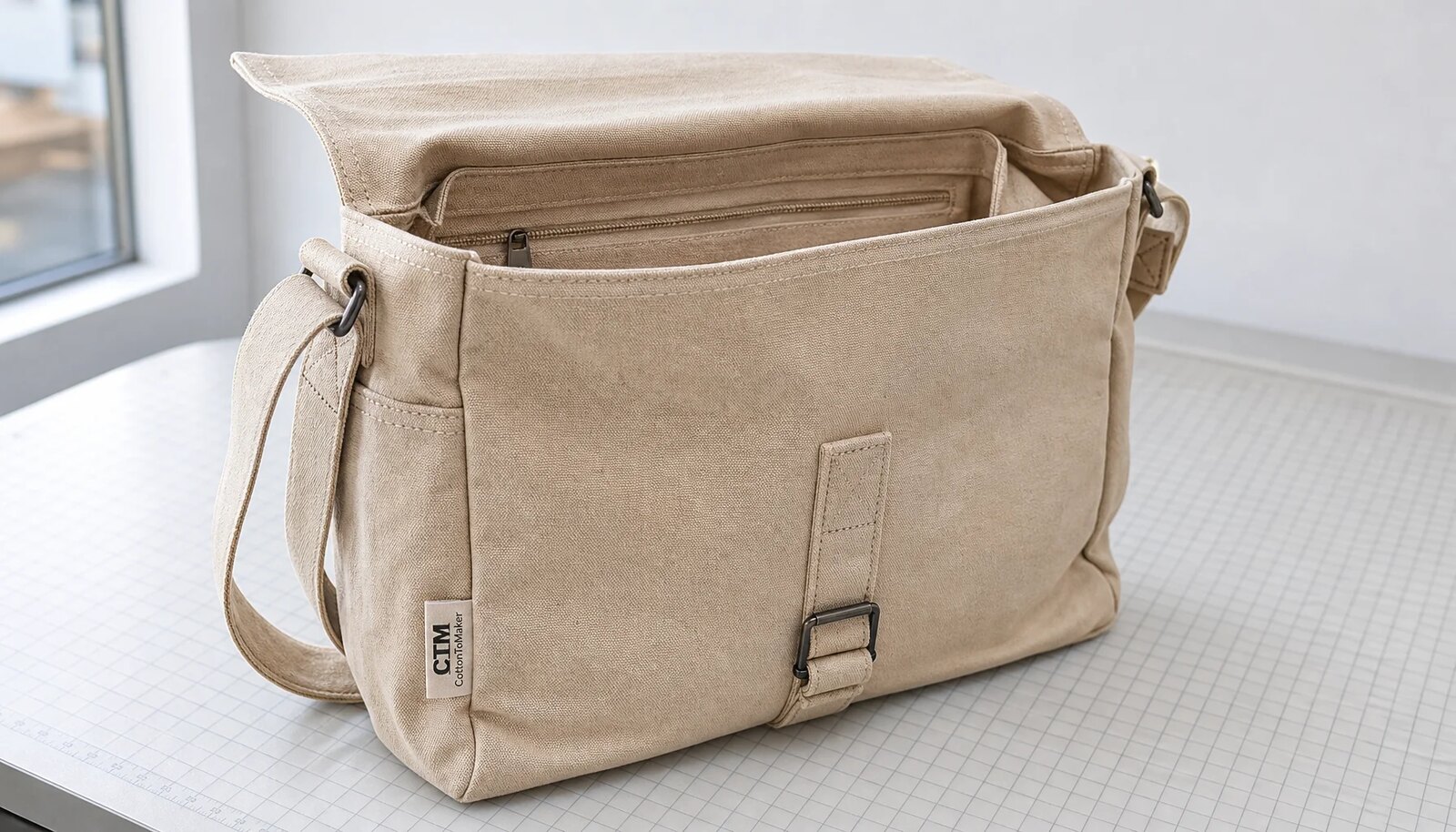
Start With the Carry Job Before You Ask for Price
A canvas messenger bag can be a simple promotional item or a serious everyday accessory. Those two products may look similar in a product photo, but they should not be quoted from the same vague brief. For B2B procurement teams, the first buying decision is the carry job: what the bag will hold, how often it will be used, and what failure would create a return, complaint, or brand problem. A bag for folded lookbooks and lightweight apparel samples can use a different fabric, pocket plan, closure, and strap construction than a commuter bag expected to carry a laptop, charger, bottle, and notebook.
Eco apparel brands also need to define the role the bag plays in the brand system. Is it a retail product, a loyalty gift, a trade show giveaway, a uniform accessory for store staff, or packaging that customers will reuse? The more visible the bag is, the less room there is for loose stitching, crooked labels, or a weak flap shape. A reusable bag tied to an environmental message should feel considered, not disposable. That does not always mean heavier fabric; it means matching the construction to the actual use case and avoiding overbuilt features that add cost without improving the customer experience.
Before sending an RFQ, write a one-paragraph use statement. Include expected contents, carry weight, retail channel, target price band, and whether the bag should feel soft and relaxed or structured and protective. This gives suppliers a practical target and makes your canvas messenger bags wholesale buying checklist for eco apparel brands much more useful because every later decision can be judged against the same carry job.
- Define the primary use: retail product, staff bag, event gift, apparel sample carry, or customer incentive.
- State the expected contents, such as folded garments, catalogs, tablet, laptop-adjacent items, notebooks, or daily essentials.
- Set the desired feel: soft natural canvas, structured commuter shape, minimal branding, or premium retail finish.
- Separate must-have requirements from nice-to-have features before suppliers begin sampling.
Build a Spec Sheet Suppliers Can Actually Price
A supplier cannot quote accurately from a mood board and a logo file. The buying team should send a measured spec sheet that covers dimensions, construction, fabric, decoration, trims, packing, and shipment assumptions. Without this, one vendor may price a stock blank with a basic print while another quotes a custom cut-and-sew bag with lining, reinforcement, and individual retail packing. The numbers may sit in the same spreadsheet, but they are not competing versions of the same product.
For messenger bags, the most important measurements are body width, body height, gusset depth, flap length, flap width, strap length, strap width, pocket dimensions, and logo position. If the bag needs to hold a device, state the minimum internal space and whether padding is required. If it only needs to hold apparel samples or documents, avoid calling it a laptop bag unless you are willing to specify the added construction and test expectations. Ambiguous claims invite factories to fill the gaps in different ways.
The spec sheet should also describe finishing details that buyers often forget: seam allowance, internal binding, topstitch spacing, thread color, hardware finish, closure position, label type, and whether the canvas is pressed flat, lightly washed, or left with a natural texture. These details affect cost, sewing time, and repeatability. For a repeat wholesale program, a clear spec sheet becomes the control document for quote comparison, sample approval, QC inspection, and reorder consistency.
- Include measurements for body, gusset, flap, strap, pockets, and decoration placement.
- Add construction notes for lining, binding, bartacks, reinforcement, closures, and hardware finish.
- Attach reference images only as visual support; do not let images replace measurements.
- Version the spec sheet with a date so quote revisions and sample comments stay traceable.
Choose Canvas Weight, Composition, and Finish With Care
Canvas weight is one of the biggest cost and performance drivers. A 12-14 oz canvas can work well for light retail merchandise, promotional programs, and bags that are meant to carry soft goods. It keeps the unit lighter, usually folds more efficiently, and can support a relaxed apparel-brand look. A 16 oz canvas is often the practical middle ground for brands that want better hand feel, better shape, and stronger daily-use perception. An 18 oz canvas can be useful for structured messenger bags and heavier carry, but it raises fabric cost, sewing difficulty, carton bulk, and sometimes needle damage risk if the factory is not equipped for it.
Buyers should ask for both ounces and finished GSM because suppliers may describe fabric differently. Some quote based on greige fabric, some on finished fabric, and some use a mill shorthand that does not reflect the final weight after dyeing, washing, or finishing. If the order requires organic cotton, recycled cotton, or a cotton blend, ask how the supplier verifies the material and whether documentation is available for your internal compliance needs. Do not ask for sustainability language only at the marketing level; ask what material, process, and paperwork the supplier can actually support.
Finish also changes the product. Natural canvas may show more slubs, seed flecks, and shade variation, which can be acceptable if approved in advance. Dyed canvas introduces color matching, dye lot, crocking, and shade band risks. Washed canvas can create a softer hand but may shrink or distort dimensions if not controlled. Water-repellent finishes can improve utility but may conflict with a brand's material policy or alter print adhesion. The best approach is to approve a physical fabric swatch before the full bag sample, then make the final sample from the same fabric route intended for bulk production.
- 12-14 oz: lighter, softer, and usually more cost-effective for low-load retail or promotional use.
- 16 oz: stronger hand feel and better structure for everyday merchandise programs.
- 18 oz: more robust, but check sewing capacity, strap engineering, packing density, and freight impact.
- Confirm finished GSM, composition, shrinkage, dye lot control, and acceptable natural-fiber variation.
Engineer Straps, Pockets, Closures, and Reinforcement
The body fabric gets attention, but functional failures usually happen at stress points. Strap anchors, flap corners, pocket openings, gusset seams, and base seams take the most abuse. A messenger bag with a wide shoulder strap but weak attachment points is not a durable product; it is a return waiting to happen. Buyers should require visible reinforcement details in the spec, such as bartacks, box stitching, internal patches, rivets where appropriate, or a reinforced seam sequence. The reinforcement method should match the intended load and the brand aesthetic.
Pocket design should be practical, not decorative guesswork. An exterior pocket may be useful for quick access, but it can distort if the opening is not reinforced. An interior slip pocket adds value for retail use, but it needs secure corners and clean lining. Zipper pockets require better sewing control and zipper sourcing. If a pocket is intended for a specific object such as a phone, notebook, or small tablet, state the target size and test it on the sample. Otherwise, the factory may choose dimensions that are easy to sew but awkward to use.
Closures also deserve early decisions. Magnetic snaps are clean and convenient, but they need correct alignment and reinforcement. Buckles look classic but can slow user access and increase hardware cost. Hook-and-loop closures are inexpensive and functional but may feel less premium and can catch fibers. Zippers improve security but change the pattern, sewing sequence, and sample timeline. For eco apparel brands, the right closure is the one that supports the intended use without adding avoidable trim complexity.
- Specify strap width, adjustable range, hardware type, anchor construction, and whether a strap pad is needed.
- Add bartacks or reinforcement at strap joints, pocket corners, flap stress points, and gusset transitions.
- Choose closures based on use: magnet for clean access, buckle for heritage styling, zipper for security, hook-and-loop for utility.
- Test loaded samples for strap comfort, flap alignment, pocket usability, and closure repeatability.
Select Branding That Fits Canvas and Repeats Cleanly
Branding method affects cost, MOQ, lead time, and quality risk. Screen printing is often the best option for simple one- to three-color logos on cotton canvas. It can be efficient, clean, and repeatable when artwork is not too fine. On textured canvas, small lettering, thin lines, gradients, and large solid fills can become difficult. Buyers should ask for a strike-off or decorated panel sample when color accuracy, edge sharpness, or placement is important. The print should be reviewed after curing and light rubbing, not only while it is fresh.
Embroidery can create a premium impression, but it is not automatically better. Stitch count drives cost, and dense embroidery can pucker softer canvas. Fine text may lose clarity, especially on smaller flaps or curved areas. Woven labels, side seam labels, and sewn patches can be a strong fit for eco apparel brands because they provide subtle repeatable branding without covering the natural canvas surface. Patches add another material and sewing operation, so the supplier should quote them separately and show the attachment method.
Logo placement should be treated as a measurable spec. A centered flap print, side seam label, lower-corner embroidery, and woven patch all require different tolerances. If the bag is folded during packing, make sure the logo does not sit on the fold line. If the flap curves after loading, confirm that the mark still reads correctly. For wholesale programs, simple artwork placed consistently often looks more premium than complicated branding executed unevenly.
- Screen print works best for simple artwork, limited colors, and larger clean logo areas.
- Embroidery should be tested for puckering, thread color, small text clarity, and backing visibility.
- Woven labels and patches can reduce print risk but add separate tooling and placement checks.
- Set logo coordinates, size, color reference, and acceptable placement tolerance before the pre-production sample.
Compare Supplier Routes and Ownership of Risk
Procurement teams usually have three routes: direct custom factory, trading company, or stock blank plus branding partner. A direct cut-and-sew factory offers the best control when the bag needs custom dimensions, material selection, specific reinforcement, or repeat production. You can discuss patterns, seam sequence, fabric sourcing, and line inspection with the people closer to the actual work. This route is best when your brand has a defined spec and enough volume to justify development time.
A trading company can be useful when you are managing several accessory styles, need consolidated communication, or do not have internal capacity to source and coordinate multiple factories. The risk is visibility. You need to know which factory will make the bags, who approves materials, how QC is handled, and whether decoration is in-house or outsourced. A trading company quote is not weak by default, but the commercial convenience should be balanced with clear control points.
Stock blank plus branding can be the right answer for urgent programs or small test runs. It is fast because the bag already exists. The tradeoff is that you inherit the blank's dimensions, construction, shade variation, strap length, and reorder availability. For an eco apparel brand building a long-term merchandise program, this may be too limiting. For a short deadline or market test, it can be practical if the blank is inspected before branding. The key is to identify which party owns each risk: fabric, construction, decoration, packing, QC, and replacement if goods fail inspection.
- Use direct factories when custom construction, repeatability, and detailed QC matter most.
- Use trading companies when sourcing coordination is valuable, but require factory and QC transparency.
- Use stock blanks for urgent or low-volume tests only after checking physical samples and reorder availability.
- Map ownership for fabric sourcing, sewing, decoration, inspection, packing, and corrective action.
Write an RFQ That Exposes the Real Cost
A good RFQ makes suppliers price the same product under the same assumptions. It should include the spec sheet, artwork, target quantities, preferred material route, decoration method, sample expectations, packing requirements, delivery terms, and timeline. Ask for pricing at multiple quantity tiers that match your buying plan, such as 300, 500, 1,000, and 3,000 pcs. Also ask for MOQ by color, design, and decoration method because the limiting factor may be fabric dyeing, print setup, label tooling, or hardware sourcing rather than sewing capacity.
The RFQ should separate unit price from one-time costs. Screen charges, embroidery digitizing, woven label tooling, special trim development, sample fees, courier cost, and carton upgrades can distort comparison if one supplier hides them in the unit price and another lists them separately. Neither approach is automatically wrong, but procurement needs the same cost categories in order to compare. Ask whether sample fees are refundable or credited after bulk order, and under what conditions.
For eco apparel brands, include material and packaging questions in the RFQ instead of treating them as later compliance tasks. Ask whether the supplier can support organic cotton, recycled cotton, undyed canvas, reduced-plastic packing, or paper-based hangtags, and what each choice does to MOQ, lead time, and cost. If documentation is required for your internal claims, ask for the document type early. This avoids a common problem: a buyer approves a product story before confirming what the supply chain can prove.
- Send the same RFQ package to each supplier: spec sheet, artwork, quantities, packing, timeline, and shipping term.
- Ask for price breaks plus separate charges for samples, screens, digitizing, tooling, labels, trims, and cartons.
- Separate MOQ by fabric color, print design, embroidery design, lining, label, and hardware finish.
- Require suppliers to state assumptions instead of filling gaps silently.
Use Samples to Freeze the Production Standard
Sampling should move from exploration to control. The first prototype can test shape, size, construction, and general appearance. It may use substitute fabric or placeholder trims if everyone understands that it is a development sample. The pre-production sample is different. It should represent the final approved fabric, color, decoration, hardware, lining, labels, and packing as closely as possible. Once approved, it becomes the production standard, not just a nice reference photo.
Measure the sample carefully. Check body width and height, gusset depth, flap position, strap length, pocket dimensions, logo placement, stitch density, and closure alignment. Put comments directly against the spec sheet and update the spec version when changes are approved. Avoid approving changes only by email phrases such as make strap slightly longer or logo a bit lower. Those comments are too easy to misread in production. Use numbers and tolerances.
Keep a sealed gold sample whenever the order is important or repeatable. Label it with style name, version, date, supplier, material, color, and approval status. If the factory also keeps an approved sample, confirm that both samples match. During inspection, production should be checked against the gold sample and the written spec together. The sample shows hand feel and workmanship; the spec sheet controls measurements and requirements.
- Separate prototype approval from pre-production approval.
- Measure every critical dimension and update the spec sheet after approved changes.
- Review decorated samples for color, edge quality, placement, curing, and interaction with seams or folds.
- Keep a dated gold sample for production, inspection, and reorder reference.
Control QC Around Functional and Cosmetic Defects
Quality control should focus on the failures that matter most for canvas messenger bags: weak strap anchors, crooked sewing, incorrect dimensions, dirty canvas, faulty closures, poor print placement, and packing mistakes. A polished sample photo cannot prove any of these are controlled in bulk production. Buyers should define major and minor defects before production begins. A broken bartack, detached strap, non-functioning zipper, wrong logo, or severe stain should be major. A small thread end or slight natural slub may be minor if it falls within the approved standard.
Functional testing does not need to be complicated, but it must be practical. Pull-test strap anchors by hand against the expected load, open and close snaps or zippers repeatedly, check that buckles do not slip, and load the bag to see whether the flap still sits properly. For lined bags, inspect inside corners and pocket attachments. For unlined bags, check internal seam finishing and fray control. Natural canvas should be inspected under good light because oil marks, dirty folds, and color contamination can be hard to see in dim factory photos.
First-run production deserves extra attention. Ask for early line photos or inspect an initial production batch before the full lot is completed. This is especially important when decoration placement, label position, or a new sewing pattern is involved. Catching a logo that is 20 mm too low after 50 pieces is a manageable correction. Catching it after 3,000 packed units is a commercial dispute. Written QC points protect both sides because the factory knows what must be controlled and the buyer has a fair basis for acceptance.
- Classify major defects: broken stitching, loose strap anchors, wrong construction, failed closures, severe stains, wrong logo, and wrong packing.
- Set measurable tolerances for size, strap length, pocket placement, flap alignment, and logo position.
- Inspect early production before the entire lot is decorated, folded, and packed.
- Use the gold sample, approved spec sheet, and artwork file together during inspection.
Plan Packing, Cartons, and Warehouse Receiving Early
Packing is part of the product cost and the customer experience. A canvas messenger bag can arrive crushed, wrinkled, stained, or miscounted if packing is left to the factory's default method. Decide whether each unit needs an individual polybag, paper sleeve, tissue insert, hangtag, barcode label, care card, or no individual packaging. For eco apparel brands, reduced-plastic packing may be important, but it has to be specified in a way that still protects the goods from moisture, dirt, and transfer marks.
Carton specifications affect landed cost. A soft unstructured bag can fold tightly, while a reinforced or padded messenger bag may need a larger carton to avoid permanent creasing. Ask for master carton dimensions, gross weight, net weight, units per carton, carton marks, and whether cartons are suitable for export handling. If goods will move through a 3PL or retailer warehouse, confirm barcode placement, carton labels, SKU separation, and any routing-guide requirements. A low factory price can become less attractive if cartons are inefficient or receiving teams must relabel every unit.
Packing also affects QC. Inspectors need to verify unit count, assortment, labels, carton marks, and the condition of bags after folding. If the product uses natural canvas, packing materials should not transfer color, leave adhesive residue, or trap strong odor. If hangtags are attached with strings or pins, check that they do not puncture visible panels. The packing standard should be included in the purchase order and sample approval, not negotiated after production is complete.
- Choose retail packing, bulk packing, or reduced-plastic packing before final quote approval.
- Request carton size, units per carton, gross weight, net weight, carton count, and carton mark format.
- Confirm barcode, hangtag, SKU, country-of-origin, and warehouse receiving requirements.
- Check that folding, inserts, and packing materials do not stain, crease, or distort the bag.
Specification comparison for buyers
| Spec decision | Recommended option | When it fits | Buyer risk to check |
|---|---|---|---|
| Direct cut-and-sew factory | Best for custom dimensions, flap shape, pocket layout, fabric selection, and repeat programs | You have a measured spec pack and expect repeat orders at 500-3,000 pcs or more | Confirm the factory controls pattern making, cutting, sewing, finishing, and final QC, not only sample coordination |
| Trading company with multiple bag factories | Useful when one buyer needs sourcing support across several bag styles or factories | You need one commercial contact for messenger bags, totes, pouches, and apparel accessories | Ask which factory will run the order, where QC happens, and who approves production changes |
| Stock blank bag plus local branding partner | Good for urgent launches, small tests, and simple logo programs | Speed matters more than custom construction, and the stock blank already matches the brand look | Check strap length, flap proportion, pocket layout, color consistency, and whether the blank can be reordered |
| Factory with in-house screen printing | Strong option for one- to three-color logos on cotton canvas | You want fewer handoffs between sewing, decoration, curing, and final packing | Verify print curing, rub resistance, registration tolerance, and whether printing happens before or after sewing |
| Factory outsourcing embroidery or patches | Acceptable when the sewing factory is strong but the decoration process is specialized | You need embroidery, woven labels, woven patches, leather alternative patches, or branded trims | Name the outside vendor in the approval record and require decoration samples before bulk production |
| 12-14 oz canvas build | Lower-cost choice for light carry, event merch, and folded apparel catalog use | You want a softer hand feel, lighter cartons, and a casual retail-merch look | Do not claim laptop or heavy commuter use unless strap anchors, base seams, and closures are upgraded |
| 16 oz canvas build | Balanced option for eco apparel retail, daily errands, and premium merchandise | You need better shape, stronger hand feel, and a more substantial brand impression | Confirm finished GSM, shrinkage behavior, color lot control, and whether the body is lined or unlined |
| 18 oz canvas with reinforcement | Use for heavier carry, laptop-adjacent programs, or a structured messenger silhouette | The bag must resist sagging at the base and stress at strap connection points | Expect higher fabric cost, slower sewing, bulkier packing, and possible needle or seam issues if not engineered well |
| Unlined construction | Simple, lighter, easier to inspect, and often suitable for natural canvas programs | The inside appearance can be clean enough with bound seams or tidy seam finishing | Check internal seam fray, loose threads, color transfer, and whether contents catch on raw edges |
Buyer checklist before sampling
- Define the end use first: apparel sample carry, office commute, laptop-adjacent use, retail merchandise, event giveaway, or subscription-box insert.
- Lock target dimensions, gusset depth, flap coverage, closure type, pocket count, strap length, and intended maximum load before requesting prices.
- Specify canvas weight in both ounces and finished GSM, plus natural, dyed, washed, recycled, organic, or conventional cotton requirements.
- State whether the bag is lined, unlined, bound internally, reinforced at stress points, or supported with interfacing or foam.
- Choose the branding method before sampling: screen print, embroidery, woven label, woven patch, printed patch, side seam label, or hangtag only.
- Send logo artwork in vector format with Pantone or approved color references, logo size, placement coordinates, and tolerance for position shift.
- Ask suppliers to quote the same quantity tiers, such as 300, 500, 1,000, and 3,000 pcs, with MOQ separated by color, design, and decoration method.
- Request sample fees, setup fees, print screen charges, embroidery digitizing charges, label tooling, hardware mold fees, and refund conditions in writing.
- Confirm packaging requirements, carton pack count, barcode labels, hangtags, carton marks, and any plastic-reduction preference before bulk pricing is finalized.
- Approve a pre-production sample against a dated spec sheet and keep a sealed gold sample for inspection reference.
Factory quote questions to send
- Is the canvas weight quoted in finished GSM, fabric ounces, or mill purchase specification, and can you provide the fabric composition and weight tolerance?
- Is the fabric natural, dyed, washed, recycled cotton, organic cotton, conventional cotton, or blended canvas, and what documentation can support that claim?
- Is the price based on a direct custom cut-and-sew order, a modified stock blank, or a stock blank with decoration only?
- What is the MOQ by body color, lining color, print design, embroidery design, label type, and hardware finish?
- What sample fees, print screen charges, embroidery digitizing fees, label tooling, trim sourcing fees, or setup charges apply, and which are refundable after bulk order?
- What construction is included in the quote: lining, inner pocket, zipper pocket, gusset, base reinforcement, strap pad, bartacks, binding, or interfacing?
- What measurement tolerance applies to body width, height, gusset, strap length, flap position, pocket placement, and logo placement?
- Will decoration be completed in-house or outsourced, and at what stage does it happen: before cutting, after panel cutting, after sewing, or after final finishing?
- What test or inspection checks do you perform for strap strength, closure function, print rub, stitch defects, stains, odor, and carton count?
- What is included in the packing price: individual bag, paper wrap, hangtag, barcode label, silica gel if required, carton mark, master carton, and palletization?
Quality-control points to confirm
- Finished canvas weight, composition, weave, color, and hand feel match the approved sample and written spec, not only the original quote.
- Bag width, height, gusset, flap length, pocket placement, and strap length stay within agreed measurement tolerance after sewing and pressing.
- Logo size, position, color, print edge sharpness, embroidery density, label placement, and patch alignment match the signed artwork standard.
- Strap anchor points use the approved bartack, box stitch, reinforcement patch, or rivet plan for the intended carry load.
- Stress seams at flap corners, gussets, base, pocket openings, and strap joints are straight, secure, and free from skipped stitches or loose ends.
- Closures such as zippers, snaps, magnetic buttons, buckles, and hook-and-loop strips align correctly and function repeatedly without catching.
- Natural canvas is free from oil marks, dirty fold lines, obvious slubs beyond the approved standard, strong odor, mold, needle damage, and color contamination.
- Inside finishing is clean: no sharp hardware backs, raw seams that fray excessively, loose lining, trapped threads, or pocket corners that tear under light pull.
- Retail packing, hangtags, barcode labels, care or content labels, carton marks, carton count, and master carton dimensions match the purchase order.
- Inspection records show defect classification, sample size, accepted tolerance, rework rules, and final shipment approval before goods leave the factory.