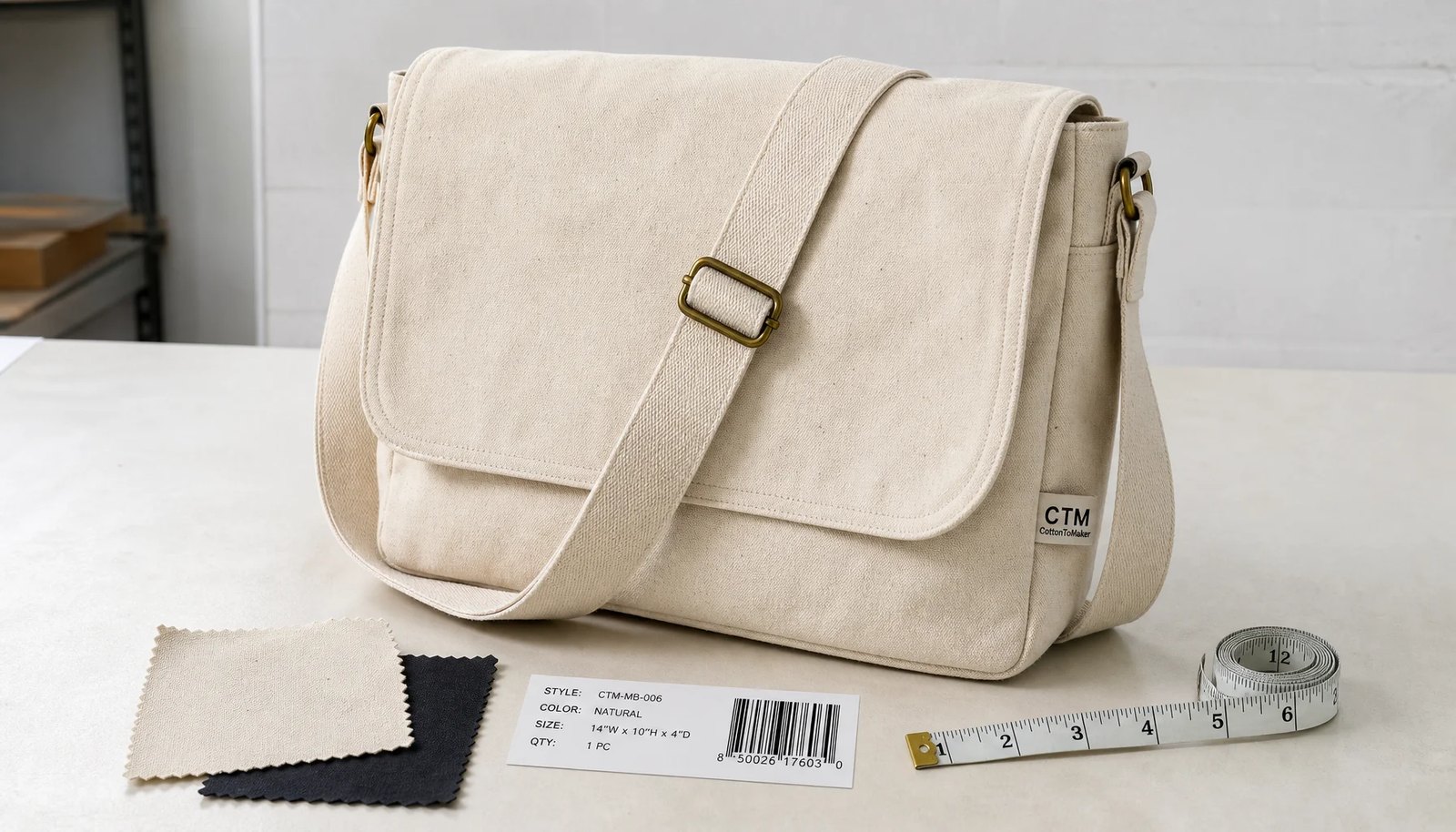
Start with the bookstore use case before choosing the bag
Canvas messenger bags for university bookstores sit between practical campus carry, school-spirit merchandise, and licensed retail product. A student may carry notebooks, a tablet, headphones, a charger, a water bottle, and bookstore purchases in the same bag. An alumni buyer may judge the item by fabric feel, logo execution, hardware finish, and whether it feels giftable. A procurement buyer gets better quotes when the RFQ explains the commercial role of the bag instead of only saying “canvas messenger bag with logo.”
The buying problem is rarely finding a factory that can sew a flap bag. The harder task is choosing a specification that survives retail handling, looks consistent under university brand rules, and lands at a wholesale price the bookstore can mark up. If the bag is too light, it feels like a giveaway. If it is overbuilt, sewing cost, freight weight, and carton volume rise quickly. A clear use case prevents the supplier from guessing between promotional, daily-use, and premium versions.
- For student daily use, prioritize strap strength, closure function, fabric abrasion resistance, and practical interior space.
- For orientation or event sales, keep the construction simple, limit artwork colors, and control packing cost.
- For alumni or campus gift assortments, improve fabric finish, hardware feel, labels, hangtags, and shelf presentation.
- For department or club merchandise, confirm whether multiple logo versions will split MOQ and raise setup charges.
- For licensed university merchandise, build artwork approval, color proofing, and trademark review into the production schedule.
Translate retail positioning into a measurable product spec
A strong wholesale buying checklist starts by translating retail goals into measurable requirements. “Durable canvas messenger bag” is not enough for procurement because suppliers may interpret durability differently. One factory may quote a single-layer 12oz bag with a narrow strap, while another may quote 16oz canvas with reinforced side tabs and metal hardware. Both can honestly call the item canvas, but they are not equal products.
Create a short product brief before requesting prices. Include target retail price range, intended buyer, expected carry contents, logo treatment, color direction, packing needs, and delivery deadline. Then convert the brief into a technical spec: finished measurements, fabric weight, trim type, closure system, pocket layout, stitch reinforcement, print placement, and carton requirements. This reduces back-and-forth and prevents quote comparisons from becoming a race to the lowest incomplete specification.
- State the intended retail tier: budget promotion, core bookstore item, premium alumni gift, or limited-edition launch.
- Define expected contents: notebooks only, tablet, A4 papers, light laptop sleeve, or general daily carry.
- List hard requirements separately from optional upgrades so suppliers can price a base version and add-ons clearly.
- Use finished bag measurements rather than cutting dimensions, because shrinkage and seam allowance change the final product.
- Attach a simple spec sheet or annotated drawing whenever possible to avoid interpretation gaps.
Choose canvas weight by carry load and margin target
For most canvas messenger bags for university bookstores wholesale buying checklist projects, 14oz to 16oz cotton canvas is the practical middle range. It has enough structure for a messenger silhouette, accepts screen printing well, and avoids the freight penalty of very heavy materials. In GSM terms, this often sits around 475-540 GSM before washing, but buyers should not rely on weight alone. Weave density, yarn count, washing, finishing, and coating all change handfeel and performance.
A 12oz canvas can work when the retail price must stay low or the bag is sold as seasonal campus merchandise. It should still have reinforcement at strap joins, side seams, flap corners, and pocket openings. An 18oz canvas gives a more premium impression, especially with a washed finish, but it adds seam bulk and may require slower sewing, stronger needles, and larger cartons. The best RFQ states both the target fabric weight and the target retail position so the factory does not quote a fabric that wins only on unit price.
- Budget retail: 12oz canvas, simple structure, reinforced stress points, minimal pocketing, and one-color print.
- Core bookstore assortment: 14oz or 16oz canvas, stable body shape, adjustable strap, practical pockets, and reliable closure.
- Premium alumni range: 16oz to 18oz canvas, washed finish, improved hardware, woven label, and more finished packing.
- Natural canvas: good for earthy campus merchandise but more sensitive to stains, cotton flecks, and handling marks.
- Dyed canvas: stronger color story but requires lab dip approval, shade control, and colorfastness attention.
Lock construction details before artwork and pricing
Messenger bags create more quote variation than flat totes because the flap, gusset, strap, closure, and internal organization all add labor. Two suppliers may quote the same outside dimensions but use different flap depth, side construction, strap width, seam allowance, hardware, lining method, and pocket layout. These differences affect durability and retail appearance more than a small unit-price gap. Procurement buyers should freeze the bag structure before asking factories to sharpen price.
A clean wholesale specification should include finished width, height, gusset, flap coverage, strap length range, strap width, pocket dimensions, closure type, hardware color, and whether the bag is lined. For campus use, the strap is often the first visible failure point. A 38-50 mm cotton webbing strap usually feels more appropriate than narrow lightweight tape. The connection area should be bartacked, box-stitched, or otherwise reinforced rather than only caught inside a side seam.
- Define whether the main compartment must fit A4 papers, notebooks, a tablet, or a 13-inch laptop sleeve.
- Specify flap coverage so the bag still closes properly when loaded and the logo remains visible.
- For adjustable straps, state minimum and maximum drop length instead of only total strap length.
- Confirm whether hardware is antique brass, nickel, black, matte, or custom plated, and require matching trim across the order.
- If a laptop is mentioned in marketing, add padding, compartment structure, and load testing; do not market an unpadded canvas bag as protective luggage.
Plan logo decoration around canvas texture and brand rules
Screen printing is usually the safest decoration method for university bookstore canvas messenger bags when the artwork uses solid school colors. It gives strong coverage, predictable cost, and good repeatability on flat panels. The artwork area should be positioned away from heavy folds, stitch lines, pocket layers, and magnetic snap points. Printing across a flap crease may look good in a digital mockup but crack, distort, or wear unevenly after use.
Embroidery can add perceived value, but on heavy canvas it may pucker if backing, stitch count, and logo size are not controlled. Woven labels work well for small side branding, collection labels, or subtle bookstore marks. Heat transfer can be used for some artwork, but it should be tested on textured canvas and is less forgiving when the bag bends or rubs. For licensed merchandise, a lab dip, print strike-off, or embroidery sample is production evidence, not a cosmetic extra.
- Provide vector artwork, Pantone references, print size, and print position measured from fixed bag edges.
- Request a print strike-off on actual bulk canvas or an approved equivalent canvas before bulk printing.
- For dark dyed canvas, confirm whether the ink needs an underbase layer to keep university colors accurate.
- For natural canvas, expect cotton flecks and slubs to show through light ink unless heavier ink coverage is approved.
- Avoid fine text over seams, flap bends, rivets, pocket edges, and textured areas that reduce readability.
Understand MOQ drivers before comparing suppliers
MOQ for canvas messenger bags is not only a sewing quantity. It may be driven by fabric purchase, dye lot, washing batch, hardware finish, woven label setup, printing screens, hangtags, barcode labels, or carton materials. A supplier offering a very low MOQ may be using stock fabric, stock hardware, and manual cutting, which can be suitable for a pilot order but may not support consistent repeat orders. A higher MOQ may reflect custom dyeing or dedicated trim sourcing.
Procurement teams should separate total MOQ from per-color and per-artwork MOQ. A bookstore order of 1,000 pieces may sound efficient, but if it is divided into five campus colors and three logo versions, the factory may treat it as several small jobs. That raises setup time, print waste, inspection complexity, and packing error risk. The quotation should show pricing at realistic quantity breaks and identify which assumptions change if colors, logos, labels, or packing versions multiply.
- Clarify MOQ per fabric color, per print artwork, per woven label, per trim finish, and per packing version.
- Request price breaks such as 500, 1,000, 2,500, and 5,000 pieces if those volumes match your sales plan.
- Separate one-time setup costs from repeat-order unit price to avoid misunderstanding reorder economics.
- For a first market test, simplify the order: one fabric color, one logo, one closure type, and one packing method.
- For replenishment programs, ask whether the factory can hold approved trims or whether each order restarts sourcing.
Use samples as production evidence, not showroom inspiration
A showroom sample made from available fabric can prove shape and sewing ability, but it does not prove the bulk order. For wholesale bookstore buying, the important sample is the pre-production sample: actual canvas weight, actual color, actual hardware, actual label, actual print method, and final packing whenever possible. This is the sample that should be measured, reviewed, commented on, and signed off before bulk cutting begins.
Sample review should be physical and measurable. Do not approve only from photos when color, print handfeel, strap slippage, odor, or flap alignment matters. Load the sample with intended contents, wear it on the shoulder, open and close the hardware repeatedly, and inspect the inside seams. Any revision should be documented in a sample comment sheet so the factory, merchandiser, QC inspector, and bookstore buyer are working from the same correction list.
- Measure finished width, height, gusset, flap depth, strap width, strap drop range, and pocket placement.
- Load the sample with the agreed weight and check strap join distortion after hanging and wearing.
- Open and close the closure repeatedly to detect weak magnets, stiff buckles, misalignment, or noisy hardware.
- Rub the print area with a clean white cloth after drying to check obvious ink transfer or surface weakness.
- Confirm barcode, hangtag, individual packing, carton mark, and any required warning label if retail packing is included.
Build quality thresholds into the purchase order
Canvas is a natural woven fabric, so buyers should expect small slubs, texture variation, and limited shade movement. That does not mean all defects are acceptable. Clear QC thresholds protect both sides. The purchase order should state which defects are critical, major, and minor. A crooked university logo on the flap is a major retail issue because it is visible at the shelf. A loose thread inside a pocket may be minor if trimmed and not affecting seam strength.
Useful QC criteria include dimension tolerance, print placement tolerance, seam strength, hardware function, odor, stain control, and carton accuracy. For campus bookstores, presentation matters as much as basic utility. A wrinkled flap, stained natural canvas, off-center logo, mismatched strap shade, or dirty packing can create markdown pressure even if the bag holds weight. The factory should know inspection level, sampling method, and acceptance criteria before production, not after the goods are packed.
- Main body dimension tolerance: commonly plus or minus 1 cm unless the design requires tighter control.
- Logo position tolerance: set in millimeters from fixed bag edges and reject visible skew on the flap.
- Stitching: no open seams, skipped bartacks, broken thread chains, loose strap joins, or exposed raw edges in visible areas.
- Hardware: no sharp burrs, rust, plating flakes, weak magnets, loose rivets, or sliders that slip under normal load.
- Fabric: reject obvious stains, holes, mildew, severe panel shade mismatch, oil marks, and dirty handling marks on light canvas.
Treat packing, barcodes, and cartons as procurement controls
Packing is often left until the end of the RFQ, but it changes labor, material cost, carton size, and receiving accuracy. University bookstores may need individual barcode labels, hangtags, recycled polybags, plastic-free paper bands, price stickers, or item labels that match their point-of-sale system. Distributors may need master carton labels that match warehouse routing rules. If these details arrive after the quote, the supplier will either add cost or rush the packing line.
Canvas messenger bags are bulkier than flat totes and should not be crushed into cartons only to hit a low freight estimate. Overpacking can crease flaps, deform padded sections, and damage print surfaces. Underpacking causes carton bulging, inaccurate container planning, and higher handling risk. The quotation should include pieces per carton, carton dimensions, gross weight, net weight, and estimated CBM so the buyer can compare landed cost, not only unit price.
- Define whether each bag is folded, flat packed, stuffed, lightly shaped with paper, or packed to avoid flap creasing.
- Specify individual polybag, recycled polybag, paper wrap, paper band, or no individual bag according to retail and compliance needs.
- Include barcode position, barcode file format, scan quality, and item number matching requirements.
- Use carton marks that match PO number, item number, color, quantity, destination, and any warehouse routing code.
- Request carton data before freight booking so landed cost comparisons include cube, weight, and handling method.
Map lead time, landed cost, and reorder risk together
A reliable lead time for custom canvas messenger bags includes artwork review, sample making, sample shipping, buyer approval, fabric preparation, cutting, printing, sewing, trimming, final inspection, packing, and export handling. If the fabric is dyed or washed, add time for lab dip approval and bulk color control. If the order uses a licensed university logo, artwork approval may take longer than sewing. A supplier’s promised ship date is only useful when buyer approval deadlines are also scheduled.
The cheapest FOB quote may not be the lowest landed cost. A heavier 18oz bag packed loosely can increase freight cost sharply. A supplier that excludes screen charges, woven label setup, barcode labels, sample cost, testing, or inner packing may look cheaper until the PO is finalized. A strong comparison sheet includes unit price, setup charges, sample cost, packing cost, carton CBM, gross weight, inspection cost, payment terms, communication quality, and repeat-order control.
- Separate sample lead time, bulk production lead time, inspection window, and international transit time.
- Add buffer for university trademark approval, color proof review, and revised sample rounds.
- Compare FOB price together with carton CBM, gross weight, setup charges, and packing requirements.
- Treat poor sample discipline or vague answers as cost risk, even when the quoted unit price is attractive.
- For back-to-school deliveries, reserve production capacity early because sewing lines and printing rooms become crowded.
Specification comparison for buyers
| Spec decision | Recommended option | When it fits | Buyer risk to check |
|---|---|---|---|
| Main body fabric | 14oz to 16oz cotton canvas, approximately 475-540 GSM before washing | Best balance for campus bookstores selling durable daily-use bags without moving into heavy luggage pricing | Some suppliers quote finished GSM after washing or coating; require testable fabric weight, roll standard, and approved handfeel sample |
| Lower-cost fabric route | 12oz canvas, approximately 400 GSM, with reinforced stress points | Works for promotional bookstore programs, orientation sales, and price-sensitive alumni campaigns | Bag may collapse when empty and show faster corner wear if the base, flap edge, and strap joins are not reinforced |
| Premium fabric route | 18oz canvas or washed canvas with heavier yarn and softer finish | Fits premium campus merchandise, alumni gifting, limited editions, and higher retail price points | Higher unit cost, longer drying time after washing, thicker seams, slower sewing, and higher freight weight per carton |
| Printing method | Screen print for one to four solid university colors on flap or front panel | Reliable for bookstore logos, department marks, athletic-style graphics, and repeat wholesale replenishment | Pantone tolerance, ink coverage on textured canvas, and cracking on flap fold line must be approved before bulk |
| Logo label option | Woven label or cotton printed label sewn into side seam, under flap, or on internal pocket | Useful when the main artwork changes seasonally but the bookstore wants consistent branded trim | Label MOQ, label color, and sewing position tolerance can delay production if not approved with the sample |
| Closure system | Magnetic snap for convenience or metal buckle with hidden snap for heritage styling | Magnetic snap is faster for students; buckle gives a more traditional campus retail look | Weak magnets, misaligned snaps, noisy hardware, or buckle prongs that scratch devices create return risk |
| Strap construction | 38-50 mm cotton webbing strap with metal slider and bartack or box-X reinforcement | Suitable for books, tablets, chargers, and light laptop-sleeve carry in daily campus use | Thin polyester webbing can feel cheap; untested sliders may slip under load or twist during wear |
| Interior organization | One internal slip pocket plus optional zipper pocket and key loop | Enough for bookstore retail without overcomplicating sewing, inspection, and price control | Too many pockets increase labor cost and inconsistent placement unless dimensions and tolerances are fixed |
| Packing route | Individual retail-ready packing with barcode, hangtag, carton marks, and defined carton quantity | Best for bookstores, campus distributors, and online bookstore fulfillment teams that scan items on receipt | Missing barcode data or late hangtag artwork causes repacking cost, shipment delay, and receiving errors |
Buyer checklist before sampling
- Define whether the bag is for daily student use, alumni gifting, orientation retail, department merchandise, or premium bookstore assortment before choosing fabric weight.
- Specify fabric in ounces and GSM, including whether the value is greige, finished, washed, dyed, laminated, or coated fabric weight.
- State fiber content clearly, such as 100% cotton canvas, recycled cotton blend, or cotton-poly canvas, and request composition confirmation if required.
- List finished bag dimensions with tolerance for width, height, gusset, flap depth, strap width, strap drop, pocket size, and pocket placement.
- Decide the expected carry load and require reinforcement at strap joins, flap corners, pocket openings, lower side seams, and stress points.
- Confirm whether the bag must fit A4 papers, notebooks, a tablet, or a laptop sleeve, and avoid laptop protection claims unless padding is specified.
- Provide Pantone codes, logo size, print position, artwork file format, and approval authority before requesting a production quote.
- Confirm whether artwork needs university licensing approval, bookstore approval, athletics approval, or all three before bulk printing begins.
- Request a pre-production sample using actual bulk fabric, hardware, lining, label, closure, print method, and final packing whenever timing allows.
- Set acceptable color tolerance for fabric and print, especially for university primary colors printed on natural, washed, or dyed canvas.
Factory quote questions to send
- What exact fabric weight are you quoting in oz and GSM, and is it before or after washing, dyeing, coating, or finishing?
- Is the canvas natural unbleached, piece dyed, yarn dyed, garment washed, enzyme washed, or coated, and what shade variation should we expect between lots?
- What is the fiber composition, yarn construction, and shrinkage expectation, and can you provide fabric test information if the bookstore requires it?
- Which seams are lockstitched, which areas are bartacked or box-stitched, and what stitch density will be used per inch or per 3 cm?
- What hardware material and finish are included in the quote, and can you provide corrosion, plating, or rubbing resistance information if needed?
- Which print method are you quoting, what is the maximum artwork size, how many colors are included, and what setup charges apply?
- Does the MOQ apply to total order quantity, per fabric color, per artwork, per label version, per trim color, or per packing version?
- What sample types are available, and which sample will use actual bulk fabric, actual print, actual hardware, actual label, and final packing?
- What are the carton quantity, carton dimensions, gross weight, net weight, and estimated CBM for the quoted bag?
- What is excluded from the quoted unit price, such as sampling, screen charges, woven label setup, hangtags, barcode labels, inner cartons, testing, or inspection?
Quality-control points to confirm
- Finished dimensions should stay within agreed tolerance, commonly plus or minus 0.5 cm for small pockets and plus or minus 1 cm for main body dimensions unless otherwise specified.
- Fabric weight should match the approved specification and handfeel sample; random rolls should not be substituted without buyer approval.
- Fabric shade should be checked by panel and by lot, especially for dyed canvas where flap, body, gusset, and strap may come from different rolls.
- Print position should be measured from fixed edges, not judged by eye; visible skew on the flap or front panel should be rejected.
- University logo colors should be checked against approved Pantone or physical color standard under consistent light.
- Strap joins, flap corners, pocket openings, and side seams should have reinforcement stitching or bartacks with no skipped stitches.
- Magnetic snaps, buckles, sliders, zippers, rivets, and D-rings should open, close, and hold normally without sharp edges or plating defects.
- The bag should pass a practical loaded hanging check using the agreed sample load, with no seam tearing, strap slippage, rivet pulling, or hardware failure.
- Interior lining, if used, should not pucker, twist, fray, or expose raw seams after the bag is turned and pressed.
- Print surfaces should show acceptable ink coverage on canvas texture with no obvious smearing, cracking, offset marks, or color contamination.