Start the RFQ with the actual bookstore selling need
A canvas messenger bag for a university bookstore is not the same purchase as a simple event tote. The buyer is usually balancing retail shelf appeal, campus branding rules, student price sensitivity, and enough durability for books, tablets, and daily commuting. If the RFQ only says “canvas messenger bag with logo,” suppliers will fill the gaps differently, and the lowest quote may be based on a thinner bag, weaker strap, or simplified pocket structure.
Before requesting prices, define the commercial role of the item. Is it a low-cost orientation product, a mid-range campus bookstore item, a premium alumni gift, or part of a branded technology accessory range? That decision controls fabric weight, closure choice, lining, print method, packaging, and acceptable MOQ. A good RFQ gives the factory a target use case, not just a sketch.
- For value retail: unlined 10-12 oz canvas, one-color print, simple flap, cotton webbing strap.
- For everyday campus use: 12-14 oz canvas, internal pocket, magnetic snaps, reinforced strap ends.
- For premium bookstore ranges: heavier canvas, lining, zipper under flap, woven label or embroidery.
- For orientation kits: simplified construction, bulk carton packing, larger MOQ per design to reduce cost.
Define the bag size by what it must carry
Messenger bag dimensions should be written as finished width x height x gusset, with the measuring method stated clearly. For university bookstore programs, a common functional range is around 36-40 cm wide, 28-32 cm high, and 8-12 cm gusset. Smaller sizes look neat on shelf but may not fit notebooks, tablets, or a light hoodie. Oversized bags increase fabric consumption, carton volume, and shoulder strain if the strap is not upgraded.
Do not let the factory decide the gusset based on a reference photo. A flat messenger bag and a gusseted messenger bag can look similar in artwork but behave very differently in use. If the bag is expected to carry textbooks, set a gusset and require bottom corner reinforcement. If it is mostly for documents and campus merchandise, a slimmer gusset can reduce cost and improve display presentation.
- State external finished dimensions, not fabric cutting dimensions.
- Mention the largest intended item, such as 13-inch laptop, A4 folder, textbook stack, or tablet sleeve.
- Define flap length so it covers the opening after the bag is filled, not only when empty.
- Set acceptable size tolerance before production; +/- 5 mm is practical for many canvas constructions.
Choose canvas weight without overbuilding the bag
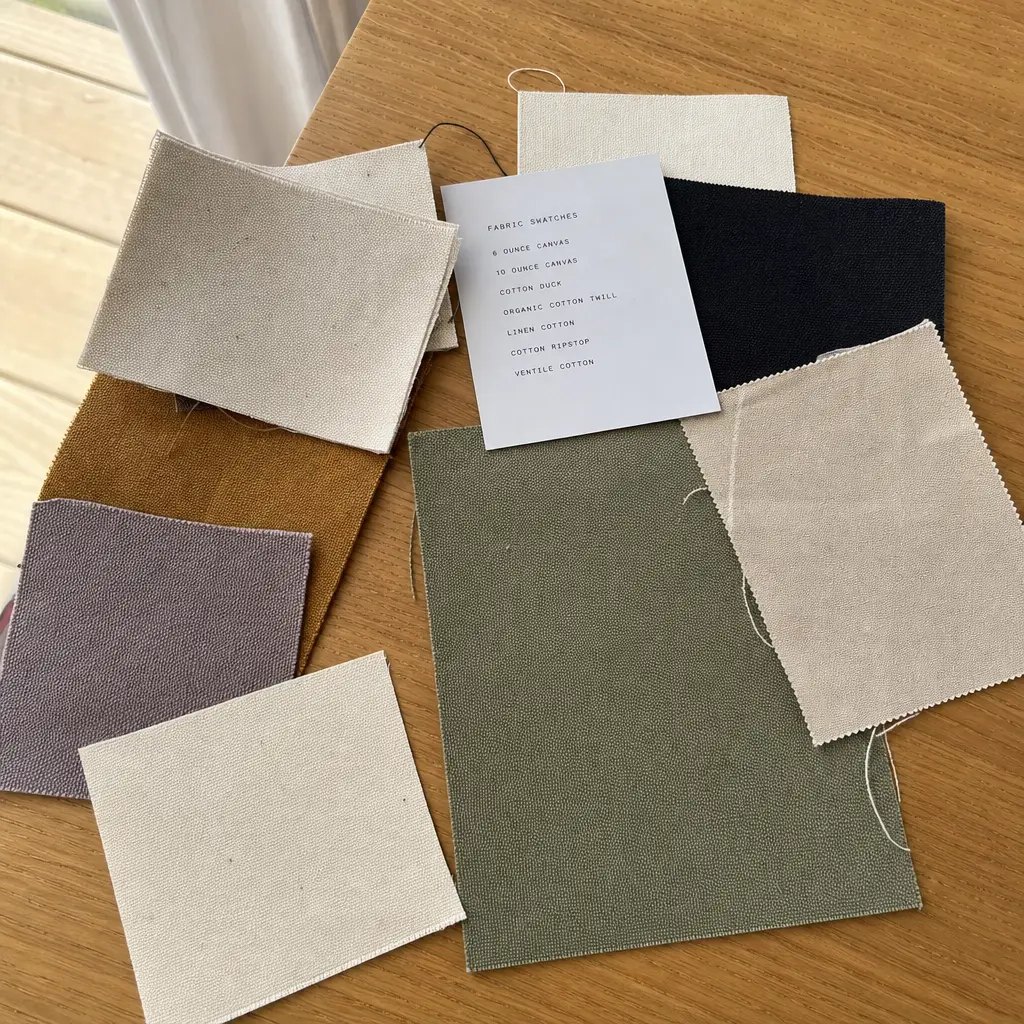
Canvas weight is one of the biggest quote variables. Factories may quote in ounces, GSM, or both. For bookstore messenger bags, 10 oz canvas is usually a budget choice, 12 oz around 400 GSM is a strong standard, and 14 oz or above gives a firmer premium feel. If the RFQ does not state fabric weight, two suppliers may both call their product “heavy canvas” while quoting very different materials.
The right fabric is not always the heaviest fabric. Heavy canvas increases material cost, sewing time, needle wear, and packed weight. It can also make corners bulky, especially when the flap, gusset, strap tabs, and seam allowances overlap. A practical RFQ should specify the target handfeel and load use, then allow the factory to recommend construction improvements if the chosen fabric creates sewing risk.
- 10 oz / about 320-340 GSM: acceptable for promotional price points and lighter use.
- 12 oz / about 380-420 GSM: recommended default for bookstore retail messenger bags.
- 14 oz / about 450-480 GSM: better for premium lines but requires stronger construction planning.
- 16 oz and above: use only when the retail concept justifies extra weight and cost.
Control strap, closure, and pocket construction
The strap system is where many low-priced messenger bag quotes quietly cut cost. A 25 mm strap may look fine in a sample photo but feel uncomfortable when loaded with books. For campus retail, 38 mm cotton webbing is a better default. The RFQ should state adjustable strap length, slider material, attachment position, and reinforcement stitching. A box stitch with cross reinforcement or multiple bartacks is more reliable than a single straight seam.
Closure and pocket choices should match the selling price. A flap with two magnetic snaps is clean and easy to use. A zipper under the flap improves security but adds cost, sewing time, and a possible failure point if the zipper is too light. Internal slip pockets are useful, but too many compartments can make the bag expensive without improving retail conversion. Keep the layout practical and document it with a simple inside-view drawing.
- Recommended strap width: 38 mm for standard bookstore messenger bags.
- Recommended adjustable length: about 75-135 cm, depending on market body size expectations.
- Load-bearing stitches: reinforced box stitch, bartack, or both at strap connection points.
- Closure options: magnetic snap for convenience, zipper for security, hook-and-loop only for budget programs.
Match print method to campus artwork rules
University bookstore graphics often include official marks, department names, mascot artwork, or alumni themes. The print method should be chosen after reviewing the actual artwork, not before. Screen printing is usually the most economical choice for solid one-to-three color logos on canvas. It gives strong coverage and keeps unit cost predictable. However, very fine lines, gradients, or many colors may require heat transfer, digital print, woven patch, or embroidery.
A buyer should include artwork size, placement, Pantone references, and whether the print must pass rubbing or washing expectations. Canvas texture can break very fine print details, especially on natural fabric. If the campus brand office requires tight color control, the RFQ should say whether Pantone matching is required on dyed canvas, natural canvas, or printed ink only. These are not the same production challenge.
- Screen print: best for bold marks, slogans, and bookstore logos with limited colors.
- Embroidery: premium appearance but can pucker lighter canvas or distort fine lettering.
- Woven patch: good for detailed crests or badges, with separate MOQ and lead time.
- Heat transfer: useful for multicolor graphics, but test adhesion on textured canvas.
- Digital print: flexible for small runs, but confirm color durability and fabric pretreatment.
Write MOQ rules so quotes can be compared
MOQ is not only a factory preference; it is driven by fabric purchasing, dyeing, printing setup, hardware sourcing, and packing SKU complexity. A simple natural canvas messenger bag with one print may be feasible around 300-500 pieces per design at many factories. A custom-dyed canvas color, custom lining, custom metal hardware, or woven patch can push the real MOQ higher because each component has its own minimum.
University bookstores often order by campus color, department logo, or seasonal design. The RFQ should separate total order quantity from per-SKU quantity. A supplier quoting 1,000 pieces total may still require 500 pieces per artwork. Another supplier may accept 1,000 pieces split across two prints if the fabric and construction stay the same. Without this detail, the buyer cannot compare quotes fairly.
- State expected quantity by color, logo, size, and packaging format.
- Ask whether MOQ is based on fabric, print setup, sewing line efficiency, or packing SKU.
- Request price breaks at realistic levels, such as 300, 500, 1,000, and 3,000 pieces.
- Keep first orders simple if the bookstore needs to test demand before expanding the range.
Use quote data to expose hidden cost drivers
A useful quotation should show more than one unit price. For canvas messenger bags, hidden cost often sits in fabric upgrades, lining, hardware, logo setup, sample revisions, packaging, and carton volume. A low unit price can become less competitive once screen charges, barcode labeling, individual packing, inspection rework, or higher freight CBM are included.
Request quote data in a format that supports landed-cost comparison. The supplier should provide unit price, sample fee, setup charges, MOQ, lead time, carton quantity, carton dimensions, gross weight, net weight, and estimated CBM. If the buyer is comparing FOB quotes from several factories, packed volume matters because messenger bags with thick gussets and hardware may consume more freight space than expected.
- Fabric cost driver: GSM, dyeing, washing, shrinkage control, and roll width efficiency.
- Labor cost driver: lining, zipper, multiple pockets, thick seam intersections, and bartack quantity.
- Decoration cost driver: number of print colors, print size, embroidery stitch count, and patch MOQ.
- Packing cost driver: individual polybag, paper belly band, barcode labels, hangtags, and carton strength.
- Freight cost driver: folded size, carton cube, metal hardware weight, and carton weight limit.
Approve samples with measurable acceptance criteria
A pre-production sample should not be treated as a visual formality. It is the control document for bulk cutting, sewing, printing, and packing. For a university bookstore order, the buyer should approve fabric shade, finished dimensions, print placement, strap comfort, hardware function, pocket layout, stitching reinforcement, and retail packaging. One approved sample should stay with the factory, and one sealed reference sample should stay with the buyer or inspection team.
Sample comments should be specific enough for production workers to follow. “Make it stronger” is weaker than “add bartack at both top corners of strap tab and use 38 mm webbing.” “Logo looks too high” is weaker than “move print center 20 mm lower from flap top edge.” The RFQ should state that bulk production cannot begin until the pre-production sample and packing sample are approved in writing.
- Measure bag width, height, gusset, flap drop, strap width, and adjustable strap range.
- Compare bulk fabric swatch to approved sample under consistent light before cutting.
- Rub the printed logo with dry and slightly damp white cloth to detect weak ink adhesion.
- Load the bag with expected use weight and inspect strap tabs, side seams, and bottom corners.
- Review folded packing shape because hard creases can damage print or shelf presentation.
Plan packing for retail shelves and export handling
Natural and light-colored canvas attracts dirt easily, so packing is not a minor detail. Individual recycled polybags are common because they protect the bag during export and warehouse handling. If the bookstore prefers reduced plastic, a paper belly band can work, but the carton should be lined and the factory must control clean handling before packing. A dirty canvas bag is difficult to fix after it leaves the sewing floor.
Retail buyers should also specify labeling needs early. University bookstores may require barcode stickers, item numbers, price labels, hangtags, or country-of-origin marking. If labels are applied after import, allow labor and repacking cost. If labels are applied at the factory, provide exact artwork, barcode files, placement instructions, and scan verification requirements before mass packing starts.
- Set maximum carton gross weight so warehouse staff can handle cartons safely.
- Use desiccant or moisture control for ocean shipments, especially during humid seasons.
- Avoid over-compression if the bag has magnetic snaps, embroidery, patches, or structured gussets.
- Require carton marks to include PO number, SKU, color, quantity, gross weight, net weight, and carton number.
- Confirm whether the bag ships flat, lightly folded, or folded into a retail band.
Build a realistic lead-time path before peak season
Back-to-school and orientation seasons leave little room for late sample approval. A messenger bag with stock canvas and simple screen print may move quickly once artwork is approved, but custom-dyed canvas, woven patches, lining colors, or special hardware can add material lead time. The RFQ should split the schedule into sample development, material booking, bulk production, inspection, packing, and export handover instead of asking only for one delivery date.
The biggest schedule risk is often buyer-side approval delay. Campus artwork approval, bookstore SKU creation, barcode confirmation, and internal PO release can take longer than expected. If the factory cannot book fabric or print screens until approval is complete, the production calendar keeps moving. A practical sourcing workflow sets deadlines for artwork, sample comments, purchase order, deposit, inspection booking, and shipping instruction.
- Sample development: often 5-10 working days for standard construction after artwork and specs are clear.
- Material booking: faster for stock natural canvas, longer for custom dye, lining, hardware, or patches.
- Bulk sewing: depends on complexity, order size, and factory season loading.
- Inspection and packing: reserve time for rework if stains, print defects, or hardware issues appear.
- Export handover: coordinate carton data early for forwarder booking and landed-cost calculation.
Specification comparison for buyers
| Spec decision | Recommended option | When it fits | Buyer risk to check |
|---|---|---|---|
| Main body fabric | 12 oz / 400 GSM cotton canvas for standard bookstore messenger bags | Good balance for textbooks, laptops, and retail shelf handling without becoming too stiff | Quote must state oz or GSM, yarn type if available, and whether fabric is pre-shrunk or regular loom-state canvas |
| Premium fabric upgrade | 14 oz / 450-480 GSM canvas for higher-ticket alumni or campus merchandise | Useful when the bag must hold shape on display and justify a higher retail price | Heavier fabric increases sewing difficulty, freight weight, and may require stronger needles and slower production |
| Lining choice | Unlined for budget retail; 210D or 300D polyester lining for laptop-style positioning | Unlined works for simple book bags; lining improves finish and protects interior seams | If lined, define pocket layout, seam binding, and whether lining color must match campus brand colors |
| Closure | Flap with magnetic snaps or hidden metal snaps; zipper under flap for higher security | Magnetic snaps are faster for students; zipper is better for commuter or travel use | Magnets can print through thin fabric and zipper length must match opening width, not just bag width |
| Logo decoration | Screen print for 1-3 color bookstore graphics; embroidery or woven patch for premium runs | Screen print controls unit cost and suits bold university marks; patches help when logos have fine detail | Require artwork size, Pantone colors, print position tolerance, and wash/rub resistance expectations |
| Shoulder strap | 38 mm cotton webbing with adjustable metal slider and reinforced box stitch | Fits most bookstore programs because it feels natural and matches canvas body | Cheap plastic sliders or narrow webbing reduce perceived value and may fail under load testing |
| MOQ logic | 300-500 pcs per color for standard canvas and print; higher if custom-dyed fabric or custom hardware | Works for bookstore season launches, orientation kits, and alumni gift ranges | MOQs can change when each campus color, logo version, or lining color is treated as a separate SKU |
| Packing format | Individual recycled polybag or paper belly band, then export carton with desiccant | Polybag protects light canvas from dirt; belly band suits stores reducing plastic packaging | Natural canvas soils easily, so carton lining, moisture control, and barcode placement must be specified before approval |
Buyer checklist before sampling
- Define finished bag size in width x height x gusset and state whether measurements are external finished dimensions.
- Specify main fabric by oz and GSM, color, dye method, and whether natural canvas color variation is acceptable.
- Lock strap width, adjustable length range, slider material, and reinforcement stitch type at both attachment points.
- Provide logo artwork with size, placement, Pantone colors, and allowed position tolerance in millimeters.
- State pocket structure, closure type, lining requirement, and whether laptop or book-load use is expected.
- Separate MOQ by color, artwork, size, and packing SKU so supplier quotes are comparable.
- Require pre-production sample approval before bulk cutting and retain one sealed sample for final inspection.
- Define packing method, carton size preference, carton weight limit, barcode label position, and plastic-free packaging needs.
- Request lead time split into material booking, sample approval, bulk production, inspection, and export handover.
- Ask for quote validity, payment terms, tooling or screen charges, sample fees, and estimated packed carton CBM.
Factory quote questions to send
- What fabric weight are you quoting in both oz and GSM, and is the canvas stock fabric or custom woven?
- What is the MOQ per color, per logo artwork, and per finished size for this messenger bag?
- Which print method is included in the base quote, how many colors are covered, and what is the print size limit?
- Are screen setup, embroidery digitizing, woven patch mold, or custom label charges included or listed separately?
- What hardware material is quoted for snaps, sliders, D-rings, and zipper pullers, and can you provide close-up photos?
- What is the estimated sample lead time after artwork approval, and how many revisions are included before extra charges apply?
- What bulk lead time applies after pre-production sample approval, and how does it change during peak back-to-school season?
- What are the finished product tolerances for size, print placement, fabric shade, and carton weight?
- Can you provide packed carton dimensions, pieces per carton, gross weight, net weight, and estimated CBM before order confirmation?
- What inspection standard do you use for stitching, stains, printing defects, broken hardware, and loose threads?
Quality-control points to confirm
- Finished size tolerance should normally stay within +/- 5 mm for width and height and +/- 8 mm for gusset, unless the construction is heavily padded.
- Print placement tolerance should be agreed at +/- 3-5 mm from approved sample reference points, not estimated by eye.
- Shoulder strap attachment should pass a practical load test using the intended packed weight, commonly 8-10 kg for bookstore book-carry use.
- Needle holes, skipped stitches, broken threads, open seams, and weak bartacks should be treated as major defects on load-bearing areas.
- Natural canvas shade variation should be controlled by approved fabric swatch and bulk roll comparison under consistent lighting.
- Metal hardware should be checked for rust, sharp edges, weak spring action, color mismatch, and poor plating on visible surfaces.
- Light-colored bags should be inspected for oil marks, dirty handling, ink transfer, and carton rubbing before individual packing.
- Carton drop condition, moisture control, barcode accuracy, and retail label placement should be reviewed before export release.