Why MOQ Negotiation Is Different for Bookstore Messenger Bags
Canvas messenger bags for university bookstores sit between promotional bags and retail accessories. A bookstore buyer may want only a few hundred pieces for a semester launch, but the product still needs to look credible beside hoodies, caps, notebooks, and licensed merchandise. This is why MOQ negotiation cannot be reduced to asking, "What is your lowest MOQ?" A low number without the right construction, print control, and packing plan can create a bag that feels too promotional for retail shelves.
The factory's MOQ is usually not one single rule. It is a combination of fabric availability, cutting efficiency, print setup, trim purchase, sewing line changeover, inspection time, and carton packing. A buyer who understands these cost blocks can negotiate better than a buyer who only pushes for a smaller PO. In many cases, the useful target is not the absolute lowest MOQ but the lowest safe MOQ that still uses the intended fabric, logo method, hardware, and packaging.
- For a first retail test, negotiate around stock canvas, stock webbing, and standard hardware before changing the bag pattern.
- For a licensed university program, treat logo placement and color control as non-negotiable even if order quantity is small.
- For distributor programs, negotiate a base MOQ for the shared construction and separate smaller artwork lots by campus or department.
- For bookstore replenishment, ask whether reorders can be produced from reserved fabric or repeated trims to avoid resetting MOQ.
Set the Base Specification Before Discussing MOQ
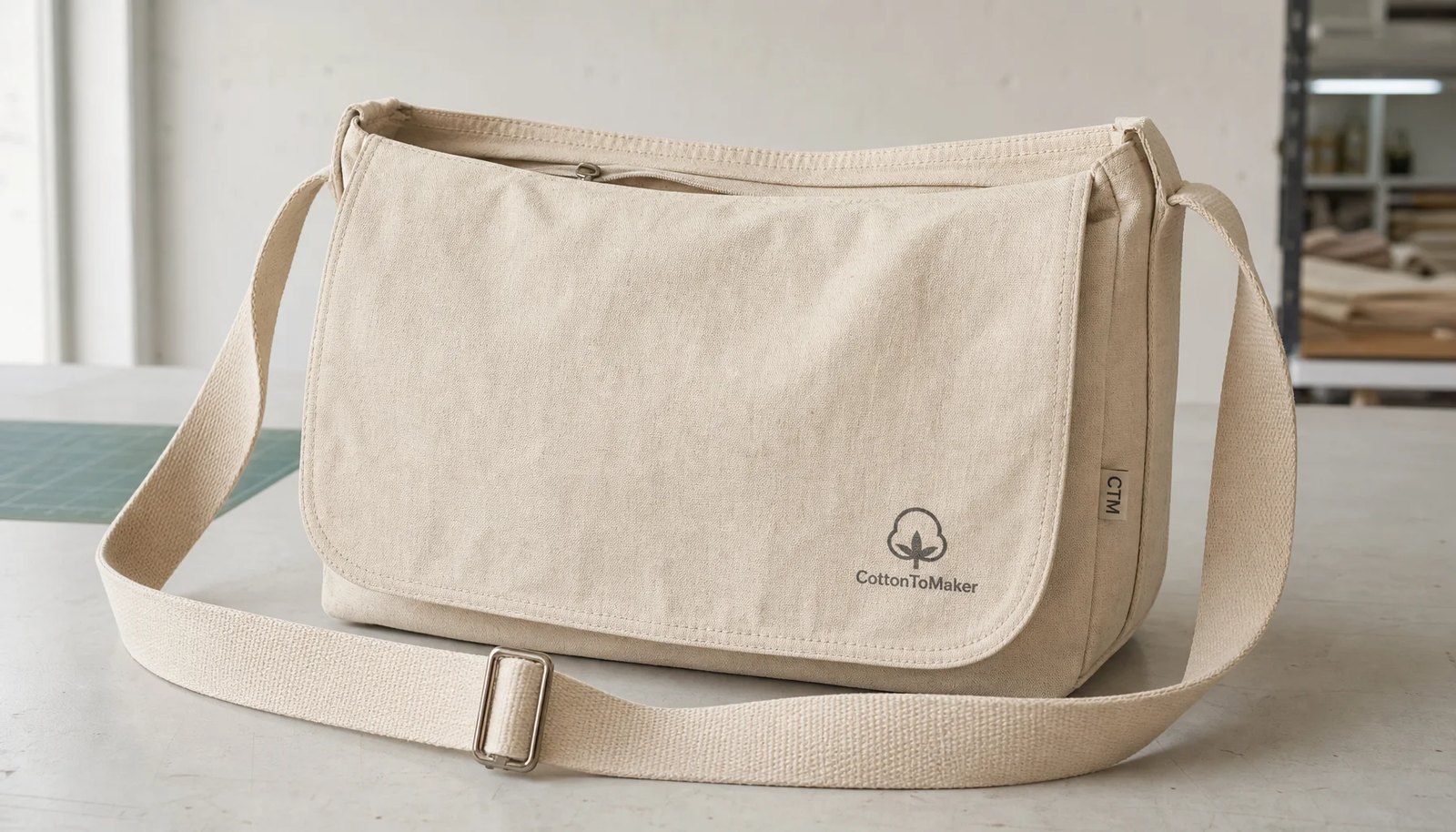
A supplier cannot quote a useful MOQ when the bag is described only as a canvas messenger bag. The key details are finished size, fabric weight, strap structure, flap style, closure, pocket layout, print method, and packing. A small change such as adding lining, using a wider strap, or switching from hook-and-loop to magnetic snaps can move the order from a stock-based production to a custom-trim production.
For university bookstore retail, common starting points are 12 oz cotton canvas around 380-410 GSM or 14 oz canvas around 440-480 GSM. A 12 oz bag is usually easier to sew, pack, and freight, while 14 oz gives a more premium hand feel. If the buyer wants garment-washed canvas, dyed canvas, or a very stiff structure, the fabric MOQ and shade control become more important than the sewing MOQ.
- Practical body size range: about 36-40 cm wide, 28-32 cm high, and 8-12 cm gusset for notebooks and campus retail use.
- Retail strap width: 3.8-5 cm cotton webbing; narrow straps reduce cost but feel cheaper under load.
- Closure options: hook-and-loop is economical, magnetic snap looks cleaner, and buckles add labor and alignment risk.
- Pocket choice: one internal zipper pocket or slip pocket adds value without turning the bag into a complex laptop case.
- Logo location: flap printing is most visible but also shows placement errors clearly; side labels are safer for subtle branding.
Understand What Really Drives MOQ
The MOQ pressure often comes from materials before it comes from sewing. If the factory has natural canvas in stock, a buyer may negotiate a lower production quantity because the cutting table can use available rolls. If the buyer requests a custom dyed canvas, custom woven strap, custom hardware plating, or a special lining color, the supplier may need to buy materials in minimum roll or batch quantities that exceed the buyer's desired PO.
Printing also affects MOQ. A one-color screen print on a flat flap panel before sewing is efficient and repeatable. Multi-color logos, crest details, metallic ink, puff ink, or embroidery can add setup charges and rejection risk. For a bookstore program, the best negotiation position is usually to keep the body spec stable and treat artwork variation as the controlled variable.
- Fabric MOQ is affected by fabric weight, width, color, washing, dyeing, shrinkage, and whether the mill has stock rolls.
- Trim MOQ is affected by strap color, slider size, zipper quality, snap finish, puller design, and label type.
- Print MOQ is affected by the number of colors, screen size, print position, ink type, and whether each campus needs a separate setup.
- Sewing MOQ is affected by pattern complexity, lining, pocket count, edge binding, flap alignment, and line changeover time.
- Packing MOQ is affected by individual retail packaging, barcode labels, hangtags, carton marks, and pallet requirements.
Use Quantity Breaks Instead of One Target Quantity
A serious RFQ should request at least three quantity breaks under the same specification. For example, 300, 500, and 1000 pieces will reveal whether the supplier's minimum is driven by setup cost, material purchase, or labor efficiency. If the price drops sharply from 300 to 500 pieces but only slightly from 500 to 1000 pieces, the practical MOQ may be around the middle quantity. If the price remains unstable until 1000 pieces, the factory may be buying custom material or trims.
Do not compare a 300-piece quote from one supplier against a 1000-piece quote from another and assume the second supplier is cheaper. The better comparison is a landed-cost view using identical specs, packing, carton data, and Incoterms. A low FOB unit price can lose its advantage if the bag is oversized, packed inefficiently, or requires air freight because sampling and approval were delayed.
- Request the same spec at three breaks, such as 300, 500, and 1000 pieces, instead of asking only for the lowest price.
- Ask suppliers to list setup charges separately from unit price so small-run cost is visible.
- Compare price with carton CBM, gross weight, and pieces per carton because messenger bags consume more space than flat totes.
- Separate the first-order price from reorder price when screens, labels, or patterns can be reused.
- Use annual forecast as negotiation context, not as a substitute for a confirmed purchase order.
Choose Print Methods That Protect MOQ and Retail Appearance
Screen printing is usually the most workable option for canvas messenger bags in bookstore quantities. It is cost-efficient, durable when ink is matched to the fabric, and easier to control on a flat flap panel before assembly. A one-color university wordmark or bookstore logo is often more reliable than a complex full-color crest, especially on textured canvas where fine details can fill in.
Digital transfer, heat transfer, embroidery, and woven patches each have valid uses, but they change the negotiation. Transfers can handle full-color artwork but may feel less integrated into a canvas retail product. Embroidery looks premium but can pucker heavy canvas or distort flap alignment if not tested. Woven patches can work well for alumni or premium bookstore lines, but patch MOQ and sewing time should be quoted separately.
- Best MOQ-friendly method: one-color screen print on natural or dyed canvas flap before sewing.
- Best for detailed logos: woven patch or high-quality transfer after a real sample test, not only a digital proof.
- Best for premium line: embroidery or sewn patch with reinforced backing and approved thread color.
- Avoid oversized prints close to seams because sewing distortion and flap curvature make alignment harder.
- Require a printed material swatch or actual panel proof before approving the full pre-production sample.
Build a Quote Sheet That Exposes Hidden Cost
A useful quote for canvas messenger bags should not be a single number. It should show fabric, printing, hardware, lining if any, labels, sewing, packing, sample cost, tooling or screen cost, carton data, and Incoterms. This structure lets the buyer see what can be adjusted without damaging the product. For example, keeping the 12 oz canvas but simplifying from two inside pockets to one pocket may reduce labor without making the bag look cheap.
Importers and distributors should also separate commercial terms from technical terms. Payment terms, validity period, production lead time, sample timing, inspection allowance, and shipment terms all affect the real cost. A quote that is valid for seven days with unclear material stock is not the same as a quote that reserves fabric after deposit. University bookstore seasons are calendar-driven, so late production can turn a good unit price into dead inventory.
- Quote line items should include fabric weight, fabric color, print colors, hardware type, pocket details, label type, packing, and carton data.
- Commercial terms should include Incoterm, payment term, quote validity, sample charge, bulk lead time, and inspection timing.
- Reorder terms should state whether screens, patterns, labels, and approved materials can be reused.
- Variance terms should define allowed overrun or underrun, especially when fabric cutting yield affects small quantities.
- Artwork terms should state whether one logo, multiple campus logos, or department variants are included.
Approve Samples With Measurable Acceptance Criteria
The sample stage is where many MOQ negotiations fail quietly. A buyer may accept a sample made with substitute fabric because the shape looks right, then receive a bulk order that feels different. For messenger bags, the pre-production sample should use actual fabric weight, actual strap width, actual hardware, actual label, and the intended print method. If a substitute is unavoidable, it must be recorded and replaced before bulk approval.
Sample approval should cover both appearance and function. A bookstore buyer will notice print position, canvas shade, flap symmetry, and retail finish. A student using the bag will notice strap comfort, closure strength, pocket access, and whether the bag carries books without seam stress. The sample should be evaluated as a retail product, not only as a manufacturing reference.
- Measure finished width, height, gusset, flap drop, strap width, and adjustable strap range against the spec sheet.
- Weigh the fabric sample or request GSM test evidence to confirm 12 oz or 14 oz material is real, not estimated.
- Load the sample with realistic bookstore contents such as two books, tablet, bottle, and hoodie for a basic stress review.
- Inspect bar tacks, seam allowance, back-stitching, pocket opening, zipper movement, and closure alignment.
- Review print size, print position, ink coverage, edge sharpness, color match, and resistance to rubbing.
Define QC Thresholds Before Bulk Sewing Starts
Quality control for canvas messenger bags should focus on load-bearing construction, visible branding, and consistent retail appearance. The most expensive defects are not always the most dramatic. Off-center flap logos, uneven flap shape, dirty canvas, weak strap anchors, and rusty hardware can all create returns or markdowns even if the bag technically functions.
Use AQL inspection for general workmanship, but treat brand defects with stricter rules. A small seam thread may be minor, while a crooked university logo on the flap is a major defect for retail. The QC plan should identify critical, major, and minor defects before production. This protects both buyer and factory because the inspection team is not forced to make subjective decisions at the shipping deadline.
- Critical defects: broken needle contamination, sharp hardware edges, mold, serious stains, or unsafe strap attachment.
- Major defects: wrong fabric weight, wrong logo color, off-center print, weak bar tack, broken zipper, defective snap, or severe size deviation.
- Minor defects: short loose threads, slight canvas slub, small non-visible shade variation, or light crease within approved tolerance.
- Functional tests: strap pull, closure repeated opening, zipper running, pocket seam stress, and filled-bag hanging review.
- Visual standards: consistent flap shape, centered logo, clean canvas surface, aligned label, and no packing abrasion on print.
Plan Packing and Freight Before Confirming the Unit Price
Messenger bags are not as simple to pack as flat tote bags. The flap, strap, hardware, and gusset influence carton size and product creasing. Flat packing can reduce CBM but may leave a hard crease across the flap. Folded packing may protect shape but increase carton volume. For bookstore retail, the buyer should decide whether the bag needs shelf-ready presentation, individual polybag, recycled paper band, hangtag, barcode sticker, or bulk packing for backroom handling.
Freight comparison should use carton data from the supplier quote, not assumptions. Canvas weight and hardware add gross weight, while the bag shape adds volume. A lower unit price can be offset by poor packing density. If the order is time-sensitive for back-to-school, late approval can force air shipment, which is usually painful for bulky canvas bags. Packing should be approved with photos and carton dimensions during sample or pre-production stage.
- Request pieces per carton, carton dimensions, gross weight, net weight, and estimated CBM for each quantity break.
- Approve whether straps are tucked, folded, tied, or protected to prevent hardware rubbing against printed flaps.
- Use inner protection for metal sliders or snaps if they contact printed or light-colored canvas during transit.
- Confirm carton marks, SKU labels, barcode stickers, hangtags, and any bookstore receiving instructions before packing.
- For retail display, test whether the bag recovers shape after unpacking and whether flap creases are acceptable.
Control Schedule Risk Around Academic Retail Seasons
University bookstore buying windows are less flexible than general retail replenishment. Orientation, back-to-school, graduation, alumni events, and sports seasons create fixed sales periods. MOQ negotiation should therefore include lead time logic, not only price logic. A smaller MOQ with delayed material sourcing may be worse than a slightly higher MOQ using stock fabric that can enter production faster.
A realistic schedule includes artwork review, sample making, sample shipping, buyer approval, material preparation, printing, sewing, finishing, inspection, packing, export booking, and customs clearance. If multiple departments or campuses need logo approval, add time before sampling. The factory can only protect the production slot when artwork, deposit, sample approval, and final packing instructions are clear.
- Typical schedule blocks to quote separately: artwork proof, sample production, material preparation, bulk cutting, printing, sewing, inspection, packing, and shipment handover.
- Build buffer for university trademark approval because logo revisions can delay screen making and sample sign-off.
- Avoid changing bag dimensions after sample approval; pattern changes can reset cutting markers and production timing.
- For multi-campus orders, group the same bag body together and schedule artwork changes as controlled print batches.
- Confirm the last safe ship date based on bookstore receiving date, not only factory completion date.
Specification comparison for buyers
| Spec decision | Recommended option | When it fits | Buyer risk to check |
|---|---|---|---|
| MOQ negotiation route | Standard body size, shared fabric stock, custom print only | Best for first bookstore order, orientation program, alumni shop trial, or seasonal campus retail test | Supplier may quote low MOQ but use thinner fabric or mixed-lot canvas shade unless material weight and color tolerance are fixed |
| Fabric weight | 12 oz cotton canvas around 380-410 GSM | Good balance for bookstore retail: structured enough for books and laptops without making freight cost too high | Below 10 oz can feel promotional; above 16 oz increases sewing difficulty, carton weight, and MOQ pressure |
| Bag construction | Flap messenger with boxed bottom, lined main compartment optional, reinforced strap anchors | Fits university merchandise where buyers need a reusable bag that can carry notebooks, tablets, and apparel | Cheap quotes may omit bar tacks at stress points or use narrow seam allowance that fails load testing |
| Print method | One-color or two-color screen print on flap before assembly | Most economical for campus logos, department marks, bookstore branding, and repeat reorder programs | Small text, gradients, and multi-color crest artwork can require digital transfer or embroidery, changing MOQ and setup cost |
| Hardware choice | Antique brass or nickel slider with magnetic snap or hook-and-loop closure | Suitable when retail buyers want a more finished bag than a basic tote but still need controllable unit cost | Custom metal hardware, logo buckles, or unusual plating usually triggers higher MOQ and longer lead time |
| Interior features | One inside slip pocket or zipper pocket using stock lining fabric | Useful for retail value without turning the product into a high-spec laptop bag | Too many compartments slow sewing, create QC variance, and weaken MOQ negotiation on small runs |
| Packing method | Individual polybag or recycled paper belly band, then export carton with carton marks | Works for bookstore receiving teams that need clean retail presentation and easy SKU counting | Flat packing saves freight but can crease heavy canvas flaps; folded packing must be approved on sample |
| Supplier quote structure | Separate fabric, printing, hardware, labor, packing, tooling, and sample charges | Helps importers compare a factory quote against a trading company quote or distributor quote | A single all-in price hides where MOQ flexibility is being subsidized or where later surcharges may appear |
| Reorder planning | Approve base spec for repeat production and vary only artwork by campus or season | Best for multi-campus programs, bookstore groups, distributors, and license-managed assortments | Changing fabric color, strap width, or pocket layout between POs can reset MOQ and sample approval each time |
Buyer checklist before sampling
- Define the bag size in finished dimensions, not only as a general messenger bag description; include width, height, gusset, flap drop, strap width, and strap adjustable length.
- State target fabric weight in oz and GSM, plus acceptable tolerance; for retail bookstore canvas messenger bags, 12 oz or 14 oz cotton canvas is usually easier to price consistently than vague heavy canvas.
- Separate your requested order quantity from your annual forecast; MOQ negotiation improves when the factory sees a realistic reorder path but is not forced to price a forecast as a firm PO.
- Limit first-order customization to artwork, label, and one or two functional upgrades; too many custom parts weaken the supplier's ability to use stock material and shared production setup.
- Provide artwork as vector files with Pantone or TCX references, print size, placement distance from seams, and whether the mark must align with the flap centerline.
- Require a pre-production sample using confirmed fabric weight, actual strap, actual hardware, and intended print method, not only a shape sample made from substitute material.
- Set measurable QC points before quoting: seam allowance, bar tack locations, load test target, color tolerance, print adhesion test, and carton drop expectations.
- Request carton dimensions, gross weight, pieces per carton, packing method, and estimated CBM with the quote so landed cost can be compared before PO approval.
- Clarify whether inspection is AQL-based, 100 percent visual for logo defects, or buyer-arranged third-party inspection; do not leave logo placement and dirt marks to factory interpretation.
- Confirm if the supplier can hold fabric or trim after the first order, and whether shade, hardware finish, and webbing color can be repeated on reorders.
Factory quote questions to send
- What is your standard MOQ for this messenger bag if we use your stock 12 oz or 14 oz canvas and only customize the print and label?
- Which parts of the MOQ are driven by fabric cutting, dyeing, print setup, hardware purchase, label production, or sewing line efficiency?
- Can you quote three quantity breaks, such as 300, 500, and 1000 pieces, using the same specification so we can see the real cost curve?
- If our first PO is below your normal MOQ, which specification concessions would reduce the surcharge without hurting retail quality?
- What is the fabric width, shrinkage allowance, and cutting yield for the proposed size, and does the quoted GSM refer to greige, finished, or washed fabric?
- Will the flap print be completed before sewing, and what print size or location creates extra handling or higher reject risk?
- Are the strap, slider, snap, zipper, lining, and label stock items or custom-purchased trims, and what are their minimum purchase quantities?
- How many days are needed for artwork proof, material preparation, pre-production sample, bulk cutting, printing, sewing, final inspection, and packing?
- What is included in the sample charge, and will the charge be refunded or deducted after bulk order confirmation?
- Can you provide carton size, pieces per carton, gross weight, net weight, and estimated CBM for each quoted quantity?
Quality-control points to confirm
- Fabric weight should be checked by GSM test from production fabric, not estimated from a showroom swatch.
- Finished size tolerance should be agreed before production, typically within plus or minus 1 cm for main body dimensions and plus or minus 2 cm for strap length.
- Strap anchors need bar tacks or box stitching at load points, with no skipped stitches, loose threads, or weak back-tacking.
- Print placement on the flap should be measured from fixed edges, with tolerance stated in millimeters because off-center logos are highly visible in retail display.
- Print adhesion should pass a basic rub test and tape test suitable for the chosen ink and fabric surface.
- Hardware finish should be consistent across the shipment, with no rust, sharp edges, loose snaps, or sliders that slip under normal load.
- Bag opening, flap alignment, pocket placement, and seam symmetry should be reviewed on pre-production sample and again during inline inspection.
- Carton packing should protect printed flaps from abrasion, moisture, and heavy compression during export handling.
- Random load testing should reflect bookstore use, such as carrying books, tablet, hoodie, and small accessories rather than only empty visual inspection.
- Final inspection should separate critical defects, major functional defects, and minor cosmetic defects so approval is not based on subjective comments.