Start with the bookstore deadline, not the factory promise
For canvas messenger bags for university bookstores, the real lead time is not the number of days a factory needs to sew the bags. The real planning window runs from artwork confirmation to bookstore receiving. A back-to-school order may look simple, but a late approval on logo color, a missing barcode file, or a carton size rejected by the campus warehouse can consume the entire safety margin.
A practical schedule should work backward from the retail floor date. If the bags must be on shelves two weeks before orientation, the buyer should set a warehouse arrival date before that, then add domestic handling, customs clearance if imported, ocean or air transit, export booking, final inspection, packing, bulk sewing, printing, cutting, material preparation, sampling, and proof approval. This is why a supplier quote that says “25 days production” is not enough for a bookstore program.
- Retail floor date: the day the bookstore wants the product available for sale.
- Warehouse arrival date: the date goods must be physically received and scanned.
- Latest ship date: calculated after allowing transit, customs, and local delivery.
- Factory release date: only valid after sample, artwork, and materials are approved.
Use fabric weight to control both durability and schedule
Most campus messenger bag programs are best built around 12 oz cotton canvas, roughly 400 GSM, because it has enough body for books, tablets, and everyday carry while still folding efficiently into export cartons. It also accepts screen printing well and is common enough that a factory may hold greige or natural fabric in stock. For budget bookstore promotions, 10 oz canvas can work, but it should not be described as heavy-duty.
If the buyer wants a premium alumni item or a laptop-focused messenger bag, 14 oz to 16 oz canvas gives a more substantial hand feel. The tradeoff is not only cost. Heavier canvas cuts slower, requires stronger needles, may need reinforced machines for thick seam intersections, and increases carton gross weight. Custom dyed heavy canvas can add time because the fabric may need to be woven or dyed to order rather than pulled from stock.
- 10 oz / about 340 GSM: lower cost, lighter structure, suitable for promotional use.
- 12 oz / about 400 GSM: common choice for bookstore retail and campus daily carry.
- 14 oz / about 475 GSM: stronger retail feel, better for premium branded programs.
- 16 oz / about 540 GSM: durable but heavier, slower to sew, higher freight impact.
Decide the construction before requesting lead time
A messenger bag quote changes quickly when the buyer adds a gusset, lined interior, zipper top closure, laptop sleeve, metal buckles, inner pockets, or reinforced flap. These are not small cosmetic choices. Every extra operation affects cutting, sewing sequence, inspection time, and sometimes component sourcing. A simple flap messenger bag can move through production faster than a multi-pocket retail bag with mixed materials and custom hardware.
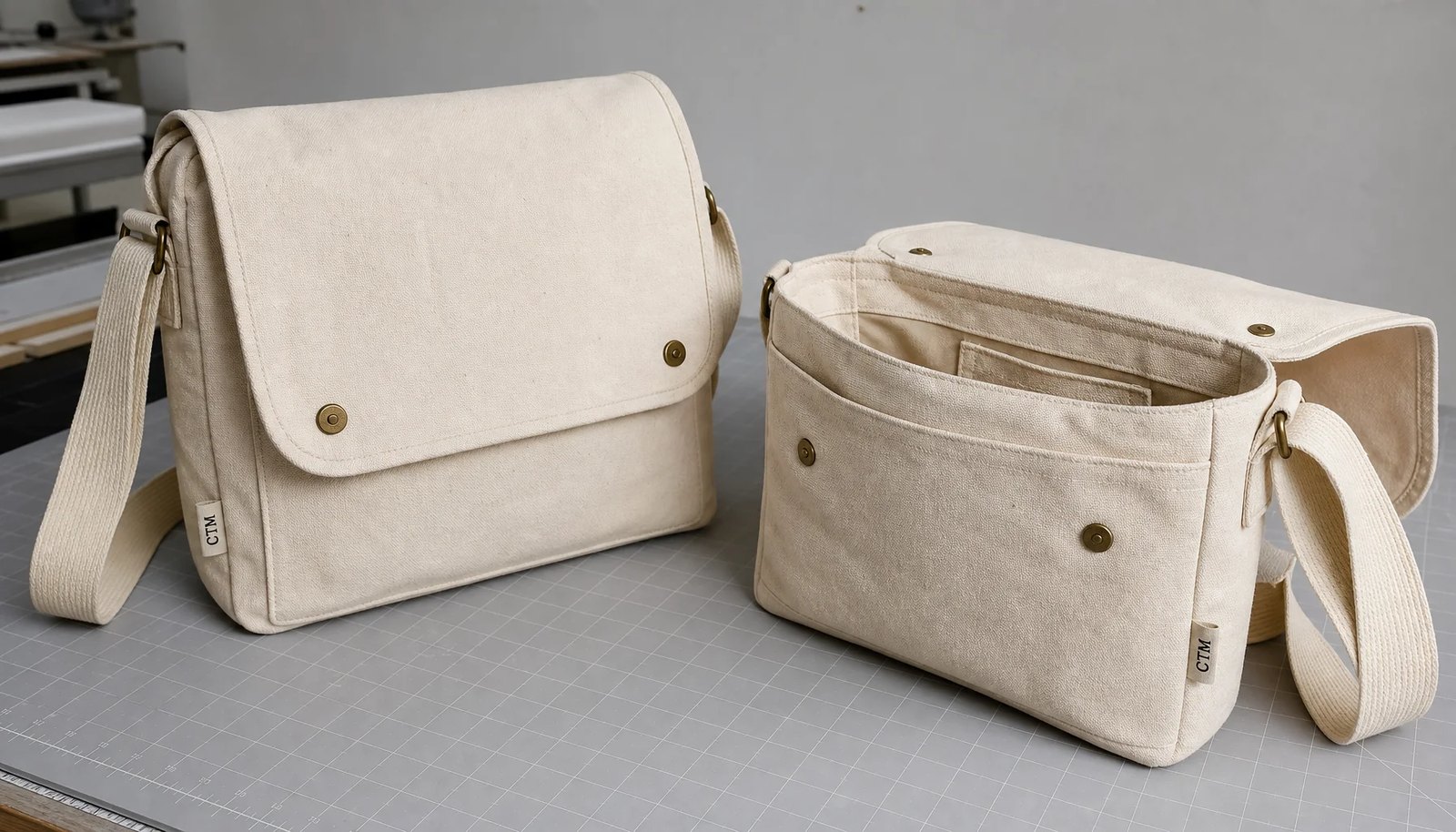
For university bookstores, the safest specification is usually a clean canvas body, flap closure, adjustable shoulder strap, one inside slip pocket, reinforced strap attachments, and one clear front logo position. If the bookstore needs a higher retail price point, upgrade the strap, add a woven label, improve hardware, or use heavier fabric before adding too many hidden compartments. Complex internal features create more sewing defects and are harder for receiving teams to inspect.
- Define finished size, not flat cutting size.
- State whether the bag must fit notebooks, a 13 inch laptop, or standard textbooks.
- Confirm strap width, strap length range, and whether the strap is cotton webbing or self-fabric.
- Specify closure type: snap, magnetic button, buckle, Velcro, zipper, or no closure.
- Identify stress points that need bartack or box-stitch reinforcement.
Match the print method to artwork and timing
Spot color screen printing is usually the most reliable method for canvas messenger bags with university logos, bookstore marks, or event graphics. It is cost-efficient for medium and bulk quantities, gives good opacity on natural canvas, and can be inspected quickly during production. The buyer should provide vector artwork, Pantone references, print dimensions, and placement measured from a stable seam or flap edge.
Digital print may help when the artwork has gradients or many colors, but it may not deliver the same hand feel or opacity on coarse canvas. Embroidery gives a premium look but can pucker on lighter fabric and becomes expensive for large designs. Woven labels and patches are useful when the school seal or bookstore identity has small details that would break down in screen print. These components add lead time because they usually require separate proofing and production.
- Screen print: best for 1–3 solid colors and repeat bookstore graphics.
- Embroidery: good for small marks, not ideal for large filled areas on thin canvas.
- Woven label: stable for fine detail and brand consistency across reorders.
- PU or cotton patch: stronger retail look but requires die, stitching, and placement approval.
- Heat transfer: useful for detail, but wash and abrasion performance should be tested.
Understand MOQ logic before comparing supplier quotes
MOQ for canvas messenger bags is not only a factory preference. It is driven by fabric purchasing, cutting efficiency, print setup, label production, hardware minimums, and labor scheduling. A supplier may accept 300 pieces if using stock natural canvas and standard hardware, while the same design in custom dyed canvas with matching strap and custom metal slider may require 800 to 1,000 pieces or more.
When quotes differ sharply, the lower price often hides a specification change. One supplier may quote 10 oz canvas instead of 12 oz, use standard plastic adjusters instead of metal, or exclude woven labels. Another may include export cartons, individual packing, and pre-shipment inspection support. Buyers should compare the quote line by line, not only the unit price.
- Stock natural canvas usually supports lower MOQ and shorter material lead time.
- Custom fabric color increases MOQ because dyeing lots must be efficient.
- Custom woven labels may have their own MOQ separate from bag quantity.
- Screen print setup cost is spread better over 500 pieces than 100 pieces.
- Hardware color changes can add minimums if the finish is not standard.
Build a lead time map with approval gates
A reliable lead time plan separates decision time from production time. Artwork proofing may take two working days if files are clean, or one week if the university licensing office needs to review the logo. Sample making can take several days after materials are ready, but sample transit and buyer approval may take longer than the sewing itself. These approval gates should be visible in the purchase schedule.
For a typical imported order using stock canvas and screen printing, a practical planning model might include artwork proofing, sample production, sample transit, buyer review, material preparation, bulk cutting, printing, curing, sewing, trimming, inspection, packing, export documentation, and vessel or air booking. The factory can compress some steps, but it cannot safely print bulk goods before the artwork and placement are approved.
- Artwork proof and technical confirmation: allow several working days, more if licensing approval is needed.
- Pre-production sample: plan time for making, internal review, shipment, and buyer comments.
- Bulk material preparation: shorter for stock natural canvas, longer for dyed or washed fabric.
- Printing and curing: allow enough time before sewing or packing to avoid smearing and odor.
- Final inspection and packing: schedule before cargo handover, not after the vessel cutoff.
Approve samples like a production tool, not a presentation piece
A messenger bag pre-production sample should represent the bulk order. It should use the final canvas weight, final strap, final hardware, final print method, final logo size, and final packing method whenever possible. A beautiful sample made from substitute fabric can mislead the buyer because bulk shrinkage, color, stiffness, and print behavior may change when the real material is used.
The sample approval record should include clear acceptance notes. If the buyer approves the bag size but changes the print placement, that must be documented. If the print color is approved with a tolerance, state the Pantone reference and acceptable variation under agreed lighting. If the strap feels too short or the flap does not cover enough of the front body, solve it before cutting bulk fabric.
- Measure sample width, height, gusset, flap, strap, pocket, and logo placement.
- Photograph approved details with a ruler for factory and inspection reference.
- Confirm whether sample shrinkage has been considered after washing or finishing.
- Retain one approved sample at the factory and one with the buyer if timing allows.
- Do not approve bulk cutting while artwork, label, or hardware details remain open.
Specify packing for bookstore receiving and shelf handling
Packing is often treated as an afterthought, but bookstore orders need clean receiving and fast inventory handling. A campus store or distributor may need each messenger bag in an individual polybag with barcode sticker, or a paper belly band if reducing plastic is a priority. The outer carton should be strong enough for export handling but not so heavy that store staff struggle to move it.
Canvas messenger bags can crease when packed too tightly, especially if the flap is folded sharply or metal hardware presses into the fabric. For heavier 14 oz and 16 oz bags, carton quantity may need to be lower. If the bookstore sells the bags directly from shelves, the buyer should decide whether straps are tucked inside, folded under the flap, or packed flat to reduce tangling during unpacking.
- Typical master carton quantity may range from 20 to 40 pieces depending on size and fabric weight.
- Set maximum carton gross weight if the warehouse has handling limits.
- Use carton marks that match purchase order, SKU, color, quantity, and destination.
- Place barcode labels where receiving teams can scan without opening every unit if required.
- Add moisture protection for sea freight, especially for natural cotton canvas.
Control quality with measurable thresholds
Canvas has natural texture, so buyers should define which variations are acceptable. Small slubs may be normal in cotton canvas, but oil stains, mildew odor, large weaving defects, and visible dirty marks are not acceptable for retail. For university bookstore stock, the first customer impression matters because the bag often sits near apparel, gifts, or branded school supplies.
Inspection should focus on functional failure points as much as appearance. Shoulder strap joins, flap closures, side seams, bottom corners, and pocket openings carry the most stress. Print placement should be measured from a fixed edge, not judged by eye. Hardware should be opened and closed repeatedly during inspection, and any sharp edge, rust mark, or weak magnetic closure should be treated as a serious defect.
- Dimension tolerance: commonly agreed around plus or minus 0.5 cm to 1 cm depending on part and construction.
- Print placement tolerance: define vertical and horizontal tolerance before bulk printing.
- Stitching: no skipped stitches, broken seams, loose bartacks, or exposed raw edges in critical areas.
- Color: compare fabric and print against approved sample under consistent lighting.
- Odor: reject strong chemical, mildew, or damp storage smell before shipment.
Compare landed cost, not only bag price
A canvas messenger bag that looks cheaper in the factory quote may cost more after freight and handling. Heavier fabric, rigid construction, retail packaging, and low carton efficiency all affect landed cost. If two suppliers quote similar unit prices but one packs 20 pieces per carton and the other packs 40 pieces safely, the freight and receiving cost can differ significantly.
Buyers should request estimated carton dimensions, gross weight, and CBM with the quote. For importers and distributors, this allows comparison between ocean freight, air freight, and courier sample shipments. For urgent bookstore windows, air freight may protect the retail date but can erase margin on heavy canvas bags. A realistic lead time plan should decide early whether the schedule supports ocean freight.
- Unit price: bag body, print, label, patch, hardware, and packing should be separated.
- Freight basis: clarify EXW, FOB, CIF, DDP, or domestic delivery terms.
- Carton data: request carton size, pieces per carton, gross weight, and total CBM.
- Inspection cost: decide whether third-party inspection is required before shipment.
- Reorder value: a slightly higher first order cost may be better if specs are repeatable.
Specification comparison for buyers
| Spec decision | Recommended option | When it fits | Buyer risk to check |
|---|---|---|---|
| Main fabric weight | 12 oz / about 400 GSM cotton canvas for standard bookstore programs | Good balance for daily campus use, book weight, screen printing, and foldable bulk packing | If quoted as only “canvas” without oz or GSM, suppliers may substitute lighter 10 oz fabric |
| Heavy-duty fabric upgrade | 14–16 oz / about 475–540 GSM canvas with reinforced stress points | Premium alumni gifts, laptop messenger bags, higher retail price points | Heavier fabric increases sewing time, carton weight, freight cost, and may require longer fabric preparation |
| Printing method | Spot color screen print for bookstore logos and simple school artwork | Best for 1–3 color logos, good opacity on natural or dyed canvas, efficient for 500+ pieces | Pantone tolerance and print placement must be approved before bulk printing |
| Small-detail branding | Woven label or PU patch plus simple front print | When the logo has fine lines, school seal details, or the buyer wants a more retail look | Labels and patches add component lead time and need separate artwork approval |
| MOQ planning | 300–500 pieces for basic stock fabric; 800–1,000+ pieces for custom dyed canvas | Works for one campus store, seasonal bookstore promotions, or distributor replenishment | Low MOQ may force stock fabric colors, limited hardware choices, or higher unit cost |
| Sample route | Pre-production sample using final fabric weight, strap width, hardware, and print size | Required before bookstore PO release or before bulk fabric cutting | A sample made from substitute fabric can hide shrinking, color, and sewing problems |
| Packing method | 1 piece per recyclable polybag or paper belly band, 20–40 pieces per export carton | Suitable for bookstore receiving, inventory labeling, and shelf replenishment | Overpacked cartons can crease flaps, deform straps, or exceed campus receiving limits |
| Lead time buffer | Add 10–14 calendar days after approval for artwork changes, component delays, or inspection rework | Important for back-to-school, orientation, alumni weekend, and holiday retail windows | A quote showing only production days may exclude sampling, approval, export booking, and inland delivery |
Buyer checklist before sampling
- Define the retail event date, required warehouse arrival date, and latest acceptable ship date before discussing production lead time.
- Specify canvas weight in oz and GSM, not only “heavy canvas” or “cotton canvas”.
- State bag dimensions, flap depth, gusset, strap width, handle option, hardware type, inner pocket, and reinforcement requirements.
- Provide final logo file in vector format with Pantone references, print size, placement, and whether artwork can be adjusted for fabric texture.
- Separate MOQ expectations for plain stock fabric, custom dyed fabric, woven labels, patches, and special hardware.
- Require a pre-production sample using final materials, final printing method, and final packing style before bulk approval.
- Add approval deadlines to the purchase order so sample feedback does not consume the production window.
- Define packing by unit, inner carton if needed, master carton quantity, carton marks, barcode labels, and maximum carton weight.
- Set inspection criteria for print placement, seam strength, strap attachment, hardware function, stains, odor, and needle damage.
- Request a quote that separates bag cost, printing cost, label or patch cost, sample charge, packing cost, export carton cost, and freight basis.
Factory quote questions to send
- What canvas weight will be used in oz and GSM, and is it stock fabric or newly woven fabric?
- Is the quoted fabric greige, bleached, natural, dyed, or garment washed, and what shrinkage should we expect?
- What MOQ applies to the bag body, custom color fabric, strap color, hardware finish, woven label, and printed artwork?
- How many days are needed for artwork proof, material sourcing, sample making, sample transit, bulk cutting, printing, sewing, packing, inspection, and export handover?
- Will the pre-production sample use final fabric, final strap, final hardware, final print inks, and final packing?
- Which print method is quoted, what is the maximum print area, and how many colors are included?
- What are the tolerances for bag dimensions, print placement, Pantone color, and seam allowance?
- How many pieces per carton, what is the estimated carton size and gross weight, and can cartons meet our warehouse receiving limits?
- What inspection standard will be used before shipment, and how are critical, major, and minor defects classified?
- What quote validity period applies, and which cost items may change if fabric, exchange rate, or freight conditions change?
Quality-control points to confirm
- Fabric weight: verify finished fabric weight against approved sample, with acceptable variation agreed before production.
- Dimensions: measure body width, height, gusset, flap depth, strap length, and pocket size against approved tolerance.
- Print quality: check opacity, registration, edge sharpness, rubbing resistance, cracking, and placement from flap edge or seam line.
- Stitching: inspect seam density, skipped stitches, broken threads, loose ends, and backtacking at strap and flap stress points.
- Reinforcement: confirm bartacks or box stitches at shoulder strap joins, handle joins, D-rings, and pocket stress areas.
- Hardware: test snaps, magnetic buttons, buckles, sliders, zippers if used, and check finish consistency.
- Cleanliness: reject oil stains, mildew odor, heavy dust, insect marks, fabric slubs outside agreed standard, and dirty packing.
- Packing: confirm unit packing, barcode placement, carton marks, carton strength, carton count, and moisture protection for sea freight.