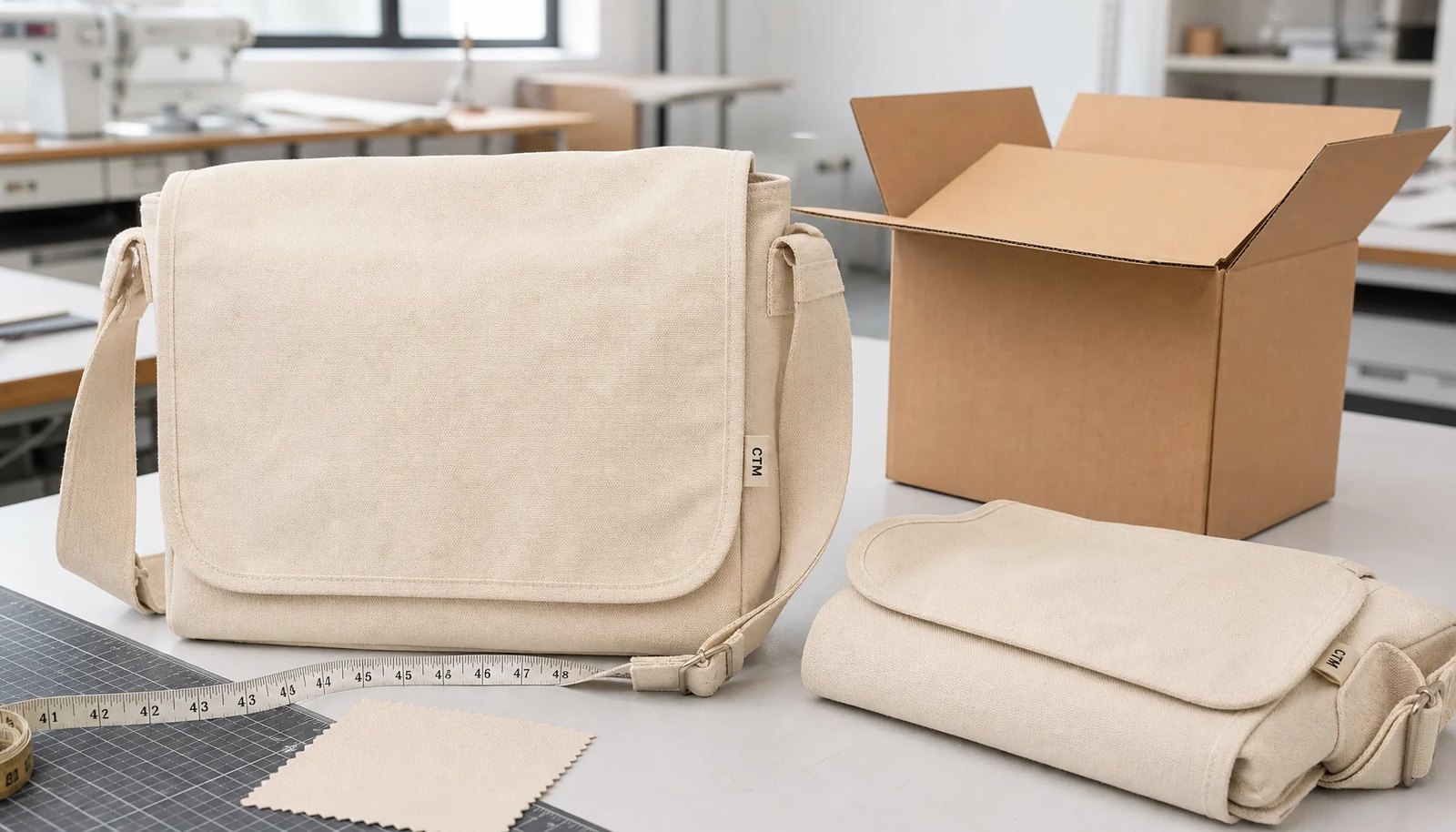
Start Carton Planning Before the Bag Is Priced
For canvas messenger bags for university bookstores, carton planning should start at the same time as the bag specification. A buyer who only sends bag size, logo artwork, and quantity will receive quotes that look comparable on unit price but may be very different in freight cost and receiving effort. The same 12 oz canvas bag can be packed at 20 pieces per carton or 40 pieces per carton depending on gusset depth, strap folding, inner packaging, and how stiff the flap is after sewing.
University bookstore orders often move through more than one handling point: factory packing, export warehouse, forwarder, campus receiving dock, store stockroom, and sometimes e-commerce fulfillment. If the carton is too heavy, too tall, poorly marked, or filled with tangled straps, the bookstore absorbs the labor. A useful RFQ should treat the carton as part of the product, not a shipping afterthought.
- State the expected selling channel: shelf display, online fulfillment, orientation kit, or departmental distribution.
- Request carton quantity, gross weight, net weight, carton dimensions, and estimated CBM with the first quotation.
- Require one packed sample approval when the order is larger, multi-SKU, or routed through a bookstore warehouse.
- Avoid comparing factory quotes only by FOB unit price when the carton cube is missing.
Choose Canvas Weight Around Use and Carton Cube
Canvas messenger bags usually become more expensive and more difficult to pack as fabric weight increases. For bookstore retail programs, 10 oz cotton canvas can work for a value item, but it may feel light if buyers expect students to carry books, tablets, chargers, and notebooks. A 12 oz canvas, roughly 380-420 GSM depending on mill and finishing, is often a practical middle point. It gives a more substantial hand feel without making the carton too heavy too quickly.
A 14 oz or heavier canvas can improve perceived durability, but the buyer should calculate carton consequences. Thick canvas folds less flat, creates bulk at the flap and bottom corners, and may force a lower case pack. If the bookstore wants a premium messenger bag, that may be acceptable. If the program needs 3,000-10,000 pieces for orientation or seasonal retail, the extra cube can change freight cost, warehouse space, and pallet count.
- Use 10 oz canvas for price-sensitive programs where the bag carries light books or promotional materials.
- Use 12 oz canvas for most bookstore retail messenger bags requiring stronger body and better shelf presence.
- Use 14 oz canvas only when premium feel, heavier load, or brand positioning justifies lower carton efficiency.
- Ask the factory whether quoted GSM is before or after washing, dyeing, coating, or shrinkage control.
Match Bag Construction to Bookstore Handling
A messenger bag for a university bookstore needs different construction from a simple flat promotional tote. The strap connection carries most of the load, especially when students add textbooks or a laptop. Strap tabs should be reinforced with bar tack, box stitch, or a strong folded seam design. The flap should cover the opening well enough to protect contents but not create a thick roll when folded into the carton.
The most common mistake is designing a large gusset without considering folding. A deep gusset helps the bag stand fuller on display and carry more items, but it adds side-panel bulk. If the gusset is stiff and the flap is wide, the carton may need a lower piece count. Buyers should approve a sample with the same fabric weight, same strap, same hardware, and same folding method planned for bulk production.
- Specify finished dimensions, not only panel dimensions, because sewing and pressing change the final shape.
- Define strap length range if the bag must fit both shoulder and crossbody wearing.
- Require reinforcement at strap tabs, flap corners, and bottom stress points.
- Avoid oversized metal hardware if freight weight and carton scratching are concerns.
Select Logo Method With Packing in Mind
For university bookstore canvas messenger bags, screen printing is usually the most efficient logo method when artwork uses one to three solid colors. It gives good coverage on cotton canvas and supports bookstore branding at a controlled cost. The buyer should provide Pantone references, print size, print position, and artwork files early. On textured canvas, small type and thin lines can fill in, so the factory should review artwork before confirming the print proof.
Packing affects logo quality after production. If the print sits on the flap and bags are folded tightly before the ink has fully cured, blocking or surface marks can appear. If metal adjusters rub against the printed area during shipment, scratches may show when the bookstore opens the carton. For repeat programs, a woven CTM-style side label or school brand label can reduce large print risk, but it needs additional MOQ and lead time planning.
- Use screen print for flat school marks, event logos, and bookstore private-label artwork.
- Use heat transfer only after testing adhesion and hand feel on the chosen canvas texture.
- Use embroidery selectively because it adds cost, backing, and possible puckering on lighter canvas.
- Use woven labels for repeat retail programs where a small branded detail is enough.
Set MOQ Logic by Fabric, Logo, and Packing Version
MOQ is not only about total order quantity. A factory may quote 1,000 pieces, but the practical MOQ can change if the buyer needs three fabric colors, two bookstore logos, separate barcode stickers, and different carton marks for multiple campus locations. Each variation creates setup work in cutting, printing, label control, packing, and carton marking. A low total quantity split into many versions can produce higher unit cost and more packing errors.
Procurement teams should build the RFQ around SKU logic. If the bookstore needs navy, natural, and black canvas with the same logo, group the quantity by color. If each campus needs its own logo, list logo version by color and destination. If the same bag ships to a central bookstore warehouse, one carton mark format may be enough. If cases ship directly to campus stores, carton marks and packing lists should reflect receiving requirements.
- Separate MOQ by fabric color, print version, woven label, and carton mark.
- Use one shared canvas color when order quantity is small and brand control allows it.
- Consolidate artwork versions if the price gap is caused by printing setup rather than sewing.
- Request surcharge details for low-quantity color splits instead of accepting a vague MOQ statement.
Build the Carton Specification From Real Handling Limits
A practical export carton for canvas messenger bags should protect the product and still be easy for bookstore teams to receive. Many buyers target cartons under about 18-22 kg gross weight because heavier cases are harder to lift, more likely to be dropped, and less friendly to campus stockrooms. The right case pack depends on fabric weight, bag dimensions, gusset, hardware, and whether the bag is individually polybagged, paper wrapped, or simply bundled.
Carton cube can be more important than carton weight for messenger bags. A bulky folded bag may create light but oversized cartons, which affects air freight, courier rates, and warehouse space. For sea freight, CBM drives part of the landed cost calculation. The RFQ should require estimated carton dimensions before order placement and final carton dimensions before shipment so the importer can compare freight scenarios accurately.
- Set a preferred gross weight limit for manual handling and campus receiving.
- Use consistent case packs such as 20, 24, 30, or 40 pieces where possible for faster counting.
- Avoid mixed colors inside one carton unless the bookstore specifically needs assortment cartons.
- Require carton burst strength or double-wall carton construction if bags are heavy or cartons are stacked high.
Approve Samples as a Packed System
A loose messenger bag sample can pass appearance review while the packed goods fail operationally. The buyer should approve the bag, inner packing, fold, strap placement, barcode location, carton mark, and carton fit together. This is especially important when the bookstore plans to scan items into inventory, add price labels, or ship individual bags through an online store. A strap folded across the barcode or a thick flap crease through the logo can create avoidable labor.
A useful sample approval process has three stages. First, a material and construction sample confirms canvas weight, color, strap, and hardware. Second, a logo proof confirms print position and color. Third, a packed pre-production sample confirms how the finished item will arrive. For tight deadlines, the buyer can combine stages, but skipping packed sample review increases the chance of repacking or receiving delays.
- Photograph the approved fold and require the factory to follow it in bulk packing.
- Test whether the print surface touches hardware, zipper pulls, or rough strap edges inside the package.
- Confirm barcode and price label position before mass packing starts.
- Keep one approved sample at the factory and one with the buyer for final inspection reference.
Use QC Thresholds That Fit Canvas Messenger Bags
Canvas has natural slubs and small texture variation, so QC standards should distinguish acceptable fabric character from true defects. Buyers should reject oil stains, major shade panels, broken yarn holes, severe weaving flaws, print smears, and visible sewing defects. Small natural cotton specks may be acceptable on undyed canvas if the approved sample shows the same material character. This standard should be written before inspection, not debated after production.
Functional QC matters more for messenger bags than for flat pouches. Strap pull strength, seam security, flap alignment, bottom corner reinforcement, and hardware function should be included in inspection. If the bag is intended to carry books or a laptop, the buyer can define a practical load test using a sample weight and hanging time. The goal is not to over-engineer the product, but to prevent strap failure and obvious returns.
- Measure finished dimensions across several cartons and record variance against agreed tolerance.
- Inspect print curing by rub test after production, especially for dark ink on natural canvas.
- Check bar tacks and box stitches at stress points for skipped stitches and loose thread.
- Open random cartons to verify count, color, logo version, label, and carton mark accuracy.
Compare Quotes by Landed Cost, Not Only FOB Price
Two factories can quote the same canvas messenger bag with a small FOB price difference, but the higher unit price may still land cheaper if the carton plan is better. A cleaner fold, higher case pack, lower cube, and fewer receiving problems can reduce total cost. For importers and distributors, the quote should include unit price, sample charge, mold or screen setup if any, carton dimensions, gross weight, net weight, pieces per carton, CBM per carton, and estimated CBM per 1,000 pieces.
The landed-cost comparison should also include internal labor. If one supplier individually polybags each bag with barcode sticker and carton mark by SKU, while another ships bulk-packed bags that require repacking, the cheaper quote may not be cheaper for the buyer. Bookstore buyers often have limited backroom space and staff time. A supplier that provides accurate packing data and consistent carton labeling reduces operational cost, even if the unit price is not the lowest.
- Calculate estimated freight per piece using carton CBM and gross weight, not only order quantity.
- Include local labeling, repacking, and inspection labor when comparing supplier quotes.
- Request photos of a packed carton before production is released for shipment.
- Flag unusually high carton cube or unusually low carton weight because both can signal packing assumptions that need review.
Control Lead Time Around Artwork and Packing Data
Lead time for canvas messenger bags usually depends on fabric availability, dyeing or washing, logo proofing, label production, cutting, sewing, printing, packing, and final inspection. A natural canvas bag with one-color screen print can move faster than a dyed canvas bag with woven labels, multiple print colors, and separate campus carton marks. Buyers should not treat all messenger bag programs as the same schedule simply because the shape is familiar.
The critical path often starts before production. Delayed logo approval, missing Pantone codes, unclear barcode files, or late carton mark instructions can hold the factory even when fabric is ready. For university bookstore seasons, late shipment can miss orientation, homecoming, or semester-start demand. The RFQ should ask for a schedule with approval deadlines, not only a production lead time counted after deposit.
- Separate sampling lead time from bulk lead time in the quote.
- Provide final artwork, barcode files, carton mark template, and PO details before production scheduling.
- Allow extra days for dyed canvas, washed canvas, woven labels, or multi-SKU packing.
- Request a production status update at fabric arrival, print approval, sewing start, packing start, and final inspection.
Specification comparison for buyers
| Spec decision | Recommended option | When it fits | Buyer risk to check |
|---|---|---|---|
| Canvas body fabric | 12 oz cotton canvas, roughly 380-420 GSM, pre-shrunk if heavy logo coverage is required | Good balance for bookstore merchandise, student daily use, and stable carton compression | Too light feels promotional; too heavy increases carton weight and may reduce units per carton |
| Messenger bag structure | Flat flap style with gusseted main compartment and reinforced strap tabs | Works for books, tablets, orientation packs, and retail display without excessive bulk | Deep gussets can distort when folded and increase carton cube more than buyers expect |
| Logo method | Screen print for one- to three-color school marks; woven side label for repeat retail programs | Best for university bookstore logos where color control and unit cost both matter | Large print on thick canvas needs ink deposit approval; labels need artwork lead time |
| Folding method | Flap folded flat, strap tucked inside, polybag or paper band used only if required by retail handling | Keeps cartons neat and reduces strap tangling during bookstore receiving | Loose straps create messy cartons and can snag during barcode labeling |
| Inner packing | Individual clear polybag with suffocation warning, or kraft paper wrap if plastic reduction is specified | Polybag fits online fulfillment and shelf stock; paper wrap fits sustainability positioning | Paper wrap protects less against dust and moisture during sea freight |
| Master carton size | Keep cartons under about 18-22 kg gross weight and avoid oversized cube from thick gussets | Helps bookstore receivers handle cases without repacking and supports pallet stability | Large light cartons look cheap to ship by sea but become costly by air or courier |
| Case pack quantity | 20-40 pieces per carton depending on fabric weight, gusset, hardware, and folding method | Allows practical receiving counts and manageable carton weight for campus stores | Choosing case pack only by unit price can cause high freight, crushed bags, or split cartons |
| Sample approval | Approve full packed sample: bag, fold, barcode position, inner pack, carton mark, and drop-test-ready carton | Best for programs with store distribution, online orders, or multiple campus locations | Approving only the loose bag misses carton fit and receiving workflow problems |
| Quote comparison | Request FOB unit price plus carton dimensions, gross weight, net weight, CBM, MOQ, and lead time | Lets procurement compare true landed cost instead of only factory unit price | A low unit price may lose advantage if carton cube, rework, or short packing data is poor |
Buyer checklist before sampling
- Define the intended use: retail sale, orientation gift, alumni shop item, online bookstore order, or department program.
- Specify canvas weight in ounces or GSM and clarify whether the fabric should be natural, dyed, washed, or color-matched.
- Confirm messenger bag dimensions by use case, including laptop/tablet fit, book thickness, flap coverage, and gusset depth.
- State logo method, logo size, placement, Pantone references, and whether print tolerance or label artwork approval is required.
- Set minimum seam reinforcement requirements at strap tabs, flap corners, bottom corners, and handle or shoulder strap joins.
- Decide if each bag needs a barcode sticker, hangtag, price tag, care label, woven side label, or campus bookstore SKU label.
- Approve one packed sample, not only one loose production sample, before mass production starts.
- Require carton dimensions, gross weight, net weight, carton quantity, CBM, and packing photos in the formal quotation.
- Choose a case pack that supports bookstore receiving counts and does not exceed practical manual handling weight.
- Include carton mark wording, PO number, SKU, color, quantity, country of origin marking, and any retail routing details.
Factory quote questions to send
- What canvas weight, measured in oz or GSM, is included in the quote, and is it greige, natural, dyed, washed, or pre-shrunk?
- What are the finished bag dimensions, gusset depth, strap length range, flap width, and dimensional tolerances after sewing?
- Which logo method is quoted, how many print colors are included, and what is the maximum print area before price changes?
- What is the MOQ by fabric color, logo version, label version, and carton mark, not only the total order quantity?
- How many pieces are packed per inner carton or master carton, and what are the estimated carton dimensions and gross weight?
- Can you provide a packed sample photo showing folding method, strap placement, polybag or paper wrap, barcode position, and carton fit?
- What seam reinforcement is included at the shoulder strap connection, and can you add bar tack or box stitch if required?
- What is the sampling lead time, bulk production lead time after approval, and latest artwork approval date for the ship window?
- Which quality checks are performed during fabric inspection, printing, sewing, trimming, packing, and final carton inspection?
- What quote validity, payment terms, Incoterm, port of loading, and estimated CBM per 1,000 pieces are included?
Quality-control points to confirm
- Canvas weight should match the approved standard within the agreed tolerance, commonly around plus or minus 5 percent unless otherwise specified.
- Finished bag dimensions should be checked after sewing and pressing, not from fabric panels before assembly.
- Logo color, registration, placement, ink coverage, and curing should match the signed print proof or approved pre-production sample.
- Strap attachment should pass a practical pull test appropriate for the expected book or laptop load, with no skipped stitches or fabric tearing.
- Flap alignment, gusset symmetry, bottom corner shape, and strap length adjustment should be checked across several cartons, not only top samples.
- Loose threads, oil marks, needle holes, fabric slubs, and shade variation should be sorted against an agreed AQL level.
- Inner packaging should protect the print surface from rubbing, strap hardware, and dust without causing deep fold marks.
- Cartons should be dry, correctly marked, consistently packed, and strong enough for stacking during export handling.
- Random carton counts should match the packing list, SKU label, and PO quantity before the shipment leaves the factory.