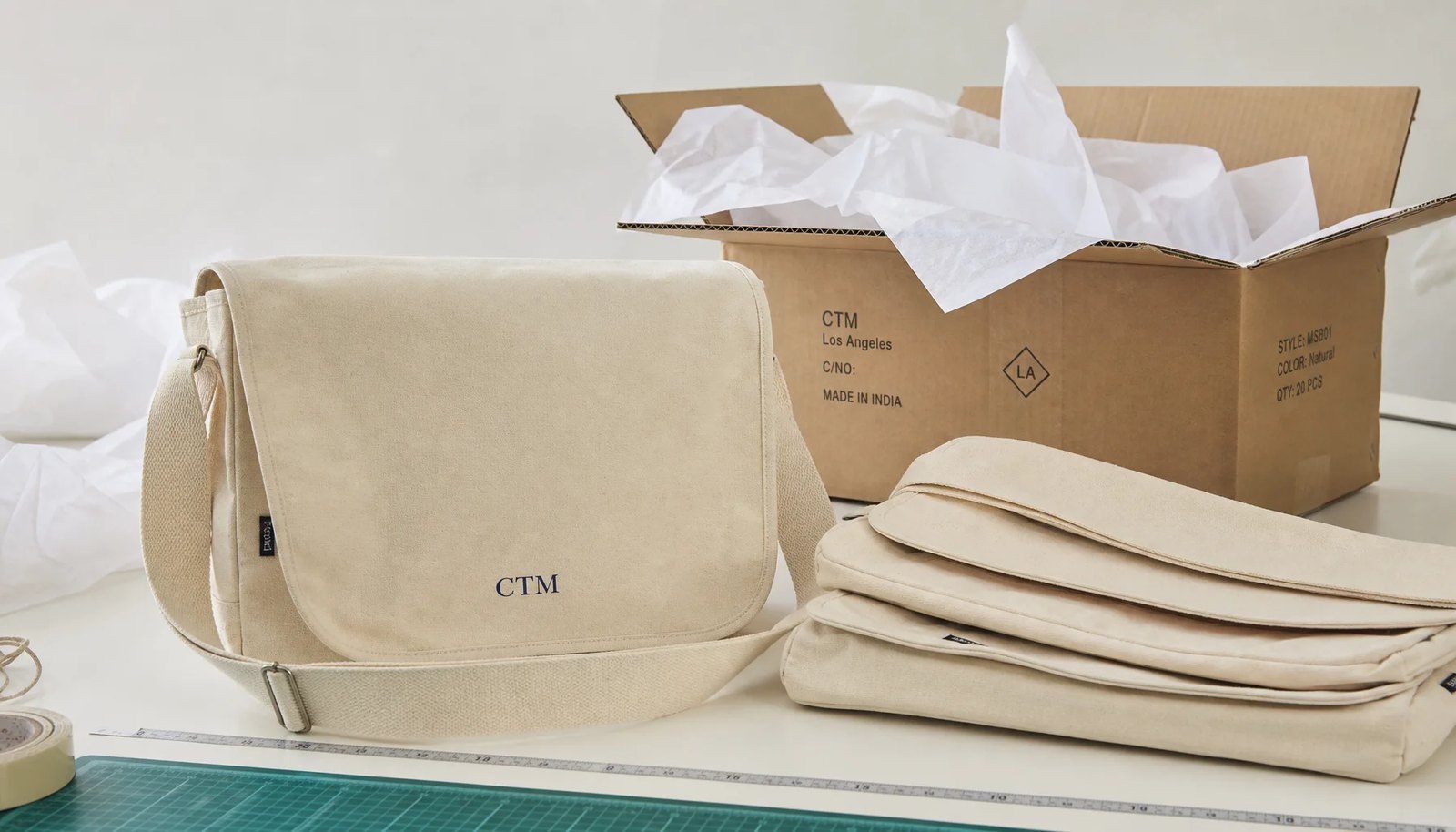
Start With Carton Economics, Not Only Unit Price
For university bookstore procurement, canvas messenger bags have to work twice: first as retail merchandise, then as packed freight. A sample can look excellent on a buying table and still become a poor order if the carton is oversized, overweight, weak, badly marked, or packed in a way that damages the flap before the product reaches the campus store. Messenger bags are less cube-efficient than flat totes because they include a flap, long adjustable strap, strap hardware, gusset depth, closure, and sometimes inner pockets or lining. Those parts create empty space when folding is loose. They create pressure marks when the carton is stuffed too tightly.
Treat the carton packing plan as part of the RFQ, not as a warehouse detail to solve after production. Ask suppliers to quote the bag and the carton together: finished dimensions, folding sequence, pieces per carton, carton dimensions, gross weight, net weight, CBM, individual packing, carton marks, and pallet rules if applicable. If the exact sample is not ready, the supplier can mark carton data as estimated, but those figures should be updated after packed-sample or first-carton approval. Without that update, two suppliers with similar FOB prices may deliver very different landed costs. One may ship too much air; the other may compress the product into damage risk.
A useful procurement comparison includes CBM per 1,000 pieces and gross weight per 1,000 pieces. These two figures help freight forwarders and internal teams compare ocean, LCL, air, courier, and consolidated delivery options. They also prevent misleading quote comparisons where one factory proposes 50 pieces per carton and another proposes 80 pieces per carton without explaining fold method, carton strength, or compression risk.
- RFQ minimum: require finished bag spec, fold method, pieces per carton, carton dimensions, gross weight, net weight, and CBM.
- Cost comparison: calculate CBM per 1,000 pieces and gross weight per 1,000 pieces for every supplier quote.
- Damage control: keep metal sliders, snaps, buckles, and rivets away from printed flap artwork during folding.
- Receiving control: define maximum carton gross weight, carton side length, and required carton mark layout before quote approval.
- Approval rule: replace estimated carton data with packed-sample or first-carton data before shipment booking.
Define the Bookstore Use Case Before Construction
A university bookstore messenger bag is not the same product as a thin conference shoulder bag. Students may carry notebooks, a tablet, a hoodie, a drink bottle, and one or two books. Alumni may buy the bag as giftable campus merchandise and judge fabric hand feel, hardware finish, and logo placement. Store staff need an item that displays neatly, scans quickly, and does not arrive with crushed flaps or tangled straps. The specification has to balance carrying function, retail appearance, manufacturing cost, and carton efficiency.
A practical bookstore messenger size often falls around 35-40 cm wide by 28-32 cm high with a 6-10 cm bottom gusset. A flat no-gusset version can reduce cube and cost, but it may feel less useful as a daily campus bag. A 12 oz canvas can work for an entry retail program if reinforcement is good. A 14 oz canvas is a common middle ground for stronger hand feel. A 16 oz canvas can support a more substantial retail impression, but it is heavier, less flexible to fold, and may increase carton cube. If the project needs foam padding, a laptop sleeve, zipper compartment, or structured lining, treat it as a different construction rather than a small add-on.
Write the use case into the product brief. An orientation program may prioritize low cost, stock natural canvas, one-color print, hook-and-loop closure, and bulk master packing. A campus bookstore retail SKU may need an adjustable strap, inside pocket, woven side label, magnetic snap, barcode hangtag, and cleaner individual packing. A premium alumni item may require lining, metal hardware, stitched label, and stricter shelf presentation. These products may share a messenger silhouette, but they should not share the same quote assumptions.
- Entry retail build: 12 oz canvas, unlined body, one-color print, simple flap, reinforced strap anchors, and basic tag.
- Mid-range build: 14 oz canvas, 3.2-3.8 cm webbing strap, magnetic snap, inside pocket, woven label, and controlled folding.
- Premium build: 16 oz canvas, lining, improved pocketing, metal hardware, stitched label, and shelf-ready packing.
- Laptop caution: foam padding and device sleeves change sewing, QC, carton cube, and sample lead time.
- Spec rule: define width, height, flap, gusset, strap, pocket, closure, label, and packing before comparing suppliers.
Write Fabric Weight and Color Standards Precisely
Canvas is often sold by ounce weight, but B2B buyers should also require finished GSM. Ounce terminology is not always used consistently. A supplier may quote 12 oz based on greige fabric, finished fabric, washed fabric, or a local mill convention. Finishing processes such as dyeing, washing, softening, brushing, coating, or lamination can change hand feel, shrinkage, and apparent weight. A reliable specification states the canvas type, weave if known, finished GSM range, tolerance, color reference, finish, and whether the fabric is stock or custom dyed.
A practical line item might read: 14 oz cotton canvas, approximately 470 GSM after finishing, plus or minus 5%, natural color, uncoated, approved by physical swatch. If the buyer accepts recycled cotton blend or cotton/poly canvas, say so directly because fiber mix can affect strength, color, shrinkage, and print appearance. For dyed campus colors, request lab dips and clarify whether the target is a Pantone reference, a prior shipment swatch, or a university brand standard. Digital photos are helpful for communication, but they are not enough for shade approval.
Color control matters even more for assortments and semester reorders. Dark canvas can make white, gold, silver, or light school colors look dull unless the print method uses sufficient opacity or an underbase. Natural cotton may have seed flecks and shade variation that fit a rustic campus look, but those same marks may be unacceptable for a cleaner private-label line. Decide early whether minor slubs and natural flecks are allowed. Then list unacceptable defects such as dye streaks, oil marks, heavy weaving bars, mold, odor, and mixed shade in the same carton.
- Fabric wording: specify finished GSM, tolerance, fiber content, finish, color, and whether fabric is stock or custom dyed.
- Tolerance example: plus or minus 5% GSM is common for sourcing discussions, but the PO should state the accepted range.
- Dark fabric rule: approve a print strike-off on the actual canvas color, not on white fabric or by digital mockup.
- Natural canvas rule: define whether seed flecks, small slubs, and shade variation are acceptable retail character or defects.
- Reorder control: keep swatch card, dye lot note, print strike-off, and prior shipment sample in the SKU file.
Engineer Reinforcement, Strap, and Hardware Details
The highest-risk points on a messenger bag are usually not the flat panels. Failures more often appear at strap anchors, gusset corners, flap corners, closure points, pocket openings, and hardware attachments. For bookstore programs, reinforcement should be specified, not assumed. Ask whether strap anchors use box-X stitching, bartack, double-layer canvas patches, binding reinforcement, rivets, or a combination. Also clarify thread color, stitch density, seam allowance, and whether stress points are inspected in line before final packing.
The shoulder strap needs a defined width and adjustment range. A 3.2-3.8 cm cotton webbing strap is a practical retail range for many messenger bags, although the exact choice depends on bag size and target price. The strap should feel comfortable for daily carry without becoming so bulky that it hurts carton efficiency. Metal sliders often look better than plastic sliders, but they need checks for sharp edges, plating defects, rust, and strap slippage. Plastic hardware can reduce cost and weight, but it may look lower value on a bookstore shelf.
Closure choice affects quality and packing. Magnetic snaps give a cleaner appearance but must align correctly and should not pull the flap off-center. Hook-and-loop is cost-effective, yet it can snag fabric, straps, or paper bands during packing. Zippers and buckles add function, labor, inspection points, and potential hardware marking. Review every hardware decision alongside the fold method. The goal is simple: no metal pressed into printed artwork, no forced flap crease, and no strap tangle when the carton is opened.
- Strap anchor: require box-X plus bartack or another written reinforcement method at both load points.
- Hardware inspection: check sharp edges, plating bubbles, rust marks, slider slippage, rivet tightness, and snap alignment.
- Closure inspection: verify magnetic snaps close naturally and hook-and-loop panels do not snag straps during packing.
- Stress points: inspect flap corners, gusset corners, pocket openings, closure tabs, and strap patches, not only main seams.
- Carton link: position hardware away from logo prints, labels, and visible flap surfaces in the approved fold.
Select Logo and Label Methods by Defect Risk
University bookstore bags often carry licensed campus marks, bookstore private-label logos, department names, alumni artwork, or athletics-related graphics. Screen printing is usually the practical choice for one to three solid colors on cotton canvas. It can give strong coverage and repeatable production when artwork is clean and color count is controlled. Heat transfer can handle more detail or gradients, but buyers should review hand feel, edge lifting, heat sensitivity, and rub resistance. Embroidery can look premium, although it may pucker lighter canvas and creates a raised area that needs protection during packing. Woven labels are useful for subtle branding and repeat programs.
Artwork placement is more complicated on a messenger bag than on a tote. The flap shifts depending on how the bag is filled, folded, and worn. A logo that looks centered on a flat flap panel may look too low once the flap hangs over the body, or too high when the bag is packed. If a magnetic snap or hook-and-loop closure pulls the flap, placement can shift visually. The supplier should show the print position on the finished sample with the bag empty, lightly filled, and folded for packing.
Labeling belongs in the compliance and receiving plan, not only the design file. A barcode on a hangtag must scan and remain unbent after packing. A barcode on a polybag should face the same direction in each carton if the bookstore or distributor scans at receiving. A sewn label should carry correct brand, fiber, origin, and care information if required by the selling market. If university licensing approvals apply, the factory should not change logo size, color, or placement without written approval.
- Screen print: best for solid school logos, low color count, strong opacity, and repeat bookstore orders.
- Heat transfer: useful for detail, but inspect edge lift, cracking, rub transfer, and hand feel on canvas.
- Embroidery: premium, but inspect pucker, backing, thread trimming, and fold pressure around raised stitches.
- Woven label: stable for private label, side branding, and programs where front artwork changes by campus.
- Placement tolerance: define logo centerline, distance from flap edge, and allowed deviation before mass printing.
Build MOQ Logic Around Real Cost Drivers
MOQ is not a single number floating above the specification. It changes with fabric availability, dye lot minimums, strap webbing color, hardware finish, lining, label type, logo setup, and packing materials. A low MOQ quote may be valid when the supplier uses stock natural canvas, black strap, standard slider, one-color screen print, and master carton packing. A higher MOQ may also be valid when the buyer requests custom dyed canvas, matched webbing, antique brass hardware, woven labels, branded hangtags, and SKU-specific barcode packing. The important point is to know what has actually been quoted.
University bookstore programs are often split by campus, department, design, or season. If four designs share the same base bag and only the one-color flap print changes, a supplier may be able to combine fabric purchasing while separating screen setup and barcode labels. If each SKU uses a different canvas color, strap color, logo method, and hangtag, MOQ will likely be separate. Ask which components can be combined across SKUs and which ones trigger a new minimum.
Overruns and underruns also deserve attention. Licensed merchandise, grant-funded programs, and department budgets may require tighter quantity control than generic promotional orders. If exact quantities are required by SKU, state that early and ask whether the factory can support it. For reorders, confirm whether the same screen, label, hardware finish, carton mark format, and fabric shade can be repeated, and whether any component has to be repurchased at a new minimum.
- Low-MOQ path: stock canvas, stock strap, standard hardware, one-color print, no lining, and simple master carton packing.
- Higher-MOQ path: custom dyed canvas, custom strap, special hardware finish, lining, woven label, and retail packing.
- Assortment rule: ask which SKUs can share fabric and which changes create separate material minimums.
- Quantity control: confirm overrun and underrun tolerance by SKU before issuing a licensed merchandise PO.
- Reorder rule: confirm whether screens, trims, carton marks, barcode files, and swatches will be retained for the next semester.
Create a Quote Table That Separates Product, Packing, and Freight Data
A strong supplier quote separates the product cost from artwork, labeling, packing, and logistics data. FOB unit price alone is not enough for a bookstore buyer, importer, or distributor. The quote should show bag construction, fabric, logo method, trim, individual packing, master carton packing, carton dimensions, gross weight, net weight, and CBM. It should also list sample cost, screen charges, mold or plate charges if any, label charges, retail packing surcharges, and any cost difference between plastic and paper-based packing.
Ask suppliers to state carton data clearly: pieces per carton, carton length, width, height, gross weight, net weight, and CBM per carton. Then convert that into CBM per 1,000 pieces and gross weight per 1,000 pieces. This normalizes quotations when suppliers propose different carton counts. If a supplier copies carton data from a tote or backpack, ask for a revised estimate based on the actual messenger bag with strap, gusset, hardware, and retail labeling.
Retail packing can change cost more than buyers expect. A bag packed loose in a master carton is different from a bag in a recycled polybag with barcode label, hangtag, tissue insert, warning statement where applicable, and inner carton allocation. Plastic-free options such as paper bands or tissue can work, but they still require labor, material control, and protection from hardware marking. Price those requirements at RFQ stage. Adding them after PO release can affect cost, carton count, lead time, and inspection criteria.
- Product quote: fabric, size, construction, strap, hardware, closure, logo method, label, and tolerance.
- Packing quote: individual packing type, barcode position, hangtag method, inner carton, master carton, and carton marks.
- Freight data: pieces per carton, carton size, gross weight, net weight, CBM, CBM per 1,000 pieces, and weight per 1,000 pieces.
- Charge review: separate sample, screen, transfer, embroidery, woven label, hangtag, barcode, and special packing charges.
- Update rule: revise quote data after packed sample approval if carton count or fold method changes.
Approve Samples With a Packing Standard
Many disputes start because the buyer approves the bag but not the packed presentation. A messenger bag can look good when opened, shaped, and photographed, then arrive with crushed flap corners, twisted straps, hardware dents, rubbed prints, or bent hangtags. Sample approval should include both the product and the packing demonstration. At minimum, request photos of the fold sequence, strap adjustment, strap tuck path, closure status, individual packing, carton orientation, carton count, carton label, and sealed carton.
The pre-production sample should use bulk-intended materials whenever possible. If the final product uses 14 oz dyed canvas, metal slider, magnetic snap, woven label, barcode hangtag, and paper band, those details should appear in the pre-production sample. If a substitute is unavoidable, record it in writing. A lighter temporary canvas may fold more easily than bulk fabric. A missing barcode means the scan workflow has not been tested. A temporary plastic slider may hide metal marking risk.
Keep the approved sample and packing record for inspection. Measure the sample after it rests flat rather than immediately after forced folding. Check the bag empty, lightly filled, and folded as packed. If a distributor or bookstore chain has receiving rules, review the packed sample against those rules before bulk cutting or print production. Late packing changes can alter carton quantity, labor time, barcode placement, and shipment booking.
- Sample photo set: front, back, flap, strap anchors, closure, pocket, labels, barcode, hangtag, folded unit, and master carton.
- Packing instruction: use photos plus measurable data rather than vague terms such as standard export packing.
- Substitute log: record any non-bulk fabric, hardware, label, or packing material used in the sample.
- Measurement rule: measure rested samples and record tolerance exceptions before approving production.
- Reference file: keep approved sample, swatch, print strike-off, label proof, carton mark, and packed-carton photos together.
Design Cartons for Bookstore Receiving and SKU Control
A carton plan should start with the way the bookstore or distributor receives inventory. Some campus stores need each bag in a clear polybag with a barcode label for scanning. Others prefer recycled polybags, paper bands, tissue, or no individual plastic. Some want hangtags visible for shelf presentation, while others want tags placed flat inside the bag to prevent bending. A distributor may require carton labels showing PO number, SKU, design code, quantity, carton number, gross weight, net weight, country of origin where required, and destination. Put these rules into the RFQ and PO.
For messenger bags, strap control is often the difference between clean receiving and messy unpacking. The strap should be adjusted to a standard length, folded consistently, and tucked inside the body or along a defined path. Hook-and-loop should be closed or covered so it does not snag the strap or paper band. Metal sliders should not sit directly on printed art. If the bag has a gusset, the fold should protect the bottom corners rather than crushing them flat. If a magnetic snap is used, the flap should close naturally without forcing a crease.
The carton itself should be manageable for receiving and strong enough for the chosen transport mode. Buyers often set a practical maximum gross weight for manual handling; the exact limit should follow the buyer's warehouse or retail DC policy. The supplier should not increase carton count or gross weight without approval just to improve cube. First-carton approval photos should show open-carton orientation, layer count, individual packing, carton label, sealed carton, and measured gross weight.
- Individual packing options: standard polybag, recycled polybag, paper band, tissue wrap, hangtag-only, or no individual packing.
- Orientation rule: all flaps face the same way, straps are tucked, hardware is isolated, and barcode location is consistent.
- Carton marks: include PO, SKU, design/campus code, quantity, carton number, gross weight, net weight, destination, and origin where required.
- Pallet rule: define pallet height, mixed-SKU stacking, carton label visibility, corner protection, and stretch-wrap expectations if used.
- First-carton approval: confirm piece count, dimensions, weight, fold method, label position, and visible compression before mass packing.
Set QC Thresholds for Load-Bearing Retail Bags
Canvas messenger bags are load-bearing products, so inspection has to go beyond appearance. A basic control plan should include incoming fabric and trim inspection, in-line stitching review, print inspection, final measurement, functional load check, barcode verification, and carton inspection. AQL sampling can be used for final inspection, but add special tests for stress points because random visual checks may not reveal weak strap anchors or slider slippage.
Write load test details clearly. State the test weight, duration, how the bag is suspended or carried, and what counts as failure. Buyers may select a test load based on intended retail use and safety margin. Pass criteria should include no strap anchor tearing, no excessive seam opening, no rivet pullout, no slider movement beyond the agreed limit, no flap deformation beyond normal use, and no hardware breakage. If the bag is sold as a casual bookstore messenger rather than a heavy laptop case, avoid overclaiming performance; test to the product's intended use.
Defect classification prevents inspection disputes. Critical defects may include wrong logo, wrong campus mark, unsafe sharp hardware, mold, severe color mismatch, unreadable barcode, and wrong carton mark. Major defects may include weak strap stitching, misaligned flap, dirty visible fabric, damaged print, missing label, wrong folding, wrong quantity per carton, or non-scanning barcode. Minor defects may include small loose threads, slight approved slubs, light removable dust, or small non-visible creases. Decide which defects are repairable and which ones block shipment.
- Material QC: verify GSM, shade, width, odor, moisture condition, slubs, stains, and trim color before cutting.
- Sewing QC: check seam allowance, stitch tension, bartacks, box-X stitching, pocket attachment, flap alignment, and raw edges.
- Print QC: inspect color, opacity, placement, dry rub, scratch resistance, fold-line cracking, and hardware contact marks.
- Functional QC: test load, strap slippage, anchor strength, closure alignment, slider movement, and hardware integrity.
- Carton QC: verify carton count, dimensions, gross weight, barcode scans, carton marks, fold method, and compression damage.
Specification comparison for buyers
| Spec decision | Recommended option | When it fits | Buyer risk to check |
|---|---|---|---|
| Finished fabric weight | 12 oz to 16 oz cotton canvas, commonly specified as about 380-540 GSM finished fabric with an agreed tolerance | Bookstore retail bags intended for notebooks, tablets, hoodies, light textbooks, water bottles, and daily campus items | Ounce claims may refer to greige, finished, washed, or coated fabric; require finished GSM tolerance, approved swatch, and lot shade control |
| Finished bag size | Typical retail messenger range: 35-40 cm W x 28-32 cm H x 6-10 cm gusset, with written tolerance | General university bookstore SKU that needs useful capacity without becoming a padded laptop briefcase | Do not approve only by laptop inch size; confirm actual body, flap, gusset, pocket, and strap measurements |
| Strap construction | 3.2-3.8 cm cotton webbing strap, stated adjustment range, metal slider, box-X stitching plus bartack at anchors | One-size retail product for students, alumni, visitors, and staff | Weak anchors and strap slippage create returns; require load test weight, duration, and pass criteria in writing |
| Logo method | Screen print for 1-3 solid colors, heat transfer for detailed art, woven label or embroidery for premium branding | Licensed campus logos, bookstore private label, alumni merchandise, department programs, and seasonal bookstore drops | Approve artwork on the finished folded flap; flat-panel approval can miss flap sag, closure pull, and fold-line cracking |
| Closure | Magnetic snap for cleaner retail look, hook-and-loop for cost control, or no closure for simplified packing | Magnetic snap suits premium retail; hook-and-loop suits budget or event programs | Magnets, hook-and-loop, and metal hardware can mark fabric or snag straps when folded; test the actual packing path |
| Retail packing | Standard fold photo, strap tucked, barcode facing out, individual polybag/recycled polybag/paper band as required, fixed master carton orientation | Bookstore DCs, campus stores, distributors, and online fulfillment teams needing clean receiving and SKU scanning | Undefined folding changes carton cube, causes mixed presentation, and can create permanent flap creases or bent hangtags |
| Carton plan | Moderate export carton controlled by gross weight target, carton strength, piece count, and stable cube rather than maximum stuffing | Ocean, LCL, air, courier, and retail DC delivery where freight cost and manual handling matter | Overpacking compresses flaps and hardware; underpacking inflates CBM per 1,000 pieces and hides landed cost |
| MOQ drivers | MOQ tied to fabric color, dye lot, strap color, hardware finish, lining, logo method, label type, and packing material | Multi-campus programs, private label assortments, licensed artwork, and semester reorders | A low MOQ may mean stock fabric and stock trim only; confirm which changes trigger a separate minimum |
| Inspection plan | AQL final inspection plus special checks for load, dimensions, print rub, barcode scan, carton count, and packed-carton condition | Importers, distributors, and bookstore buyers shipping into retail receiving systems | Visual inspection alone misses seam strength, wrong carton marks, scan failures, excessive carton weight, and inconsistent fold methods |
Buyer checklist before sampling
- State the finished bag dimensions with tolerance: body width, body height, flap depth, gusset depth, strap width, strap adjustment range, pocket size, and closure position.
- Specify finished fabric weight in GSM or GSM range after finishing; if using ounce terminology, clarify whether it refers to greige or finished fabric and require a swatch approval record.
- Set measurement tolerances before sampling, such as plus or minus 1 cm for main body dimensions and plus or minus 0.5 cm for small features unless the program needs tighter control.
- Confirm all retail requirements: barcode label, hangtag, warning statement where applicable, inner carton, individual polybag, recycled polybag, paper band, tissue, or plastic-free master packing.
- Provide target carton limits before quote comparison, including maximum gross weight, carton dimension restrictions, retail DC label format, pallet rules, and mixed-SKU restrictions.
- Approve logo color on actual bulk-intended canvas because natural, dyed, washed, navy, black, and recycled canvas can change ink opacity and perceived shade.
- Require stress-point reinforcement at strap anchors, flap corners, gusset corners, pocket openings, and closure points; define whether bartack, box-X, double-layer patch, or rivet is included.
- Ask for a loaded bag test with agreed weight, duration, and pass criteria; for bookstore retail, the test should reflect notebooks, a tablet, water bottle, and daily carry use rather than a light display load.
- Require each quotation to show pieces per carton, gross weight, net weight, carton dimensions, CBM, packing method, carton strength, and carton mark format.
- Lock the folding sequence with photos before bulk packing; specify strap length setting, strap tuck path, closure status, barcode position, and hardware separation from printed areas.
Factory quote questions to send
- What finished fabric construction are you quoting: cotton canvas, cotton/poly canvas, recycled cotton blend, organic cotton canvas, washed canvas, or coated canvas?
- What finished GSM range and tolerance are included, and does the quoted ounce weight refer to greige fabric or finished fabric?
- What are the exact finished dimensions for body width, body height, flap depth, gusset depth, strap width, strap length, adjustment range, and inside pocket?
- Which reinforcement method is included at strap anchors and stress points: bartack, box-X, double-layer patch, rivet, binding tape, or a combination?
- What stitch density, thread type, and needle control will be used for the main seams, strap anchors, flap edge, and pocket opening?
- Which logo method is included, how many colors are included, what is the printable area on the finished flap, and what tolerance applies to logo placement?
- Will the logo be printed before sewing or after sewing, and how will you control final alignment after the flap folds over the bag body?
- What closure and hardware are included: magnetic snap size, hook-and-loop size, buckle, slider, rivet, zipper, plating finish, and corrosion or sharp-edge control?
- What individual packing is included: no polybag, standard polybag, recycled polybag, paper band, tissue, hangtag, barcode label, warning label, or inner carton?
- What are the estimated pieces per carton, master carton dimensions, gross weight, net weight, carton material, and CBM per 1,000 pieces?
Quality-control points to confirm
- Finished fabric GSM should match the approved swatch within the agreed tolerance, commonly plus or minus 5% unless a wider tolerance is accepted in writing.
- Main body dimensions should stay within the written tolerance, often plus or minus 1 cm for body width/height and plus or minus 0.5 cm for smaller details such as pocket opening or label position.
- Canvas shade, strap shade, lining shade if any, logo color, and label color should be checked against approved physical references under consistent lighting before cutting and printing.
- Fabric should be clean, dry, and free from mold, oil marks, unacceptable slubs, heavy weaving defects, dye streaks, and odor that would affect retail saleability.
- Stitching should show secure seam allowance, balanced tension, no skipped stitches, no broken thread, no loose bartacks, no raw-edge exposure, and no distorted reinforcement patches.
- Strap anchor load testing should confirm no seam tearing, excessive strap slippage, hardware deformation, rivet pullout, or reinforcement patch failure under the agreed weight and duration.
- Print should pass agreed dry rub, tape pull where suitable for the method, light scratch review, and fold-line check without obvious cracking, peeling, color transfer, or severe ink loss.
- Hardware should be smooth and functional, with no sharp edges, rust, plating bubbles, loose rivets, weak sliders, misaligned snaps, or closure tension that distorts the flap.
- Retail barcodes, hangtags, insert cards, care labels, country-of-origin labels where required, and carton marks should match SKU data and scan correctly before cartons are sealed.
- Cartons should meet the approved piece count, dimensions, gross weight, net weight, orientation, carton mark, and compression condition; mixed folding methods should be treated as a packing defect.