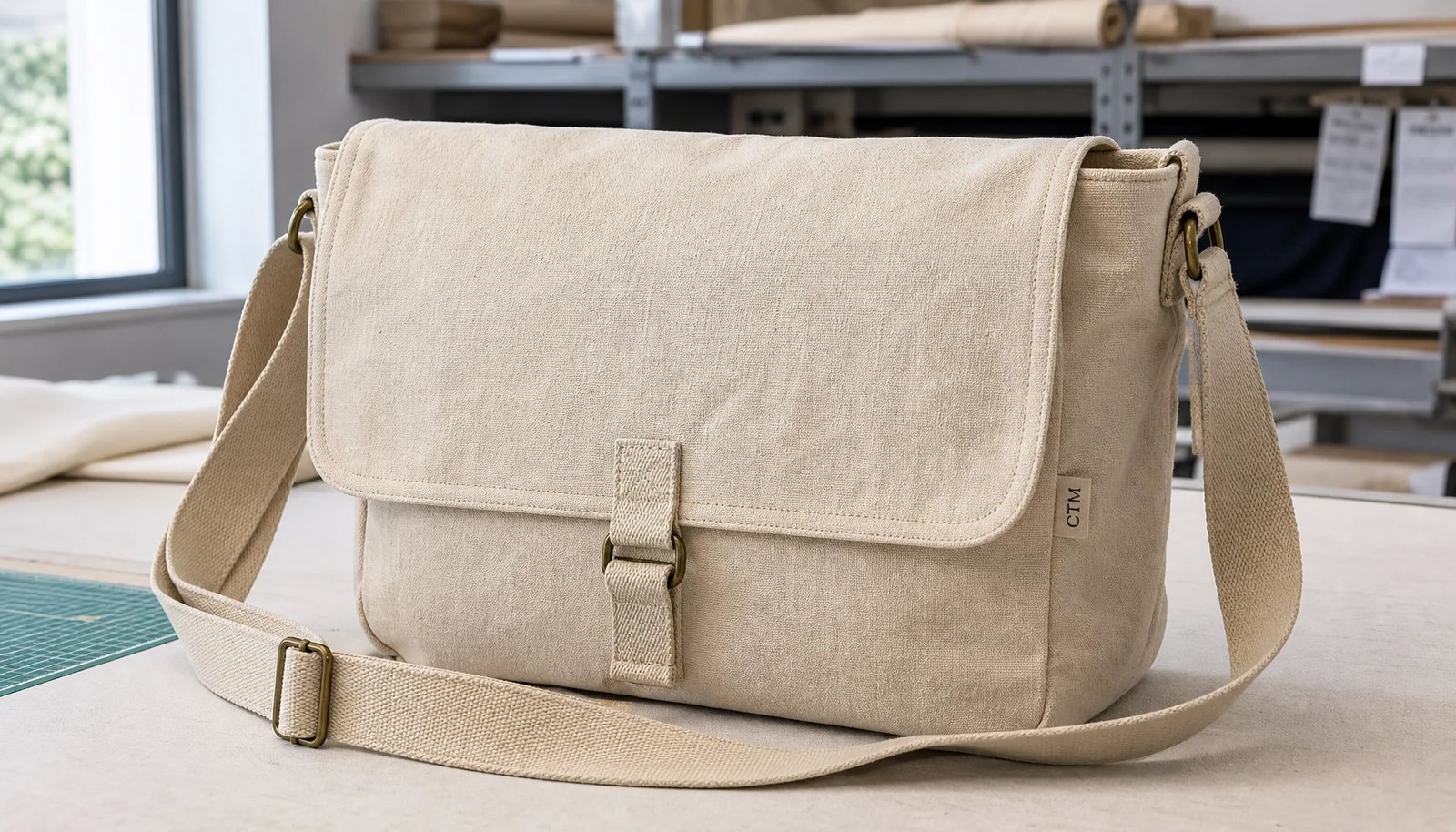
Start With the Event Use Case
For trade show exhibitors, the real buying problem is not only price. The bag has to move catalogs, samples, a tablet, and a few loose items without looking sloppy on the floor. If you start the negotiation by pushing for a lower MOQ, the factory often reacts by protecting itself with a heavier quote or a looser spec. A better opening is to define how the bag will be used, what it must carry, and when it has to arrive. That gives the supplier a basis for a clean proposal instead of a defensive one.
Canvas messenger bags for trade show exhibitors usually sit in a practical middle zone. Light brochure bags can work at 10 to 12 oz, or roughly 340 to 400 GSM, but that range is thin if you expect repeated use or a device inside. For a more durable event bag, 14 to 16 oz canvas is the safer starting point. A buyer who understands the load requirement can negotiate against the right spec, not against a vague product name. That matters because a factory quote for a 12 oz bag and a 16 oz bag should not be treated as the same item.
- Light handout bag: 10 to 12 oz canvas
- General trade show carry bag: 14 oz canvas
- Heavier sample bag or repeat-use bag: 16 oz canvas
- Define the carry load before talking about unit price
Pick a Spec That Still Prints Cleanly
The best trade show bag spec is the one that survives a normal event day, then prints cleanly without pushing the factory into rework. A canvas messenger bag with a simple flap and one main compartment is easier to quote, easier to sew, and easier to inspect than a bag with many hidden pockets and custom inserts. If you need a laptop sleeve, zipper pocket, or organizer panel, keep the design disciplined. Every extra panel adds needle time, material waste, and more chances for alignment drift in bulk production.
The most useful buyer decision is to separate structural needs from marketing needs. Structure includes canvas weight, gusset depth, strap width, closure type, and whether the lining is necessary. Marketing includes logo size, patch style, and whether you need one or two accent colors. A 14 oz bag with a 4 inch gusset, a 1.5 inch webbing strap, and a simple screen print often gives a better cost-to-value result than a lighter but over-designed bag. Ask the factory to quote the functional version first, then the premium version. That exposes the real cost of each feature.
- Use a simple body pattern first, then add features only if they serve the event use
- Keep strap width and bartack placement standard where possible
- Avoid small pockets that increase sewing time but do not improve show-floor utility
- Request separate quotes for lined and unlined versions if you are uncertain
How Factory MOQ Is Really Built
MOQ is usually a combination of several small thresholds, not one magical number. The bag body may be easy to cut, but the canvas roll, lining, webbing, zipper color, label, and print screens each create their own minimum. This is why one supplier may say 300 pieces while another says 1,000 for what looks like the same bag. The difference is often not the sewing line. It is the number of stocked components versus the number of parts that have to be made or reserved just for your order.
A buyer should ask the factory to split the quote into true MOQ and economic MOQ. True MOQ is the minimum the factory can physically make. Economic MOQ is the point where the factory can price the job competitively without paying too much for setup and scrap. If you are buying a 2-color screen print on 14 oz canvas, the factory may accept a lower quantity if you allow a setup fee. If you then change strap color, zipper pull, and inside label, the acceptable quantity can move back up fast. The right negotiation is not always to force a lower MOQ. Sometimes it is to standardize enough parts that the factory can keep the price stable at a moderate quantity.
- Ask which component drives the highest MOQ: fabric, print screen, trim, or packaging
- Treat custom hardware and custom zipper colors as MOQ multipliers
- Separate a first-run MOQ from a repeat-order MOQ if you expect replenishment
- Use the same base pattern across colorways to reduce setup waste
Compare Sourcing Routes Before You Negotiate
A clean quote comparison starts with the route, not just the bag. A stock blank bag printed by a wholesaler is the fastest route, but the least flexible. A direct factory with standard materials gives you better control over stitch quality and trim, while a trading company can help if you need multiple products consolidated into one shipment. Local printing on imported blanks can also work when the event date is tight and the branding requirement is simple. Each route solves a different problem, and each carries a different risk profile.
For trade show buyers, the best route is often the one that matches schedule, not the one that looks cheapest on paper. If you need a branded messenger bag in a narrow window, stock blanks plus a local print partner may reduce delay even if unit price is slightly higher. If your brand will reorder the same bag through the year, a direct factory run usually becomes cleaner because you can lock the spec and avoid handoffs. The wrong route creates hidden cost in the form of reproofing, rework, and freight recovery. That is why buyers should compare supplier type and sourcing logic before they negotiate the number.
- Stock blank plus print: fastest, least flexible
- Direct factory: better for repeat orders and tighter spec control
- Trading company: useful for mixed product consolidation
- Local print on imported blanks: helpful when lead time matters more than full customization
Use the Sample to Protect the Order
A sample is not a formality. It is the only point where you can catch weak assumptions before they become a full production dispute. For canvas messenger bags, review the material hand feel, panel alignment, strap attachment, logo position, pocket depth, and closure function. If the bag is supposed to hold a tablet or a brochure stack, load it during sampling and see how the shape behaves. A messenger bag that looks fine empty can sag, twist, or pull at the strap once weight is added.
The sample approval should include measurable points, not only a visual thumbs-up. Good buyer practice is to lock the body dimensions, strap length, logo placement, and print density against the approved sample. If the print is too dark, the webbing too soft, or the flap too short, the factory should revise before bulk. Do not approve a sample if it already looks like a compromise. You will only get more of the same in production. A small revision at the sample stage is cheaper than a carton of bags that cannot be used at the event.
- Load-test the sample with the actual event contents
- Measure body size, strap drop, and pocket depth against the drawing
- Confirm print position before approving screens or transfer art
- Approve the sample only when material, trim, and construction all match the target use
Choose the Print Method for Event Traffic
For most canvas messenger bags, screen print is still the most practical branding method. It is durable, cost-effective, and easy for the factory to control on a flat canvas panel. A one-color or two-color logo usually gives the best price and the cleanest result. If the artwork has many gradients or small type, the bag can still be printed, but the risk of soft edges goes up. Buyers should look at logo size and viewing distance. A trade show bag is read from a few feet away, so it does not need fine-detail artwork that was designed for a brochure.
Alternative decoration methods have a place, but each adds a different kind of risk. Heat transfer or digital transfer can handle more colors, yet the hand feel may be less premium and the durability can vary by supplier. Woven patches and sewn labels can elevate the bag, but they require good placement control and often cost more than a simple print. If the bag will be reused beyond the event, a woven label plus a restrained print often gives a better brand impression than an oversized graphic. The practical question is not which method is trendy. It is which method survives transport, handling, and repeated use without making the bag look tired.
- Screen print works best for simple logos and controlled unit cost
- Use transfer methods only when the artwork truly needs more color flexibility
- Keep the main logo panel flat and unobstructed
- Test abrasion resistance if the bag will be reused after the show
Set the Packing Plan Before Freight Is Booked
Trade show bags often fail in the last mile, not on the sewing line. The packing plan should be part of the quote because carton count, carton size, and pack ratio affect freight, handling, and event readiness. If bags are going to a distributor warehouse, you usually want bulk-packed master cartons with clear carton marks, a packing list, and a sensible piece count per carton. If they are going straight to a show site, labels become more important than retail packaging. The goal is to make receiving fast and prevent carton opening at the venue.
A strong packing plan also helps the factory protect the product. Canvas bags can pick up dirt or edge crush if they are packed too loosely, yet overpacking can flatten the shape and make inspection harder. For export, it is worth asking about moisture protection, carton strength, and how many pieces per carton keep the gross weight manageable for manual handling. Many buyers forget to include spare pieces for damage, late samples, or replacements. For event goods, a small overage can be more valuable than squeezing the last cent out of the unit price.
- Align carton count with warehouse or show-site handling
- Use carton marks that match the purchase order and packing list
- Keep gross weight practical for manual lifting
- Reserve spare units for damage, show-site replacement, or last-minute requests
Protect the Schedule With a Backward Plan
Lead time for canvas messenger bags should be planned backward from the event, not forward from the PO date. The schedule usually includes artwork approval, sample review, material reservation, production, packing, and freight. If you have a fixed show date, you need a buffer because each stage can slip for different reasons. Fabric shade confirmation, print screen approval, and hardware availability often take longer than buyers expect, especially when the first order introduces a new spec. A quote that looks good but leaves no recovery time is not a good quote.
The biggest schedule mistakes come from mixing design revision with production timing. If the buyer changes the logo position after sample approval, the factory may need a fresh print setup. If the bag spec changes after materials are ordered, the delay becomes even larger. The practical answer is to freeze the critical decisions early: fabric weight, dimensions, print method, and packing method. If some elements must stay flexible, make that explicit in the quote. A split shipment can also help, with part of the order moving by air for the event and the balance by ocean if replenishment is needed later.
- Freeze the critical spec before bulk purchase materials are ordered
- Allow buffer time for sample approval and print setup
- Use split shipping only when the event date justifies it
- Treat artwork changes after approval as schedule risk, not a small edit
Read the Quote Like a Buyer, Not a Browser
The best quote is the one you can compare cleanly. A proper factory quote for canvas messenger bags should show the bag spec, fabric weight, decoration method, MOQ, sample fee, packaging, lead time, and shipping term. If any of those are missing, the unit price may look attractive while the real landed cost is higher. Many buyers focus on the bag price and ignore setup fees, carton charges, or a higher freight class caused by oversized packing. For trade show programs, that can erase the apparent savings very quickly.
When comparing suppliers, make the quote into a landed-cost view. Include freight mode, duties, inland delivery, and any necessary rework or repacking. A direct factory may appear more expensive if it quotes honestly on setup and packing, while a middleman quote can look lower until extra charges appear later. The right question is not which supplier is cheapest. It is which supplier can reproduce the sample, hit the event date, and keep the unit economics stable on the second order. A buyer who pushes for a fair quote structure usually gets a cleaner production relationship than one who only pushes for the lowest headline number.
- Compare unit price, setup fee, sample fee, packing cost, and freight together
- Ask whether the quote is FOB, EXW, or another term before comparing numbers
- Convert every supplier quote into a landed-cost view
- Treat missing detail in the quote as a sourcing risk, not a minor oversight
Negotiate the Order Structure, Not Only the Price
A better negotiation on canvas messenger bags usually starts with structure. If you need a lower MOQ, the factory will be more open when you standardize the canvas weight, use one print location, and keep trim colors within standard stock. You can also negotiate the first order as a trial run with a clear repeat order path. That gives the factory a reason to hold price because there is a realistic second order. If you have different event needs, consolidate them into one base bag with modular changes, rather than asking for three unrelated versions of the same bag.
For buyers managing multiple events or channels, the best leverage is predictability. Share your annual forecast if you have one, even if it is only directional. A factory can often improve pricing when it sees likely replenishment, especially if the initial run is not too fragmented. If the supplier cannot move on price, ask for value instead: better packing, improved seam reinforcement, extra sample photos, or a more stable production slot. Those items matter when the bags are needed on a show floor. A small gain in reliability is often worth more than a tiny unit price cut.
- Lower MOQ becomes easier when the spec is standardized
- A repeat-order forecast can support better pricing
- Ask for value in packaging, reinforcement, or scheduling if the unit price is fixed
- Keep the first run focused so the factory can quote it cleanly
Specification comparison for buyers
| Spec decision | Recommended option | When it fits | Buyer risk to check |
|---|---|---|---|
| Order route | Stock blank bags with origin print from a bag factory or wholesaler | When the event date is close and the body shape is standard | Limited control over exact color, stitch layout, and strap reinforcement |
| Order route | Semi-custom direct factory run using standard canvas, custom print, and small trim changes | When you want a branded bag but do not need a fully unique pattern | MOQ can rise if you change zipper color, lining, or hardware |
| Order route | Fully custom direct factory program with custom pattern and custom materials | When the bag is part of a long-term brand or retail line | Higher setup cost and longer lead time, especially for first production |
| Supplier type | Direct factory with bag specialization | When you need clearer control over material, stitching, and production scheduling | Ask whether the factory actually cuts and sews in-house or only assembles |
| Supplier type | Trading company or consolidator | When you need mixed product sourcing or multiple bag styles in one PO | Margin layering can hide the real factory MOQ and make change requests slower |
| Print method | Single or two-color screen print on canvas | When you want durable branding with a clean price point | Too many colors or fine gradients can lead to soft detail and higher setup cost |
| Print method | Woven patch or sewn label plus small print | When the logo should feel more premium and the bag will be reused after the show | Patch placement must be locked before bulk because movement is easy to spot |
| Packing route | Bulk-packed master cartons with carton marks and spare allowance | When bags are shipping directly to warehouses, reps, or show sites | Poor carton planning creates recounts, damage claims, and missing extras at the event |
Buyer checklist before sampling
- Final use case: brochures only, tablet carry, or sample bag with heavier load
- Target fabric weight in oz or GSM, plus an acceptable alternate range
- Exact logo size, print position, number of colors, and artwork file format
- Target MOQ by color and by decoration method, not just one total number
- Sample approval criteria for dimensions, stitch quality, print alignment, and color
- Packing requirement, carton qty, and whether retail polybags are needed
- Event date, ship-to address, and the latest acceptable delivery window
- Incoterm and the landed-cost line items you want included in the quote
Factory quote questions to send
- What is the MOQ by color, by print color count, and by fabric weight?
- Which parts of the quote are included in the unit price and which are separate setup charges?
- Can you quote the same bag in two fabric weights so I can compare cost and hand feel?
- What sample fees apply, and will the pre-production sample match the bulk material and trim?
- What carton pack, gross weight, and carton dimension do you recommend for trade show shipping?
- What is the production lead time after sample approval, and what usually causes delays?
- Can you share photos of similar messenger bag production, including stitching and print close-ups?
- What tolerance do you hold on strap length, bag size, print placement, and color consistency?
Quality-control points to confirm
- Canvas weight matches the agreed spec, with an acceptable tolerance stated in the PO
- Main seams, side seams, and strap anchors use consistent stitch count and visible bartacks
- Flap alignment, zipper function, and pocket placement are even across the production lot
- Print opacity, registration, and edge sharpness stay within the agreed sample standard
- Bag dimensions remain within a practical tolerance, such as plus or minus 1 cm on body size and strap length
- Handle and strap webbing feel dense enough for the intended load, without twisting or weak edge burn
- Carton counts match the packing list, and outer carton marks are legible and consistent
- Bulk color and label placement stay close to the approved pre-production sample, with no mixed shades in one lot