Start With the Show Logistics
A carton packing plan for canvas messenger bags should start from the trade show delivery route, not from the factory's default carton size. Exhibitor goods often move through more hands than normal retail stock: factory, forwarder, import warehouse, event contractor, booth storage, and finally the show floor. Every extra handling step increases the chance of crushed flaps, dirty natural canvas, mixed cartons, or missing kits.
The buying problem is simple: the bag must arrive looking presentable at a fixed date, and the cartons must be easy for a warehouse or booth team to count, move, and open. A cheaper carton plan can become expensive if staff need to steam bags, wipe marks, relabel cartons, or split cartons in the aisle before a show opens.
- For direct-to-venue delivery, keep carton weight moderate because event receiving teams may handle cartons manually.
- For 3PL distribution, carton marks and SKU labels matter more than decorative retail packing.
- For VIP kits, inner protection and shape control matter more than the absolute lowest freight CBM.
- For booth giveaways, the carton should open cleanly and allow staff to remove bags without unpacking a tangled strap pile.
Define the Bag Around Real Contents
Messenger bags for exhibitors usually carry catalogs, sample cards, notebooks, tablets, badge holders, and sometimes a small product sample. The carton plan depends on the finished bag thickness, and that thickness depends heavily on gusset depth, flap construction, hardware, and strap material. A flat document bag can pack tightly; a structured messenger bag with wide strap, zipper, lining, and magnetic buttons will consume more carton space.
A practical RFQ should include the expected contents or at least the largest item. If the buyer only sends a flat artwork file and says 'standard messenger bag,' suppliers may quote different sizes and packing counts. Those quotes may look comparable on unit price but will not compare fairly on freight, carton handling, or final usability.
- Document-heavy programs usually need about 36 x 28 cm body size so A4 or letter-size materials fit without bending.
- A 6-8 cm gusset is enough for most show kits; deeper gussets increase volume quickly.
- A tablet or laptop requirement may require padding or lining, which changes folded thickness.
- Wide cotton webbing straps feel better but pack bulkier than narrow polyester straps.
- Metal adjusters and D-rings improve durability but need protection from rubbing against printed panels.
Choose Canvas Weight Before Carton Count
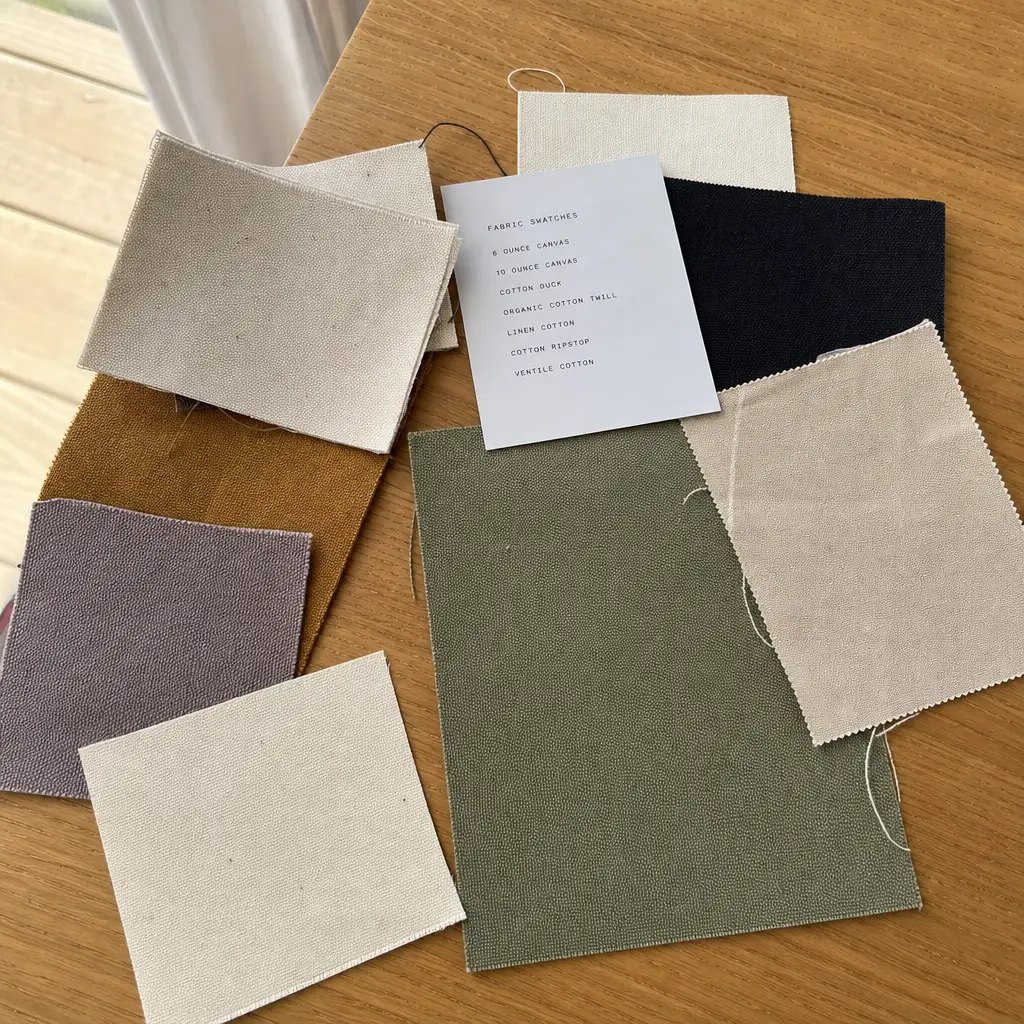
Canvas weight is one of the first carton packing variables. A 10 oz canvas messenger bag can be folded flatter and usually supports higher pieces per carton, but it may feel too light for a premium exhibitor kit. A 12 oz canvas is a common balance for trade show bags: strong enough for repeated use, still manageable for freight. A 14 oz or 16 oz canvas gives a better hand feel and structure, but carton quantity drops and gross weight rises.
Buyers should compare fabric weight carefully because suppliers may quote in ounces, GSM, or casual terms like 'thick canvas.' For cotton canvas, ounce weight and GSM are related but not always exact because width, weave, finishing, and moisture affect the number. The quotation should state the fabric basis clearly and include the tolerance, because a small weight change across thousands of bags affects cost, fold behavior, and carton compression.
- 10 oz canvas: suitable for cost-sensitive giveaways and lighter printed document bags.
- 12 oz canvas: recommended starting point for most custom canvas messenger bags for exhibitors.
- 14 oz canvas: better for retail resale, distributor gifts, and heavier show materials.
- 16 oz canvas: premium feel, but confirm sewing capability, needle marks, carton weight, and fold creases.
- Natural canvas may show dirt more easily than dyed canvas, so packing cleanliness becomes more important.
Match Print Method to Packing Risk
Logo decoration is not only a branding decision. It changes how the bag should be packed. A large screen print on the front flap may look clean and economical, but the printed face needs proper curing time and surface protection before bags are stacked. If the factory packs too soon, ink can transfer to the back of the next bag or leave pressure marks. This is especially visible on natural canvas and dark solid logos.
Heat transfer can reproduce detailed artwork, gradients, or small sponsor logos, but it may create a different hand feel and needs temperature control. Embroidery adds perceived value, yet it pulls on fabric and can make the panel less flat for packing. Woven labels or sewn patches work well for subtle branding, but label placement must avoid fold lines and strap contact points.
- Use screen print for one to three solid logo colors and medium-to-large front flap artwork.
- Use heat transfer when artwork includes fine detail, gradients, or many colors.
- Use embroidery on heavier canvas, smaller logos, and premium programs where raised texture is desired.
- Use woven side labels when the buyer wants low-key branding and faster bulk packing.
- Require a print rub check before packing and again after one sample carton has been closed for 24 hours.
Build a Carton Quantity That People Can Handle
For medium canvas messenger bags, a realistic starting point is often 20 to 30 pieces per master carton. The final number should come from a real packed sample, not from an old carton template. Messenger bags have straps, flap seams, hardware, and sometimes lining, so two bags with the same outside dimensions can pack very differently.
A good carton plan balances three things: freight volume, carton strength, and bag appearance. Too few pieces per carton increases CBM and can make freight quotes look high. Too many pieces create heavy cartons, crushed edges, strap dents, and hard creases on the flap. For trade show delivery, a slightly lower carton quantity can be the better commercial decision if it reduces repacking work and presentation problems.
- Target carton gross weight that warehouse staff can lift safely, often below about 18-20 kg unless the buyer has a different standard.
- Use the same fold direction for every bag so the carton opens in an orderly way.
- Place printed flaps face-to-face only when protected by tissue or paper; otherwise alternate or separate printed surfaces.
- Keep straps tucked inside the bag or bundled consistently to avoid tangling.
- Record the approved packing method with photos, not only written carton quantity.
Specify Inner Packing Without Wasteful Guesswork
Inner packing should fit the sales channel. For pure booth giveaways, individual recyclable polybags may be enough if the buyer needs clean handling and quick distribution. For a more sustainable requirement, tissue wrap or paper belly bands can be used, but the buyer should test whether the bag remains clean through shipping. For retail resale, barcode stickers, hangtags, silica gel where appropriate, and consistent folded dimensions may be required.
The key is to describe the protection function, not only the material. A front flap print may need a tissue sheet between printed panels. A light canvas bag may need a paper insert to keep the flap from curling. A metal adjuster may need to be positioned away from the logo. These details cost little compared with the cost of reworking several thousand show bags.
- Use individual polybag when cleanliness, counting, or retail handling is the priority.
- Use tissue wrap when avoiding plastic is important but the delivery route is controlled.
- Use a paper insert under the flap for large printed front panels or premium presentation.
- Use carton liners when natural canvas is packed in humid or dusty routes.
- Avoid loose desiccant unless there is a real humidity risk and the destination allows it.
Make the Quote Comparable
Canvas messenger bag quotes often look close at first glance, but the hidden differences sit in fabric weight, hardware, print coverage, inner packing, and carton plan. A supplier quoting 30 pieces per carton with no individual packing may appear cheaper than a supplier quoting 24 pieces per carton with tissue protection and stronger cartons. For trade show programs, the second quote may land better if the goods arrive cleaner and easier to distribute.
Procurement teams should request both unit price and logistics data at quotation stage. Carton dimensions, pieces per carton, net weight, gross weight, and total CBM allow the buyer to compare landed cost. If air freight may be used because of a fixed event date, dimensional weight becomes especially important. A few centimeters added to carton size can matter across hundreds of cartons.
- Quote fabric as exact material, weight, color, and finishing, not only 'canvas.'
- Separate mold, screen, sampling, and artwork charges from unit price.
- State whether packing material, carton labels, hangtags, and barcode stickers are included.
- Require total carton count and estimated CBM for the full order quantity.
- Compare FOB unit price together with freight impact, not in isolation.
Approve a Packed Carton Sample
A loose pre-production sample confirms the bag design. A packed carton sample confirms whether the order can survive the delivery route. For exhibitor bags, both approvals are useful. The packed carton does not always need to be shipped internationally, but the factory should pack it using the proposed method, measure it, photograph each layer, record gross weight, and leave it closed long enough to reveal pressure marks or heavy creasing.
The buyer should review the first open-carton photos carefully. Look at flap flatness, logo contact points, strap placement, carton fullness, and whether the top layer is being compressed by the carton flaps. If the first packed carton looks forced, mass packing will be worse when workers are trying to finish before shipment.
- Approve one finished bag sample for material, size, print, stitching, hardware, and hand feel.
- Approve one packed carton sample for fold method, pieces per carton, label, carton size, and gross weight.
- Check the same bag after unpacking to see whether creases relax or remain visible.
- Confirm the carton can close without pushing down hard on the top layer.
- Keep approval photos in the purchase order file so inspection can compare against them.
Control Production and Inspection Points
Messenger bags have more failure points than simple totes. Strap joints, flap corners, zipper ends, magnetic snaps, D-ring tabs, and gusset seams all need attention. If the bag will carry catalogs and samples, the strap attachment is not decorative; it is a load-bearing part. A practical quality plan should define the visible defects and the functional defects separately.
For trade show orders, the inspection date is often close to the shipping deadline. That means the buyer needs acceptance criteria before production starts. The supplier should know what will be rejected: off-center logo, wrong carton mark, dirty natural canvas, weak strap stitching, zipper jamming, severe flap crease, or mixed bag colors inside one carton. Clear criteria reduce argument when time is already tight.
- Use AQL inspection for appearance and workmanship, with critical defects set at zero acceptance where safety or function is affected.
- Load test the strap and body with a practical weight that reflects show materials, such as catalogs and sample packs.
- Measure finished dimensions at body width, body height, gusset, flap position, and strap length range.
- Review print adhesion, color, position, curing, and rub resistance against the approved sample.
- Open random cartons to verify packing method, carton quantity, label content, and carton condition.
Plan Lead Time Around the Event Date
Trade show bag orders are schedule-sensitive because the delivery date is fixed. A normal production delay can become a serious problem if goods miss the booth contractor's receiving window. Lead time planning should include artwork approval, sample making, fabric booking, printing, sewing, trimming, QC, carton packing, inspection, export customs, freight, import clearance, and final delivery.
The carton plan affects schedule too. Custom carton marks, barcode labels, special packing, and multi-destination sorting add time. If the buyer waits until production is finished to provide delivery labels, cartons may need to be reopened or relabeled. For urgent orders, simplify the carton structure before cutting product quality. A clean, consistent carton plan is faster to execute than a complicated last-minute distribution map.
- Allow sample time before bulk production, especially for new fabric color, new logo placement, or custom hardware.
- Freeze artwork before printing screens or heat transfer films are made.
- Confirm carton label data before mass packing starts.
- Book inspection after goods are packed but before the shipment deadline becomes impossible to recover.
- Keep a buffer for event warehouse appointment dates, not only vessel or flight arrival.
Specification comparison for buyers
| Spec decision | Recommended option | When it fits | Buyer risk to check |
|---|---|---|---|
| Main fabric weight | 12 oz canvas for most exhibitor giveaways; 14-16 oz when the bag carries catalogs, samples, or tablets | 12 oz keeps carton weight and unit cost controlled, while heavier canvas improves perceived value for VIP kits | If quotes mix oz and GSM, convert before comparing; 12 oz cotton canvas is commonly around 400 GSM but mill tolerance matters |
| Bag size and gusset | Approx. 36 x 28 x 8 cm for brochures and a small laptop sleeve; reduce gusset for flat document bags | Works for trade show welcome kits, distributor meetings, and booth staff packs | Oversized bags reduce carton count per CBM and can wrinkle more if folded poorly |
| Closure and flap structure | Full flap with magnetic snap or hook-and-loop; zipper top if security is more important than speed | Flap bags look cleaner at booth handout; zipper top suits retail resale or conference travel packs | Magnets must be positioned consistently; hook-and-loop can catch lint and may look cheaper on premium canvas |
| Logo method | Screen print for solid logos; heat transfer for detailed artwork; embroidery only on heavier canvas and simpler shapes | Screen print is the usual balance for exhibitor quantities and carton stacking | Fresh ink must be cured and protected before packing; poor curing causes offset marks on the next bag |
| Carton quantity | 20-30 pcs per export carton for medium messenger bags, adjusted after packed sample measurement | Keeps cartons liftable and reduces crushed flaps compared with overpacked 40-50 pc cartons | A low carton count increases freight volume; an overfilled carton causes creases, bent straps, and misshaped corners |
| Inner packing | Individual recyclable polybag or tissue wrap, with strap tucked and flap protected by paper insert when print is on the flap | Needed for printed bags, white or natural canvas, retail distribution, and mixed delivery to multiple booth locations | Skipping inner protection can save cents but may create print rub, lint transfer, and dirty corners during handling |
| Master carton board | Five-layer corrugated export carton, around 48 x 38 x 35 cm as a starting point, confirmed by real packed sample | Suitable for sea freight, air freight, and domestic parcel transfer after import | Do not approve carton dimensions from a spreadsheet only; folded bag thickness changes with canvas weight and hardware |
| Carton marking | PO number, SKU, color, bag size, quantity, gross/net weight, carton number, destination code, and made-in label if required | Useful when goods ship to exhibition contractors, 3PL warehouses, or multiple distributor offices | Unclear carton marks cause receiving delays and carton relabeling costs right before the show date |
Buyer checklist before sampling
- Define the trade show use: booth giveaway, VIP pack, staff bag, retail resale, or distributor kit.
- Lock bag size around the actual contents, not only a drawing; test with catalogs, sample boxes, badge lanyards, and tablets.
- State fabric weight in oz and GSM if possible, and require mill tolerance on the final quotation.
- Choose print method after reviewing artwork size, color count, canvas color, and required rub resistance.
- Require one fully packed pre-production sample carton, not only one loose bag sample.
- Approve carton quantity only after checking carton weight, carton shape, and bag creasing after 24-48 hours packed.
- Specify inner packing: polybag, tissue, paper insert, silica gel if needed, strap bundling, and barcode label position.
- Set acceptance criteria for print curing, color shade, stitch strength, flap alignment, zipper movement, and hardware attachment.
- Request carton dimensions, CBM, gross weight, net weight, and units per carton in the supplier quote.
- Confirm the delivery address type: port, 3PL, booth contractor warehouse, hotel receiving, or direct-to-event venue.
Factory quote questions to send
- What canvas weight are you quoting in oz and GSM, and what is the normal production tolerance?
- Is the quoted canvas cotton, recycled cotton blend, polyester-cotton, or another blend?
- What is the finished bag size, gusset size, strap width, and strap length range after adjustment?
- Which print method is included, and how many print colors and print positions are covered?
- Does the price include individual packing, paper insert, carton labels, and export carton?
- How many pieces fit in one carton after real sample packing, and what are the carton dimensions and gross weight?
- Can you provide a packed carton photo and a carton drop or compression observation before mass packing?
- What is the sample lead time, bulk production lead time, and earliest date for packed goods ready for inspection?
- What MOQ applies per bag color, fabric color, print design, and shipping destination?
- Which inspection standard do you use for AQL, and what defects are considered critical for this product?
Quality-control points to confirm
- Fabric weight within agreed tolerance and no mixed fabric lots across visible panels.
- Finished bag dimensions within agreed tolerance, normally plus or minus 1 cm unless a tighter retail standard is specified.
- Logo placement centered and within agreed tolerance, commonly plus or minus 3 mm for screen print placement.
- No ink offset, tacky print surface, cracking, heavy pinholes, or obvious color mismatch against approved sample.
- Main seams, strap joints, flap corners, zipper ends, and D-ring tabs reinforced according to approved sample.
- Shoulder strap adjustment works smoothly and holds under practical load testing.
- No dirty marks, needle cuts, loose threads over agreed length, broken stitches, or rust marks on hardware.
- Carton quantity, inner packing, label content, carton mark, gross weight, and carton condition match the packing plan.