Start With the Event Load, Not the Bag Name
For canvas messenger bags for trade show exhibitors bulk pricing plan work, the first mistake is treating every messenger bag as the same product. A small canvas shoulder bag for brochures is not the same as a reinforced laptop-style messenger bag for sponsor gifts. The cost difference is not only fabric; it affects gusset depth, strap strength, buckle choice, printing area, carton volume, and inspection criteria.
A practical RFQ should describe the load the bag must carry during the show. Trade show visitors often put catalogs, notebooks, chargers, sample packs, badges, and water bottles into one bag. If the bag collapses, tears at the strap, or has a flap that does not close over the contents, the promotion becomes a complaint. Build the specification around the heaviest normal use, not the clean product photo.
- For brochure-only use, a flat or shallow gusset bag can work, but it should still use firm canvas and reinforced strap joints.
- For exhibitor kits with catalogs and sample packs, use a gusset of about 6-10 cm so the bag stands better and does not distort the flap.
- For tablets or light laptops, upgrade strap width, seam reinforcement, and inner pocket construction before upgrading decorative trim.
- For retail resale or VIP gifts, include lining, inner zipper pocket, branded label, and cleaner edge finishing in the first quotation.
Fabric Weight Drives Both Price and Perceived Value
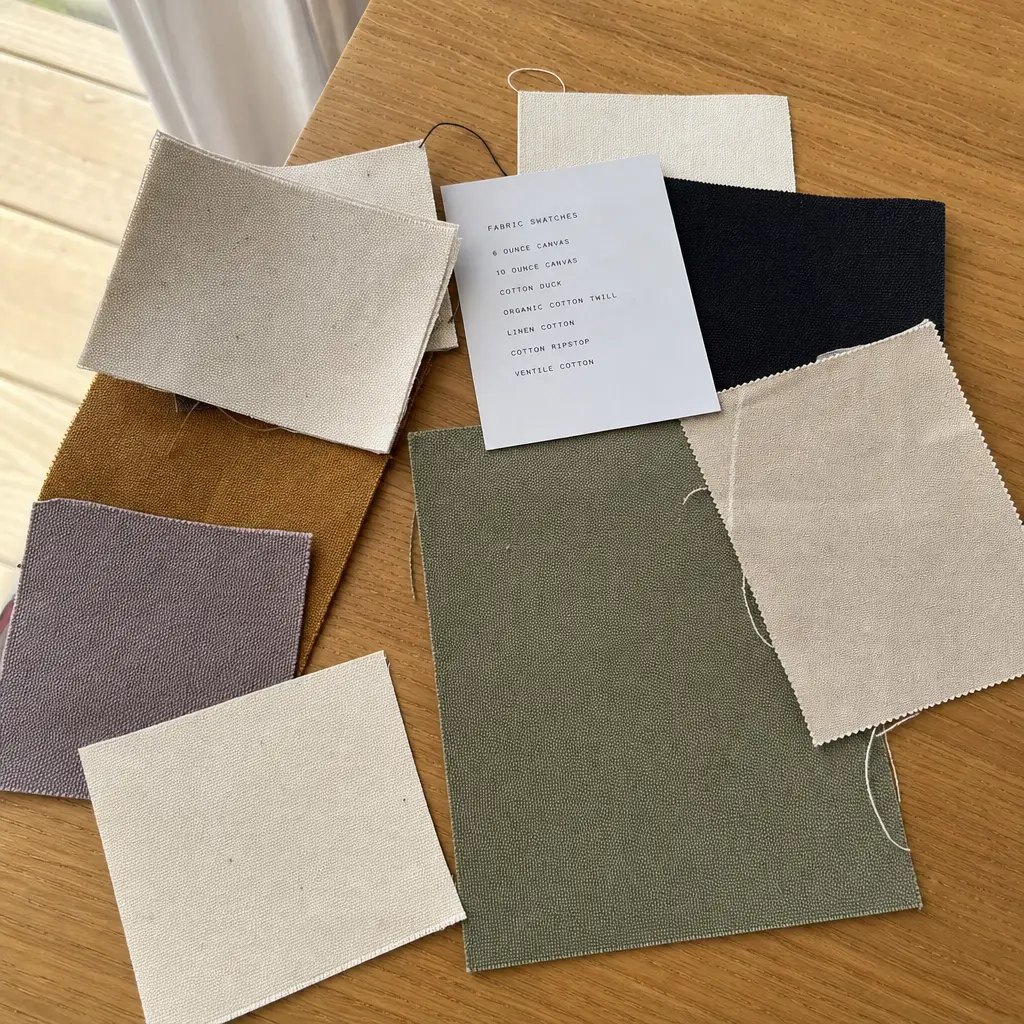
Canvas is often quoted casually as 10 oz, 12 oz, 14 oz, or 16 oz, but buyers should request GSM as well. As a working reference, 10 oz canvas is about 339 GSM, 12 oz is about 407 GSM, 14 oz is about 475 GSM, and 16 oz is about 542 GSM. Mills and finishes vary, so the approved sample should be the control standard, but GSM keeps quotations more comparable across suppliers.
For trade show messenger bags, 12 oz canvas is often the most balanced starting point. It has enough body for a professional promotional bag without pushing freight cost too high. When the bag needs a premium hand feel or heavier load capacity, 14 oz or 16 oz can be justified. Below 10 oz, the bag may still be called canvas, but it can feel like a thin giveaway and may wrinkle heavily after packing.
- Natural canvas usually costs less than dyed canvas and gives a clean promotional look, but shade and cotton seed flecks must be accepted or controlled.
- Dyed canvas improves brand color matching but adds dye lot risk, minimum quantity pressure, and possible crocking or shade variation concerns.
- Washed canvas feels softer and more retail, yet shrinkage and measurement tolerance need tighter sample approval.
- Laminated or coated canvas may improve structure but can change print adhesion, sewing behavior, and recyclability claims.
Choose Construction Before Negotiating Unit Price
A messenger bag has more cost variables than a simple tote. The flap, gusset, shoulder strap, adjuster, closure, inner pocket, lining, piping, binding, and hardware all create labor minutes. A supplier can lower price by removing reinforcement, narrowing the strap, using lighter hardware, simplifying pockets, or changing stitch density. Those changes may not be obvious in a spreadsheet, but they show quickly when the bag is carried at a busy event.
For exhibitor bulk programs, the best construction is usually strong but not overbuilt. A flap with magnetic snap or simple buckle-look detail is easier for visitors than a complex closure. An adjustable strap is useful, but the slider must hold position and the strap ends should be secured cleanly. If the bag carries documents, inner organization matters less than a stable main compartment and one secure zipper pocket.
- Use 3 cm to 4 cm strap width for comfortable shoulder carry on heavier programs.
- Specify back-tack or box-stitch reinforcement where the shoulder strap connects to the bag body.
- Avoid decorative buckles that do not add function unless the program is premium and the budget supports better hardware.
- For large front prints, keep flap seams and closure hardware away from the logo area.
- If lining is included, define fabric type and GSM so the factory does not substitute a very thin lining to hold price.
Build a Quote Sheet That Exposes the Real Cost Drivers
A useful bulk pricing plan separates cost drivers instead of asking for one blended unit price. Canvas messenger bag quotes can look inconsistent because one factory includes logo setup, export carton, tissue paper, reinforced strap stitching, and inner pocket, while another quotes only the basic sewn bag. Procurement teams should force the same structure across all supplier responses before comparing price.
For trade show exhibitors, the volume may be 500 pieces for one event or 20,000 pieces across several regions. The pricing curve depends on fabric availability, cutting efficiency, print setup, labor complexity, and packing volume. A small quantity in stock natural canvas can move quickly. A large order with custom dyed canvas and multiple logo versions needs more planning and may not be cheaper until setup costs are spread over enough units.
- Base bag cost: fabric, cutting, sewing, hardware, closures, strap, pockets, lining, and normal thread trimming.
- Decoration cost: screen setup, print charge per color, heat transfer charge, embroidery, woven label, patch, or embossing mold.
- Packing cost: individual polybag, kraft band, tissue interleaving, silica gel, master carton, carton marks, and palletization if needed.
- Compliance and inspection cost: material test, colorfastness test, AQL inspection, needle inspection, or third-party audit if required.
- Logistics cost: inland freight to port, export handling, ocean or air freight, duty, local delivery, and event warehouse receiving rules.
MOQ Logic for Exhibitor Programs
MOQ is not only a factory preference. It comes from fabric roll length, dyeing minimums, print setup time, cutting table efficiency, and labor arrangement. A factory may accept 300 pieces in natural canvas with one screen print because fabric is available and setup is simple. The same factory may need 1,000 pieces per color for dyed canvas or multiple logo versions because each colorway and artwork breaks production into smaller batches.
The cleanest way to plan bulk pricing is to group demand by base bag color and then by decoration version. If ten exhibitors each need 100 bags with different logos, the order is not the same as one 1,000-piece run. The factory must prepare separate screens, separate print approvals, separate carton marks, and often separate packing lists. Those handling steps can remove much of the expected quantity discount.
- For 300-500 pieces, use stock fabric colors, one print position, and simple packing to keep the order practical.
- For 1,000-3,000 pieces, consider custom label or patch options if the same design will be reused.
- For 5,000 pieces and above, negotiate fabric booking, staged production, and inspection schedule instead of only pushing unit price.
- For multi-logo distributor programs, request a matrix showing setup fee and unit cost by logo version.
- For regional trade show rollouts, confirm whether repeat orders can use the same print screens, labels, or patch tooling.
Print Method Selection for Canvas Messenger Bags
Screen printing is usually the most reliable and economical decoration for bulk canvas messenger bags when the artwork is solid, simple, and limited to a few colors. It works well on natural canvas and gives a strong brand impression on the flap or front panel. The buyer should provide vector artwork, Pantone references, print size, and exact placement from seam or flap edge. A photo of a logo on a bag is not enough for production.
Heat transfer, embroidery, woven labels, rubber patches, and leather-look patches each solve a different problem. Heat transfer can handle more detailed artwork but may feel less natural on heavy canvas. Embroidery adds texture but can pucker if the canvas or backing is not suitable. Woven labels are good for repeat programs and retail style, while patches give a premium look but add tooling, sewing labor, and more approval points.
- For one-color exhibitor logos, screen print is normally the first option to quote.
- For full-color artwork, quote heat transfer separately and request wash, rub, and adhesion feedback on canvas.
- For premium corporate gifts, combine a woven side label with a small front print rather than covering the entire flap with ink.
- For embroidery, approve stitch density and backing because heavy fill can distort the flap.
- For large white prints on dark canvas, request opacity samples because one ink pass may not be enough.
Sample Approval Should Simulate Production
A pre-production sample is the buyer's control document. It should not be a showroom sample with similar fabric and approximate hardware. For a trade show deadline, the sample must use the quoted fabric weight, the correct strap, actual closure, real logo method, final thread color, agreed lining, and intended packing. If the sample is approved loosely, the factory has too much room to interpret the order during bulk production.
The approval record should include photos, measured dimensions, fabric weight, print position, hardware description, and any accepted deviations. Keep one sealed approval sample at the factory and one with the buyer or inspection company. When a dispute happens, written descriptions alone are weaker than a physical approved sample with signed or dated comments.
- Measure width, height, gusset, flap length, strap width, strap length, pocket size, and print placement.
- Load the sample with the expected event contents for at least several minutes to review strap comfort and flap closure.
- Rub the printed area with a white cloth after curing to spot obvious ink transfer risk.
- Open and close snaps, zippers, buckles, and adjusters repeatedly to catch weak hardware before bulk production.
- Pack the sample in the proposed carton method for a short compression check if flap shape matters.
QC Thresholds That Matter Before Shipment
Canvas messenger bags should be inspected for both appearance and functional strength. A bag can look acceptable on a table but fail when carried with catalogs. Inspection should cover fabric defects, size tolerance, print quality, seam strength, hardware function, strap attachment, packing, and carton markings. For bulk trade show orders, mixed logos and carton labeling errors can be as damaging as sewing defects because the bags may be distributed directly to booths or event warehouses.
A common approach is AQL inspection, with major and minor defects defined before production. Major defects include broken straps, open seams, incorrect logo, severe stains, wrong dimensions affecting use, nonfunctional closures, or sharp hardware. Minor defects include small thread ends, slight wrinkles, minor shade variation within tolerance, or small print position deviation. The buyer should define what is acceptable instead of leaving the inspector to guess.
- Set finished size tolerance before production; for many canvas bags, plus or minus 1 cm is practical for main dimensions.
- Use a pull test on strap joints when the bag is intended for catalogs, samples, or electronics.
- Classify wrong logo, wrong color, wrong print position beyond tolerance, and mixed carton contents as major defects.
- Require print curing time before packing to reduce ink transfer between folded flaps.
- Review the first finished pieces from bulk production before the factory completes the full run.
Packing and Freight Can Change the Real Bulk Price
Messenger bags are bulkier than flat totes, so packing method affects landed cost. A thick canvas flap, hardware, strap, and gusset all increase carton volume. If the factory packs too tightly, the buyer may receive creased flaps, crushed corners, print transfer, or bent hardware. If the factory packs too loosely, the freight bill rises. The right packing plan balances presentation, protection, and container efficiency.
For most trade show exhibitor programs, flat packing with the strap placed inside or neatly folded is the safest starting point. Tissue or kraft paper between printed faces helps prevent rubbing. Individual polybags may be required for clean distribution, but some buyers prefer paper bands or reduced plastic. Whatever method is used, the quote should include pieces per carton, carton dimensions, gross weight, and estimated CBM so procurement can compare landed cost instead of only FOB unit price.
- Request carton dimensions and gross weight before confirming the order, not after production.
- Avoid placing metal buckles directly against printed panels during packing.
- Use inner separation for dark prints, large ink coverage, or rubber patches.
- For event warehouse delivery, confirm carton labels show event name, exhibitor name, SKU, logo version, quantity, and carton number.
- If air freight is possible, calculate volumetric weight early because bulky canvas bags can become expensive to fly.
Lead Time Planning for a Fixed Show Date
Trade show orders have a hard deadline, so the production plan should be built backward from the delivery date. A realistic timeline includes RFQ clarification, artwork preparation, sample making, sample freight, sample approval, fabric booking, bulk cutting, printing, sewing, finishing, inspection, export packing, international freight, customs clearance, and local distribution. A quote that only states production days after deposit can hide schedule risk.
The riskiest delays usually come from artwork changes, custom dyed fabric, sample revisions, print curing, inspection rework, and freight booking. If the event date is close, reduce variables: choose stock canvas, limit logo colors, use proven hardware, avoid complicated pockets, and approve a practical packing method. Paying for a complicated bag that arrives after the show is worse than choosing a simpler bag that ships cleanly.
- Allow time for one sample revision unless the design is already proven.
- Book inspection before the final production week so the factory reserves time for correction.
- Separate the latest factory ship date from the latest event warehouse delivery date.
- For sea freight, include destination port congestion, customs inspection possibility, and local trucking appointment windows.
- For urgent programs, ask for a split plan: partial air shipment for critical exhibitors and sea shipment for the remaining quantity.
Specification comparison for buyers
| Spec decision | Recommended option | When it fits | Buyer risk to check |
|---|---|---|---|
| Fabric weight for trade show giveaway use | 12 oz cotton canvas, about 407 GSM, with plain weave | Good balance for exhibitor kits, catalogs, brochures, and light daily carry after the show | Too light below 10 oz can look promotional; too heavy above 16 oz increases freight and makes the bag feel bulky |
| Fabric weight for premium sponsor or VIP bag | 14-16 oz cotton canvas, about 475-542 GSM, with reinforced stress points | Suitable when the bag must carry laptops, samples, drink bottles, or retail-style gift bundles | Higher fabric cost can be wasted if the strap, buckle, and stitching are not upgraded at the same time |
| Main print method | Screen print for solid CTM-style logos, event marks, and 1-3 color artwork | Best for 500-10,000 pieces when brand color control and unit cost matter | Artwork with gradients, tiny copy, or large ink coverage may crack or feel stiff on heavy canvas |
| Logo execution for repeated yearly programs | Woven label, rubber patch, or leather-look patch plus smaller print | Works for distributors and brand owners who reuse a base bag design across several events | Patch tooling and sewing add setup cost; label placement must be approved on a real pre-production sample |
| Closure construction | Flap with magnetic snap or buckle-look strap plus inner zipper pocket | Practical for trade show visitors who need quick access while walking the hall | Low-grade magnets can pull out; metal buckle corners can scratch if packed without protection |
| MOQ planning | Start around 500-1,000 pieces per color for custom canvas messenger bags | Fits most exhibitor programs while keeping printing setup and fabric cutting efficient | Small orders with many colors or many logo versions create hidden setup charges and carton mixing errors |
| Packing method | Flat packed in export cartons with tissue or kraft paper between printed faces | Best for reducing print transfer, flap deformation, and carton volume | Over-compression can crease canvas and bend flap edges; request carton size, gross weight, and loading estimate |
| Supplier route | Factory-direct program with documented sample approval and inline inspection | Better for importers, distributors, and repeat trade show buyers who need stable specs and price breaks | A trading quote may look cheaper if it omits GSM, hardware grade, printing setup, inner packing, or inspection terms |
Buyer checklist before sampling
- Define the bag size by what exhibitors will actually place inside: A4 catalogs, tablets, water bottles, sample packs, or press kits.
- Lock fabric weight in oz and GSM, not only the word canvas.
- Specify natural, dyed, or washed canvas because shrinkage, color tolerance, and print hand feel change by fabric finish.
- Separate base bag cost, logo setup, print charge, patch or label charge, packing cost, and inland freight in the RFQ.
- Confirm MOQ by fabric color and logo version, not only total order quantity.
- Request a pre-production sample made with the correct fabric, hardware, strap, lining, print, and packing.
- Approve real measurements with tolerance, especially bag width, height, gusset, flap length, and strap length.
- State acceptable print tolerance for position, color, registration, and ink coverage.
- Require carton marking, carton size, gross weight, and pieces per carton before final price approval.
- Build the schedule backward from the event delivery date, including sample approval, production, inspection, vessel or air booking, customs, and local distribution.
Factory quote questions to send
- What exact fabric weight will be used in oz and GSM, and is the quotation based on greige, bleached, dyed, or washed canvas?
- Is the fabric in stock or custom woven/dyed, and what MOQ applies per color?
- What are the finished bag dimensions, gusset depth, flap size, strap width, and strap adjustment range?
- Which print method is included, how many colors are priced, and what is the maximum printable area on the flap or body?
- Are screen setup, plate charges, patch mold charges, and label charges included or listed separately?
- What hardware grade is used for buckles, snaps, adjusters, zippers, and magnetic closures?
- Are reinforcement stitches included at strap joints, flap corners, pocket openings, and side seams?
- How will each bag be packed, how many pieces per carton, and what are the estimated carton dimensions and gross weight?
- What is the sample lead time, production lead time after sample approval, and realistic inspection window before shipment?
- What quote validity period applies if cotton yarn, dyeing, or freight costs change before deposit?
Quality-control points to confirm
- Fabric weight should match the approved sample within the agreed tolerance, commonly plus or minus 5 percent unless otherwise contracted.
- Finished dimensions should stay within practical tolerance, usually plus or minus 1 cm for width and height and plus or minus 0.5 cm for pocket position.
- Print position should be measured from fixed seams or flap edges, not estimated by eye.
- Logo color should be compared against the approved Pantone or physical print swatch under consistent lighting.
- Strap joints should withstand pull testing appropriate for the intended load, especially when bags carry catalogs or electronics.
- Magnetic snaps, buckles, zipper sliders, and adjusters should operate smoothly without sharp burrs or plating defects.
- Seams should be straight, back-tacked at stress points, and free from skipped stitches, loose threads, and open seams.
- Canvas panels should be free from major slubs, stains, oil marks, dye streaks, and noticeable shade variation within the same order.
- Packing should prevent print transfer, metal scratching, crushed flaps, moisture exposure, and mixed logo versions in the same carton.