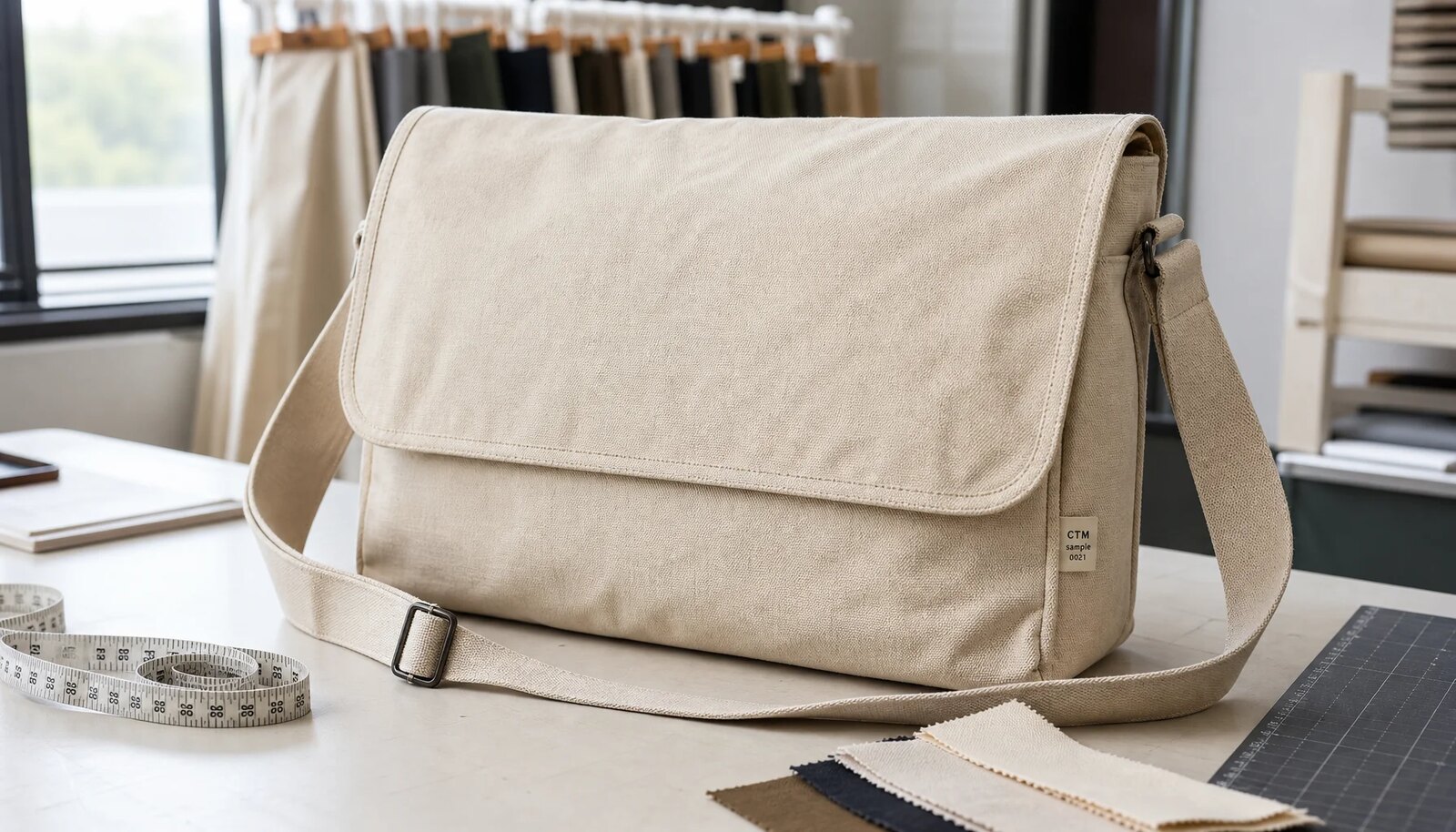
Start With The Hotel Retail Risk, Not Only The Bag
A canvas messenger bag for hotel retail is a different buying decision from a basic giveaway tote. It may sit in a lobby shop, hang in a resort boutique, ship as conference merchandise, or move through several hotel properties under one group program. The bag has to look brand-correct on the shelf. It also has to carry realistic guest items, arrive clean, scan correctly at receiving, and pass importer or distributor document review without emergency relabeling.
The problems are usually predictable. Natural canvas shade varies from lot to lot. Flaps land slightly crooked. Strap anchors look acceptable until the bag is loaded. A front logo drifts a few millimeters and suddenly looks amateur. Barcodes are assigned to the wrong property. Cartons are mixed, labels are missing, or the supplier sends a generic compliance file that does not match the actual order. A practical canvas messenger bags supplier compliance checklist for hotel retail turns those risks into quote requirements before the supplier locks the price.
Keep two types of compliance separate. Product compliance covers material composition, restricted substances, labeling, packaging warnings, country-of-origin marking, barcode accuracy, and support for sustainability claims. Supplier capability covers pattern control, sewing consistency, branding control, inspection access, retained samples, packing discipline, and corrective action. One supplier may sew beautifully but struggle with documentation. Another may send polished paperwork while outsourcing production to an unknown workshop. Buyers need evidence for both.
- Define whether the bag is sold to adults, used by guests, included with an event, or issued to staff because risk and labeling needs may differ.
- List destination markets in the RFQ; do not let the supplier guess EU, US, UK, GCC, or APAC documentation needs.
- Treat artwork, swatches, trim cards, packing layouts, barcode files, and test documents as controlled specifications.
- Ask which documents are order-specific and which are general company documents reused across many products.
- Create one RFQ attachment for product specifications and one for supplier evidence so quotes are easier to audit.
Specify Canvas Weight, Composition, Finish, And Tolerance
Canvas weight drives more than handfeel. It affects shelf presence, sewing stability, print coverage, strap behavior, carton weight, and landed cost. For many hotel retail messenger bags, 12 oz cotton canvas, roughly 407 GSM, is a practical starting point for light guest use, brochures, small tablets, resort day items, or lower-price retail. A 14 oz canvas, roughly 475 GSM, gives a sturdier feel and better structure on display. A 16 oz canvas, roughly 542 GSM, can suit a premium program, but the construction must account for seam bulk, needle choice, gusset corners, reinforcement, and freight weight.
Do not accept a quote that says only “canvas.” Two mills can use the same weight description while delivering different yarn counts, weave density, shrinkage, finish, and surface character. Natural canvas may include seed flecks and slubs. Dyed canvas adds lab dip approval, shade-lot control, rubbing colorfastness, and dye declaration questions. Washed canvas can look relaxed and premium, but it may shrink, soften, and distort differently from unwashed fabric. Keep a signed swatch with the approved sample and define what the bulk shade will be judged against: lab dip, production swatch, or physical sample.
Tolerance language should be realistic and written. A common fabric-weight tolerance is ±5%, but a tighter range should be confirmed with the mill before it appears in a purchase order. Finished dimensions on soft sewn bags often need practical sewing tolerance, such as around ±1 cm for main body measurements. Logo placement may need tighter control, often ±3 mm to ±5 mm depending on the artwork, print method, and flap design. If the tolerance is not in the quote or quality agreement, it becomes an argument during inspection.
- 12 oz canvas: value retail, simple construction, lighter cartons, and stock-fabric programs.
- 14 oz canvas: stronger handfeel, better shelf presence, and more stable flap branding for mid-range hotel shops.
- 16 oz canvas: premium use only when seam bulk, reinforcement, and freight cost are justified.
- Dyed canvas: request lab dip, bulk shade tolerance, rubbing colorfastness expectation, and azo-free dye statement where relevant.
- Natural canvas: approve acceptable seed flecks, slub level, shade range, and logo-area cleanliness.
- Avoid vague terms such as heavy, premium, eco, or thick unless paired with GSM, oz weight, composition, finish, and swatch.
Build The Construction Around Real Guest Use
A messenger bag needs to do more than display a hotel logo. It should carry ordinary travel items without twisting, sagging, or making the flap lift awkwardly. The body width needs to fit realistic contents. The gusset should not collapse into a shapeless pouch. The strap should adjust comfortably for shoulder or crossbody use. Closures should not scratch devices, catch on clothing, or pull the flap out of shape.
Use a technical drawing rather than a reference photo alone. The drawing should show body width, body height, gusset depth, flap length, flap corner shape, strap width, adjustable strap range, front pocket, inner pocket, zipper or snap location, D-ring position, side-label position, and hangtag position. The front flap is usually the main branding zone, so symmetry, edge distance, and flap alignment deserve extra care.
Construction should match expected contents. If guests may carry a tablet, notebook, water bottle, folded apparel, or travel documents, reinforce strap anchors and keep sharp hardware away from the interior. If the item is a light souvenir, a simpler unlined interior may be acceptable. For a premium resort boutique bag, lining, inner zipper pocket, woven label, shaped flap reinforcement, and upgraded hardware may be worth the added cost. Each feature adds inspection points, so decide what matters before the supplier prices the order.
- State intended contents: tablet, notebook, brochures, water bottle, room-key pack, light apparel, or retail gift items.
- Use a strap width of at least 30 mm for more than lightweight carry; 38 mm can improve comfort for heavier use.
- Define strap range for shoulder use, crossbody use, or both, and ask for measurements on the finished sample.
- Keep flap artwork away from seam edges, curved corners, snaps, and fold lines to reduce distortion.
- Request a loaded-sample photo or video to check sagging, twisting, flap lift, and strap pull direction.
- Specify whether lining, internal binding, seam overlock, or raw-edge finish is acceptable for the retail price point.
Compare Supplier Routes By Evidence, Not Catalog Language
Supplier type changes the level of control you can expect. A direct sewing factory is often stronger for custom canvas weight, exact logo placement, pattern consistency, and repeat production. The same team can adjust reinforcement, cutting, sewing tension, and packing when issues appear. That does not automatically make the factory stronger on export paperwork, barcode control, retail packing, or multi-destination hotel programs. Check those capabilities early.
A trading company can be useful when a hotel group consolidates several categories, such as bags, towels, caps, pouches, or amenity products. The trade-off is visibility. If the trading company will not identify the production factory, explain subcontracted print or embroidery, provide inspection access, or show material sourcing, defect decisions become slow. Judge trading partners by transparency, document control, and corrective-action authority, not by the size of their catalog.
A specialized bag workshop is often the strongest route for messenger bags with shaped flaps, pockets, adjustable straps, hardware, and repeat brand programs. These suppliers tend to understand load paths, seam allowance, webbing behavior, and the difference between a promotional item and a retail accessory. Still, capacity matters. Confirm peak-season calendar, subcontracting, and backup plans before hotel launch dates are promised.
- Request photos or video of cutting tables, sewing lines, print or embroidery area, QC station, packing area, and finished-goods storage.
- Confirm legal supplier name, production factory name, production address, and export invoice party before order confirmation.
- Ask who approves first-piece production and who pays for rework if bulk goods do not match the signed sample.
- Require third-party inspection access for any hotel retail order.
- Check experience with SKU separation, property logos, barcode labels, carton sequence, and retail DC requirements.
- Avoid approving a first order based only on a perfect sample made by an unknown sample room.
Control Branding Before Bulk Production Starts
Branding is where small errors become highly visible. The flap is the front of the product, and a crooked logo is hard to hide in a hotel shop. Screen print works well for solid hotel logos and simple artwork when ink coverage, mesh selection, registration, and curing are controlled. Embroidery gives a more premium feel, but it can pucker lighter canvas, distort small text, and raise cost through stitch count. Woven labels create a clean retail-accessory look and reduce large print variation, but label MOQ and lead time must be included in the schedule. Heat transfer can handle complex graphics, although adhesion must be tested on the selected canvas texture.
Measure logo placement from fixed bag points, not from a digital mockup. Use distance from the flap edge, center line, pocket seam, snap position, or side seam. If the flap has curved corners, snaps, stitching, or a fold line, place the artwork inside a stable zone. On natural canvas, dark inks are usually easier to control. On black or navy canvas, light ink may need an underbase, which can change handfeel, opacity, cost, and sample timing.
Keep setup charges separate from unit price. Ask for screen charges, embroidery tape charges, woven label MOQ, color-change charges, proofing costs, and repeat-order charges. Hotel groups often use one base bag with several property logos. Each logo version adds setup, sorting, barcode, inspection, and packing complexity. If that work is hidden inside one vague number, the comparison between suppliers will be misleading.
- Artwork package: AI, EPS, or PDF vector file, Pantone references, logo size, placement drawing, and approved proof.
- Screen print acceptance: no bleeding, cracking, heavy pinholes, misregistration, ink contamination, or obvious placement shift.
- Embroidery acceptance: correct thread color, no loose threads, clean backing trim, no severe puckering, and readable detail.
- Woven label acceptance: straight sewing, correct orientation, no fraying, stable color, and agreed position tolerance.
- Heat transfer acceptance: clean edges, no lifting after flexing, no scorch marks, and adhesion suitable for canvas texture.
- Require a branded pre-production sample using final fabric and final branding method before bulk production.
Use MOQ Logic That Matches Production Reality
MOQ is almost never one clean number. For canvas messenger bags, minimums may be driven by greige fabric purchase, dye lot, stock fabric availability, webbing color, hardware finish, print setup, embroidery tape, woven label production, lining fabric, or packing assortment. A supplier may accept 300 to 500 pieces in stock natural canvas with one screen print but require a higher MOQ for custom-dyed fabric, antique brass hardware, special webbing, or multiple embroidered logos.
Hotel groups often want one base bag for several properties. That can be efficient when the pattern, fabric, hardware, and packing format remain the same and only the logo changes. It is not automatically simple. Every property logo adds artwork approval, setup, SKU separation, barcode control, carton marks, packing-list accuracy, and inspection sampling. A useful quote should show one-logo pricing and then the cost impact of three, five, or ten property logos.
MOQ also affects compliance evidence. Stock canvas may come with existing fabric records, while custom dyeing may require separate lab dip approval and dye documentation. Recycled cotton, organic cotton, or reduced-plastic packaging can bring separate MOQ, certification, claim-review, and label approval questions. Align MOQ, documents, sample timing, and lead time before issuing the purchase order.
- Quote scenario A: one fabric color, one size, one logo, one packing method, one warehouse.
- Quote scenario B: one base bag with three property logos, packed and carton-marked by logo version.
- Quote scenario C: two fabric colors with separate barcodes, carton marks, and packing lists.
- Quote scenario D: optional hangtag, woven label, belly band, or individual bag priced separately.
- Record whether MOQ applies to total order, fabric color, logo, hardware finish, label, lining, or packing assortment.
- Compare stock-material and custom-material pricing so buyers do not pay for unnecessary customization.
Demand Compliance Evidence That Matches The Actual Order
Compliance requirements depend on destination market, selling channel, age grading, material claims, and packaging format. Hotel retail buyers may need fiber composition support, azo-free dye statements for dyed fabric, REACH-related declarations for EU sales, CPSIA-related support where children may reasonably use the item in the US, packaging material statements, country-of-origin support, and substantiation for recycled or organic claims. The supplier should not choose the compliance path by guesswork. The importer or brand owner should list required documents in the RFQ.
Documents matter only when they connect to the ordered goods. A generic report from a different canvas, color, ink, hardware finish, or supplier may not satisfy importer review. Ask for the report holder, test date, tested component, tested color, material supplier, and a written explanation of how the report applies to the order. For hardware, review sharp-edge and plating concerns. For print or heat transfer, confirm that the declaration covers the actual ink, film, or adhesive. For packaging, confirm polybag warning text, recycling marks, carton labels, and any retailer-specific receiving rules.
Be careful with sustainability language. Recycled cotton, organic cotton, low-impact dye, plastic-free packaging, and similar claims can add retail value, but the wording must be supported before it appears on hangtags, labels, ecommerce copy, or hotel retail signage. If the supplier cannot support the exact claim, use neutral wording or remove the claim from customer-facing materials.
- Match documents to fabric color, batch, composition, print ink, hardware finish, packaging material, and destination market.
- Do not print recycled, organic, low-impact, or plastic-free claims until evidence supports the exact wording.
- Review fiber labeling, country of origin, polybag warnings, suffocation warnings, recycling marks, and barcode rules by market.
- Ask whether retained samples and batch records are kept for repeat orders or post-shipment questions.
- Keep swatches, signed samples, test reports, declarations, packing approval, inspection report, and shipping records together.
- If a document is generic, require a written explanation of why it applies to the order before accepting it.
Approve Samples Under Production Conditions
A showroom sample is not a production standard. It may use substitute canvas, different hardware, hand-cut panels, or a branding method that is easier than mass production. The pre-production sample should use final canvas weight, final color, final strap material, final hardware, final branding, final lining if any, final labels, and final retail packing. If the supplier changes fabric after approval, the print result, sewing tension, shrinkage, flap shape, and finished bag weight can all change.
Measure the sample like an inspector. Check body size, gusset, flap symmetry, strap adjustment range, stitch density, closure function, pocket function, logo placement, logo color, label position, and packing. Then load it. Put in a tablet, notebook, bottle, brochure pack, or folded apparel depending on intended use. A messenger bag that looks tidy when empty may twist, gape, or sag once a guest uses it.
Sample comments should be specific enough for production to act on. Instead of writing “make it nicer,” write “increase flap drop by 10 mm,” “move logo 8 mm upward,” “change webbing to 38 mm,” “add bartack at strap anchor,” “reduce loose threads,” or “replace snap with magnetic closure.” Keep one sealed sample with the factory and one duplicate with the buyer or inspection company.
- Approve a sealed factory sample and a duplicate buyer or inspector sample.
- Write tolerances on the approval sheet for body dimensions, strap range, logo position, shade, and branding defects.
- Photograph front, back, inside, gusset, strap anchors, hardware, labels, hangtag, and packing.
- Mark substitute-material samples as development only, not final production standards.
- Request first-piece production photos before mass sewing continues.
- Release bulk only after artwork, swatch, trim card, sample, and packing method are approved together.
Set QC Thresholds Before Deposit
Quality control should combine general AQL inspection with messenger-bag-specific checks. Appearance matters because this is a retail product. Dirty canvas, wavy seams, crooked flaps, uneven strap anchors, weak closures, and off-center logos are major issues when the bag is displayed in a hotel shop. Define critical, major, and minor defects before production so the supplier knows the acceptance standard.
Use concrete criteria. Logo placement may allow ±3 mm to ±5 mm for visible flap branding depending on artwork and process. Main dimensions may allow around ±1 cm for soft construction if the buyer accepts that range. Strap length needs its own tolerance because webbing, adjusters, and measurement method affect results. Stitch density should be specified along seams and stress points. Strap anchors should be reinforced and checked visually, and any load or pull method should be agreed before production.
QC must include retail and carton details. A bag can pass sewing inspection and still fail receiving if the barcode is wrong, the hangtag is missing, the carton mark is incomplete, the inner count is off, or property logos are mixed. For multi-property hotel orders, carton-level accuracy is not clerical housekeeping. It is a procurement risk.
- Critical defects: sharp hardware, needle fragment, mold odor, wrong logo, severe strap weakness, or prohibited material issue.
- Major defects: off-center print, dirty front flap, broken stitch, wrong closure, wrong barcode, incorrect SKU, or wrong carton assortment.
- Minor defects: small loose thread, slight approved shade variation, small inside seam irregularity, or non-visible trim imperfection.
- Final inspection timing: book after packing is at least 80% complete and cartons are available for random selection.
- Inspection photos: dimensions, logo placement, stress points, hardware, pockets, barcode scan, carton marks, and packed carton view.
- Corrective action: state whether supplier must repair, replace, sort, discount, retest, or remake before shipment release.
Plan Packing, Cartons, And Hotel Receiving Early
Packing affects both product condition and receiving efficiency. Natural canvas marks easily in dusty warehouses, humid containers, or cartons where metal hardware rubs against fabric. Tight packing can crease the flap and make a new bag look tired before it reaches the shelf. Too much individual packaging adds cost and waste. The right method depends on whether the order ships to a distributor warehouse, retail DC, hotel property stockroom, or several properties at once.
Carton planning belongs in the quote, not after production. Request pieces per inner bundle, pieces per master carton, carton dimensions, gross weight, net weight, and estimated CBM. If several property logos, colors, or barcodes are in one order, carton marks must prevent receiving errors. A wrong barcode or mixed property logo can cost more than the unit-price saving that won the order.
Moisture and cleanliness controls should be practical. For humid routes or long storage, discuss warehouse conditions, carton strength, moisture-control measures, and container loading. Protect buckles, snaps, sliders, and D-rings so they do not scratch light canvas or transfer plating marks. If the buyer wants less plastic, test kraft belly bands, tissue interleaving, or inner bundles before committing to that method for retail.
- Use inner bundles to keep bags aligned when individual retail polybags are not required.
- Protect metal hardware from rubbing directly against light canvas during transit.
- Limit carton weight for safe handling and to reduce crushing of flaps and gussets.
- Carton marks should include PO, SKU, logo version, color, quantity, gross weight, carton number, and destination where required.
- For multi-property orders, require carton assortment photos and packing-list reconciliation before shipment.
- Ask for carton dimensions, total carton count, gross weight, net weight, and CBM for freight planning before PO approval.
Specification comparison for buyers
| Supplier option | What to verify | Commercial advantage | Buyer risk to control |
|---|---|---|---|
| Direct sewing factory | hardware trim card, strap-load photo, lining close-up, approved flap sample, and first-piece production photos | Better sample-to-bulk control and faster production feedback | May be weaker on export paperwork or branded packing unless checked early |
| Trading company | Factory name, production photos, trim-source proof, and who owns QC decisions | Can coordinate small mixed orders and extra services | Markup can hide real factory capability and slow defect decisions |
| Specialized bag workshop | flap shape, strap webbing, buckle, D-ring, inner pocket, zipper pocket, seam allowance, and load path | More practical for detailed construction, trims, and repeat programs | Capacity may be limited during peak seasons |
| Low-price general supplier | 10-16 oz canvas, washed canvas, rPET canvas, lining fabric, interfacing, and hardware finish | Useful for simple promotional runs with loose specs | Material downgrades, weak packing, and vague inspection scope can erase savings |
| Retail-ready supplier | shape support, strap folding, hardware protection, individual bag, carton drop expectation, and retailer hangtag placement | Can handle labels, SKU separation, carton marks, and receiving rules | Higher unit cost must be compared against reduced warehouse work |
| Compliance-focused supplier | Fabric records, labeling review, test plan, and production traceability | Safer for retail programs and repeat brand orders | Documentation claims need evidence, not only sales language |
| Local sample room plus bulk factory | Signed sample, bulk factory handoff, first-piece photos, and deviation owner | Good for complex branding before large production | Sample room quality may not match bulk line unless handoff is controlled |
Buyer checklist before sampling
- Define the commercial use first: hotel gift-shop item, resort boutique accessory, conference retail merchandise, guest welcome product, loyalty-store item, or staff-facing accessory.
- State destination markets and importer responsibility before requesting price because labeling, chemical, packaging, and claim requirements vary by market.
- Issue a dimension drawing with tolerances for body width, body height, gusset depth, flap drop, strap width, adjustable strap range, pocket size, closure position, and logo placement zone.
- Specify canvas composition, weight in oz and GSM, acceptable tolerance, color, dye method, finishing, shrinkage target, handfeel, lining, and whether recycled, organic, or blended fiber is acceptable.
- Lock branding before quoting: screen print, embroidery, woven label, leather or fabric patch, heat transfer, or combined method, with setup charges separated from unit price.
- Provide artwork as vector files with Pantone references, logo size, color count, placement measurements from fixed edges, and restrictions near seams, curves, snaps, or fold lines.
- Separate MOQ by bag style, fabric color, logo version, webbing color, hardware finish, lining, label type, packing assortment, and hotel property destination.
- Require a pre-production sample made with final fabric, final hardware, final branding, final lining if any, final labels, and final retail packing.
- Set inspection tolerances for dimensions, shade, print placement, stitch defects, strap attachment, closure function, barcode accuracy, carton quantity, and SKU separation.
- Confirm order-specific compliance documents before deposit, including which reports apply to the actual material, color, ink, hardware, labels, and packaging.
Factory quote questions to send
- Are you the sewing factory, or will cutting, sewing, printing, embroidery, washing, finishing, inspection, or packing be subcontracted? Please name each production location.
- What stock canvas weights are available for natural, black, navy, and custom-dyed colors, and what GSM tolerance can you control per batch?
- Can you quote the same construction in 12 oz, 14 oz, and 16 oz cotton canvas with unit price, estimated finished bag weight, carton quantity, carton dimensions, gross weight, and CBM?
- What is the MOQ by fabric color, logo version, webbing color, hardware finish, woven label, lining, and packing assortment? Does MOQ apply per SKU or to the total order?
- Which order-specific documents can you provide for fiber composition, azo-free dye, REACH-relevant substances, CPSIA-relevant requirements where applicable, packaging material, country of origin, and recycled-content claims?
- Can the pre-production sample be made with final fabric, final branding, final hardware, final lining, and final packing? How many working days are needed after artwork and material approval?
- What dimensional, shade, stitching, and logo-placement tolerances will you accept in the proforma invoice, quality agreement, or inspection checklist?
- What seam reinforcement is used at strap anchors: bartack, box stitch, double stitch, rivet, or internal reinforcement? Can you provide photos from a loaded sample?
- How many pieces fit per inner pack and master carton, and how will you prevent flap creasing, dirty canvas, hardware scratches, odor, and moisture during transit?
- Which lead-time steps are on the critical path: fabric weaving, dyeing, washing, print screen, embroidery tape, label production, hardware arrival, cutting, sewing, packing, or inspection?
Quality-control points to confirm
- Fabric weight should match the approved specification within the contracted range, commonly ±5% unless the buyer requires a tighter tolerance and the mill confirms it can support that range.
- Finished dimensions should stay within the agreed tolerance, for example ±1 cm for body width or height on many soft bags and tighter millimeter-level control for visible logo placement.
- Canvas shade should match the signed swatch or approved bulk shade range; panel-to-panel shade variation on the front, flap, and gusset should not be visually disruptive.
- Print color should match the approved Pantone target or signed print swatch under consistent lighting, with no obvious pinholes, bleeding, cracking, misregistration, contamination, or off-center placement.
- Embroidery should be checked for thread color, stitch density, backing trim, fabric puckering, loose threads, skipped stitches, and correct orientation on the flap, pocket, or patch.
- Stitch density should be consistent, commonly specified as stitches per inch or centimeter, and stress points should include bartack, box stitch, double stitch, or reinforcement as approved.
- Strap attachment should be visually inspected and function-checked; any pull test or load check must use an agreed weight, duration, and pass/fail standard documented before production.
- Metal hardware should be free from sharp edges, rust marks, plating inconsistency, weak adjusters, noisy loose fittings, and finish transfer onto light canvas.
- Canvas surface should be retail clean, with no oil marks, mildew odor, foreign fibers, severe slubs in the logo area, needle damage, or unacceptable shade mismatch.
- Closures, zipper pulls, magnetic snaps, side-release buckles, hook-and-loop, and pockets should operate smoothly without twisting the flap or distorting the bag body.