Why a simple-looking messenger bag still needs a compliance checklist
Canvas messenger bags look straightforward. That is exactly why procurement teams sometimes under-specify them. A short brief such as “natural canvas messenger bag with logo” leaves the factory to choose the fabric weight, weave, shrinkage allowance, lining, webbing, buckle, reinforcement, logo technique, label package, packing method, and inspection standard. Two suppliers can read the same sentence and quote two very different bags.
For eco apparel brands, the risk goes beyond stitching quality. The bag may become a retail accessory, wholesale add-on, staff kit, launch gift, subscription insert, event item, or branded merchandise piece. If the product will be described as organic, recycled, undyed, natural, plastic-reduced, or low-impact, the wording has to match the supplier file. “Canvas” describes a fabric construction. It does not, by itself, prove cotton content, organic origin, recycled content, responsible packing, or chemical management.
A strong canvas messenger bags for eco apparel brands supplier compliance checklist protects three things: sellable product quality, quote comparability, and claim evidence. Sellable quality covers the dimensions, shape, strap strength, logo durability, hardware function, and clean presentation. Quote comparability prevents a 12 oz unlined promotional bag from being judged against a 16 oz washed, lined retail bag. Claim evidence keeps ecommerce copy, hangtags, retailer setup forms, and shipment records from saying more than the supplier can support.
- Define the public product claim before the RFQ is issued.
- Compare suppliers only after fabric, construction, logo, packing, and QC scope are aligned.
- Treat the approved sample as a production control standard, not a general inspiration piece.
- Separate marketing language from fileable evidence such as material declarations, certificate scope, or packing statements.
Turn the design idea into measurable bag specifications
The RFQ should move quickly from inspiration to measurable detail. Start with finished dimensions: body width, body height, gusset depth, flap drop, flap width, strap width, minimum and maximum strap length, pocket dimensions, closure location, and label placement. Sewn canvas has natural variation, so tolerances need to be realistic. A practical starting point is about ±1.0 cm for main body dimensions and ±0.5 cm for smaller features such as pocket height, flap drop, or label position, then adjust based on the pattern and approved sample.
Function matters as much as the flat measurement. A bag can pass the size check and still hang badly if the strap anchors sit too low, the buckle slips, the flap is too heavy, or the gusset collapses. Ask suppliers for sample photos from the front, back, side, open flap, inside, empty, and lightly filled. If worn or hanging photos are appropriate, request those too. For office or laptop-style messenger bags, state the intended device size or carry weight. For lighter fashion or promotional styles, keep the construction efficient but still define strap reinforcement.
Write fabric weight in both oz/yd² and GSM. The rough conversion is 1 oz/yd² equals about 33.9 GSM, so 12 oz is about 407 GSM, 14 oz is about 475 GSM, and 16 oz is about 542 GSM. Finishing changes the result. A quoted 14 oz greige canvas may not behave like a finished 14 oz washed canvas after cutting, shrinkage, sewing, and printing. The RFQ should say whether the target weight is before washing, after washing, or after final finishing.
- Use finished-goods measurements, not only a sketch or reference photo.
- State tolerances, for example ±1.0 cm body, ±0.5 cm pocket or flap, and a separate logo placement tolerance.
- Specify body shape, gusset, flap coverage, strap range, closure position, and pocket layout.
- State canvas weight in oz/yd² and GSM, plus the measurement basis and finish condition.
Control canvas type, weight, shrinkage, and material claims
Canvas is a broad commercial category. A supplier might quote conventional cotton canvas, organic cotton canvas, recycled cotton blend canvas, rPET canvas, cotton-poly canvas, washed canvas, pigment-dyed canvas, or a waxed-look finish. Those choices affect price, hand-feel, print result, shrinkage, shade control, and claim language. Ask for composition, fabric weight, finishing route, fabric source, and whether the material is stock or custom ordered.
Set a fabric-weight tolerance before price comparison. Many buyers use ±5% from approved GSM when the product and supplier agree, while higher-visibility retail programs may require a narrower range. The purpose is simple: avoid approving one material and receiving a lighter substitute. If the approved spec is 14 oz finished cotton canvas, a visibly thinner 10 oz or 12 oz alternative should not pass unless the buyer has approved a cost-down revision in writing.
Shrinkage and shade control deserve the same discipline. Washed canvas can feel softer and more relaxed, but washing may create shrinkage, panel twisting, seam puckering, or shade variation. Natural canvas may show seed flecks and small lot differences; that can be acceptable when it is part of the approved character. Dyed canvas should be reviewed for shade lot, crocking risk, and colorfastness expectations. If the bag combines materials, such as a cotton canvas body with polyester webbing, the label and claim should not imply a single-material product unless that is accurate.
For eco claims, procurement needs to separate material description from certification scope. A declaration that fabric contains recycled polyester is not the same as finished-product certification. Organic cotton paperwork may cover fiber, yarn, fabric, or facility handling depending on the certificate and standard. If a retailer requires a specific certification, confirm scope and validity before bulk cutting. If third-party certification is not required, use precise copy such as “cotton canvas body” or “canvas made with recycled polyester content” only when supplier documents support it.
- Ask whether fabric is stock, custom dyed, washed, pigment dyed, or finished after weaving.
- Set a GSM tolerance and confirm whether it applies before or after finishing.
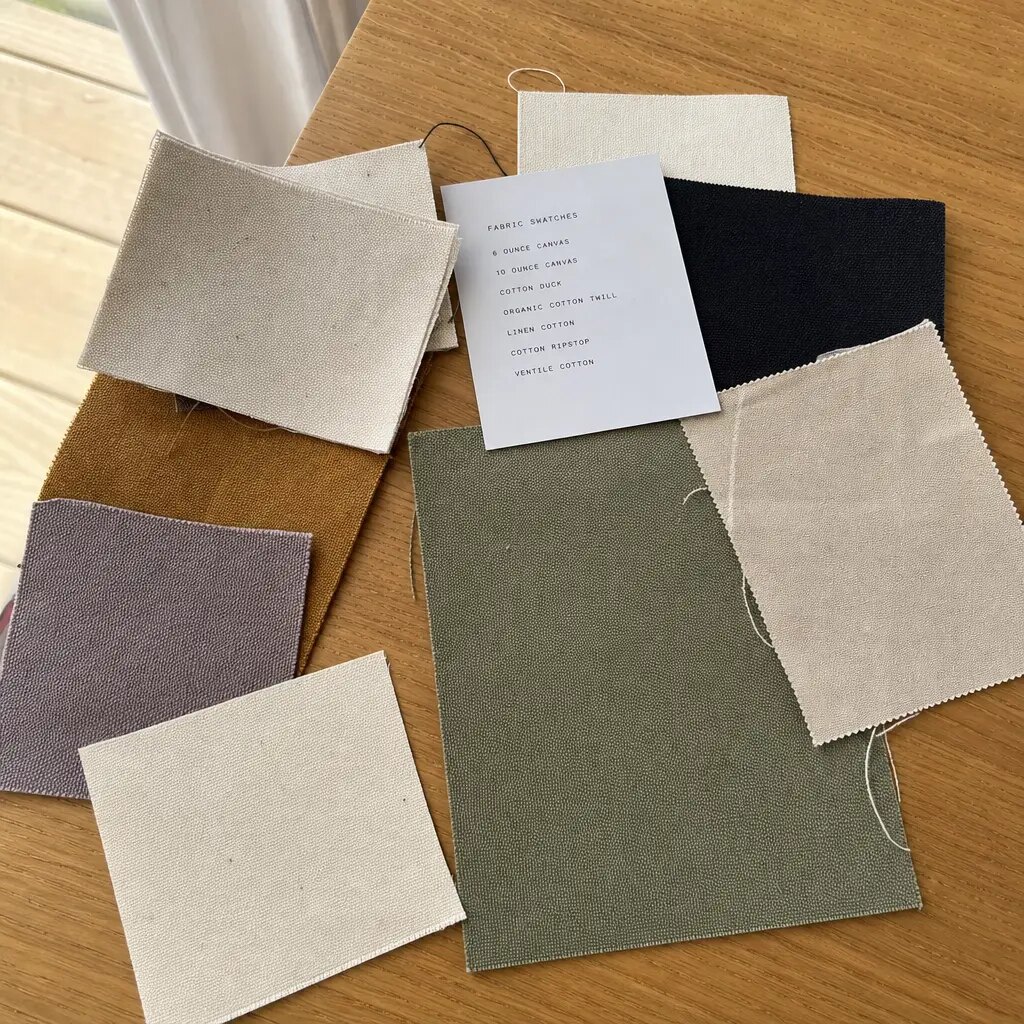
- Approve fabric swatches for shade, texture, slubs, flecks, and hand-feel.
- Match sustainability copy to documents that can be reviewed before shipment.
Specify construction, trims, and load points before comparing price
Construction is where many quote gaps hide. A messenger bag can be unlined with bound seams, fully lined, softly structured, or supported with interfacing. It may include a slip pocket, zipper pocket, padded sleeve, pen slots, inner label, outer patch, magnetic snap, buckle closure, or hook-and-loop closure. Every extra detail changes sewing time, trim cost, and inspection scope. A complete RFQ lists what is included and what is excluded, so a low quote cannot win simply by omitting important construction.
The strap-to-body connection is the main load path. It should be reinforced with bar-tacks, box-X stitching, multiple stitch rows, or another approved method. Pocket openings, gusset corners, flap edges, top handles, and closure areas may also need reinforcement. Where appearance matters, specify seam allowance, stitch density, thread type, binding width, and topstitch position. A visible flap edge, for example, may need consistent topstitching at 3 mm or 5 mm from the edge, depending on the approved sample.
Hardware needs more detail than “metal buckle.” State the finish: antique brass, nickel, matte black, gunmetal, or another approved reference. Confirm the buckle inside width against the webbing width, D-ring or O-ring inner diameter, zipper size if used, puller type, snap type, and magnetic closure strength expectation. QC should check sharp burrs, plating bubbles, rust marks, weak closure, zipper snagging, and buckle slippage. Hardware defects can make a bag unusable, so they deserve more attention than minor cosmetic marks.
- List every construction feature included in the price: lining, pockets, closure, labels, binding, and reinforcement.
- Define strap webbing width, thickness or grade, adjuster type, and load-path stitching.
- Approve a trim card with hardware finish, webbing, zipper, snaps, labels, and thread.
- Inspect hardware for function and safety, not only color.
Choose logo decoration for the artwork, fabric, and durability requirement
Logo method is both a branding decision and a production-control decision. Screen printing is often practical for canvas messenger bags because it scales well for simple one-color or two-color artwork on flat panels. The buyer should specify print size, placement from fixed seam points, ink type where known, color reference, artwork file version, and acceptable print hand-feel. Coarse canvas can break up fine lines or fill in small text, so ask for the supplier’s minimum recommended line thickness and a print strike-off on the actual fabric.
Embroidery can make a small logo feel more premium, especially for tonal branding, but it also introduces risk. Dense stitching may pucker the panel, stiffen the flap, or distort a pocket. RFQs should ask for stitch count, backing method, thread color standard, and whether backing will be visible inside the bag. If the embroidery sits on a pocket or flap, check that the pocket still opens and the flap still lies correctly after stitching.
Heat transfer and digital decoration can help with complex artwork or lower quantities, but they need durability checks. Transfers may show edge shine, poor adhesion, cracking, or lifting on textured canvas if the method is not suitable. Digital prints may vary in opacity and hand-feel depending on fabric color and coating. Whatever method is chosen, the supplier should explain how bulk will be checked: dry rub, tape pull where appropriate, visual cracking, color match, registration, placement, and adhesion after handling. Decoration materials may also affect eco claims, so do not imply that inks, adhesives, or transfers carry the same sustainability status as the fabric unless documented.
- Screen print: efficient for simple logos, but set opacity, edge clarity, and placement tolerance.
- Embroidery: premium, but inspect puckering, backing, thread color, and flap behavior.
- Heat transfer or digital: useful for complex art, but confirm adhesion, edge quality, and rub resistance.
- Approve decoration on the actual fabric and finished panel, not only a digital mockup.
Verify supplier route, documentation ownership, and compliance scope
Supplier type changes how much visibility the buyer has. A direct sewing factory usually gives better access to cutting, sewing, first-piece approval, and defect correction. That helps when pattern accuracy and strap reinforcement matter. A strong sewing factory, however, may still need support with export paperwork, barcode labels, retailer hangtags, or formal compliance files. Check production capability and administrative capability separately.
Trading companies can be useful when the order includes mixed accessories, split shipments, small quantities, or extra export coordination. The trade-off is distance from the production line. If you use a trader, ask whether the actual factory can be disclosed for inspection booking, whether production photos will be provided, and who can stop packing or approve rework. Also map outsourced steps: dyeing, washing, printing, embroidery, hardware sourcing, cutting, sewing, inspection, packing, and carton sealing.
Specialized bag workshops often understand messenger-bag structure better than broad promotional suppliers. They may be stronger at flap shape, gusset balance, strap placement, pocket layout, and hardware matching. Their limitations may be capacity, formal testing support, or sustainability documentation. A low-price general supplier can still be appropriate for a short promotional run, but only if the spec is simple and the buyer accepts the limits. For an eco apparel brand building a repeat accessory SKU, supplier compliance should be judged on repeatability, traceability, and willingness to work from a written spec.
Documentation ownership must be clear from the start. Decide who provides material declarations, certificates, test reports, production photos, inspection reports, packing lists, carton marks, and label approvals. Also define timing. Some documents must be reviewed before bulk production, while others may be acceptable before shipment. If a claim or retailer setup depends on a document, do not wait until finished goods are packed to request it.
- Ask who physically cuts, sews, prints, inspects, and packs the bags.
- Confirm whether third-party inspection is allowed and at what production stage.
- Require evidence for claims before bulk cutting when claims affect product copy.
- Make one party responsible for document collection and rework decisions.
Normalize quotes so the commercial comparison is fair
A unit price is only useful when every supplier is quoting the same item. One supplier may price 12 oz natural canvas, an unlined body, one-color print, basic webbing, and bulk packing. Another may price 16 oz washed canvas, lining, inner zipper pocket, reinforced strap joins, antique brass hardware, woven label, hangtag, barcode sticker, and individual packing. Those are not the same bag. Before negotiation, build a quote matrix covering fabric, size, construction, decoration, trims, labels, packing, sample charges, setup charges, lead time, Incoterms, and inspection scope.
Hidden exclusions are common in bag quotations. Print screens, artwork setup, woven labels, care labels, barcode stickers, hangtags, carton marks, sample revisions, custom hardware, mold charges, and packing materials may sit outside the headline unit price. Terms matter too. EXW, FOB, FCA, and delivered pricing cannot be compared without freight and handling assumptions. A heavier canvas bag with metal hardware can change carton gross weight and volume, so carton data belongs in the cost comparison, not in a later logistics email.
MOQ should be broken down by the factor that drives it. A supplier may offer 500 pcs for a stock natural body with one-color print, then require 1,000 pcs per color for custom dyed canvas, 2,000 pcs for custom webbing, or a trim MOQ for special hardware. Ask for price breaks at 500, 1,000, 3,000, and 5,000 pcs if those volumes fit your buying plan. Also ask whether quantities can be split by artwork, body color, or shipment date. A low MOQ can be worth the premium for a test launch; a larger MOQ may make sense for a proven SKU.
- Normalize every quote to the same fabric weight, finish, size, construction, logo, and packing.
- Ask suppliers to list exclusions line by line, including setup and sample costs.
- Compare carton size, gross weight, packing labor, receiving rules, and Incoterms.
- Negotiate by adjusting known variables, not by accepting undefined downgrades.
Use sample approval to prove repeatable production, not just appearance
A sample approval should show how the bag actually works. Measure it flat and lightly filled. Review flap alignment, side gusset shape, strap comfort, adjustment range, closure position, pocket access, and whether the bag hangs evenly. If the sample twists when loaded or the strap pulls the body out of shape, the problem usually becomes more visible in bulk. For bags expected to carry laptops, books, or event kits, ask the supplier what reinforcement they recommend for the intended load and confirm it in the sample.
The sample should also prove that decoration works on the chosen fabric and panel. Check logo edges, opacity, color match, print hand-feel, embroidery puckering, transfer adhesion, and placement after sewing. Artwork should be approved after final panel dimensions are known because seam allowance and flap shape affect placement. For small logos, a 5 mm shift can look careless. Define tolerance by artwork size and location, using fixed seam points instead of vague wording such as “centered on flap” unless the pattern is symmetrical and easy to measure.
Reference control keeps approval from becoming a memory test. Keep one signed or sealed approval sample with the buyer and one with the factory. If a third-party inspector will be used, provide the inspector with the spec sheet, photos, and defect definitions. A pre-production sample should use bulk fabric, bulk trims, and the intended production process, not leftover sample-room materials. First-piece photos should show exterior, interior, logo, strap joins, hardware, labels, packing, and carton marks before the line continues. Any deviation should be recorded with buyer approval, not handled only through informal chat.
- Measure samples against the spec sheet and record actual dimensions.
- Test sample shape with realistic contents before approving the strap and flap design.
- Approve bulk-material decoration, trims, labels, and packing before cutting full quantity.
- Keep signed reference samples and version-controlled artwork files.
Set QC tolerances, defect classes, and inspection checkpoints
A useful QC plan defines critical, major, and minor defects before production. Critical defects include sharp hardware, broken needle contamination, unsafe edges, severe mold or chemical odor, or structural failure that makes the bag unusable. Major defects include weak strap attachment, open seams, wrong fabric weight, obvious shade mismatch, incorrect logo, severe logo misplacement, broken zippers, dimensions outside tolerance, missing labels, or incorrect packing. Minor defects include small loose threads, fabric slubs within approved character, or slight cosmetic marks that do not affect saleability.
Inspection can include both in-line and final checks when order size and risk justify it. In-line inspection is useful after cutting and early sewing because it can catch wrong panels, fabric shade issues, missing reinforcement, or print placement drift before the full lot is assembled. Final inspection should sample finished and packed goods from cartons, not only loose units selected by the supplier. If using AQL, state the inspection level and acceptable quality limits in the PO or inspection booking. If using a custom sampling plan, state the sample size and rejection rules clearly.
Measurement tolerances should be practical for sewn canvas. As a starting point, main body dimensions may be controlled around ±1.0 cm, gusset around ±0.5 cm to ±0.8 cm, strap length around ±1.5 cm, and logo placement around ±3 mm to ±5 mm for small marks or as agreed for larger artwork. These are not universal standards; they should be adjusted to the product design and approved sample. The key is that the supplier, buyer, and inspector use the same numbers.
Quality checks should focus on failure points: strap anchors, bar-tacks, box-X stitching, pocket openings, gusset corners, flap seams, closure points, zipper ends, and hardware attachments. Pull tests can be specified by the buyer if required, but even without laboratory testing, inspectors should manually check that buckles grip, snaps close, zippers run, magnets align, and straps do not slip under reasonable handling. For metal trims, needle control and broken-needle procedures should be discussed, especially when bags are produced in environments serving apparel or retailer programs.
- Define critical, major, and minor defects before production starts.
- Use in-line checks for fabric, print, reinforcement, and early sewing quality.
- Inspect finished goods from sealed or ready-to-ship cartons.
- Use written tolerances for measurements, logo placement, shade, and packing accuracy.
Plan packing, labeling, moisture protection, and receiving requirements
Packing directly affects product quality. Canvas can pick up dust, lint, moisture, creases, and rub marks. Metal hardware can mark printed panels if bags are compressed without protection. If bags are packed loose in cartons, the buyer should knowingly accept that risk. If they are individually packed, specify whether the unit uses a polybag, paper band, tissue wrap, paper sleeve, glassine-style bag, or another option. Plastic reduction is a valid brand goal, but the alternative still has to protect the logo and keep SKUs identifiable.
Retail-ready packing is more detailed than bulk promotional packing. Buyers may need woven labels, care labels, country-of-origin labels, hangtags, barcode stickers, price stickers, suffocation warnings where polybags are used, carton marks, master carton labels, SKU separation, and inner pack ratios. Put these requirements in the RFQ instead of adding them after final sample approval. For first orders or retailer-bound shipments, ask for packing photos or a packing mockup before bulk packing begins.
Carton data is part of procurement accuracy. Ask for units per carton, carton dimensions, net weight, gross weight, carton material, carton mark format, and whether cartons will be strapped, taped, or palletized. A 16 oz lined canvas messenger bag with metal hardware may have a different freight profile from a 10 oz unlined bag. For long ocean transit or humid routes, ask about moisture control, desiccants if appropriate, and whether goods are fully dry after washing or finishing before packing. Mildew odor or carton moisture can damage an otherwise acceptable production run.
- Define unit packing before price comparison, including plastic-free or plastic-reduced requirements.
- Protect printed panels from hardware contact, abrasion, dust, and compression.
- Confirm barcode format, hangtag placement, label content, and country-of-origin marking.
- Require carton count, carton dimensions, net weight, gross weight, and SKU separation rules.
Specification comparison for buyers
| Supplier option | What to verify | Commercial advantage | Buyer risk to control |
|---|---|---|---|
| Direct sewing factory | hardware trim card, strap-load photo, lining close-up, approved flap sample, and first-piece production photos | Better sample-to-bulk control and faster production feedback | May be weaker on export paperwork or branded packing unless checked early |
| Trading company | Factory name, production photos, trim-source proof, and who owns QC decisions | Can coordinate small mixed orders and extra services | Markup can hide real factory capability and slow defect decisions |
| Specialized bag workshop | flap shape, strap webbing, buckle, D-ring, inner pocket, zipper pocket, seam allowance, and load path | More practical for detailed construction, trims, and repeat programs | Capacity may be limited during peak seasons |
| Low-price general supplier | 10-16 oz canvas, washed canvas, rPET canvas, lining fabric, interfacing, and hardware finish | Useful for simple promotional runs with loose specs | Material downgrades, weak packing, and vague inspection scope can erase savings |
| Retail-ready supplier | shape support, strap folding, hardware protection, individual bag, carton drop expectation, and retailer hangtag placement | Can handle labels, SKU separation, carton marks, and receiving rules | Higher unit cost must be compared against reduced warehouse work |
| Compliance-focused supplier | Fabric records, labeling review, test plan, and production traceability | Safer for retail programs and repeat brand orders | Documentation claims need evidence, not only sales language |
| Local sample room plus bulk factory | Signed sample, bulk factory handoff, first-piece photos, and deviation owner | Good for complex branding before large production | Sample room quality may not match bulk line unless handoff is controlled |
Buyer checklist before sampling
- State fabric weight in both oz/yd² and GSM, with an acceptable tolerance such as ±5% or an agreed GSM range, and specify whether weight is measured before washing, after washing, or after final finishing.
- Confirm canvas composition, yarn or weave description where available, dyeing or washing status, shrinkage expectation, color-lot control, and whether the fabric is stock, greige-dyed, piece-dyed, pigment-dyed, washed, or custom ordered.
- Define the exact sustainability or material claim that will be used commercially, then request matching evidence such as material declarations, organic cotton scope documents, recycled-content records, supplier certificates, or packing material statements where relevant.
- List finished bag dimensions including width, height, gusset depth, flap drop, strap width, minimum and maximum strap length, pocket dimensions, closure position, and sewn-goods measurement tolerance such as ±0.5 cm for small features and ±1.0 cm for main body panels unless otherwise agreed.
- Specify logo method, print or embroidery size, placement coordinates from fixed seams, ink or thread type, color reference such as Pantone or approved swatch, artwork file version, minimum readable line thickness, and durability expectations for rub, cracking, puckering, or adhesion.
- Approve hardware material and finish, buckle function, adjuster grip, D-ring or O-ring inner diameter, zipper size if used, snap or magnetic closure strength, plating appearance, burr-free requirement, corrosion expectations, and whether metal detection or needle-control records are available.
- Define stress-point construction: bar-tack length and location, box-X stitching size, stitch density, seam allowance, edge binding width, thread type, backstitching, topstitch distance from edge, and loose-thread trimming standard.
- Clarify MOQ by style, fabric, body color, lining color, artwork, print color count, hardware finish, label version, packing method, and shipment split so suppliers cannot quote a low base MOQ that excludes your real variables.
- Require sample stages, signed reference sample control, bulk-material pre-production sample where needed, first-piece approval, in-line inspection access, final AQL or agreed sampling method, defect classification, and rework responsibility before bulk production starts.
- Confirm unit packing, carton count, carton dimensions, estimated net and gross weight, barcode or hangtag inclusion, SKU separation, moisture control, desiccant use where relevant, carton strength, and whether polybags, paper bands, tissue, or other plastic-reduction alternatives are included in the quoted unit price.
Factory quote questions to send
- What is the finished fabric weight in oz/yd² and GSM, what tolerance do you apply, and is the quoted canvas measured before washing, after washing, or after final finishing?
- What is the exact canvas composition and sourcing basis: conventional cotton, organic cotton, recycled cotton blend, rPET canvas, cotton-poly blend, or another fabric? What documents can you provide before bulk cutting to support that description?
- Is the quoted fabric stock or custom made? If custom dyed or washed, what is the fabric MOQ, expected shade tolerance, shrinkage range, and extra lead time compared with stock natural canvas?
- Which decoration method is included in the unit price, and what are the setup charges, screen charges, per-color charges, per-location charges, artwork limits, minimum line thickness, and durability checks for that method?
- What is your MOQ by style, body color, lining color, artwork, print color count, hardware finish, label version, and packing version, and how does the price change at 500, 1,000, 3,000, and 5,000 pcs?
- Which construction details are included in the base quote: lining, inner pocket, zipper pocket, flap closure, magnetic snap, buckle, adjustable strap, reinforcement, binding, woven label, care label, and hangtag attachment?
- Can you provide estimated carton pack count, carton size, net weight, gross weight, packing method, barcode or hangtag cost, export carton marks, SKU separation, and whether individual polybags, paper bands, or paper wrap are included?
- What sample stages are included before bulk approval, how many calendar days does each stage take, and what is the charge if we request artwork, pattern, material, trim, or packing changes?
- Which production steps do you control in-house, and which are outsourced, including dyeing, washing, printing, embroidery, hardware sourcing, cutting, sewing, inspection, packing, and carton sealing?
- What QC standards do you use for fabric shade, GSM, measurement tolerance, print alignment, seam strength, strap attachment, hardware function, needle control, broken-stitch repair, and final carton audit?
Quality-control points to confirm
- Fabric must match the approved swatch within the agreed shade range under consistent lighting; cartons with obvious lot-to-lot mismatch should be segregated before packing and reported for buyer decision.
- Finished fabric weight should be checked against the approved spec using the same measurement basis stated in the RFQ; do not compare a greige-fabric value against a washed finished-goods requirement.
- Canvas surface should be reviewed for holes, stains, oil marks, weaving breaks, excessive slubs beyond approved character, shade streaks, odor, mildew risk, and unacceptable fabric skew after washing or pressing.
- Finished bag measurements should be checked on final goods after pressing or final handling, including width, height, gusset, flap drop, strap range, pocket size, closure alignment, and label placement.
- Logo placement tolerance should be stated from fixed seam points; for small chest-style or flap marks, use a tighter tolerance such as ±3 mm to ±5 mm where practical, while larger casual graphics may allow a wider agreed range.
- Prints should be checked for opacity, edge clarity, registration, crocking or dry-rub risk, cracking, pinholes, skipped ink, contamination, color consistency, and correct artwork version against the approved physical or digital standard.
- Embroidery should be checked for thread color, stitch density, loose loops, backing visibility, puckering, needle holes, panel distortion, and whether the flap or pocket still closes correctly after embroidery.
- Stitching at strap joins, gusset corners, flap edges, pocket openings, lining joins, and top handles if included must be even, secure, and free of skipped stitches, broken thread, open seam ends, or loose bar-tacks.
- Stress points should use reinforced bar-tacks, box-X stitching, extra stitching rows, or another approved reinforcement where the bag carries weight, where the strap anchors to the body, and where closures pull on the flap.
- Hardware should operate smoothly, stay aligned, and show no sharp burrs, rust, plating bubbles, color mismatch, weak magnetic closure, poor snap grip, zipper snagging, cracked pullers, or buckle slippage during manual pull checks.