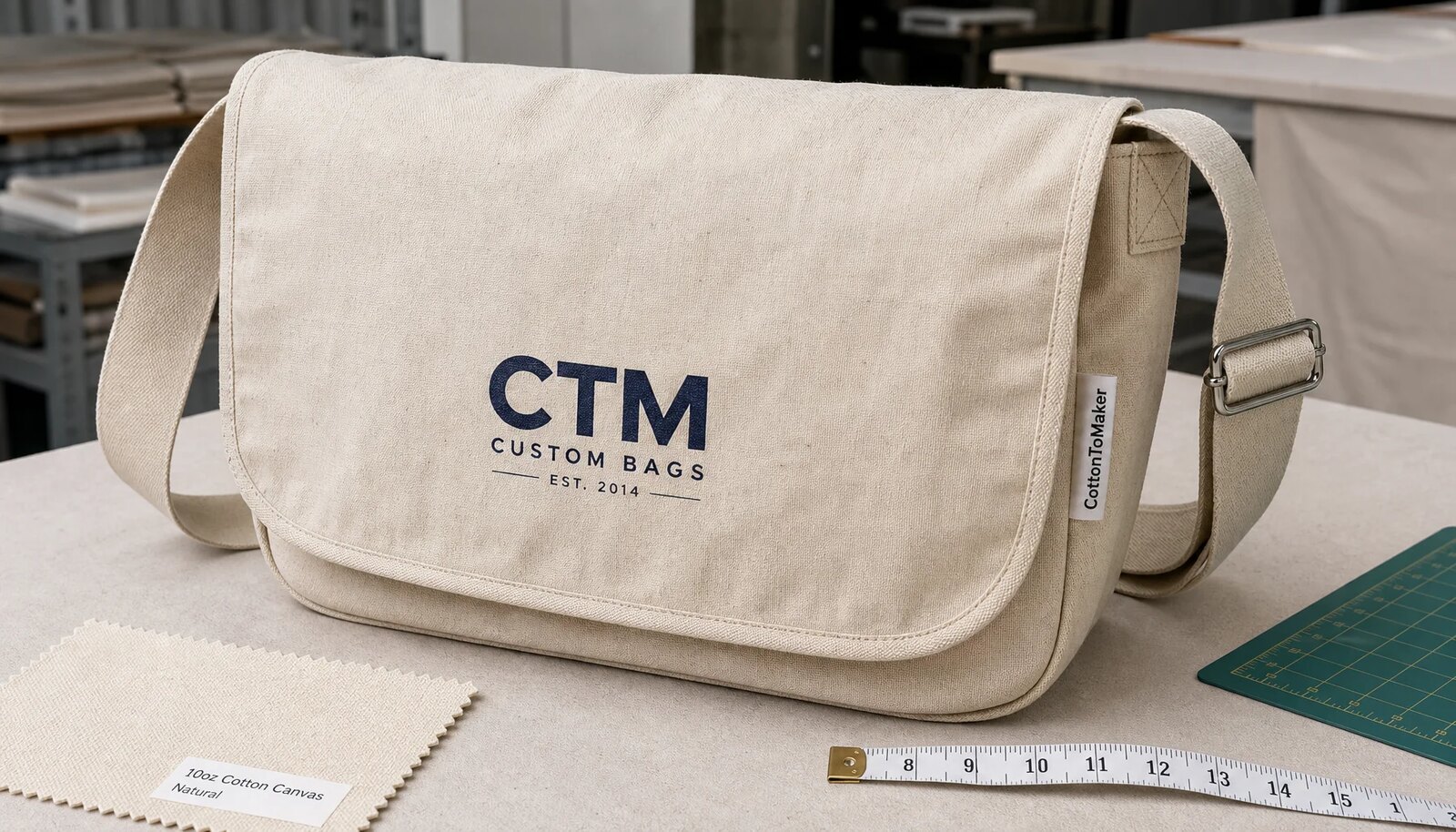
Start With the Craft Fair Use Case
A canvas messenger bag for craft fairs has a very specific job. It is not quite a fashion crossbody, not a school satchel, and not a thin conference giveaway. During an event, it may carry catalogs, order forms, receipt books, small handmade products, workshop materials, sample packs, water bottles, tablets, card readers, or customer purchases. A useful supplier compliance checklist starts with that real handling situation, not with a product photo alone.
Before asking for prices, define how the bag will be used: branded resale merchandise, booth-staff utility bag, VIP buyer gift, sponsor giveaway, workshop kit, school or youth event item, or distributor stock. The difference matters. Resale bags need cleaner finishing, consistent shade, retail labels, and better presentation packing. Booth-staff bags need practical pockets, comfortable straps, quick access, and strong load points. Giveaways can stay simple, but they still need safe seams, readable branding, and reliable delivery.
Tell suppliers what happens after production. Will the bags hang on a booth wall? Will consumers handle them before purchase? Will they be packed into kits, shipped to several venues, stored in humid conditions, or repacked by a distributor? Those answers influence canvas weight, closure choice, reinforcement, carton method, and lead time. When the use case is missing, suppliers often quote a lightweight messenger-style bag that looks fine in a photo but performs poorly during a full craft fair day.
- For resale merchandise: require clean flap shape, consistent shade, retail labels, hangtags, barcode placement, and controlled carton presentation.
- For booth staff: prioritize strap comfort, reinforced hardware, internal pocket access, darker stain-resistant colors, and fast closure operation.
- For giveaways: simplify construction, use stock fabric colors, limit print colors, control MOQ, and define visible-defect limits.
- For workshop kits: define kit contents, expected bag load, packing sequence, and whether paper materials must remain flat.
- For distributor stock: require SKU separation, carton marks, retained samples, reorder traceability, and repeatable specifications.
Build a Quote-Ready Specification Sheet
Many sourcing problems begin with an RFQ that says only “custom canvas messenger bag” and attaches a few reference photos. The supplier then fills in the blanks with its own standard canvas, strap, pocket, closure, and packing. That can work for a loose promotional order. It is not enough when the bags must arrive before a fixed craft fair date and represent a brand in front of buyers.
Put the commercial, technical, and compliance details in one specification sheet. Include finished size, usable internal size, fabric weight, fiber content, fabric color, flap style, gusset depth, strap width, strap adjustable range, closure type, pocket layout, logo method, label requirements, packing method, quantity split, target shipment date, and destination. Reference photos help with styling, but written dimensions and tolerances should control the order.
Measurement points deserve their own notes. State whether width is measured at the top opening or bottom seam, whether height includes the flap, whether strap length is measured end-to-end or by wearable range, and whether the bag is measured flat or filled. Canvas can shrink, twist, or soften after washing and printing, so confirm whether final measurements apply before or after finishing.
The RFQ should also set the approval sequence. A design sample may confirm shape while using substitute materials. A print strike-off confirms artwork on the chosen fabric. A pre-production sample confirms final components before bulk cutting. Spell out which sample is mandatory, what it must include, who signs approval, and whether production may begin from photos or only after a physical sample is approved.
- Use finished dimensions plus tolerance, not only a retail reference link or product image.
- State whether measurements are flat, filled, after washing, or after printing and drying.
- List trims separately: strap webbing, thread, buckle, D-ring, zipper, snap, magnet, label, patch, and carton.
- Attach vector artwork with Pantone, CMYK, thread, or material references depending on the logo method.
- Require written approval for any substitute fabric, hardware, label, ink, packaging, or subcontracted process.
Specify Canvas Weight, Composition, and Finish
Canvas messenger bag pricing is not comparable unless the material is comparable. One supplier may quote 8 oz cotton canvas, another 12 oz cotton canvas, and a third a cotton-poly canvas with a different handfeel and shrinkage profile. Photos rarely show the difference clearly. The material affects unit cost, sewing strength, print absorption, carton weight, perceived retail value, and freight cost.
State fabric weight in GSM or oz, then clarify what stage that number refers to. Greige fabric weight before dyeing or washing may not match finished fabric weight. For procurement control, ask the supplier to confirm expected finished weight and tolerance, commonly ±5% unless the program needs a tighter limit. If the bag uses dyed or washed canvas, also set shade-lot rules and approval limits for visible variation.
For many craft fair messenger bags, 10 oz to 12 oz cotton canvas is a practical middle range. It feels more substantial than lightweight giveaway fabric without becoming too stiff or freight-heavy. An 8 oz to 10 oz canvas can work for budget giveaways or light literature bags, but it may wrinkle more and needs careful reinforcement. A 14 oz to 16 oz canvas supports a premium retail position, but it can increase sewing difficulty, needle wear, carton weight, and print cracking risk on folded areas.
Composition matters as much as weight. 100% cotton canvas gives a natural handfeel and suits many craft-market programs. Recycled cotton blends may support sustainability messaging, but buyers should request composition evidence and expect more shade variation. Cotton-poly canvas can improve dimensional stability and reduce shrinkage, though it changes the feel and may need different print testing. rPET-blend canvas requires clear composition records if recycled-content language will appear on labels, hangtags, or marketing materials.
- 8 oz to 10 oz: budget giveaways, lighter load, lower carton weight, softer structure, and easier folding.
- 10 oz to 12 oz: balanced choice for craft fair resale, branded event bags, and general merchandise programs.
- 14 oz to 16 oz: premium positioning where strength, structure, and handfeel justify higher cost and freight impact.
- Washed canvas: softer vintage effect but requires approval of shade variation, shrinkage, wrinkles, and seam puckering.
- Coated canvas: may improve surface resistance, but confirm odor, cracking, print adhesion, and market suitability.
- Recycled blends: request order-specific composition records and define how much shade variation is acceptable.
Control Construction and Load Points
Supplier compliance is not only paperwork. For canvas messenger bags, it also means the delivered product matches the approved construction and performs safely in the intended use. Strap attachment, gusset depth, flap alignment, pocket placement, seam allowance, closure type, lining, and reinforcement should be fixed before sampling. If the RFQ stays vague, the supplier has room to cut cost through thinner webbing, smaller seam allowances, cheaper adjusters, or missing reinforcement.
Strap joints need extra attention because they carry the working load. A narrow strap sewn into a light side seam may be acceptable for a small document pouch, but not for a bag expected to hold catalogs, craft tools, a tablet, and purchases. For many craft fair messenger bags, a 30 mm to 40 mm shoulder strap is practical. Wider straps may improve comfort, but they add cost and bulk. Adjustable straps improve fit, but the adjuster must move smoothly, hold under load, and have no sharp edges.
Gusset and bottom construction decide real capacity. A 50 mm to 80 mm gusset is common for brochures and small products; deeper gussets need stronger side seams and better bottom support. If the bag must carry a laptop or tablet, specify internal dimensions and padding expectations instead of assuming a standard messenger construction is enough. If the bag is mainly for flat literature, a slimmer gusset can reduce cost and improve carton efficiency.
Closures should match the event environment. Hook-and-loop is economical, but it is noisy and can collect lint. Magnetic snaps look clean, yet they need reinforcement and careful placement. Metal snaps are secure but can stress the canvas if the backing is weak. Buckles give a traditional look, although they slow access. A plain flap is low cost but less secure. Include each closure component on the trim card and check it during sample approval.
- Flap: define shape, drop length, corner radius, edge finish, closure position, and whether it must lie flat when packed.
- Gusset: specify depth, bottom seam method, side seam allowance, and whether the bag must stand, fold, or hang cleanly.
- Strap: define width, material, adjustable range, hardware finish, attachment angle, and reinforcement stitch type.
- Pockets: define internal pocket size, zipper pocket position, opening direction, and intended contents such as phone or receipt book.
- Closure: choose magnet, snap, hook-and-loop, zipper, buckle, or plain flap based on security, noise, appearance, and cost.
- Reinforcement: require bartacks, box stitching, cross stitching, backing patches, or binding at stress points.
Match Logo Method to Canvas
Most craft fair canvas messenger bags use screen printing because it is economical, scalable, and reliable for bold logos or sponsor graphics. For one-color or two-color artwork on natural, black, navy, or dyed canvas, screen print is often the safest B2B option. The buyer should provide vector artwork, print size, Pantone references, placement coordinates, color count, and the exact print location. A flap print, front-panel print, strap print, and inside label each carries different sewing and packing risks.
Other decoration methods can also fit the program. Digital print can reproduce detailed artwork, but it may look muted on coarse canvas. Heat transfer can handle gradients and smaller runs, but it needs adhesion testing on textured fabric. Embroidery gives a premium impression, though it can pucker lighter canvas and may need backing. Woven labels and sewn patches are stable brand elements, but placement tolerance, stitching quality, and colorfastness still need approval.
Do not approve bulk decoration from a screen image when brand color or sponsor approval matters. Ask for a strike-off, embroidered panel, woven-label proof, or patch proof before the full pre-production sample if artwork is large, color-critical, or placed across a fold. Review opacity, edge sharpness, registration, rub resistance, curing, and how the logo behaves when the flap bends.
Make tolerance measurable. For a simple flap logo, placement might be ±3 mm to ±5 mm from a defined reference edge. A large centered print may need a centerline measurement. Color approval should use a Pantone reference or approved physical standard under consistent lighting, while recognizing that ink on natural cotton canvas will not look exactly like color on coated paper.
- Screen print: strong option for bold event marks, sponsor logos, and medium-to-large quantities with limited colors.
- Digital print: useful for complex artwork but requires approval for color strength, surface coverage, and rub behavior.
- Heat transfer: practical for small runs and gradients but test edge lifting, cracking, and adhesion on textured canvas.
- Embroidery: premium appearance but check puckering, backing, thread shade, needle marks, and cost on lighter canvas.
- Woven label: specify size, fold type, sewing location, colorfastness, and placement tolerance.
- Patch: confirm material compliance, debossing or printing quality, edge finish, and sewing strength.
Break Down MOQ, Price, and Lead Time
MOQ for canvas messenger bags is not just a sales number. It is shaped by fabric sourcing, dyeing, cutting efficiency, print setup, label production, hardware purchasing, sewing-line changeover, carton marking, and inspection sorting. A supplier can quote neatly for 1,000 bags in one color with one print. The same 1,000 pieces split across five fabric colors, ten sponsor logos, and four event destinations is a different production job.
Craft fair buyers often need artwork splits by event, city, sponsor, or workshop. Put the split table directly into the RFQ. This allows suppliers to separate screen charges, setup fees, label minimums, carton sorting, and changeover costs instead of hiding them inside one unit price. It also prevents misleading comparisons. A low quote may exclude the real cost of multiple print versions, individual packing, barcode labels, or destination-specific cartons.
Low MOQ becomes easier when the buyer reduces variables. Stock fabric colors with custom screen print are usually more efficient than custom-dyed canvas. Shared hardware across all colors is easier than separate antique brass, nickel, and black finishes. One woven label version is easier than multiple sponsor labels. If the program repeats each year, negotiate screen retention, sample retention, and reorder pricing after the approved specification is stable.
Ask suppliers to quote lead time by stage, not as one optimistic total. You need days for fabric procurement, dyeing or washing, print strike-off, sample making, bulk cutting, printing or embroidery, sewing, finishing, QC, packing, inland transport, and export handover. Craft fair dates do not move easily, so identify the latest approval date and the schedule risk if artwork, deposit, or sample approval arrives late.
- Separate MOQ by fabric color, print design, label version, hardware color, packing SKU, and destination.
- Ask for price breaks at realistic levels such as 500, 1,000, 2,500, and 5,000 pieces per construction.
- Expect lower cost when all bags share one fabric and only the flap print changes.
- Expect higher cost when each color requires separate dyeing, cutting, printing, inspection, and packing.
- For tight schedules, choose stock fabric, standard hardware, one logo size, and simple carton separation.
- For repeat programs, request screen retention, fabric availability, approved-sample storage, and reorder terms.
Request Order-Specific Compliance Evidence
Compliance evidence should match the actual canvas messenger bag being quoted. A generic factory certificate, an old test report for a tote bag, or a sales statement without material references is weak support. Stronger records connect to the fabric composition, color, print ink, coating, hardware, label, patch, and production process used for the purchase order.
The level of review depends on destination market, sales channel, and end user. A local adult craft fair giveaway may need basic material declarations, labeling confirmation, and quality records. A retail program, corporate brand order, school event, or youth-oriented fair may require closer review of restricted substances, sharp hardware, small parts, fiber content, care labeling, country-of-origin labeling, packaging warnings, and traceability. State the market and channel before the supplier quotes.
Documents should connect to production control. The approved sample, fabric swatch, trim card, signed artwork, carton marks, inspection report, and any test records should all reference the same SKU or purchase order. If the supplier changes the fabric mill, dye lot, ink, hardware finish, printer, label supplier, or packing method after approval, require written notice and approval before work continues.
Avoid broad sustainability or compliance claims unless the evidence supports them. If the bag will be marketed as organic, recycled, plastic-free, low-impact, or retail compliant, the supplier must provide records supporting that exact claim for the order. If the claim cannot be supported, use more conservative wording and focus on verified specifications.
- Match fabric records to the same fiber content, weight, color family, finishing process, and supplier source when possible.
- Match ink, transfer, embroidery thread, label, or patch evidence to the exact decoration method used on the bag.
- Review fiber content, country of origin, care information, barcode, hangtag wording, and retail claims before mass packing.
- Request needle-control or broken-needle records if the buyer requires metal contamination prevention.
- For youth-oriented events, review age grading, small-part risks, sharp hardware, and market-specific safety obligations.
- Store approved samples, signed artwork, trim cards, test records, inspection reports, and photos for reorder control.
Approve Samples With Pass-Fail Criteria
A sample is more than a sales prop. It becomes the reference for cutting, sewing, printing, finishing, inspection, and packing. The approved sample should show the correct canvas weight, color, handfeel, dimensions, flap position, strap length, hardware, stitching, pocket layout, print size, print color, labels, and packing method. If the first sample uses substitute fabric, temporary hardware, or a different print process, mark it as a design sample only and require a pre-production sample before bulk cutting.
Sample comments should be measurable. Instead of writing “flap looks good,” record flap width, flap drop, closure position, and skew tolerance. Instead of “strap feels strong,” record strap width, adjustable length, attachment method, stitch type, and load expectation. Instead of “print color approved,” record the Pantone reference or approved physical standard. These notes tell the supplier which details cannot drift during mass production.
Physical sample approval is safer for a new supplier, new construction, retail launch, or large artwork area. If timing forces photo approval, request structured photos with rulers and close-ups: front, back, side, inside, flap, gusset, strap joint, hardware, pocket, label, logo, stitching, and packing. Ask the supplier to confirm in writing whether the photographed sample uses bulk fabric and trims.
For larger or repeat orders, keep one approved sample with the buyer and one sealed reference sample with the supplier. Retain the fabric swatch, trim card, print strike-off, carton mark, and signed sample comments. This makes future reorders faster and reduces the chance that a visually similar substitute is treated as acceptable.
- Measure finished width, height, gusset, flap drop, pocket size, strap length, and logo position against the spec sheet.
- Check handfeel, stiffness, slub level, shade, odor, wrinkles, and seam puckering against the intended use.
- Rub the print with a dry white cloth and a damp white cloth to screen for weak curing or dye transfer.
- Load the bag with expected craft fair contents and hang it for a practical stress check before approving strap construction.
- Review zipper, snap, magnet, buckle, adjuster, and D-ring operation against the trim card.
- Photograph and sign the approved sample from front, back, side, inside, flap, strap joint, label, logo, hardware, and packing views.
Set Inspection Standards Before Cutting
Inspection standards should be agreed before fabric cutting, not argued after cartons are packed. Factory QC and third-party inspectors should separate critical, major, and minor defects. Critical defects include sharp hardware, mold, severe contamination, unsafe foreign objects, strong chemical odor, or wrong material that creates legal or safety risk. Major defects include broken stitches at load points, wrong dimensions outside tolerance, missing straps, wrong logo, wrong shade, defective closures, or missing labels. Minor defects may include small loose threads, light removable dust, or slight wrinkles within the approved standard.
AQL can help, but it must be paired with a clear defect list. The sampling level alone does not tell an inspector whether a print offset, flap skew, loose thread, or small slub is major or minor. Many bag buyers use general inspection levels with defined acceptable quality limits, but the exact plan should be agreed with the supplier and inspector before production. The key is simple: write shipment-release rules before final inspection.
Canvas has natural texture, so some slubs, weave variation, and handfeel differences may be normal. Define the acceptable range with reference photos. A practical standard might allow small natural slubs outside the main logo area but reject dark contamination, oil spots, mildew, large weaving defects, obvious dye streaks, or stains on the flap. For natural cotton canvas, this prevents disputes caused by treating every fabric texture as a defect.
Measurement needs a shared method. Identify whether inspectors measure the bag flat, lightly smoothed, or filled. State how many pieces are measured and what happens if measurements cluster near the tolerance limit. For logo placement, name the reference point: top flap edge, side seam, centerline, bottom edge, or pocket seam. Without this, a supplier and inspector may both measure carefully and still reach different results.
- Use AQL or a written sampling plan so pass-fail decisions are not subjective.
- Classify mold, sharp hardware, wrong material, strong odor, severe stains, and unsafe contamination as shipment-blocking.
- Set logo placement tolerance in millimeters and define the reference edge or centerline.
- Define acceptable canvas slubs and reject dark contamination, oil stains, mildew, large weaving defects, and dye streaks.
- Check load points for bartack presence, seam security, skipped stitches, broken threads, and open seams.
- Require rework instructions for loose threads, dust, minor creases, packing errors, and removable marks before shipment release.
Control Packing, Cartons, and Distribution
Packing often gets treated as a final detail. For craft fairs, it can decide whether bags arrive ready to sell or require emergency labor. Messenger bags with flaps can crease badly when compressed the wrong way. Straps can tangle. Metal hardware can rub printed panels. Mixed SKUs can slow receiving and booth setup. Approve packing as part of the product specification, not as an afterthought.
Match packing to the distribution plan. If all bags ship to one warehouse, bulk inner packing may be acceptable. If bags ship directly to several fairs, destination labels, carton marks, SKU separation, and accurate carton counts become more important. If bags are sold as merchandise, individual bags, paper bands, hangtags, barcode labels, or retail-ready presentation may be required. If sustainability rules apply, define whether polybags are allowed, whether recycled polybags are acceptable, and whether paper-based packing protects the bags well enough.
Moisture control matters with cotton canvas. Natural fibers can absorb moisture during humid storage, washing, printing, ocean transit, or LCL freight. Ask how bags are dried after washing or printing, how long they rest before packing, and whether desiccants are used. Cartons should be strong enough for stacking and handling, and gross weight should remain practical for warehouses and event venues.
Confirm carton marks before production finishes. A useful carton mark may include PO number, SKU, color, artwork version, quantity, gross weight, net weight, carton number, destination, and country of origin if required. For multi-event programs, request a packing list by destination so receiving teams can verify shortages quickly.
- Pack bags flat with flap aligned and straps arranged to prevent deep creases or distortion.
- Keep metal hardware away from printed surfaces or use tissue, paper, or positioning rules to prevent abrasion.
- Limit carton gross weight so cartons can be handled safely at warehouses, venues, and booths.
- Mark cartons by SKU, color, artwork version, quantity, PO number, carton number, and destination when required.
- Use moisture-control steps for long transit, humid storage, washed canvas, or natural cotton fabric.
- Confirm whether individual bags, paper bands, hangtags, barcode labels, desiccants, and upgraded cartons are included in the unit price.
Specification comparison for buyers
| Supplier option | What to verify | Commercial advantage | Buyer risk to control |
|---|---|---|---|
| Direct sewing factory | hardware trim card, strap-load photo, lining close-up, approved flap sample, and first-piece production photos | Better sample-to-bulk control and faster production feedback | May be weaker on export paperwork or branded packing unless checked early |
| Trading company | Factory name, production photos, trim-source proof, and who owns QC decisions | Can coordinate small mixed orders and extra services | Markup can hide real factory capability and slow defect decisions |
| Specialized bag workshop | flap shape, strap webbing, buckle, D-ring, inner pocket, zipper pocket, seam allowance, and load path | More practical for detailed construction, trims, and repeat programs | Capacity may be limited during peak seasons |
| Low-price general supplier | 10-16 oz canvas, washed canvas, rPET canvas, lining fabric, interfacing, and hardware finish | Useful for simple promotional runs with loose specs | Material downgrades, weak packing, and vague inspection scope can erase savings |
| Retail-ready supplier | shape support, strap folding, hardware protection, individual bag, carton drop expectation, and retailer hangtag placement | Can handle labels, SKU separation, carton marks, and receiving rules | Higher unit cost must be compared against reduced warehouse work |
| Compliance-focused supplier | Fabric records, labeling review, test plan, and production traceability | Safer for retail programs and repeat brand orders | Documentation claims need evidence, not only sales language |
| Local sample room plus bulk factory | Signed sample, bulk factory handoff, first-piece photos, and deviation owner | Good for complex branding before large production | Sample room quality may not match bulk line unless handoff is controlled |
Buyer checklist before sampling
- Define the bag role first: resale merchandise, booth-staff utility bag, VIP buyer gift, sponsor giveaway, workshop kit, school or youth event item, or distributor stock.
- Specify usable internal dimensions as well as finished outside dimensions; include laptop, tablet, catalog, receipt book, POS device, craft-kit, or sample-pack measurements if relevant.
- State fabric weight in GSM or oz and clarify whether the stated weight is greige fabric, dyed fabric, washed fabric, coated fabric, or finished fabric after all processing.
- Confirm fiber composition such as 100% cotton canvas, recycled cotton blend, cotton-poly canvas, organic cotton canvas, or rPET-blend canvas, and request material records tied to the PO.
- Lock construction details: flap shape, flap drop, gusset depth, strap width, strap length range, adjuster type, closure type, pocket layout, lining, seam allowance, reinforcement points, and thread color.
- Define practical tolerances before quoting: finished dimensions, flap skew, logo placement, print color variation, stitch density, strap length, pocket placement, fabric weight, and carton quantity.
- Provide artwork in vector format with Pantone or approved color references, print size, print location, orientation, color count, and acceptable placement tolerance in millimeters.
- Choose the logo method and define tests for screen print, digital print, heat transfer, embroidery, woven label, cotton label, leather patch, or PU patch before sample approval.
- Ask suppliers to separate MOQ and pricing by fabric color, artwork version, label version, hardware color, packing SKU, and destination instead of quoting one blended quantity.
- Require a pre-production sample made with bulk fabric, bulk hardware, final artwork, final logo method, final label, and intended packing before bulk cutting starts.
Factory quote questions to send
- Are you the factory sewing the canvas messenger bags, or will cutting, printing, embroidery, washing, labeling, packing, inspection, or export handling be subcontracted?
- What similar messenger bag constructions have you produced, and can you provide close-up photos of strap joints, flap alignment, gussets, pockets, lining, hardware, and carton packing?
- What fabric GSM or oz options do you recommend for our craft fair use case, and what tolerance do you hold after dyeing, washing, coating, or finishing?
- Is the quoted fabric 100% cotton, recycled cotton blend, cotton-poly, organic cotton, rPET blend, or another composition, and what order-specific material evidence can you provide?
- What is the MOQ by fabric color, bag size, print design, label version, hardware color, packing SKU, and ship-to destination, and how does pricing change when artwork is split?
- Which logo method do you recommend for our artwork on canvas, and what checks do you use for rubbing, folding, wash resistance, colorfastness, curing, registration, and edge lifting?
- Can you provide a print strike-off, embroidered panel, woven-label proof, or patch proof before the full pre-production sample if the flap artwork is large or color-critical?
- Can the pre-production sample be made with bulk fabric, bulk trims, final logo method, final label, and intended packing, and what items would still be substitutes?
- What dimensional tolerance do you hold for width, height, gusset, flap drop, strap length, pocket position, closure position, and logo placement?
- What reinforcement do you use at strap joints and other load points: bartack, box stitch, cross stitch, extra binding, backing patch, double seam, or reinforced seam allowance?
Quality-control points to confirm
- Fabric weight should remain within the agreed tolerance, commonly ±5% unless the buyer sets a tighter limit; do not mix visibly different GSM, handfeel, or shade rolls in one SKU without written approval.
- Fabric shade, handfeel, weave density, slub level, coating, washing effect, shrinkage behavior, and odor must match the approved swatch and pre-production sample.
- Finished bag dimensions should follow written tolerances, such as ±5 mm for width and height, ±5 mm for gusset, ±5 mm for flap drop, and ±10 mm for strap length unless otherwise agreed.
- Flap shape, flap symmetry, pocket position, zipper length, closure alignment, and gusset balance must match the approved template so the bag sits evenly when displayed, packed, or worn.
- Stitch density should match the approved sample and specification, with no skipped stitches, open seams, broken threads, unsecured seam ends, needle cuts, or exposed raw edges beyond the defect limit.
- Strap joints must include the approved reinforcement method, such as bartack, box stitch, cross stitch, or backing patch, and should be checked under a practical load based on expected craft fair contents.
- Print color, size, opacity, curing, registration, edge definition, rub resistance, and placement must match the approved strike-off, with placement tolerance stated in millimeters from defined reference points.
- Embroidery, woven labels, cotton labels, patches, and hangtags must match approved size, color, backing, sewing method, placement, orientation, and trim cleanliness.
- Hardware must have no sharp edges, rust, plating inconsistency, burrs, weak springs, rough adjuster movement, loose magnets, defective snaps, or visible color mismatch against the trim card.
- No customer-facing panel should show oil stains, mildew marks, severe slubs, dark contamination, loose dye marks, foreign fibers, glue marks, heavy dust, dampness, or strong chemical odor.