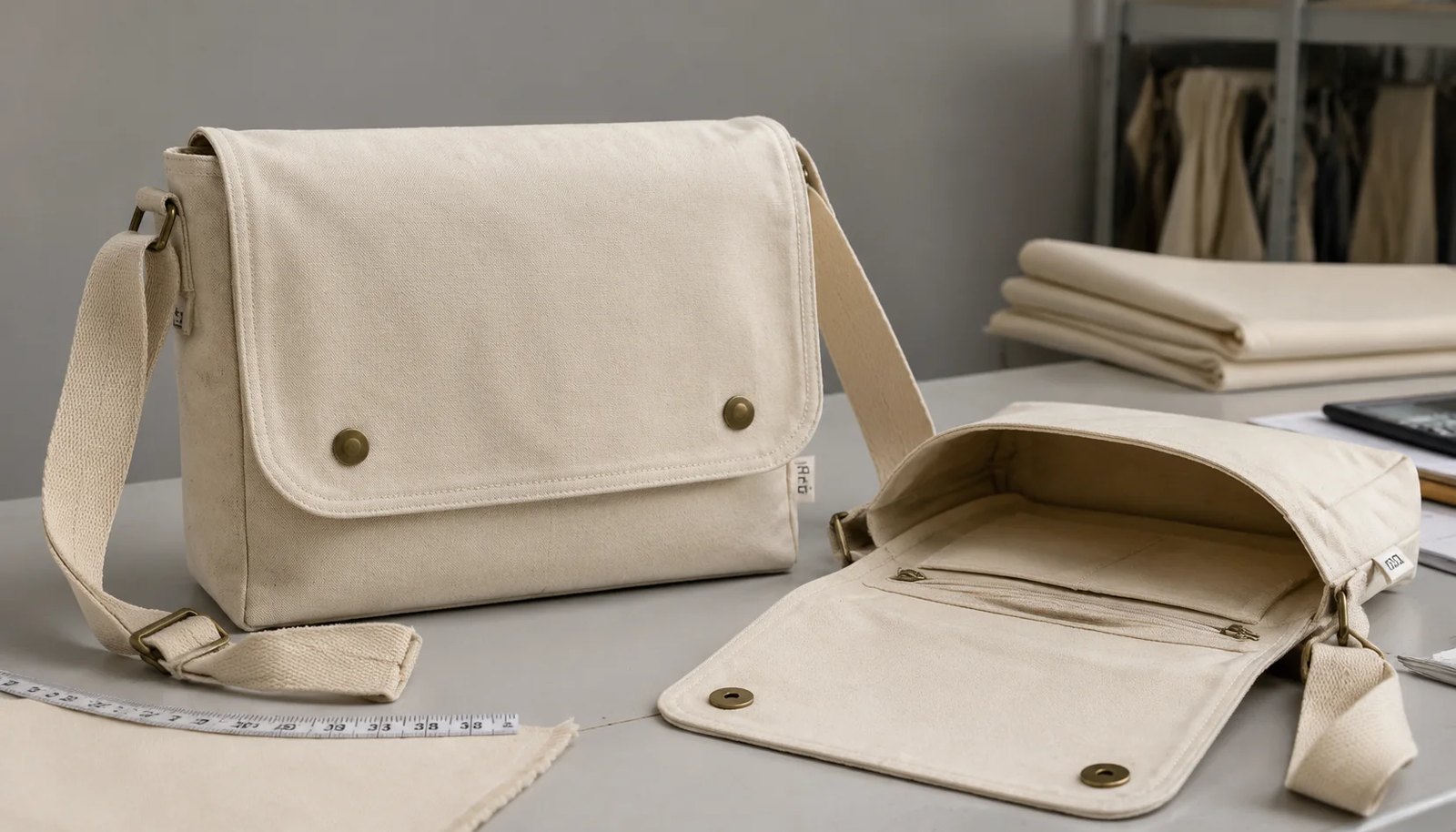
Why skincare bags need more than a generic promo inspection
Canvas messenger bags for skincare brands sit between packaging and reusable merchandise. They may carry boxed cleansers, glass droppers, jars, refill pouches, consultation cards, and retail inserts, while also representing the brand in store photos or gift-with-purchase campaigns. A weak strap or dusty flap is not only a textile issue; it can affect the perceived quality of the skincare set inside.
The sourcing risk usually begins with vague RFQ wording such as “canvas messenger bag with logo.” That allows suppliers to quote different fabric weights, webbing widths, closure types, seam finishes, and packing methods while appearing comparable on price. The buyer then discovers the difference at sample stage or, worse, after bulk production.
Skincare also has category-specific risks. Loose cotton lint can stick to dark cartons. Uncured ink can rub onto white gift boxes. Strong dye or solvent odor can damage the unboxing experience. A closure that aligns on an empty sample may sit crooked when full-size products are loaded. These issues belong in the specification and inspection checklist, not only in post-shipment complaints.
- Treat the bag as retail-facing packaging if it ships with skincare units inside.
- Use the approved sample plus written tolerances; do not rely on photos alone.
- State the actual load, target presentation, and packing route in the RFQ.
- Inspect odor, rub-off, dust, and internal finish as skincare-specific risks.
- Ask suppliers to confirm what will remain identical between sample and bulk.
Start with the load plan: size, weight, and bag behavior
A messenger bag should be sized from the contents, not from a lifestyle reference image. Width and height matter, but so do gusset depth, opening width, flap reach, closure position, and whether packing staff can insert cartons without crushing edges. A bag for sachets can be simpler than one carrying jars, glass bottles, and a printed gift box.
Prepare a load plan before sampling. List every item going inside the bag, including dimensions, weight, and orientation. If the set includes tissue, insert cards, refill pouches, or a rigid presentation box, include those too. The supplier can then recommend whether a boxed bottom, larger gusset, wider strap, or lower snap position is required.
The sample should be reviewed empty, partially filled, and fully filled. Check whether the flap lies flat, whether the closure strains, whether the bag stands or collapses, and whether the strap pulls the front panel out of shape. These simple checks turn subjective feedback into measurable corrections.
- List each skincare product with dimensions and weight.
- Show whether products are upright, stacked, wrapped, or boxed together.
- State target loaded weight and required safety margin for testing.
- Confirm whether the bag must stand, hang neatly, or fit into a master kit carton.
- Measure fit with real products or accurate weight-and-size substitutes.
Fabric specification: GSM, composition, weave, and finish
Fabric is the most visible quality driver. For most reusable skincare messenger bags, 12oz to 16oz cotton canvas is a practical range. Lighter 10oz-12oz options may suit low-load promotions, but they often feel less structured. Heavier 14oz-16oz fabrics improve shape and perceived value, while increasing unit cost, freight weight, and sometimes print complexity.
Write fabric weight in both oz and GSM. Directionally, 12oz canvas is often around 390-410 GSM, 14oz around 450-480 GSM, and 16oz around 520-540 GSM, depending on weave and finish. Because suppliers may use these terms differently, the PO should state target GSM and tolerance rather than relying only on the ounce description.
Composition and finish must also be locked. Natural unbleached canvas gives an apothecary or eco look, but seed specks and shade variation are normal unless otherwise agreed. Bleached canvas looks cleaner but shows stains more easily. Dyed canvas supports brand colors but adds MOQ, lab dip approval, and shade-control risk. Washed canvas feels softer but can affect dimensions and flap stability.
- State target oz and GSM with tolerance on the PO and PI.
- Confirm 100% cotton, recycled cotton blend, cotton-poly blend, or other composition.
- Record whether the canvas is natural, bleached, dyed, washed, brushed, or coated.
- Approve acceptable specking and shade variation for unbleached fabric.
- Ask how the factory checks incoming GSM, width, flaws, and color lot consistency.
Construction details that affect durability and retail appearance
Messenger construction should be specified like engineered packaging. The highest-risk areas are strap attachment, bottom seams, gusset corners, flap edge, closure placement, and internal seam finishing. A bag can look fine on a table but fail when carried with dense skincare products.
Strap joins should use box stitch, bar-tack, cross-stitch reinforcement, or another agreed method. Webbing width should match the intended load and comfort standard; 38-50 mm is common for reusable retail bags, while narrow straps may reduce cost but feel promotional. The buyer should also confirm strap length range if the bag must suit different users.
A boxed bottom usually performs better than a flat body for cartons and jars because it reduces sag and improves shelf shape. For heavier kits, a double-layer base or reinforced bottom panel may be worth quoting separately. The flap should have defined depth, corner shape, topstitching, and closure position, because flap defects are immediately visible in retail presentation.
- Specify reinforcement method at all strap attachment points.
- Define flat body, boxed bottom, or reinforced base construction.
- Set flap depth, flap shape, and closure position from fixed measuring points.
- Confirm seam finish: overlock, folded seam, bound edge, or other method.
- Check internal seams and hardware backs so they do not damage cartons.
Closure and hardware choices: appearance versus function
Closure choice affects cost, lead time, use experience, and quality inspection. Metal snaps are practical and familiar for many retail programs. Magnetic snaps can feel more premium and easier to close, but they may add sourcing time and require careful alignment. Hook-and-loop is economical, but it can catch tissue, scratch cartons, collect lint, and feel noisy in premium beauty retail.
Hardware finish should match the brand tone and other trim. Antique brass, nickel, matte black, or painted finishes may not share the same MOQ or lead time. If custom plating is requested, ask whether the finish is stock or made to order, and confirm whether color variation or minor plating marks are acceptable.
Inspection should include function, not just appearance. Closures must align when the bag is loaded, not only when empty. Snaps should engage without excessive force. Magnets should hold the flap closed without pulling it crooked. Sliders and adjusters should move smoothly and should not have sharp edges that cut webbing or scratch packaging.
- Quote snap, magnetic snap, and hook-and-loop options separately if budget is sensitive.
- Check whether hardware finish is stock or custom.
- Inspect sharp edges, plating defects, rust, oil residue, and loose components.
- Test closure alignment with the intended skincare load inside.
- Ensure hardware does not press directly into printed panels during packing.
Branding approval: print, label, embroidery, or patch
Choose the logo method from the artwork and fabric behavior. Screen print is usually efficient for solid logos and medium-to-large placements. It is less reliable for very fine lines, pale inks, small serif text, or low-contrast artwork on textured natural canvas. A physical strike-off on the final fabric is essential for approval.
Heat transfer can handle gradients and sharper graphics, but it may look less natural on a premium cotton bag. Embroidery adds texture but can pucker lighter fabric or distort a flap. Woven labels and sewn patches can be strong options for skincare brands that want understated, reusable accessory branding rather than a large promotional print.
Logo placement should be measured from fixed panel points. A centered logo on an empty bag may shift visually once the gusset opens or the flap bends over product cartons. Inspectors should check size, position, color, edge clarity, registration, adhesion, dry rub, and light damp rub. For skincare kits, rub testing against white cloth or white paperboard is particularly useful because bags often contact clean retail cartons.
- Approve vector artwork, Pantone references, print size, and placement tolerance.
- Use a physical strike-off on final fabric, not only a digital proof.
- Check logo appearance on empty and loaded bags.
- Test dry rub and light damp rub for visible transfer.
- Inspect label stitching, patch edges, embroidery puckering, and loose threads.
Pre-production sample approval before bulk cutting
The pre-production sample should be a complete production reference, not a collection of partial samples. It should use the final canvas, final webbing, final closure, final logo method, final label, final internal finish, and final packing method. If any component is temporary, mark the approval as conditional.
Load the sample with real skincare products or accurate substitutes. Confirm that packing staff can insert and remove products quickly, the flap closes without strain, the bag hangs correctly, and inner seams do not rub cartons. Also check odor, lint, loose fibers, and visible dust before approving the sample for bulk.
Create a sample record with photos and measurements. Include front, back, side, inside, strap joins, closure, logo placement, carton packing, and loaded appearance. Keep one approved sample with the factory and one with the buyer or third-party inspector so final QC has a physical benchmark.
- Approve one complete pre-production sample before authorizing bulk cutting.
- Photograph measurements, logo position, closure alignment, and internal finish.
- Record acceptable natural canvas variation if using undyed fabric.
- Confirm final folding and packing method at sample stage.
- Require written approval before any material, trim, or artwork substitution.
AQL inspection plan with clear defect categories
Final inspection should combine AQL sampling with functional checks. A common starting point for soft goods is General Inspection Level II, with AQL 0 for critical defects, 2.5 for major defects, and 4.0 for minor defects, but buyers should set levels based on brand risk, order size, and retailer requirements. The important point is to define defect categories before production.
Critical defects are issues that make the goods unsafe, unusable, or commercially unacceptable: wrong logo, wrong material, mildew or solvent odor, sharp unsafe hardware, severe color transfer, contamination, or gross packing mix-up. Major defects affect saleability or function: open seams, failed strap reinforcement, closure misalignment, visible stains, incorrect dimensions beyond tolerance, severe shade mismatch, print smearing, or missing required labels. Minor defects are small issues that do not materially affect function or presentation, such as limited removable thread ends or slight internal marks within the approved standard.
Inspectors need measurement instructions. State where to measure width, height, gusset, flap depth, strap length, and print position. Soft bags can produce inconsistent results if one inspector measures flat while another measures loaded shape. Include tolerance values and approved sample photos in the inspection file.
- Suggested format: Critical AQL 0; Major AQL 2.5; Minor AQL 4.0, unless your retailer specifies otherwise.
- Add functional tests for load, closure alignment, odor, print rub, and internal abrasion risk.
- Measure from fixed points and record actual values, not only pass or fail.
- Use the approved sample to judge handfeel, shade, structure, and print texture.
- Schedule in-line inspection for first orders, custom dyed fabric, or premium launches.
Packing controls that protect presentation in transit
Packing can damage otherwise acceptable bags. Common problems include flap creases, snap pressure marks, print abrasion, print-to-print sticking, dust pickup, and carton compression. For skincare brands, these defects are highly visible because the bag may go straight into a gift set, ecommerce kit, or retail counter display.
Decide whether units need individual polybags. Ecommerce and retail programs may need polybags for cleanliness, barcode control, or kitting. Sustainability-led brands may prefer bulk packing with paper interleaving. Either can work if the packing method prevents dust, moisture, hardware contact, and logo abrasion.
Approve folding direction with photos, especially when the flap carries the main logo. Hardware should not press into printed areas if avoidable. Carton weight should be limited to prevent lower layers from being crushed during sea freight or warehouse storage. Confirm that goods are packed only after ink is fully cured and fabric is dry, aired, and stable.
- Approve fold direction and carton orientation before shipment.
- Use interleaving or shielding where hardware can mark print panels.
- Set carton quantity and maximum carton weight.
- Verify barcode, SKU, PO number, color name, and carton count.
- Request packed-carton photos before final release when retail packing is complex.
MOQ, quote comparison, and lead-time questions
MOQ is usually driven by the most customized component, not the bag shape alone. A stock natural canvas bag with standard webbing and simple screen print may be feasible at several hundred pieces. Custom dyed fabric, custom webbing, special hardware finish, woven labels, or retail-specific packing can push MOQ higher.
Compare quotes by component. One supplier may appear cheaper because the fabric is lighter, the webbing is narrower, the closure is basic, and packing is bulk only. Another may include heavier canvas, reinforced strap ends, individual labels, and export-ready packing. Without line-item assumptions, price comparison is misleading.
Ask for a cost breakdown covering fabric, cutting and sewing, branding, hardware, labels, packing, sample fee, screen or setup charge, inland freight, and inspection support. Then value-engineer without weakening the most important functional points. For heavier skincare kits, strap reinforcement, base stability, closure alignment, and print quality should not be the first items downgraded.
Lead time should include artwork proof, swatch or lab dip, strike-off, sample making, revisions, material booking, bulk sewing, printing, finishing, inspection, and export packing. Identify critical-path items early. Custom dyeing, washed finish, special hardware, or woven labels usually need more time than basic stock materials.
- Ask which component sets MOQ: fabric, webbing, hardware, label, or packing.
- Separate one-time setup fees from unit price.
- Compare EXW and FOB offers carefully if suppliers quote different terms.
- Freeze artwork and materials before bulk cutting.
- Book inspection early enough to allow rework before shipment cutoff.
Specification comparison for buyers
| Sourcing option | Typical specification | Best fit | Cost-performance risk to compare |
|---|---|---|---|
| Stock natural canvas messenger bag with screen print | 12oz-14oz cotton canvas, stock webbing, standard snap or magnetic snap, one-color logo | Retail test orders, gift-with-purchase programs, spa launches, PR kits, and lower-risk first orders | Usually the best MOQ and lead-time balance, but confirm GSM, fabric lot shade, print opacity, and whether the quoted webbing is strong enough for the loaded skincare set |
| Heavier reusable retail messenger | 14oz-16oz canvas, boxed bottom, reinforced strap ends, adjustable 38-50 mm webbing, inner slip pocket | Premium skincare bundles, refill programs, boutique retail merchandise, distributor gifts | Higher unit and freight cost can be justified if the bag is expected to be reused; inspect base sag, strap comfort, flap alignment, and carton protection when loaded |
| Custom dyed brand-color canvas bag | Dyed cotton canvas or cotton-blend canvas, matching webbing or contrast trim, screen print or woven label | Brands requiring a strong color system, seasonal launch color, or coordinated retail display | MOQ and lead time rise because fabric dyeing controls the order; require lab dip approval, shade tolerance, colorfastness checks, and written substitution rules |
| Low-cost promotional messenger | 10oz-12oz canvas or cotton-poly blend, simple flat body, narrow strap, basic closure, bulk packing | Light sample sachets, event giveaways, short-use campaigns with limited product weight | Lowest price may come from weaker structure; check that the bag is not too floppy for skincare cartons and does not create a cheap impression beside premium packaging |
| Premium understated branded bag | 14oz-16oz canvas, woven side label or sewn patch, clean internal finishing, magnetic snap, controlled folding | Skincare brands that want the bag to feel like a reusable accessory rather than temporary packaging | Branding cost may shift from print to label and sewing labor; check label placement, patch edges, odor, hardware pressure marks, and consistency across bulk |
| Retail-packed ecommerce version | Selected canvas weight plus individual polybag, barcode, hangtag or insert, carton marks, controlled fold direction | Subscription kits, DTC gift sets, regional SKU programs, hotel spa or reseller fulfillment | Packing adds cost but can reduce receiving labor; verify barcode data, SKU labels, dust control, fold marks, print abrasion, and carton quantity before shipment |
Buyer checklist before sampling
- Build the bag size from the actual skincare kit layout: product dimensions, packed orientation, total weight, insert cards, tissue, gift box, and whether the bag must stand when filled.
- Specify fabric in both oz and GSM, including composition, color, weave, finish, shrinkage expectation, and whether the canvas is natural, bleached, dyed, washed, brushed, coated, or blended.
- Define finished measurements: width, height, gusset, flap depth, strap width, strap length range, pocket size, closure location, seam allowance, and reinforcement points.
- Provide vector artwork, Pantone references, logo size, print or label position, and approved viewing standard; for natural canvas, approve a physical strike-off on final fabric.
- Set tolerances for dimensions, GSM, print position, color deviation, stitch density, closure alignment, strap strength, hardware finish, carton packing count, and barcode accuracy.
- Approve one complete pre-production sample made with final fabric, logo method, webbing, hardware, label, closure, internal finish, and packing method before bulk cutting.
- Run a load test using the heaviest intended skincare set plus a safety margin; review strap joins, bottom seams, gusset corners, closure function, and visible panel distortion after testing.
- Check odor, dust, lint, loose fiber, print rub, dye transfer, and rough inner seams because the bag may contact premium cartons, glass packaging, refill pouches, or fragrance-sensitive products.
- Confirm whether each unit needs polybag, paper wrap, hangtag, barcode sticker, care label, silica gel, retail insert, master-carton bulk packing, or carton photo approval.
- Request quote details separated by fabric, cutting and sewing, logo method, hardware, labels, packing, sample fee, screen or setup charge, inspection support, inland freight, and lead time by stage.
Factory quote questions to send
- What exact canvas will be used in oz and GSM, what is the composition, and what tolerance do you control during incoming fabric inspection?
- Is the bulk fabric 100% cotton canvas, recycled cotton blend, cotton-poly blend, or another composition, and will it match the approved sample lot standard?
- What MOQ applies for stock natural canvas, and what MOQ applies if we require custom dyed fabric, custom webbing color, special hardware finish, or woven labels?
- Which logo method do you recommend for our artwork on this fabric, and can you provide a physical strike-off before bulk printing?
- Can you quote screen print, heat transfer, embroidery, woven label, and sewn patch separately so we can compare cost, appearance, and durability?
- What closure and hardware options are stock: metal snaps, magnetic snaps, hook-and-loop, sliders, buckles, and adjusters? Which require longer sourcing time?
- What reinforcement will you use at strap ends, flap corners, pocket mouth, gusset seams, and bottom load points? Can you share close-up photos of similar bags?
- How many days are needed for artwork proof, fabric swatch or lab dip, sample making, sample revision, material booking, bulk production, inspection readiness, and export packing?
- What carton size, carton weight, folding method, and packing count do you recommend to prevent flap creasing, print abrasion, and hardware pressure marks?
- Which defects are critical, major, and minor in your internal QC standard for canvas messenger bags, and how do you document rework before shipment?
Quality-control points to confirm
- Fabric GSM should match the approved standard within the written tolerance, commonly plus or minus 5% unless the PO states another commercial tolerance.
- Finished dimensions should stay within agreed tolerance, commonly plus or minus 1 cm for width and height and plus or minus 0.5-1 cm for gusset, flap, and closure position depending on construction.
- Stitch density should be consistent on visible seams; open seams, skipped stitches, seam grin, loose bar-tacks, needle damage, and exposed raw edges at stress points should be rejected.
- Strap attachment should pass the agreed load test with no seam tearing, bar-tack failure, hardware deformation, or obvious body-panel distortion.
- Print or label artwork must match approved size, position, color, edge clarity, and adhesion; dry rub and light damp rub should not create obvious transfer onto white cloth or cartons.
- Closure alignment should allow the flap to sit flat and close cleanly when the bag contains the intended product set; offset snaps or magnets should be treated as functional defects when they affect use.
- Odor must be controlled; mildew, strong solvent smell, oily hardware smell, dye odor, or warehouse contamination is unacceptable for skincare retail packing.
- Inner seams, pocket edges, hardware backs, and labels should not scratch, stain, snag, crush, or mark skincare cartons, sleeves, inserts, jars, or refill pouches.
- Packing must prevent hardware pressure marks, print-to-print sticking, dust contamination, moisture exposure, and excessive compression during export transit and warehouse storage.
- Carton marks, SKU labels, bag color, logo version, barcode data, packing quantity, and carton count must match the PO, approved artwork, and final packing instructions.